


 |
Exploring linkages between Womes empowerment workforce Participation and population Dynamics in the Indian conteExecutive _Summary |
|
|
1 Page 1 |
▲back to top |
EXPLORING LINKAGES BETWEEN WOMEN’S
EMPOWERMENT, WORKFORCE PARTICIPATION, AND
POPULATION DYNAMICS IN THE INDIAN CONTEXT
A Comprehensive Macro-Micro Analysis
Executive Summary
|
|
2 Page 2 |
▲back to top |

About Population Foundation of India
Founded in 1970 by the late J.R.D. Tata, Population Foundation of India is a leading non-
governmental organisation (NGO) working in the field of population dynamics, gender
equity, and sexual and reproductive health (SRH). It addresses population issues within
the context of empowering women, men, and youth, enabling them to make informed
decisions about their fertility, health, and well-being.
The organisation's approaches include strategic engagement with policymakers, media,
and other key stakeholders; knowledge generation and dissemination; leveraging
technology; scaling up pilot projects; and social and behaviour change communication.
Population Foundation of India collaborates closely with and provides technical support
to national and state governments, as well as other NGOS.
Suggested Citation
Population Foundation of India and IWWAGE - Institute for What Works to Advance
Gender Equality. (2025). “Exploring Linkages Between Women’s Empowerment,
Workforce Participation, and Population Dynamics in the Indian Context: A
Comprehensive Macro-Micro Analysis”, New Delhi. India
Contact Information
Population Foundation of India
B-28, Qutab Institutional Area,
New Delhi – 110016
info@populationfoundation.in
+91-11-4389 4100
Study Team
Population Foundation of India
Sanghamitra Singh
Alok Vajpeyi
Varun Sharma
Aishwarya Adhikari
IWWAGE-Institute for What Works to Advance Gender Equality
Mridusmita Bordoloi
Surabhi Awasthi
Prakriti Sharma
Vidhi
Aneek Chowdhury
EXPLORING LINKAGES BETWEEN
WOMEN’S EMPOWERMENT, WORKFORCE
PARTICIPATION, AND POPULATION
DYNAMICS IN THE INDIAN CONTEXT
A COMPREHENSIVE MACRO-MICRO ANALYSIS
Executive Summary
|
|
3 Page 3 |
▲back to top |
Background
Women are the architects of a nation’s development. Dr. Bhim Rao Ambedkar, a social
reformer and the father of the Indian Constitution, once stated, “I measure the progress
of a community by the degree of progress which women have achieved.” This statement
summarises the pivotal role women play in shaping and advancing a nation—socially,
culturally, economically, technologically, and philosophically. The idea remains relevant
today, as the World Bank estimates that narrowing gender disparities could yield a $172
trillion ‘gender dividend’ globally. In the Indian context, research suggests that women’s
economic participation could add ₹35 trillion to India’s Gross Domestic Product (GDP)
by 2025. Thus, strategic investments in women’s health, education, and workforce
participation can unlock the potential of an entire generation—capable of advancing
both economic growth and social change.
India’s demographic shifts reflect global trends, i.e. declining fertility rates, an ageing
population, and an expanding youth population, with regional variations. These shifts
carry profound gendered implications. The Total Fertility Rate (TFR) has fallen to
2.0, signalling a demographic transition with opportunities and risks. However, this
statistical achievement masks underlying inequities (social, economic, and regional).
In a country like India, with its significant potential for both demographic and gender
dividend, failing to invest in women and girls risks reinforcing vicious cycles of poverty
and inequality.
Against this backdrop, Population Foundation of India commissioned this research titled
“Exploring Linkages Between Women’s Empowerment, Workforce Participation, and
Population Dynamics in the Indian Context: A Comprehensive Macro-Micro Analysis” to
construct a persuasive, evidence-based narrative advocating for increased investment
in women and girls. The study combines macro-level data with individual-level analysis
to examine the interlinkages between women’s empowerment, workforce participation,
and population dynamics, generating critical insights to inform and elevate the policy
and programmatic discourse and actions.
4
Population Foundation of India
Methodology
At the macro level (i.e., state and union territory levels), we developed two composite
indices to measure women’s empowerment and human development, drawing on
globally accepted methodologies for human development and women’s empowerment.
The Adaptive Human Development Index (AHDI) builds on the global Human
Development Index (HDI) and incorporates child underweight and maternal mortality to
better reflect gendered health and wellbeing outcomes in the Indian context. Similarly,
the Adaptive Women’s Empowerment Index (AWEI) draws from the global Women’s
Empowerment Index by incorporating context-relevant indicators such as paid work,
menstrual hygiene, and political representation in state assemblies. At the micro level,
we used the National Family Health Survey (NFHS-5) data from 2019-21. We used
Structural Equation Modelling (SEM) to establish a bidirectional relationship between
women’s agency, workforce participation, and fertility. To understand the impact of
social and cultural norms on women’s agency, workforce participation, and fertility, we
employed a qualitative approach. We conducted in-depth interviews using vignettes
that involved adolescent girls and young women in urban, peri-urban, and rural areas
across six districts in Bihar, Uttar Pradesh, and Delhi.
The findings are presented at three levels: (a) macro level, (b) micro level, and (c)
qualitative findings, which are discussed in the subsequent section.
Salient Findings
At the Macro Level
The study highlighted substantial room for improvement in the status of women’s
empowerment across most Indian states, as evidenced by AWEI. Of the 22 major
states, 17 states fall in the ‘Mediumi’ AWEI category, and five states fall in the ‘Lowii’
AWEI category. No Indian state or union territory was categorised under the ‘High’
Population Foundation of India
5
|
|
4 Page 4 |
▲back to top |
AWEI category. While the status of human development also falls short of the ideal
goal post, as indicated by AHDI, the strong positive correlation (0.8) between the two
indices underscores the imperative for policy prioritisation of women’s empowerment
to enhance human development indicators. The study further identified moderate yet
negative correlations between the AHDI (-0.64) and AWEI (-0.50) indices and the TFR,
suggesting that at a macro level, declining fertility is associated with improvements in
both human development and women’s empowerment in India.
At the Micro Level
To elucidate these interlinkages, an econometric model revealed a bidirectional
relationship between fertility and women’s empowerment. The findings indicate that
while women with more children tend to have greater agency in intra-household
decision-making, an increase in women’s agency is associated with a decrease in the
number of children. However, the impact of higher fertility on women’s agency is
significantly stronger than the reverse impact. This reflects the complex relationship
between women’s agency and fertility. Similarly, employed women are significantly
more likely to have higher agency compared to those who are not working and tend
to prioritise a smaller number of children. While higher workforce participation
leads to lower fertility rates, the reverse—lower fertility leading to more workforce
participation—is not clearly supported. For married women, having more children
increases their chances of working to some extent, likely due to financial needs. Overall,
employment and economic independence help women opt for smaller families, but
socio-economic pressures often push women, especially those from lower-income
backgrounds, into the workforce.
To Elucidate the Role of Gender Norms and Social
Barriers
In-depth interviews were conducted with a limited number of adolescent girls and
young women. The interviews provided insight into how these norms significantly
restrict women’s agency, their bodily autonomy, and their access to modern family
planning methods. In most rural and peri-urban areas, young women face pressures
to get married at a very early age and have children right after. Patriarchal norms
result in disproportionate caregiving responsibilities, restricted mobility, and limited
access to social networks, often hindering women’s opportunities for higher education
6
Population Foundation of India
and economic empowerment. Social norms continue to reinforce male authority
over decisions related to fertility and economic wellbeing. Most of the respondents
acknowledged the significance of financial independence in enhancing their agency
and reproductive justice. However, challenges such as inadequate access to skill
development, limited job opportunities near the place of residence, safety concerns
related to travel for work, and poor road connectivity continue to pose obstacles to
economic opportunities in rural and some peri-urban areas. Despite these obstacles,
many interviewed young women express a desire for financial independence and
autonomy over reproductive choices.
Recommendations
The findings call for stronger fiscal, legislative, policy, and programmatic measures
to advance women’s empowerment, increase workforce participation, reduce fertility
rates, and achieve gender equality.
Strengthen Gender-Responsive Budgeting for
Inclusive Development
Despite the introduction of gender budgeting in 2005–06, the 2025–26 Union Budget
reports only 8.86% of total allocations under the gender budget. Only 10 central
ministriesiii allocate more than 30% of their budgets to gender-responsive programmes.
These figures signal the urgent need for making gender-responsive budgeting universal
and accountable by:
Mandating gender budgeting in all states and union territories.
Tracking and publicly reporting performances.
Creating ‘Gender Budgeting Cells’ in all the ministries with dedicated staff and
training to facilitate the process.
Addressing current gaps in capacity, coordination, and accountability will be crucial
to ensuring that gender budgeting achieves its intended results.
Population Foundation of India
7
|
|
5 Page 5 |
▲back to top |
Advancing Women’s Workforce Participation
through Skills and Supportive Systems
To elucidate these interlinkages, an econometric model revealed a bidirectional
relationship between fertility and women’s empowerment. The findings indicate that
while women with more children tend to have greater agency in intra-household
decision-making, an increase in women’s agency is associated with a decrease in the
number of children. However, the impact of higher fertility on women’s agency is
significantly stronger than the reverse impact. This reflects the complex relationship
between women’s agency and fertility. Similarly, employed women are significantly
more likely to have higher agency compared to those who are not working and tend
to prioritise a smaller number of children. While higher workforce participation
leads to lower fertility rates, the reverse—lower fertility leading to more workforce
participation—is not clearly supported. For married women, having more children
increases their chances of working to some extent, likely due to financial needs. Overall,
employment and economic independence help women opt for smaller families, but
socio-economic pressures often push women, especially those from lower-income
backgrounds, into the workforce.
Advancing Women’s Leadership through Legislative
and Programmatic Actions
The findings reflected that most states scored below 0.5 in the ‘Participation in Decision-
Making’ dimension of AWEI. Women hold 13.6% of seats in the 18th Lok Sabha, 13% in
the Rajya Sabha, and 9% in state assemblies. In the judiciary, only 9% of Supreme Court
judges and 14% of High Court judges are women. Board representation stands at 28%
with limited influence at executive levels. Advancing women’s leadership requires going
beyond mere representation to addressing structural barriers in both the public and
private sectors. This includes:
Institutionalised capacity-building, inclusive appointments, strengthening
mentorship and promotion pathways, and embedding gender accountability
mechanisms.
Accelerating the enactment of the Women’s Reservation Bill.
Focusing on gender-inclusive policies, early mentorship, and accountability.
8
Population Foundation of India
To elucidate these interlinkages, an econometric model revealed a bidirectional
relationship between fertility and women’s empowerment. The findings indicate that
while women with more children tend to have greater agency in intra-household
decision-making, an increase in women’s agency is associated with a decrease in the
number of children. However, the impact of higher fertility on women’s agency is
significantly stronger than the reverse impact. This reflects the complex relationship
between women’s agency and fertility. Similarly, employed women are significantly
more likely to have higher agency compared to those who are not working and tend
to prioritise a smaller number of children. While higher workforce participation
leads to lower fertility rates, the reverse—lower fertility leading to more workforce
participation—is not clearly supported. For married women, having more children
increases their chances of working to some extent, likely due to financial needs. Overall,
employment and economic independence help women opt for smaller families, but
socio-economic pressures often push women, especially those from lower-income
backgrounds, into the workforce.
Strengthening Reproductive Autonomy through
Integrated, Gender-Responsive Approaches
The econometrics analysis shows that for every one-point increase in the agency score,
the likelihood of having children decreases by 24%. This suggests that empowered
women are more likely to have control over reproductive decisions and access to
contraceptives to delay pregnancy, limiting the number of children they want to have.
This suggests that advancing reproductive autonomy must be central to both policy and
programme design to enable informed, voluntary choices and realise gender equality.
This needs to include:
Ensuring the provision of a full range of contraceptive choices, quality postpartum
care, and safe abortion services across both public and private health facilities.
Broadening the scope of Mission Parivar Vikas to include initiatives that promote
gender equality in healthcare delivery, with particular focus on sexual and
reproductive health and decision-making.
Reaching excluded groups through last-mile delivery, mobile units.
Adopting a cross-sectoral approach linking health with empowerment, mobility, and
economic security, and embedding these priorities into health planning, financing,
and monitoring systems.
Population Foundation of India
9
|
|
6 Page 6 |
▲back to top |
Keeping Girls in School: A Strategic Imperative for
Gender and Demographic Justice
The study’s findings reflected that on the AWEI education and knowledge dimension,
Goa, Himachal Pradesh, and Kerala performed strongly, with higher female secondary
education completion rates. Bihar, Madhya Pradesh, and Odisha lag, while high NEET
rates highlight barriers to women’s education-to-work transition. A key barrier to girls’
continued education is the persistence of regressive social norms that devalue girls’
education, restrict their mobility, and prioritise early marriage. These socio-cultural
expectations, combined with structural barriers, directly undermine retention and
completion of secondary schooling. Essential steps recommended to address the
barriers are:
Amend the Right to Education Act to extend free and compulsory education up to 18
years of age.
Invest in targeted Social Behaviour Change (SBC) campaigns that promote the value
of girls’ education and challenge gender-biased norms at the community level.
Invest in removing practical barriers—such as poor sanitation, lack of menstrual
hygiene support, unsafe school transport, and distance to schools—that
disproportionately affect girls.
Shift Social Norms Through Innovative Social
Behaviour Change (SBC) Strategies
Social norms across rural and urban contexts place the burden of unpaid care on
women and strongly influence reproductive and family planning decisions, limiting
women’s agency, even in states with high levels of empowerment. Unpaid care work
remains a major barrier to women’s economic participation, with women performing
over 75% of such work globally. Strengthening the care ecosystem is essential to
realising women’s economic and reproductive potential across life stages. These need
to be addressed by:
Sustained investment in innovative, evidence-based SBC initiatives to address
regressive social norms and promote messages around gender equality, positive
masculinity, male engagement, and women’s empowerment.
Expanding investments in the use of digital tools such as AI chatbots, voice
assistants, digital learning platforms, and interactive formats to reach young
audiences at scale.
10
Population Foundation of India
Strengthening Data Systems and Evidence-Based
Evaluations for Advancing Women’s Empowerment
The study highlights the lack of standardised, longitudinal data on women’s empower-
ment. Strengthening the availability of comprehensive, standardised, and disaggregated
data that captures the full spectrum of women’s empowerment across time, geography,
and other background characteristics is vital for effective policymaking and programme
implementation. Key actions to support evidence-based policymaking include:
Institutionalisation of periodic data systems, capturing its multidimensional aspects.
Promoting third-party evaluations of women-centric programmes for tracking prog-
ress, enabling course correction, and informing scale-up.
One Size Does Not Fit All: Tailor Policies and
Programmes to State Realities
The analysis reveals significant sub-national disparities in human development (AHDI),
women’s empowerment (AWEI), and fertility rates (TFR), along with a strong positive
correlation between AHDI and AWEI and moderate negative correlations between
AHDI and TFR, as well as AWEI and TFR. These findings underline the critical need for
tailored policy and programmatic responses that reflect the unique demographic and
development profiles and imperatives of each state and union territory. While low-
fertility states need to prioritise maintaining quality sexual and reproductive health
(SRH) services and improving elderly care, high-fertility states must focus on basic
investments in education and family planning (FP)/SRH services. Also, policy intent
alone is insufficient. Progress is often constrained by weak implementation, limited
coordination across sectors, and inconsistent follow-through at the state and district
levels. Translating national priorities into sustained, context-specific action remains the
key challenge and opportunity for policy action.
Population Foundation of India
11
|
|
7 Page 7 |
▲back to top |

Scan the QR Code to download the full report
HEAD OFFICE
B-28, Qutab Institutional Area,
New Delhi – 110016
T: +91 11 43894 100
Twitter: @PopFoundIndia
Facebook: @PopFoundIndia
STATE OFFICES
Uttar Pradesh
Bihar
Instagram: @populationfoundationindia
www.populationfoundation.in
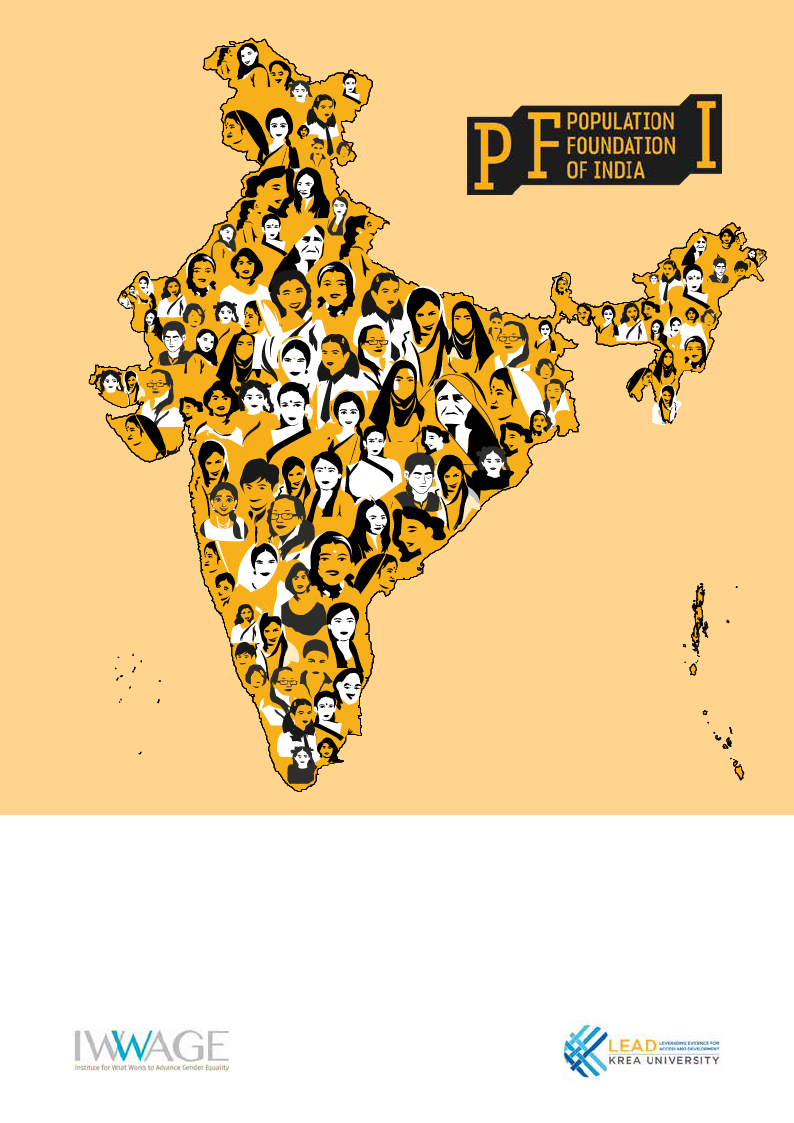
Map Disclaimer
The map of India on the cover of the report has been drawn for illustrative and artistic purposes only.
It may not accurately reflect the current official boundaries, names, or territories of Indian states or
union territories. No part of this map is intended to infringe upon the legal, territorial, or political
integrity of India as defined by the Government of India. If any inaccuracies exist, no offence or claim
of authority is intended by this depiction. For any official use or reference, please consult maps issued
by the Survey of India and other authorized agencies
All illustrations used on the cover are representative and purely artistic. They are not indicative of any
specific individual, community, or demographic group.