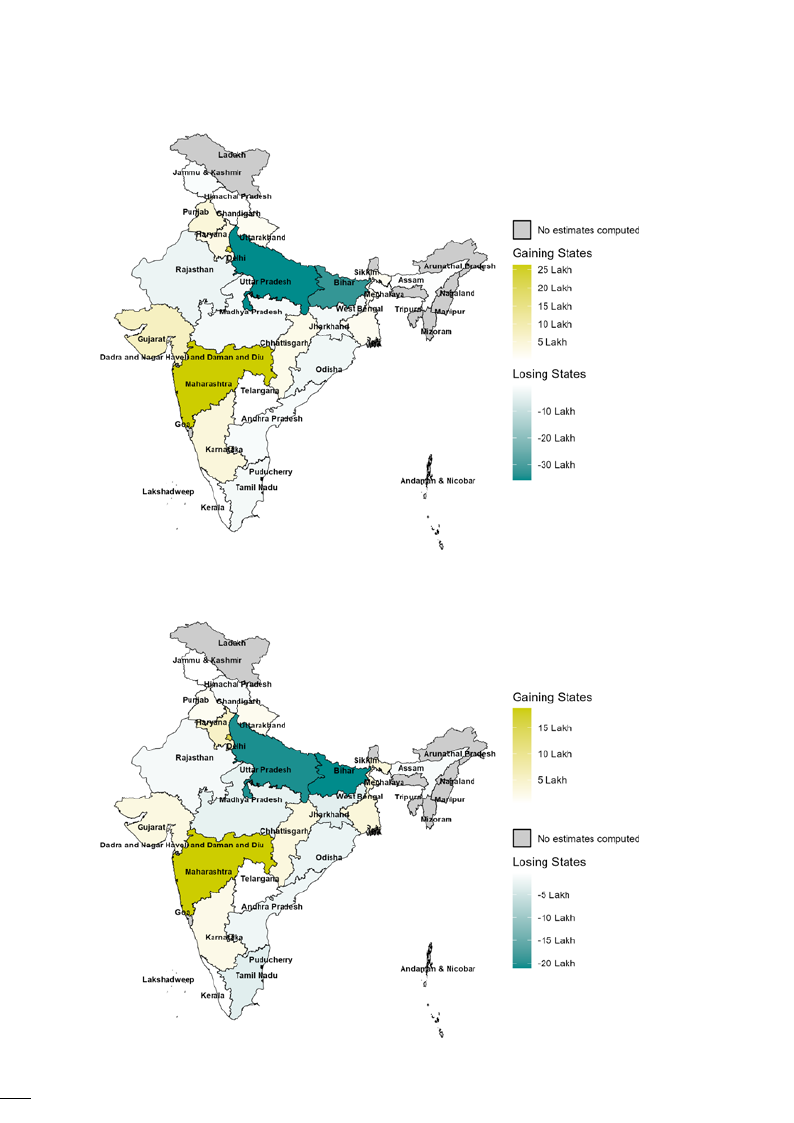
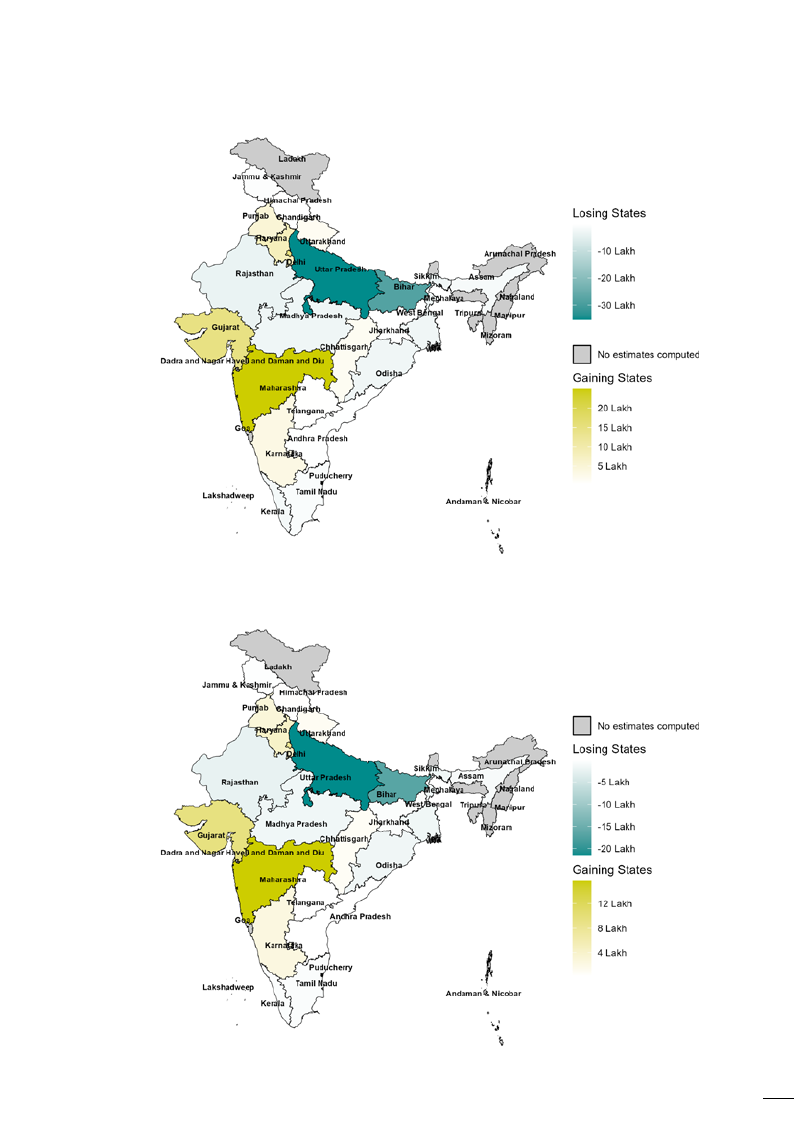
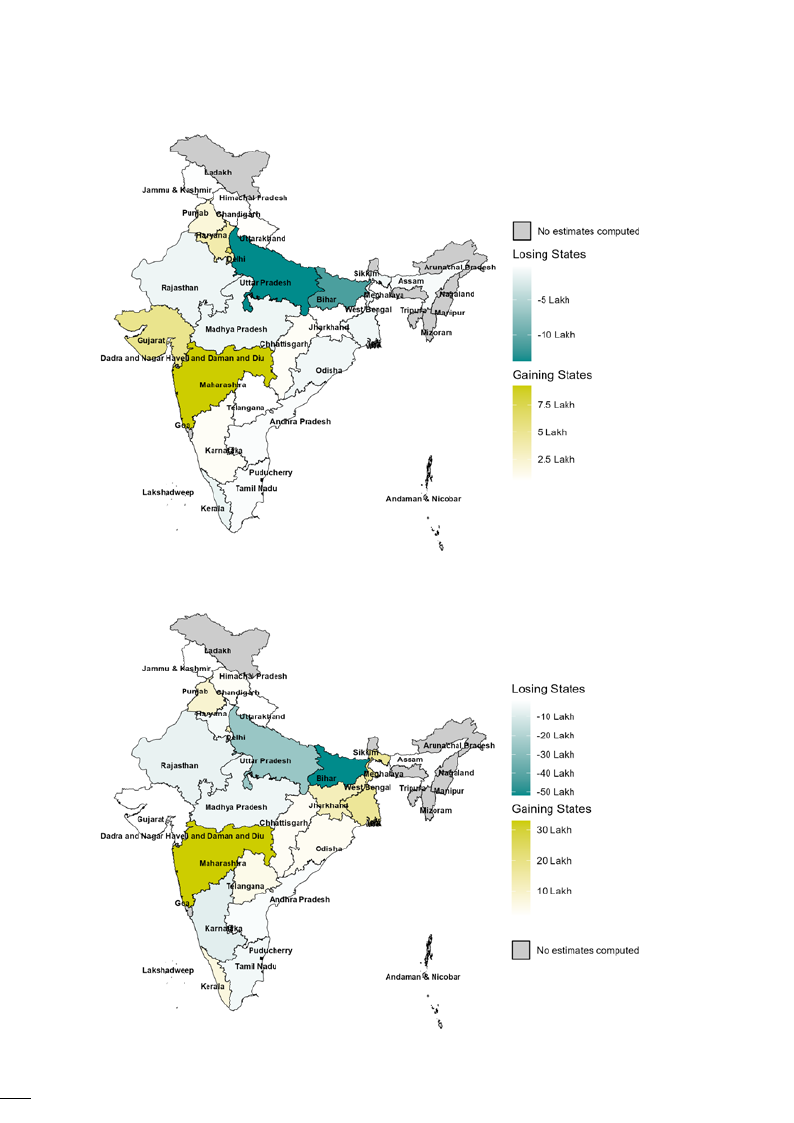
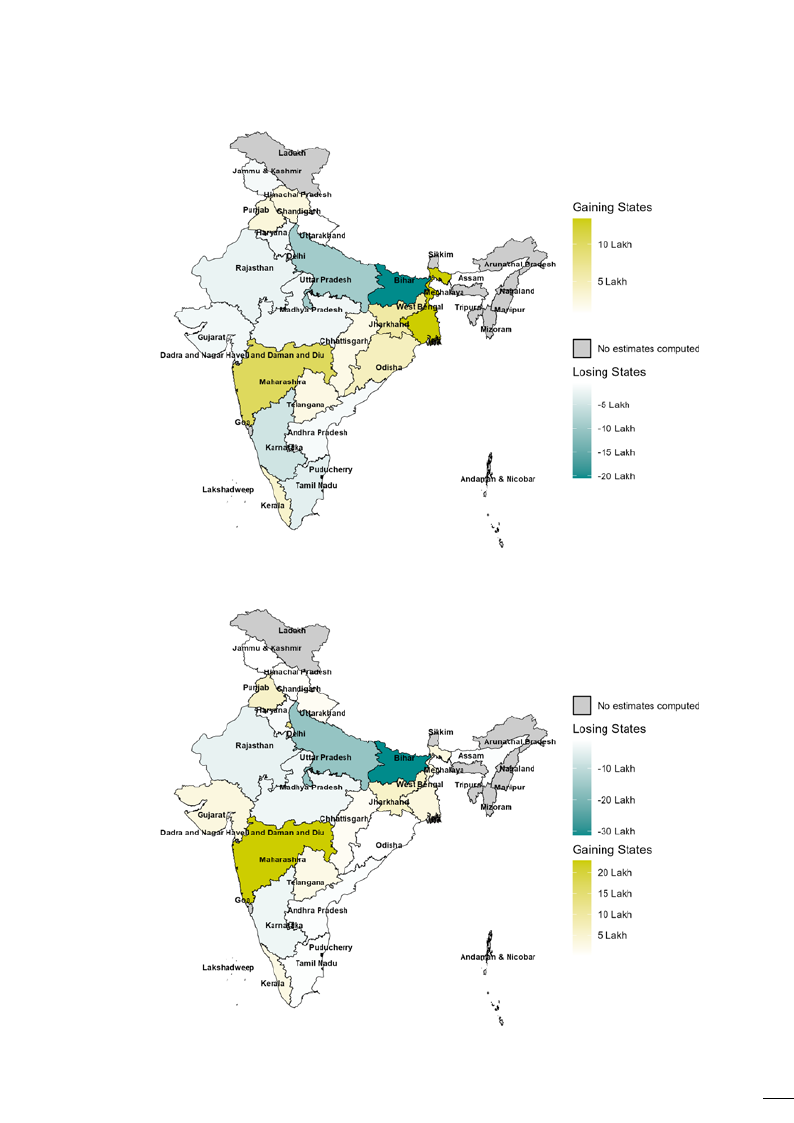
Unravelling India Demographic Future_Population Projections 2021-2051 _Full Report

Unravelling India Demographic Future_Population Projections 2021-2051 _Full Report


1 Pages 1-10

▲back to top


1.1 Page 1

▲back to top


UNRAVELLING
INDIA’S DEMOGRAPHIC FUTURE
Population Projections for States and Union Territories
2021–2051
POPULATION FOUNDATION OF INDIA i

1.2 Page 2

▲back to top


About Population Foundation of India
Founded in 1970 by the late J.R.D. Tata, Population Foundation of India is a leading
non-governmental organisation (NGO) working in the field of population dynamics,
gender equity, and sexual and reproductive health (SRH). It addresses population
issues within the context of empowering women, men, and youth, enabling them to
make informed decisions about their fertility, health, and well-being.
The organisation's approaches include strategic engagement with policymakers,
media, and other key stakeholders; knowledge generation and dissemination;
leveraging technology; scaling up pilot projects; and social and behaviour change
communication. Population Foundation of India collaborates closely with and
provides technical support to national and state governments, as well as other NGOs.
About The International Institute of Migration and Development (IIMAD)
The IIMAD is a non-profit research think tank based in Kerala, India and primarily
works on the intersection of migration and development. IIMAD was established
in 2019 by Professor K C Zachariah, President and Professor S Irudaya Rajan, Chair.
IIMAD collaborates with government and NGOs that deal with refugees, diasporic
migrants, and migrant workers in the region.
The IIMAD tries to serve as a node in the domain of migration with excellence in
cutting edge academic scholarship that fosters practice-oriented research and policy
formulation pertaining to international migration. The IIMAD, with its distinguished
scholar community, works to develop a new thematic pathway and facilitate the
future scholars to disseminate knowledge through academic publications, data banks
and conferencing.
Suggested Citation
International Institute of Migration and Development and Population Foundation of
India. (2025). “Unravelling India’s Demographic Future – Population Projections for
States and Union Territories 2021-2051”, New Delhi. India
Map Disclaimer
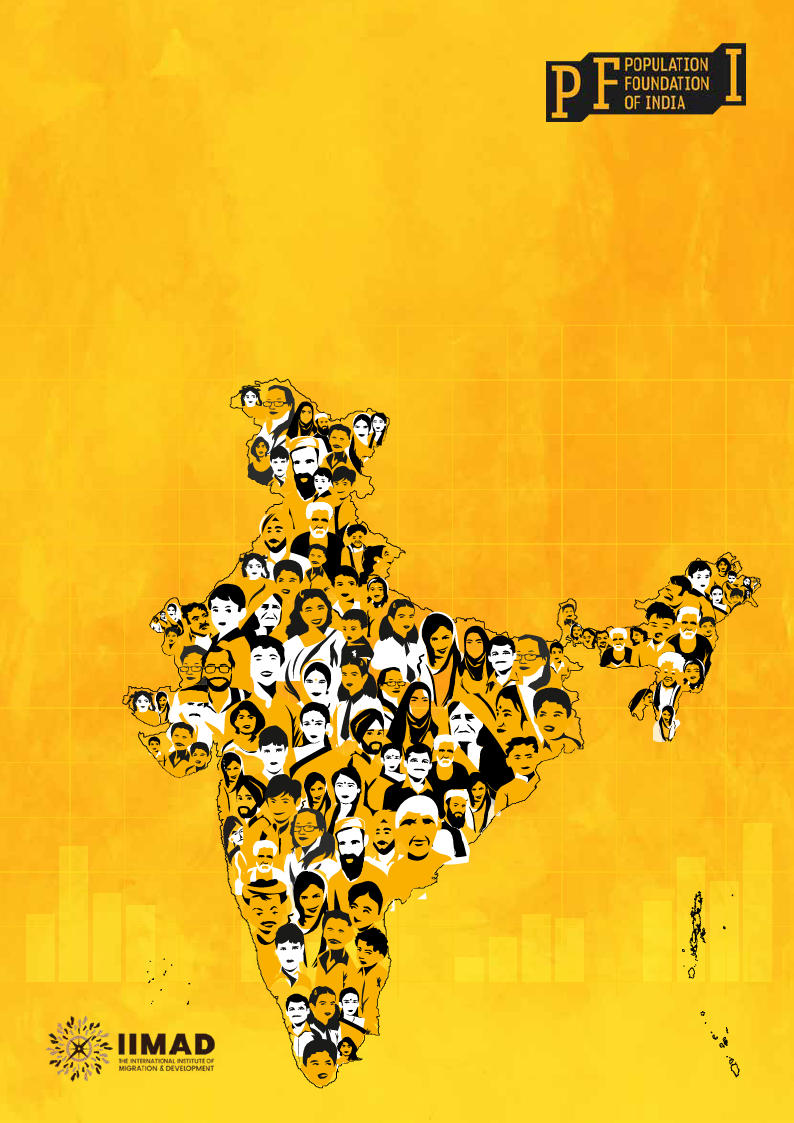
This map of India has been drawn for illustrative and artistic purposes only.
It may not accurately reflect the current official boundaries, names, or territories of
Indian states or union territories. No part of this map is intended to infringe upon
the legal, territorial, or political integrity of India as defined by the Government
of India. If any inaccuracies exist, no offence or claim of authority is intended by
this depiction. For any official use or reference, please consult maps issued by the
Survey of India and other authorised agencies.
All illustrations used on the cover are representative and purely artistic. They are
not indicative of any specific individual, community, or demographic group.

1.3 Page 3

▲back to top


UNRAVELLING
INDIA’S DEMOGRAPHIC FUTURE
Population Projections for States and Union Territories
2021–2051
S Irudaya Rajan
J Retnakumar
International Institute of Migration and Development [IIMAD], Kerala
Population Foundation of India [PFI], New Delhi

1.4 Page 4

▲back to top


1.5 Page 5

▲back to top


ACKNOWLEDGEMENTS
The research team is deeply grateful to Population Foundation of India [PFI],
New Delhi, for our collaboration on the project ‘Unravelling India’s Demographic Future:
Population Projections for States and Union Territories, 2021–2051’. We extend our sincere
thanks to Ms Poonam Muttreja, Executive Director, PFI; Dr Sanghamitra Singh, Chief
of Programmes; Mr Alok Vajpeyi, Lead–Core Grants and Knowledge Management;
Dr Varun Sharma, Senior Specialist, Monitoring and Evaluation; and Mr Martand
Kaushik, Senior Specialist, Media and Communications. This research would not have
been materialised without their unwavering encouragement, insightful guidance,
and steadfast commitment to strengthen the evidence-driven policy-making initiatives
in India.
We are highly indebted to members of the Expert Advisory Committee constituted
for this project, whose wisdom and guidance were instrumental in shaping this work
at every stage. We sincerely acknowledge their valuable insights and constructive
feedback offered by Prof. K Srinivasan [former Executive Director, PFI and former
Director, International Institute of Population Sciences, Mumbai], Prof. Leela Visaria
[former Director, Gujarat Institute of Development Research, Ahmadabad], Prof.
Faujdar Ram [former Director, International Institute for Population Sciences, Mumbai],
Prof. Sulabha Parasuraman [former Professor, International Institute for Population
Sciences, Mumbai], Prof. P M Kulkarni [former Professor, Jawaharlal Nehru University,
New Delhi], Prof. U S Mishra [Professor, International Institute for Population Sciences,
Mumbai], Dr Amrita Datta [Assistant Professor of Development Studies, Department
of Liberal Arts, Indian Institute of Technology, Hyderabad], and Dr Chinmay Tumbe
[Associate Professor, Indian Institute of Management, Ahmedabad]. Their long-standing
contributions to the field of population sciences, together with thoughtful and incisive
suggestions have immensely elevated the quality and the scientific rigour of this study.
We greatly acknowledge the support received from Dr Gopal Aggarwal, Deputy
Director, Office of the Registrar General of India, New Delhi, Dr K K Hari Kurup, Advisor,
Seventh Finance Commission, Government of Kerala; Dr Mahesh Ramachandran,
Senior Consultant and Economist, Asian Development Bank; Dr John Stover, Vice
President, Avenir Health, USA; Dr Mahesh Kumar T, Assistant Professor, Dr B R
Ambedkar School of Economics, Bengaluru, Dr Benoy Peter, Executive Director, Centre
for Migration and Inclusive Development, Ernakulam; Prof. Nandita Saikia, Professor
in Public Health and Mortality Studies, International Institute for Population Sciences,
Mumbai; and Prof. R B Bhagat, Visiting Professor, Institute for Human Development,
New Delhi. Their expertise—ranging from technical guidance to constructive reviews
at sequential stages of this work—have substantively enriched the depth and quality
of this work in enduring ways.
POPULATION FOUNDATION OF INDIA v

1.6 Page 6

▲back to top


Special thanks to our colleagues and research team at the International Institute for
Migration and Development, in particular, Dr Krishnakumar C S, and Dr Sunitha S
played a pivotal role in all the stages of this project from conceptualising to refining
the methodological assumptions of the population projections, that laid a strong
foundation to this research. Dr Rakesh Ranjan Kumar and Dr C V Irshad provided
dedicated support in facilitating the research work with commitment and efficiency.
We gratefully acknowledge the invaluable contributions of Mr Ajay P Karuvally,
Ms Parvathy J, Ms Varsha Joshi and Ms Sneha Najeeb in preparing the graphs, charts
using R Studio, editing the drafts which substantially enhanced the clarity and
coherence in the visual presentation of the data. On a personal note, I extend my
heartfelt gratitude to my Co-Principal Investigator, Dr J Retnakumar, for his constant
collaboration, critical insights, and untiring support throughout this project. His
partnership has been indispensable in successfully completing this initiative.
Finally, we place on record our sincere gratitude to all individuals and institutions who,
directly or indirectly, contributed to this study. This collective effort reflects the spirit
of collaboration in the field of population studies, and we hope the findings will serve
as a useful resource for planning among policymakers, researchers, and practitioners
engaged in shaping India’s future.
Professor S Irudaya Rajan
Principal Investigator and Chair
International Institute of Migration and Development
vi POPULATION FOUNDATION OF INDIA

1.7 Page 7

▲back to top


EXECUTIVE SUMMARY
The entire world has been closely observing India’s demographic
trajectory, as we have become the most populous nation on the planet,
surpassing China. This gives India an instrumental role in shaping
global demographic trends, owing to its large youth population.
Over the coming decade, it has the potential to effectively leverage
its demographic and gender dividends for sustained economic
development through both internal and international migration. This
encompasses an important demographic benchmark, wherein India’s
population growth is sustained by significant population momentum
arising from its large base.
Currently, there is a lack of reliable population projections, not only for
the national level but also for the states and Union Territories [UTs].
Most of the existing projections are based primarily on the data from the
old censuses. At present, policymakers largely rely on the population
projections published in 2019 by the Registrar General of India, based
on the 2011 Census, which provide estimates only up to 2036. Over
time, population projections have become obsolete, rendering the
input data used in their formulation potentially extraneous. Secondly,
a sustained flow of migrants from the labour-surplus to labour-deficit
states may have reshaped the demographic profiles of both the
sending and receiving destinations. Thirdly, the demographics of most
nations, including India, have changed due to the pandemic, which
disrupted age structures and smooth trajectories of life expectancies.
Finally, most projections are made at the national level and do not
cover all states, especially the smaller ones and UTs. This might have
aggravated data voids in accurate population estimates, and these
estimates are often serving multiple and divergent purposes. Against
this backdrop, a new set of population projections has been prepared
extending to the middle of this century, with the objective of providing
the most reliable and updated population estimates for India under
the changed circumstances.
A new set of
population
projections has
been prepared
extending to the
middle of this
century, with
the objective of
providing the
most reliable and
updated population
estimates for India
under the changed
circumstances.
This exercise draws on a range of demographic datasets, including
the Census, the Sample Registration System [SRS], the National Family
Health Survey [NFHS], the Civil Registration System [CRS], and the
National Sample Survey [NSS]. The Cohort Component Method has
been applied to 22 states with a population in excess of six million, as
enumerated in the 2011 Census. The smoothed age–sex distribution
from the 2011 Census was carried forward to 2021 with fertility,
mortality inputs from the SRS and migration data from the NSSs.
POPULATION FOUNDATION OF INDIA vii

1.8 Page 8

▲back to top


The findings
highlight that
the demographic
transition over
the next three
decades will be
characterised
by a steady
decline in fertility
and constant
improvements in
life expectancy
at birth.
These data sources were then used to project the demographic inputs,
which were subsequently used as the basis for population projections
till 2051. Appropriate adjustments have been made for Andhra
Pradesh, Telangana, Jammu and Kashmir [UT], Ladakh [UT], and Dadra
and Nagar Haveli and Daman and Diu [UT] to account for boundary
changes since the 2011 Census. Mathematical models—specifically
the curve estimation regression model—were employed to project the
populations of the rest of the smaller states and UTs.
This study posits the Gompertz Curve [GC] for projecting future
fertility patterns at both national and state level. These were classified
and assumed different set of lower asymptotes to project the future
population. Life expectancies at birth were projected using the
Logistic Curve [LC] method. Gender-specific life tables were created to
encompass the bearing of pandemic on life expectancy at birth using
the Age-Specific Death Rates obtained from SRS data for 2020 and
2021. These rates were subsequently transformed into nMx values for
constructing life tables at the state level. Migration patterns and sex ratio
at birth [SRB] were projected using logarithmic convergence models.
The findings highlight that the demographic transition over the next
three decades will be characterised by a steady decline in fertility and
constant improvements in life expectancy at birth. The Total Fertility
Rate [TFR] is projected to decline from the current level of two children
per woman in 2021 to 1.67 by 2051 under medium-variant assumptions.
Fertility is anticipated to decline in all parts of the country, though at
varying pace. Northern states are now expected to play a leading role
in shaping India’s demographic trajectory, as southern states—having
largely completed their fertility transition phase—exhibit fertility
rates at or below replacement level, leaving limited scope for further
decline. The Crude Birth Rate [CBR] is expected to decline appreciably
from 17 per 1000 population in 2021 to 10.8 by 2051. Consequently,
the annual number of births will fall from the current level of 23 million
to 17.1 million during the same period. The primary driver of such
demographic changes is the expected reduction in fertility rates over
the next three decades. Crude Death Rate [CDR] on the other hand,
will show a modest increase from 7.7 to 8.6 over the same period—
reflecting an increase in the ageing population and its consequences.
As a result, life expectancy at birth is projected to increase moderately,
with male life expectancy rising from 66.6 years in 2021 to 75.4 years
in 2051, and female life expectancy from 70.9 to 81.4 years. Thus, the
rate of natural increase in the population would fall to 0.22 percent
from the current level of 0.8 percent.
India’s total population is expected to reach 1590.1 million by 2051
from the 2021 base population of 1355.8 million, indicating an increase
viii POPULATION FOUNDATION OF INDIA

1.9 Page 9

▲back to top


of 17.3 percent or a 0.5 percent annual increase. Our projected figures
are much lower than the medium-variant assumptions adopted
in other recent projections, including those by the United Nations
[2025] and by Kulkarni [2021]. This can be attributed mainly to two
reasons—the use of updated fertility trends and the inclusion of latest
data in the core assumptions behind the population projections. The
proportion of the child population [0–4] dwindles from 9.3 percent
to 5.4 percent in a span of the next three decades. The population
in ages 15–59 years, comprising workers, peaks at 65.8 percent in
2031 before declining to 62.7 percent by 2051. The proportion of
the elderly population [aged 60 and above] rises substantially from
one in ten persons in 2021 [9.6%] to two in ten persons [20.4%] by
the end of the projected horizon. This demographic shift is further
reflected in an increase in the median age of the population from 29
to 40 years, reinforcing the ongoing demographic transition reflected
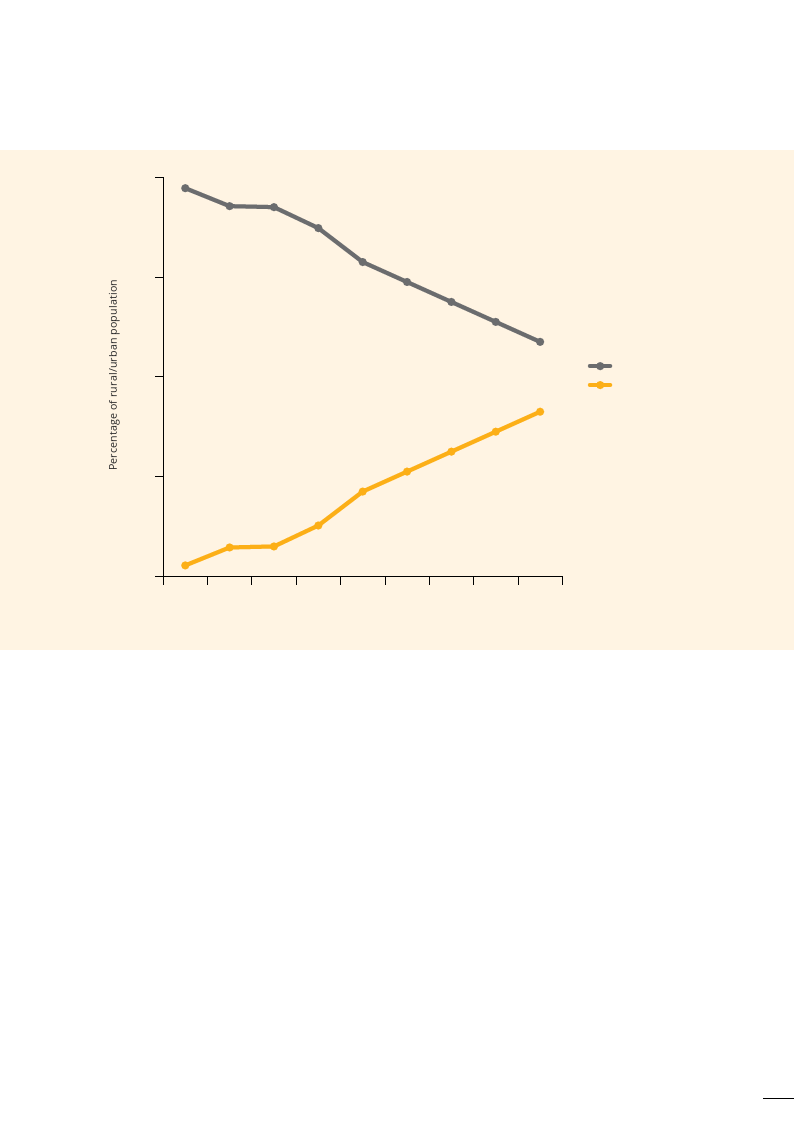
in terms of an ageing population. Urban–rural population projections
using the revised UN [2018] method suggest that, by the mid-21st
century, one out of every two persons in the country will be residing in
urban agglomerations.
The study classifies India into six geographical regions for analytical
purposes1. Population projections suggest that regional demographic
patterns across the country are expected to become more varied in the
years to come. As these states in various regions are at different stages
of demographic transition, they require tailored policy and programme
interventions for their socio-economic development. While large-scale
demographic shifts are underway, our population projections suggest
that the country will fall short of achieving population stabilisation
even by the middle of the 21st century. Given the current demographic
trajectories, it may take another half a decade to achieve this target.
On the other hand, most of the southern states are projected to
see population decline beginning around 2036, with the region as a
whole expected to reach this stage by 2041. The projected results also
suggest that India’s demographic dividend window might close by
2031, underscoring the importance of harnessing its benefits before
its influence on economic growth begins to wane. The education
and skill development systems in our country must be fine-tuned to
ensure that they can effectively respond to and absorb the available
opportunities before they disappear.
Urban–rural
population
projections using
the revised UN
[2018] method
suggest that, by the
mid-21st century,
one out of every
two persons in
the country will be
residing in urban
agglomerations.
1 1: N orthern region [Jammu and Kashmir [UT], Ladakh [UT], Himachal Pradesh, Punjab,
Uttarakhand, Haryana, National Capital Territory [NCT] of Delhi, Rajasthan and Chandigarh]
2: C entral region [Uttar Pradesh, Bihar, Madhya Pradesh and Chhattisgarh]
3: Eastern region [Odisha, West Bengal and Jharkhand].
4: Western region [Gujarat, Maharashtra, Dadra and Nagar Haveli and Daman and Diu]
5: Southern region [Andhra Pradesh, Telangana, Tamil Nadu, Karnataka, Kerala, Goa,
Puducherry, Andaman Nicobar Islands and Lakshadweep]
6: N orth-eastern region [Sikkim, Arunachal Pradesh, Nagaland, Manipur, Mizoram, Tripura,
Meghalaya and Assam].
POPULATION FOUNDATION OF INDIA ix

1.10 Page 10

▲back to top


UNRAVELLING INDIA’S DEMOGRAPHIC FUTURE:
KEY HIGHLIGHTS
India is on the threshold of a profound demographic transformation. Between 2021
and 2051, India is set for a transition from a predominantly young and rapidly growing
population to a country experiencing slower population growth, signalling the onset of
a more balanced and ageing demographic structure. As India heads towards population
stabilisation, the proportion of children in the population is projected to decline
sharply, while the elderly population will see a substantial increase—both changing by
nearly 50 percent by the end of the projection horizon. India’s demographic dividend
is expected to wane over the next one decade and may taper off after 2031. By the
middle of this century, over half of the country's population is projected to live in
urban agglomerations.
National-level demographic projections [2021–2051]
Ü As per the medium-variant population projections, India’s population is expected
to increase from 1355.8 million in 2021 to 1590.1 million in 2051 with the overall
growth rate of 17.3 percent. With the annual population growth rate projected to
touch 0.5 percent, India is all set to experience a marked slowdown in population
growth in the near future.
Ü Fertility in India is projected to decline from 2.0 [2021] to 1.67 [2051], with the
states in north expected to contribute most to the decline, while the states in the
south have already experienced significant demographic transition.
Ü Life expectancy at birth is projected to improve, with male life expectancy increasing
from 66.7 years to 75.4 years, and female life expectancy from 71.0 years to
81.4 years. This trend suggests that current gender gap in life expectancy at birth is
expected to persist throughout the projection period.
Ü CBR will taper off from 17 per 1000 to 10.8, while the total number of annual births
is expected to decline from 23 million to 17.1 million.
Ü CDR will rise slightly from 7.7 to 8.6 per 1000, indicating the deepening of the ageing
population.
Ü A significant decline in the proportion of children [0–4] from 9.3 percent to 5.4
percent reflects the continuing contraction of the population in the base of
population pyramid.
Ü The working-age population [15–59] is expected to reach a peak level of 65.8 percent
in 2031 and decline subsequently, marking the beginning of the tapering off of
India’s demographic dividend.
Ü The elderly [60+] will make up 20.4 percent of the total population by 2051; more
than double their 9.6 percent share in 2021.
x POPULATION FOUNDATION OF INDIA

2 Pages 11-20

▲back to top


2.1 Page 11

▲back to top


Ü Urban Rural Growth Difference [URGD] projections highlight a historic demographic
turning point in India, with more than half the population projected to live in urban
centres by mid-century, while the rural share drops to less than half.
Regional variations [2021–2051]
Ü The population share of the northern region remains constant at 14 percent, while
the share of the central region increases from 34.6 percent to 38.8 percent.
Ü With their combined population share rising from 48.6 percent to a projected
52.7 percent, these regions—north and central—continue to serve as the centre of
demographic gravity.
Ü The share of the southern region will fall from 20 percent to 17 percent, and the
entire region is anticipated to experience population decline after 2041.
Ü The eastern region will experience a slow decline in its population share from 2021
onwards.
Ü The share of the western region mirrors the trend in eastern region, but records a
decline of more than one percentage point over the projected period.
Ü The north-eastern region will record a modest increase in their demographic share.
Ü In all regions, the share of children [0–14] will decline by more than one-third; with
the steepest drop happening in the southern region, reflecting its advanced position
in terms of fertility transition.
Ü The total working-age population [15–59] is projected to grow in the central and
northern regions through the mid-century, as it has already peaked in the south.
Ü The central region is expected to see an expansion in its working-age population
from 62.9 percent in 2021 to close to 65 percent, positioning it as a key source of
workforce for the rest of the country, and potentially supporting balanced regional
development through internal migration between regions.
Ü A decline in the working-age population from 67 percent to close to 58 percent in
the southern region, marks the earliest onset of the demographic dividend loss in
the country.
Ü The elderly population [60+] is expected to rise in all the regions, increasing by close
to 100 percent in the central region and nearly 140 percent in the northern region.
Ü The oldest-old population [80+] will grow much faster than the elderly in general,
rising by 171 percent in the central region and nearly 300 percent in the eastern
region.
POPULATION FOUNDATION OF INDIA xi

2.2 Page 12

▲back to top


State-wise variations [2021–2051]
Ü Bihar had the highest TFR of 3.0 in 2021, while West Bengal and the NCT of Delhi
[1.4 each] had the lowest. Although TFR will be declining, Bihar is projected to
remain the state with the highest TFR of 1.9 in 2051. Besides the lowest fertility
states in 2021, Andhra Pradesh, Tamil Nadu, Kerala, Maharashtra, and Punjab are
also projected to touch the floor TFR limit of 1.4 by 2051.
Ü Kerala reported the highest male and female life expectancies at birth—70.4 and
75.9 years, respectively, in 2021. These are projected to rise to 80.0 and 85.7 years
by 2051. In contrast, Chhattisgarh had the lowest life expectancies at birth in 2021—
60.5 years for males and 65.8 years for females—expected to increase to 66.6 and
75.2 years, respectively, by the end of the projection horizon.
Ü In 2021, the gender gap in life expectancy at birth favoured women by 5.9 years
in Maharashtra, compared to 1.6 years in Jharkhand and Bihar. By 2051, this gap
is projected to widen further—reaching 8.6 years in Chhattisgarh and 2.4 years
in Assam.
Ü The proportion of child population [0–14] was the largest in Bihar [30.3%] and lowest
in Kerala [19.3%] in 2021. By the mid of this century, Bihar will continue to have
the highest share of children at 22.6 percent, while Kerala’s share will decline to
12.8 percent, the lowest share in the country.
Ü In 2021, the share of the working-age population [15–59 years] was highest in NCT
of Delhi [70.0 percent] and lowest in Bihar [61.6 percent]. By the culmination of
the projection timeframe, Bihar and Uttar Pradesh [65.3% each] are expected to
have the highest proportions, while Kerala and Tamil Nadu [56.6% each] will have
the lowest.
Ü Kerala had the highest percentage of the elderly population [60+] at 16.1 percent,
while Uttar Pradesh had the lowest at 8.0 percent. By 2051, the share of the aged is
projected to rise to 31.1 percent in Tamil Nadu, followed by 30.7 percent in NCT of
Delhi, while Bihar will have the lowest share at 15.3 percent.
Ü In 2021, Kerala had the largest percentage of the oldest-old [80+] at close to
2 percent, while Assam and Bihar had the lowest [0.6%]. It is presumed that by
2051, Kerala will continue to have the largest share of them, at 6.4 percent, followed
by Tamil Nadu at 5.2 percent. The lowest percentage of oldest-old will be found in
Uttar Pradesh [1.8%].
Ü According to our projections, Bihar will remain the youngest state in India, while
Kerala will remain the oldest.
Policy signals
Ü India will experience a shift from a youthful to an ageing population, with the
elderly share doubling and the proportion of children shrinking sharply.
xii POPULATION FOUNDATION OF INDIA

2.3 Page 13

▲back to top


Ü The decline in the total number of annual births will open opportunities to reallocate
resources toward improving the quality of maternal and child healthcare services
across all life stages.
Ü The northern and central regions will remain relatively younger and more populous,
while the southern region will experience rapid ageing and a subsequent decline in
population. This calls for necessitating urgent policy interventions in social security,
healthcare, and elderly care infrastructure in addition to empowering and engaging
senior citizens through additional skills and creating new avenues to harness the
silver dividend and spur economic growth.
Ü Bihar and Uttar Pradesh, with large populations that are either working age or about
to enter working age, need more investments in education, skill development, and
job creation to fully harness the potential of their demographic dividend before it
diminishes. The government should ensure safe and orderly migration between
states and regions as internal migrants play a key role in the development of the
urban sector.
Ü As India’s demographic dividend is expected to taper off after 2031, it is critical
to accelerate skill development, women’s workforce participation rate, and create
avenues for better employment.
Ü India’s economic future depends on how effectively it harnesses the potential of
its large female population. Investing in care infrastructure, such as affordable
childcare, eldercare, and safe transport, can ease the unpaid work burden on
women and increase their participation in formal, productive employment.
Ü The emerging labour market mismatch between labour surplus states in the north
and central region and deficit states in the southern region is set to intensify,
highlighting the need for more effective internal migration and labour mobility
policies.
Ü Sustained financing for family planning and sexual and reproductive health is
essential to prevent early and unintended pregnancies, improve maternal and child
health outcomes, and secure the country’s demographic dividend. Integrating family
planning services with primary healthcare and education systems, while ensuring
access to diverse contraceptive options and comprehensive sexuality education,
will enable young people to make informed choices and contribute to economic and
social progress.
Ü Rising numbers of the oldest-old [80+] will strain healthcare systems, especially in
demographically advanced states, calling for focused policies and programmes on
geriatric care and social security systems.
Ü With fertility rates touching below replacement levels, India is on course to stabilize
its population—not within the projected timeframe, but probably after 2055—
thereby underscoring a pressing need for comprehensive and forward-looking
population management policies.
POPULATION FOUNDATION OF INDIA xiii

2.4 Page 14

▲back to top


Ü India’s states are at different stages of demographic transition, from high fertility
to below-replacement levels. Reproductive health and family planning policies
and programmes have historically focused on pregnancy and contraception.
As cohorts age and marriage/childbearing are delayed, new needs are emerging:
infertility, reproductive cancers, perimenopause/menopause, endometriosis/
Polycystic Ovary Syndrome [PCOS] management, Sexually Transmitted Infections
[STI]-related sequelae, male reproductive health, and psycho-social care. A life-
course approach is now essential, tailored to each state’s demographic profile,
without sliding into coercive or pronatalist measures.
xiv POPULATION FOUNDATION OF INDIA

2.5 Page 15

▲back to top


CONTENTS
Acknowledgements
v
Executive Summary
vii
Unravelling India’s Demographic Future: Key Highlights
x
Glossary
1
Abbreviations
5
Section 1: Unravelling India’s Demographic Future: Population Projections
for States and Union Territories, 2021–2051
7
1.1 Introduction
8
1.2 A review of existing population projections for national and state levels
8
1.3 Rationale for a fresh population projection for India
10
1.4 Organisation of the report
12
1.5 Methodological approaches to population projections
13
1.6 Sources of data
15
1.7 Methodological tribulations
15
1.8 Data quality considerations
16
1.9 A word of caution
17
1.10 The dynamics of demographic variations
17
1.11 Key insights from the national population projections [2021–2051]
18
1.11.1 Projected trends in elderly population
24
1.11.2 Major insights from the regional population projections
25
1.11.3 W hen parts don’t equal the whole: Comparative assessment of the
projected populations
28
1.11.4 Validation of the population projection
29
1.12 Population projections for the smaller states and UTs
30
1.13 Summary results from urban-rural population projections
30
1.14 Policy implications
32
Section 2: Detailed Methodological Framework
39
2.1 Approaches to population projection for major states
40
2.2 Establishing the base year population
41
2.3 Assumptions on fertility
41
2.3.1 Assumptions on age-specific fertility rates
46
2.4 Mortality assumptions
49
2.4.1 Life expectancy trends in India: An analytical overview
49
2.4.2 Pandemic and life expectancy
50
2.4.3 Fitting the model
51
2.4.4 Projected trends in life expectancies
52
2.5 Assumptions on migration trends
54
2.5.1 Magnitude of migration in India
54
2.5.2 Complexities in measuring migration
56
POPULATION FOUNDATION OF INDIA xv

2.6 Page 16

▲back to top


2.5.3 Three datasets, divergent approaches and compatibility issues
2.5.4 Approaches in estimating net-migrants
2.5.6 Modelling of net migrant population in projections
2.6 Estimates of sex ratio at birth
2.6.1 Is it possible for the sex ratio at birth to converge?
2.6.2 Projection of Sex ratio at birth
2.7 Issues in projecting urban-rural population
2.8. Methodologies for urban-rural population projections
2.9 Approach to population projection for smaller states
SECTION 3-10: Appendix: I–VIII
References
57
59
61
62
63
65
66
67
69
71–251
255
List of figures
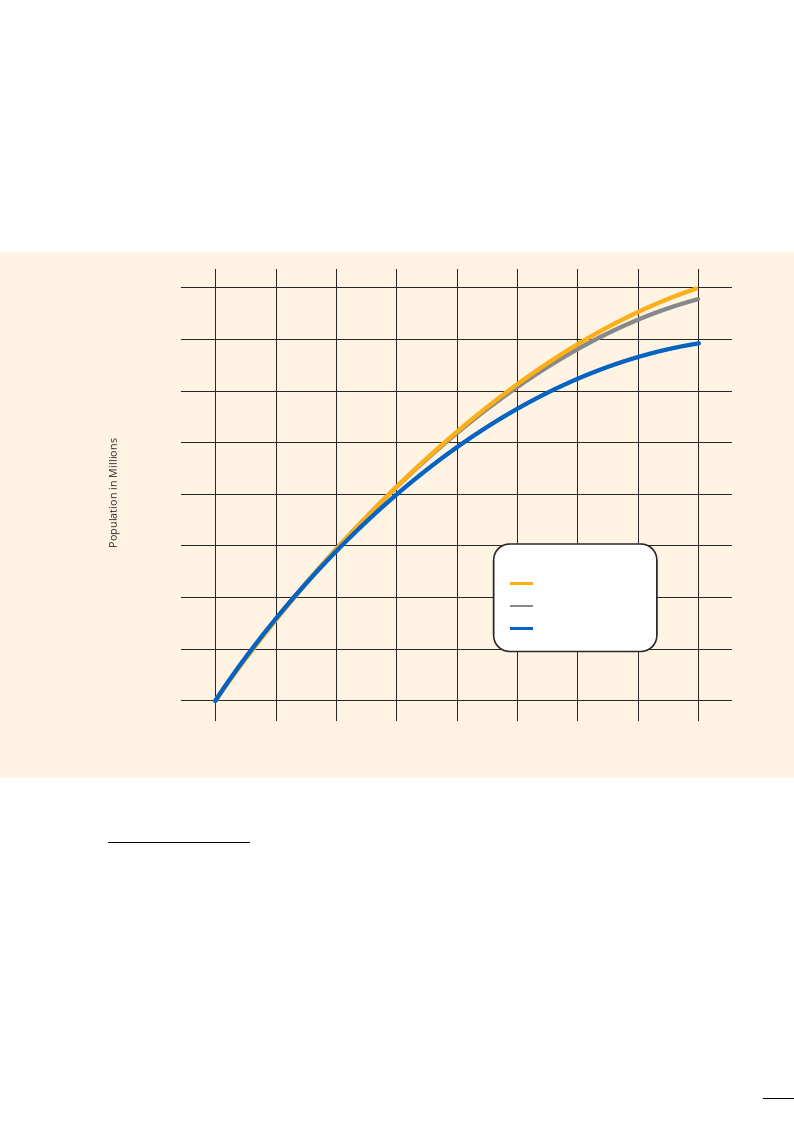
Figure 1.1: Projected population under different variants, 2021–2051
21
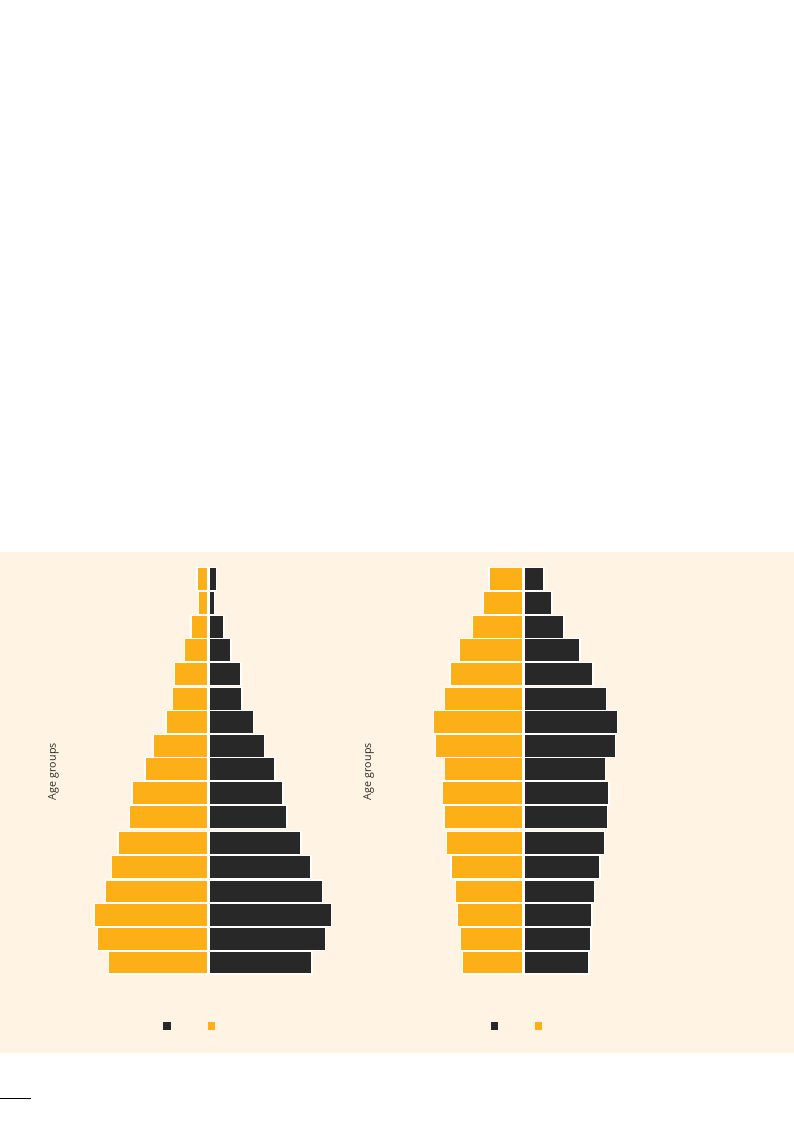
Figure 1.2: Population pyramid for India, 2011 and 2051
22
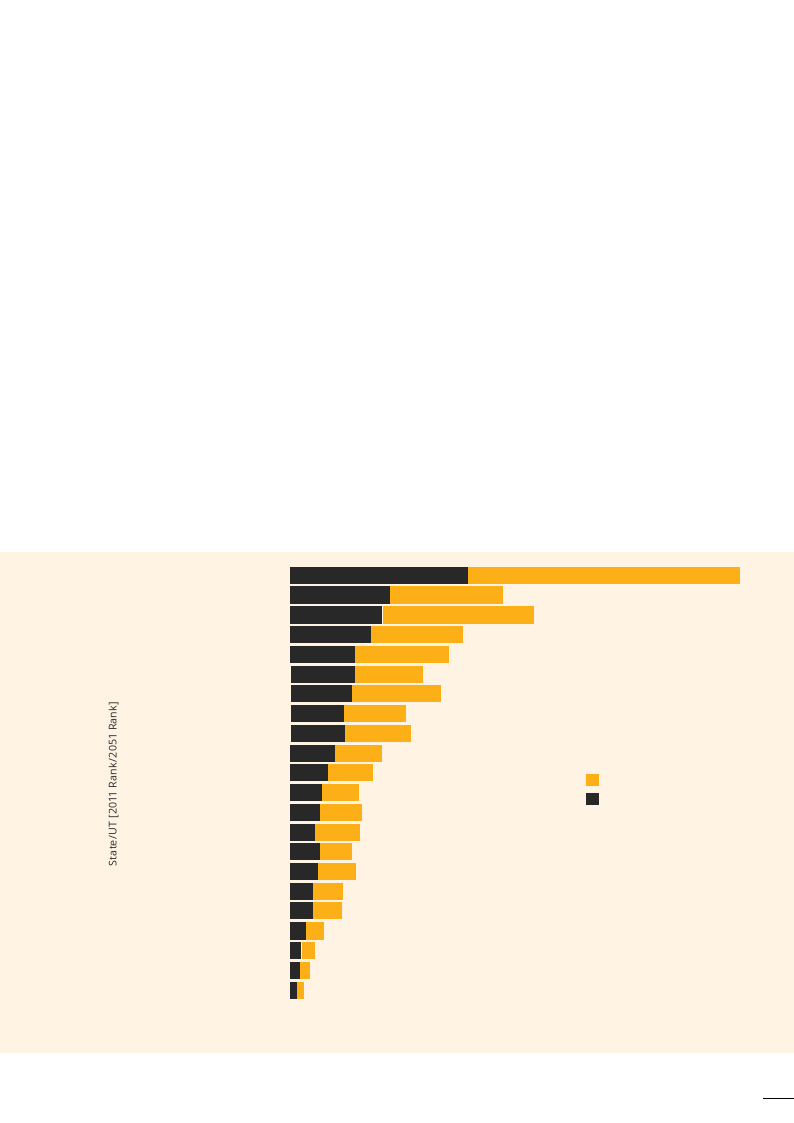
Section Figure 1.3: Ranking of states by population size [medium-variant], 2011 and 2051 23
1
[in million]
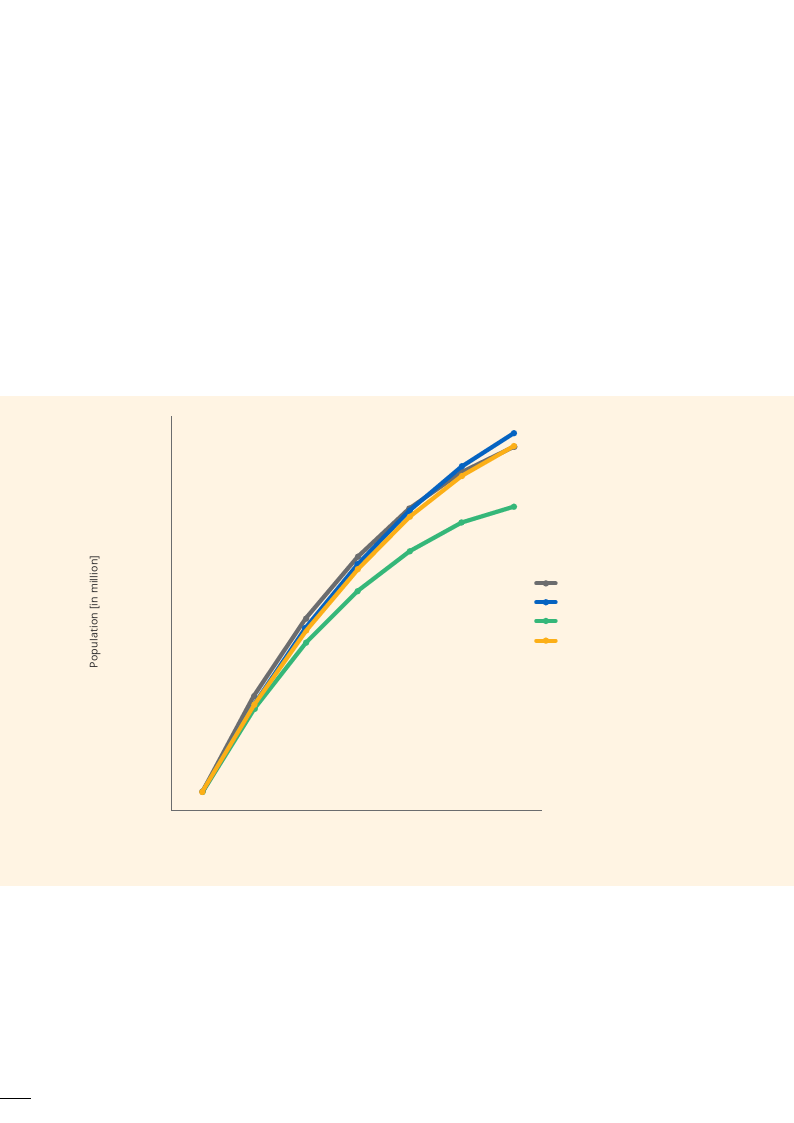
Figure 1.4: Projected population of India using four different projection methods, 28
2021–2051
Figure 1.5: Projected percentage of urban-rural population for India, 2011–2051 31
Figure 2.1: Classification of the states based on TFR [2021] and their year of
replacement level of fertility status
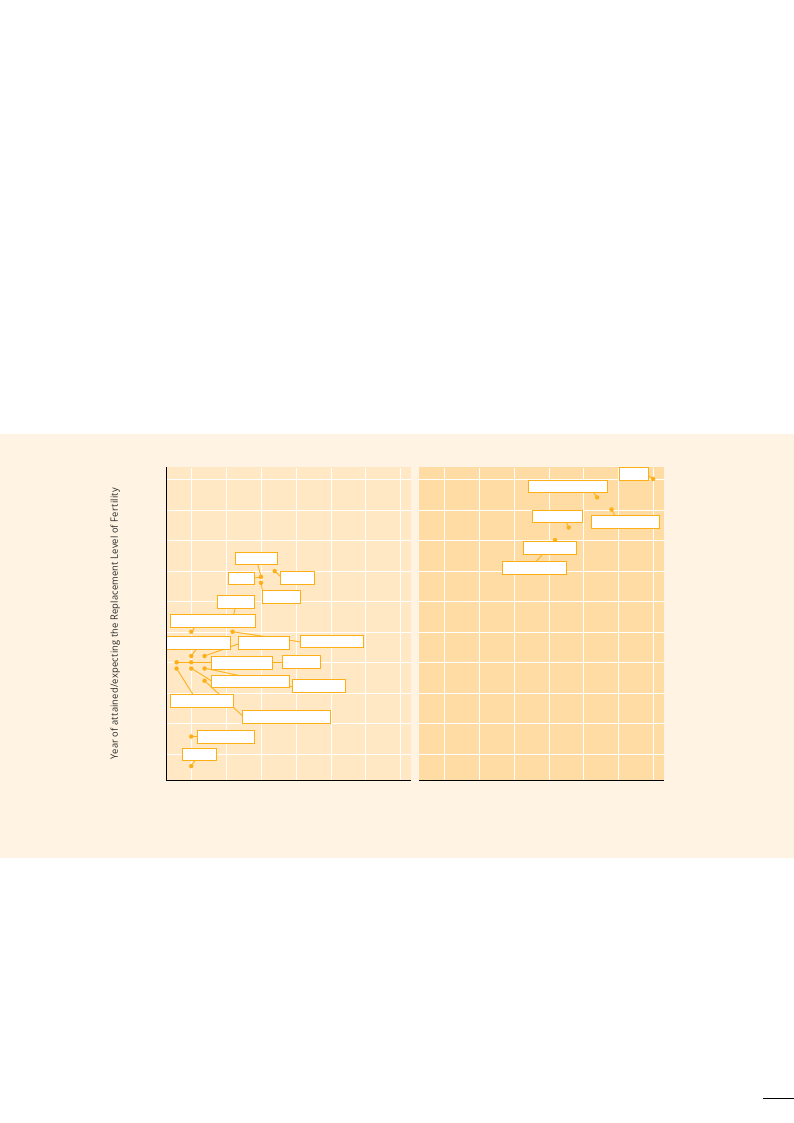
43
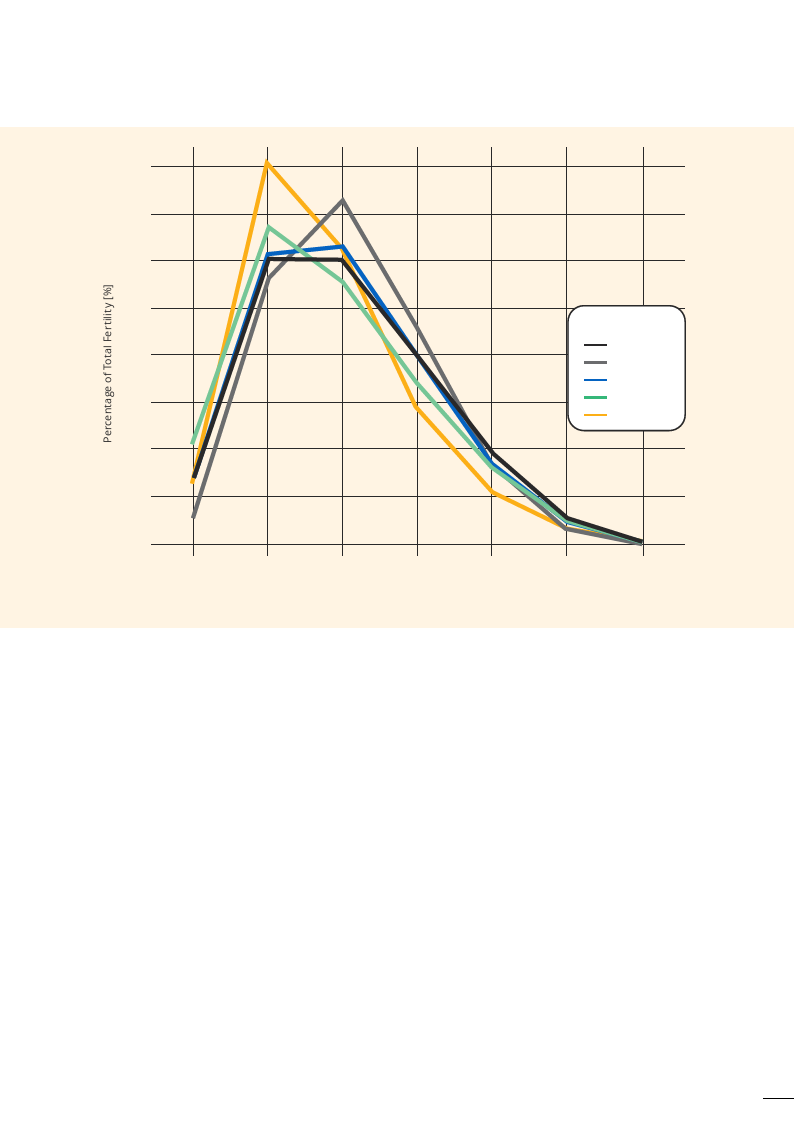
Section Figure 2.2: Age-specific fertility profiles corresponding to a TFR equals 2.40
47
2
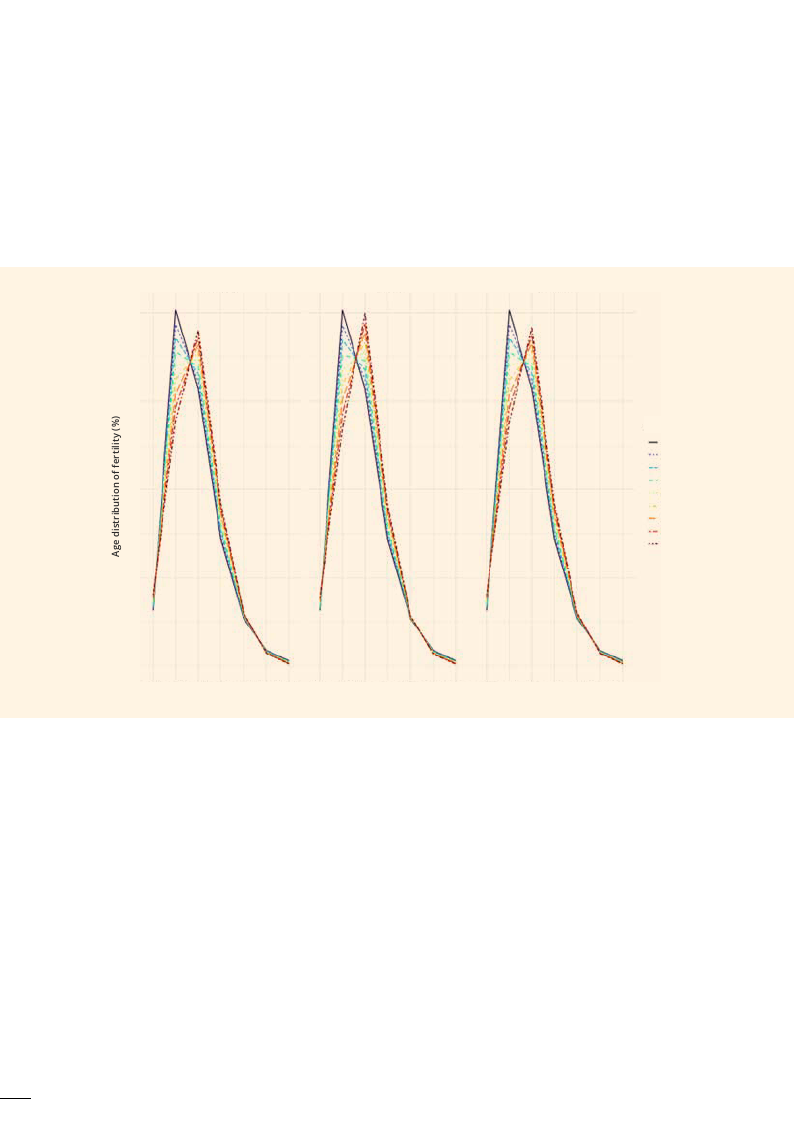
Figure 2.3: Projected patterns of age-specific Fertility Rate [2011–2051]
48
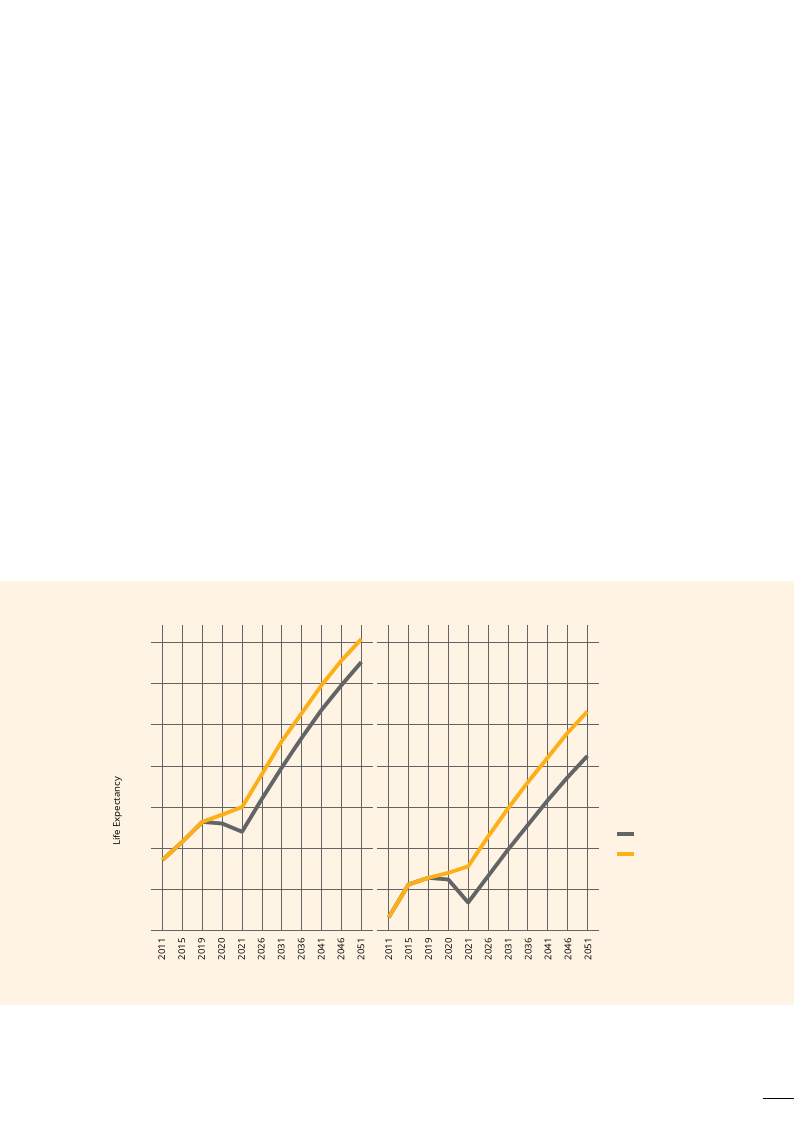
Figure 2.4: Projected life expectancy trends by gender with and without
pandemic, 2011–2051
53
List of tables
Unravelling India’s Demographic Future: Population Projections for States
7
and Union Territories, 2021–2051
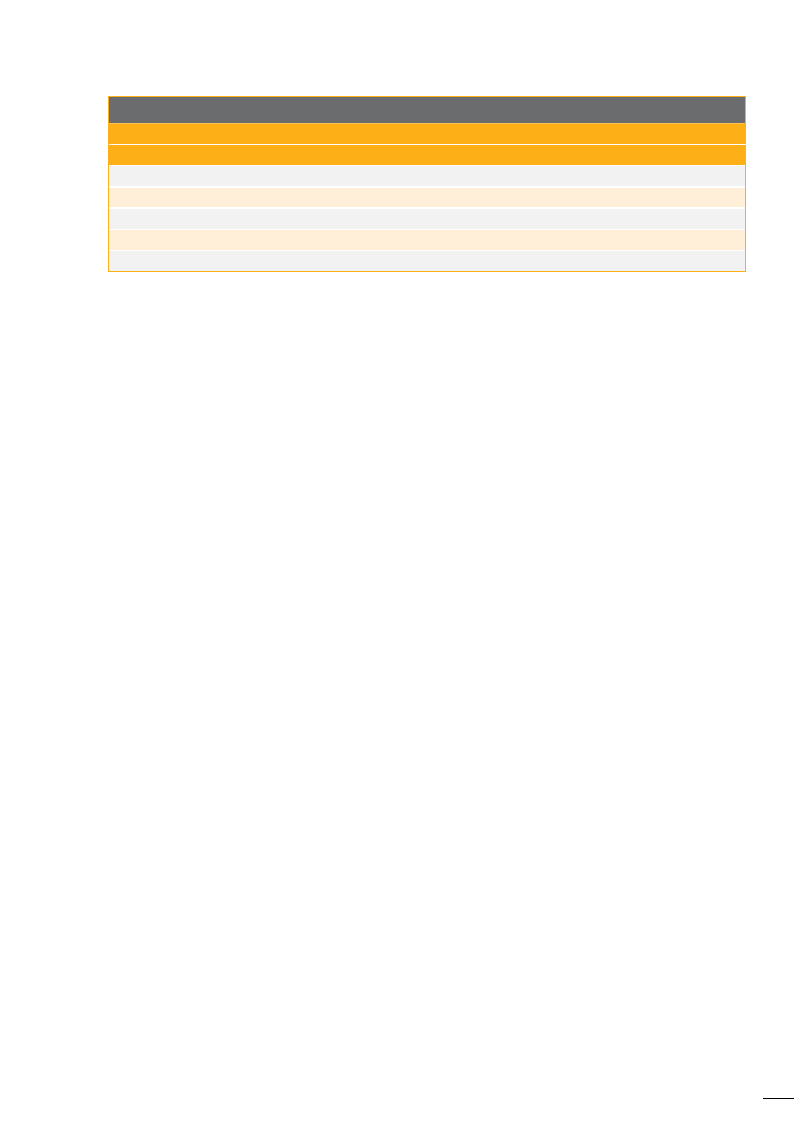
Table 1.1: Projected population for India by various sources, 2026–2300 [In million]
9
Table 1.2: Detailed description of inputs and outputs related to population
projections
15
Table 1.3: Projected summary of demographic indicators for India, [medium-
Section variant] 2026–2051
1
19
Table 1.4: Regional percentage share of population by broad age groups, 27
2021–2051
Table 1.5: Population projections of IIMAD and PFI versus other selected sources,
2026–2051 [in million]
29
Detailed Methodological Framework
39
Section Table 2.1: State-wise range of asymptote values used to fit the Gompertz Curve
44
2
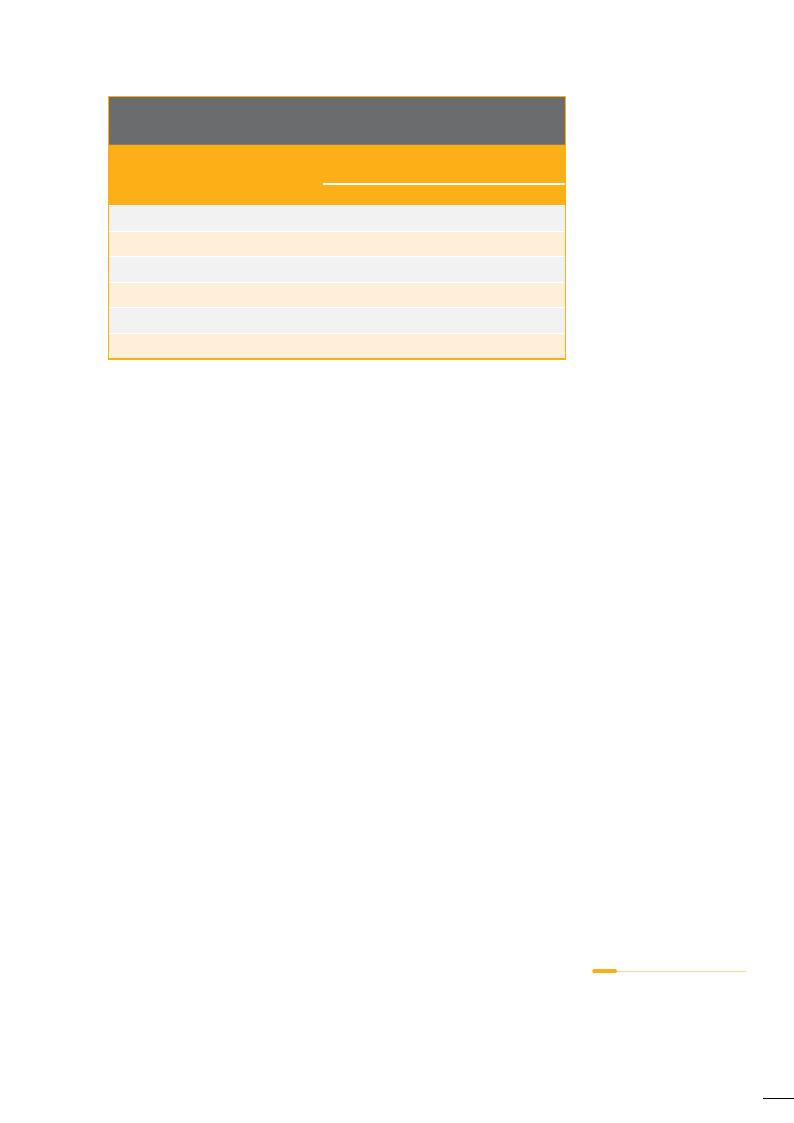
Table 2.2: Expected timeframe for attaining below-replacement fertility
45
xvi POPULATION FOUNDATION OF INDIA

2.7 Page 17

▲back to top


Appendix tables, figures and maps
APPENDIX: I
Section 3 Appendix Tables: Statistical Inputs for Model Estimation
71
Appendix Table 1.1: State-wise trends and absolute decline in TFR, 2011–2021
72
Appendix Table 1.2: Life expectancy at the national and state level by gender in
India, 2011–2021 [in years]
73
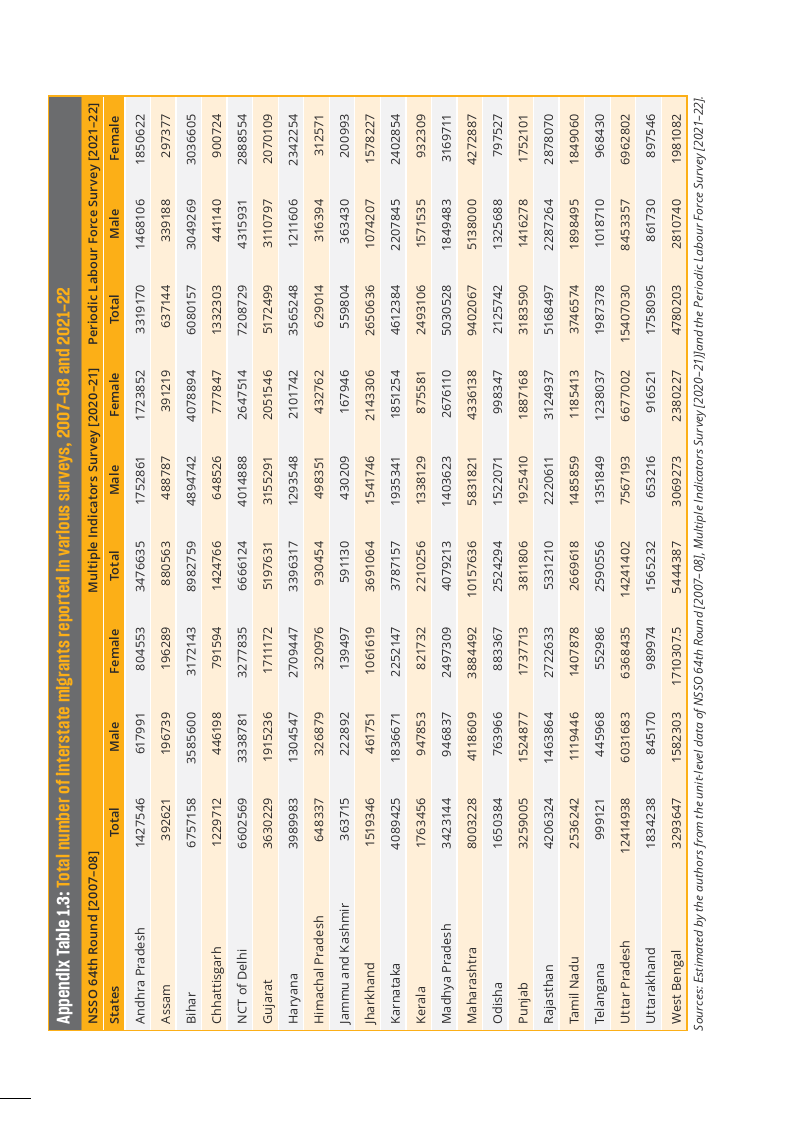
Appendix Table 1.3: Total number of interstate migrants reported in various
surveys, 2007–08 and 2021–22
74
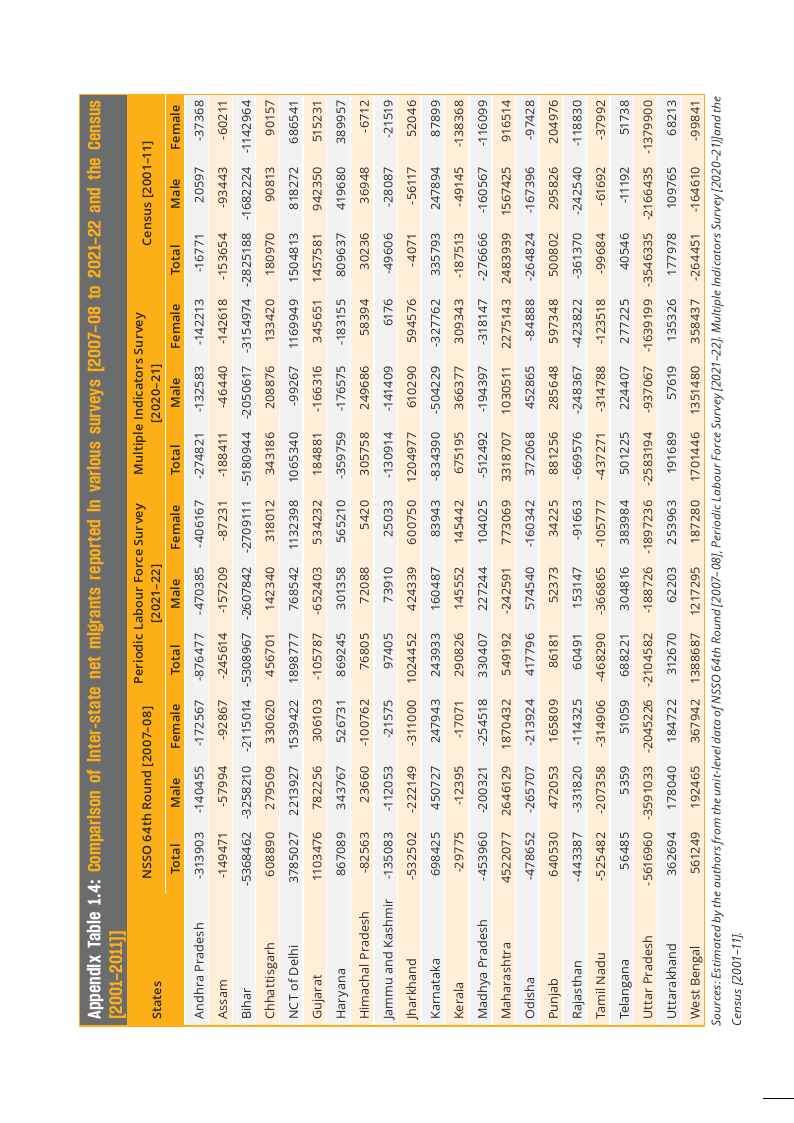
Appendix Table 1.4: Comparison of inter-state net migrants reported in various
surveys [2007–08 to 2021–22 and the Census [2001–2011]]
75
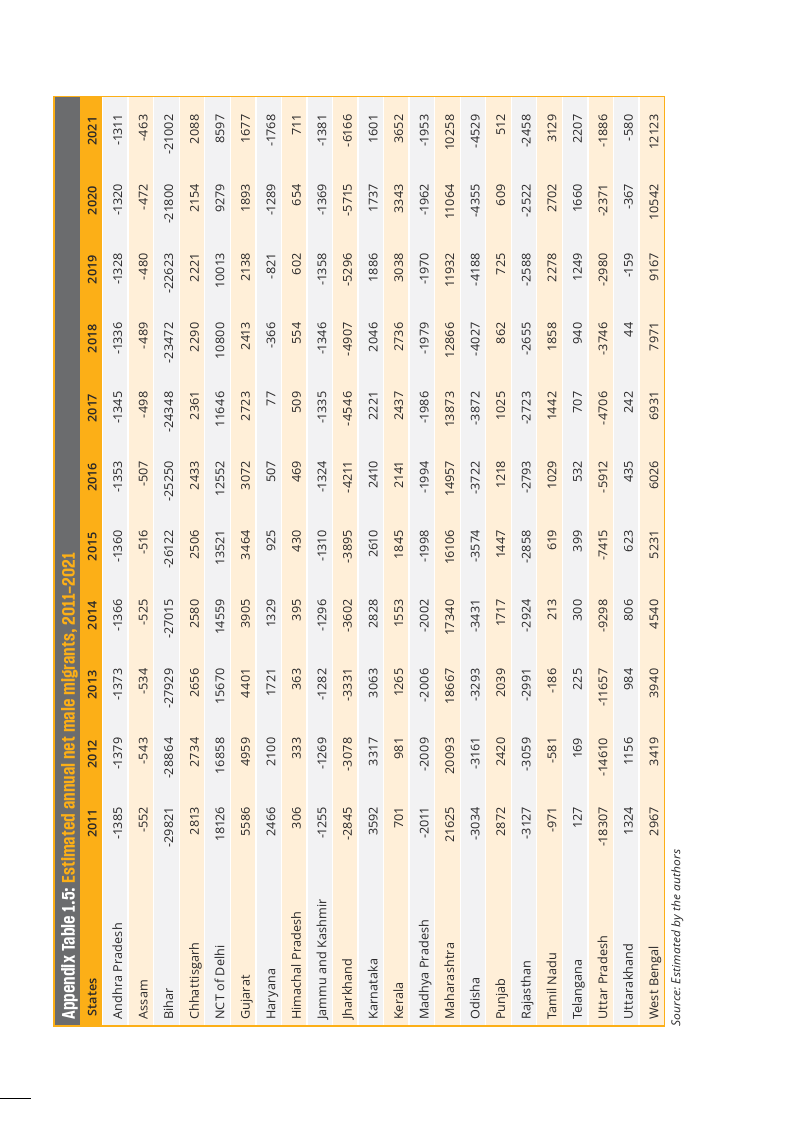
Appendix Table 1.5: Estimated annual net male migrants, 2011–2021
76
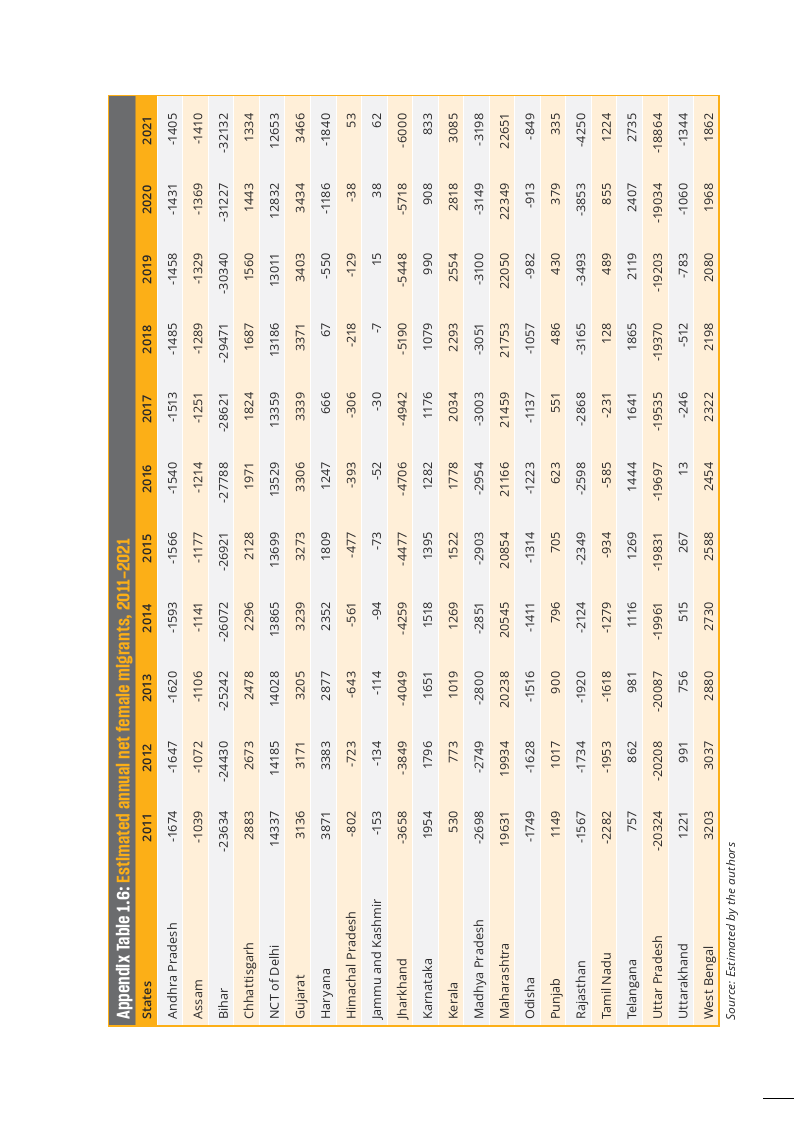
Appendix Table 1.6: Estimated annual net female migrants, 2011–2021
77
Appendix Table 1.7: State-level trends in sex ratio at birth, 1991–2011
78
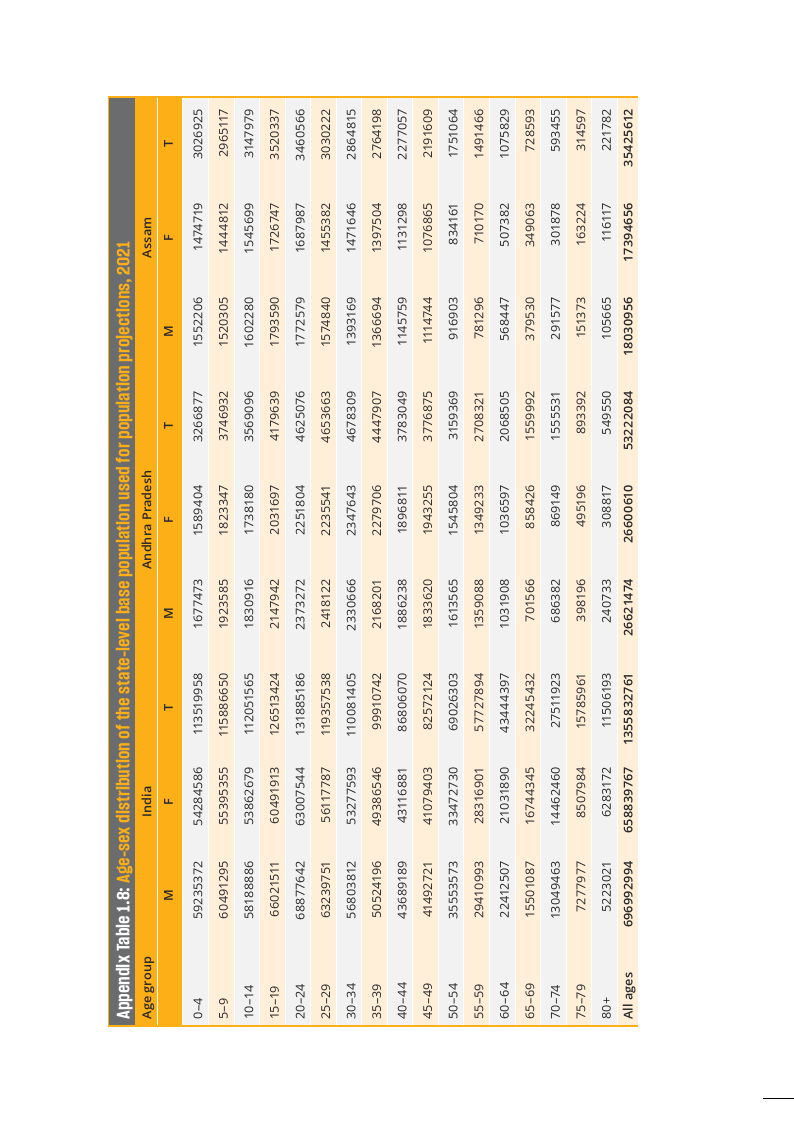
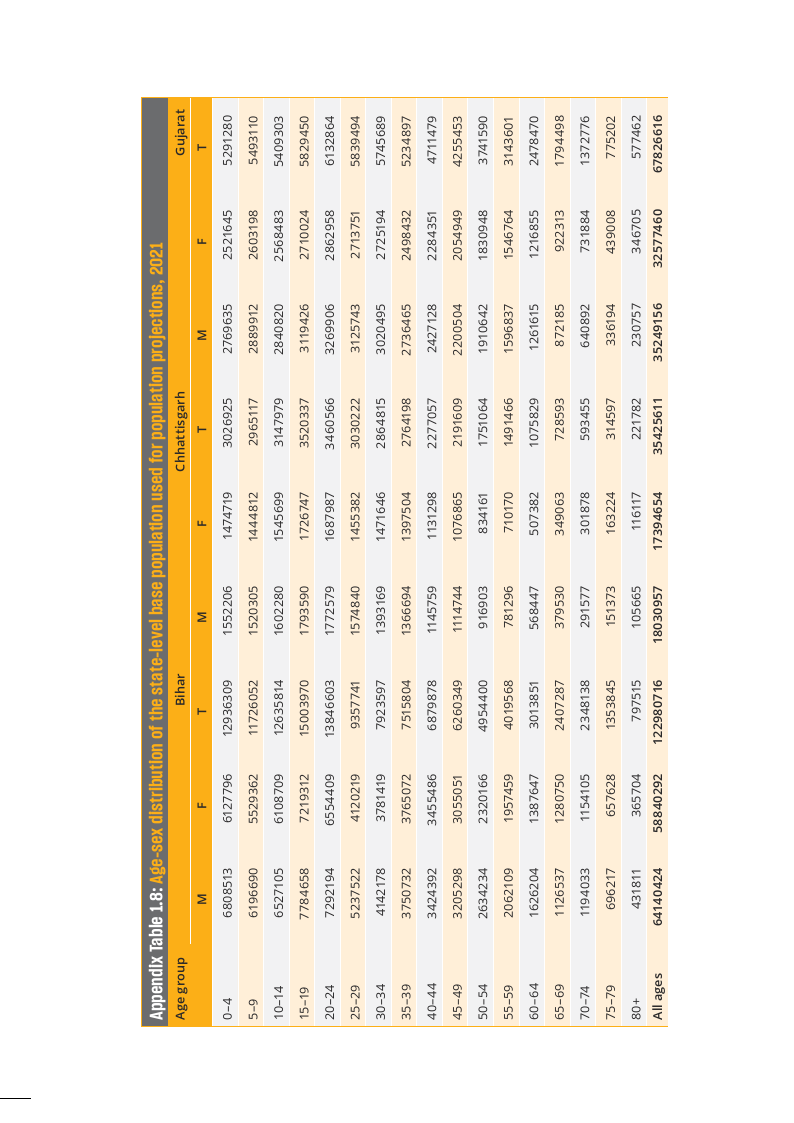
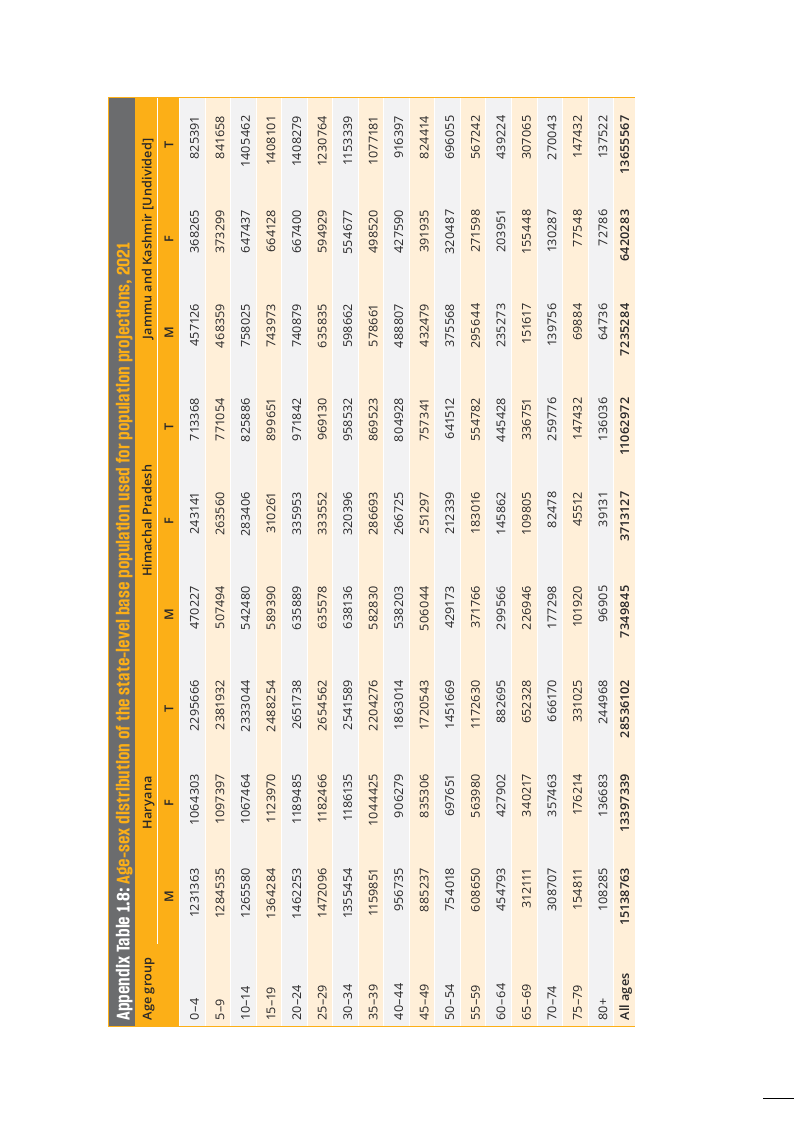
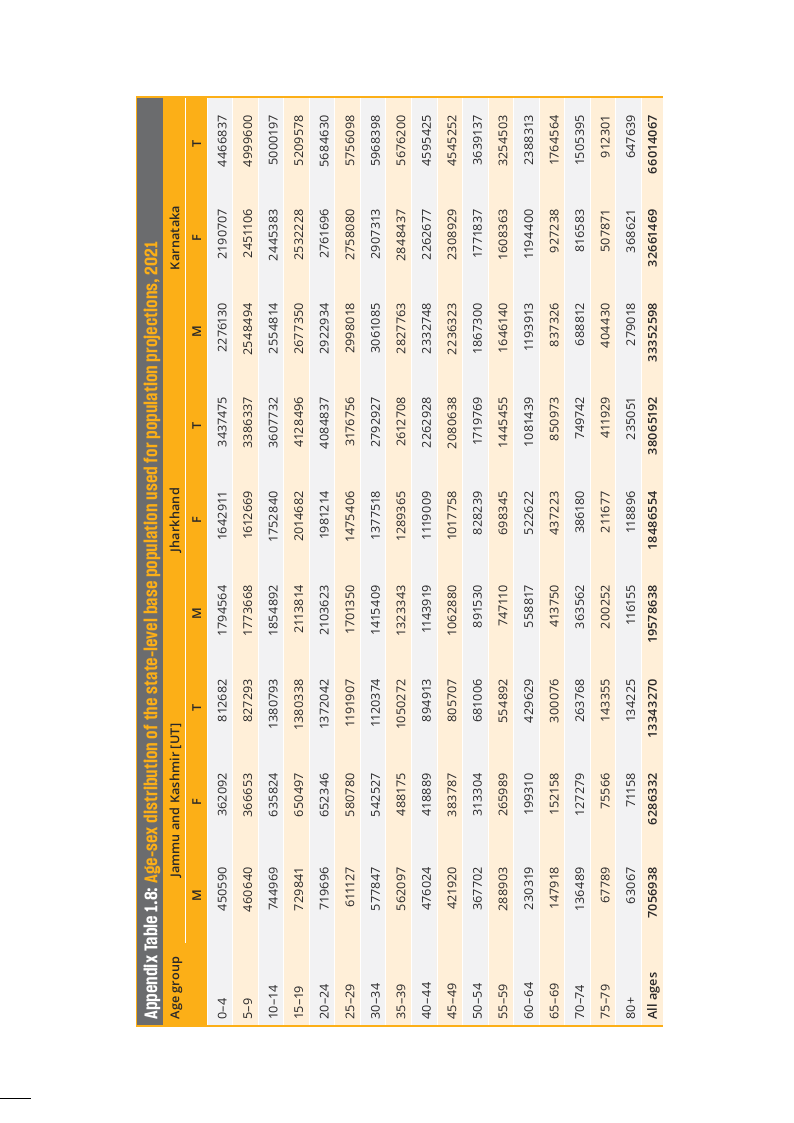
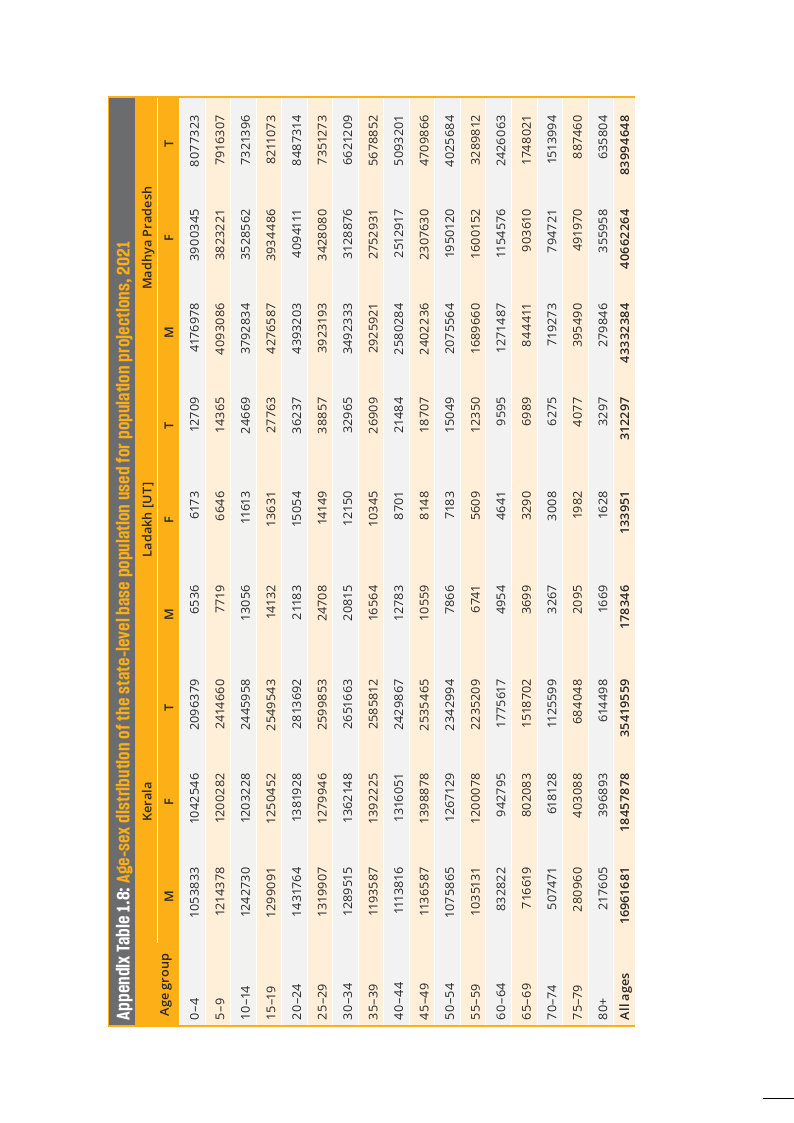
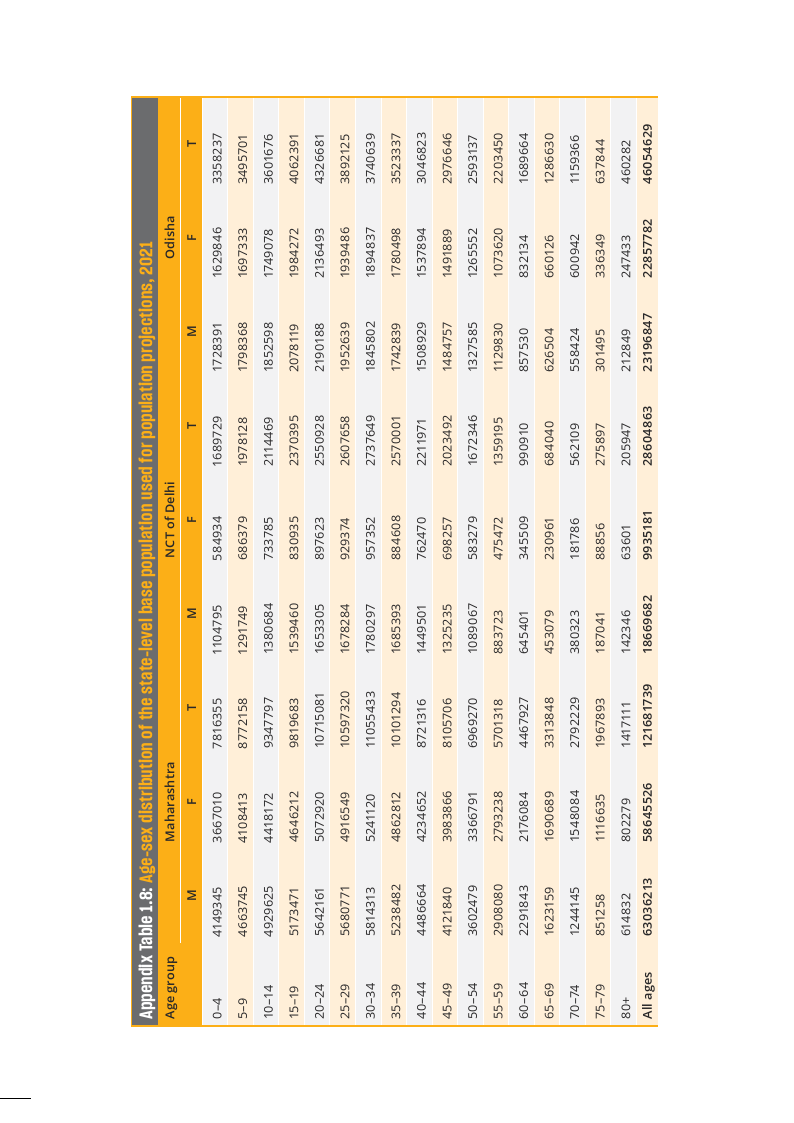
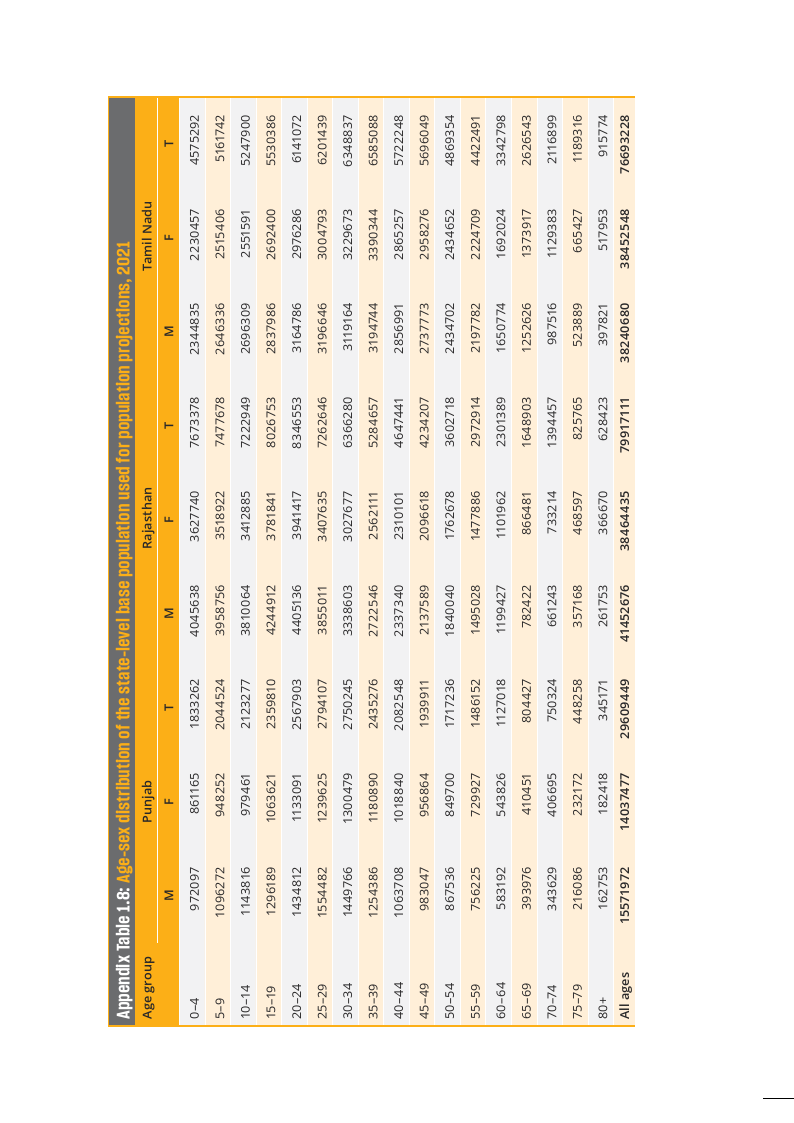
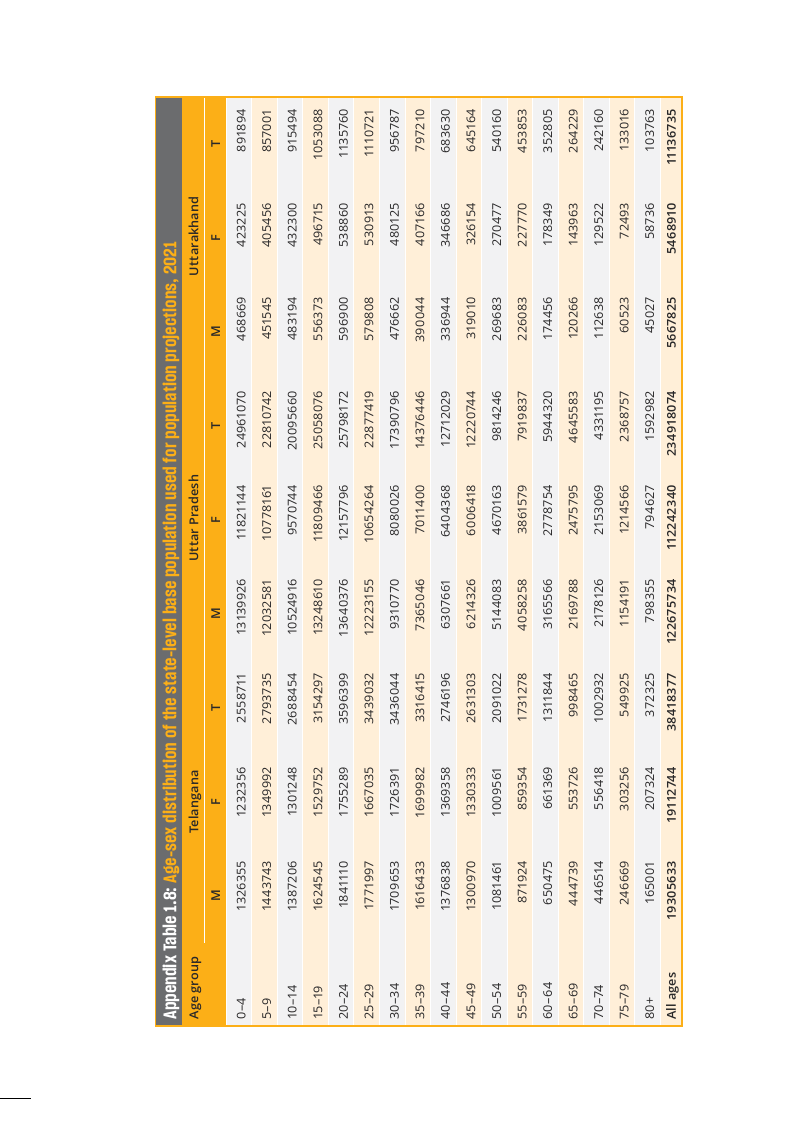
Appendix Table 1.8: Age-sex distribution of the state-level base population used
for population projections, 2021
79
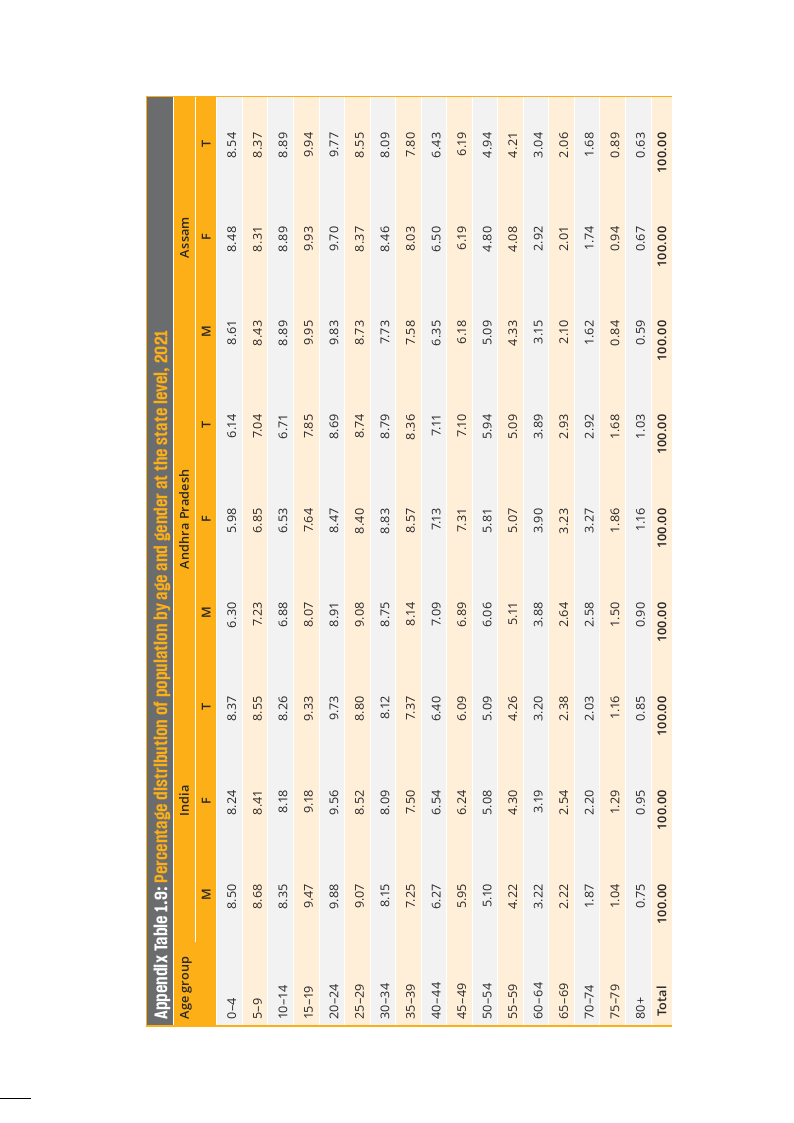
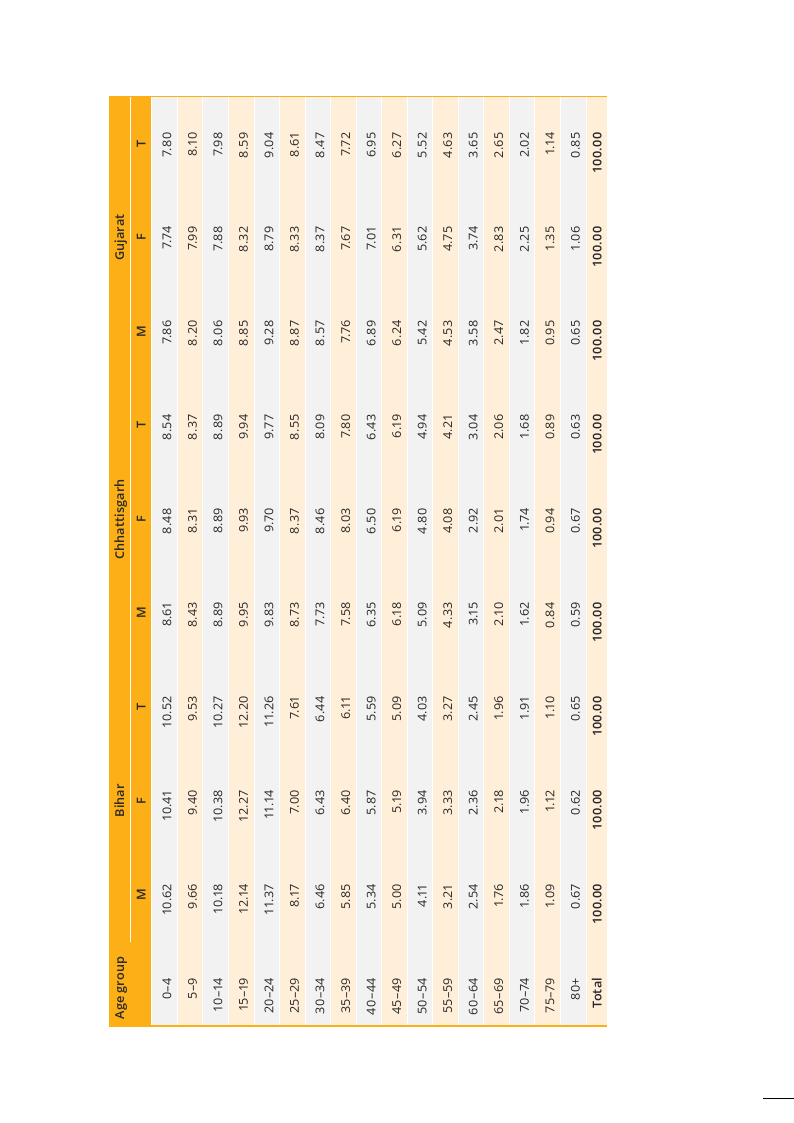
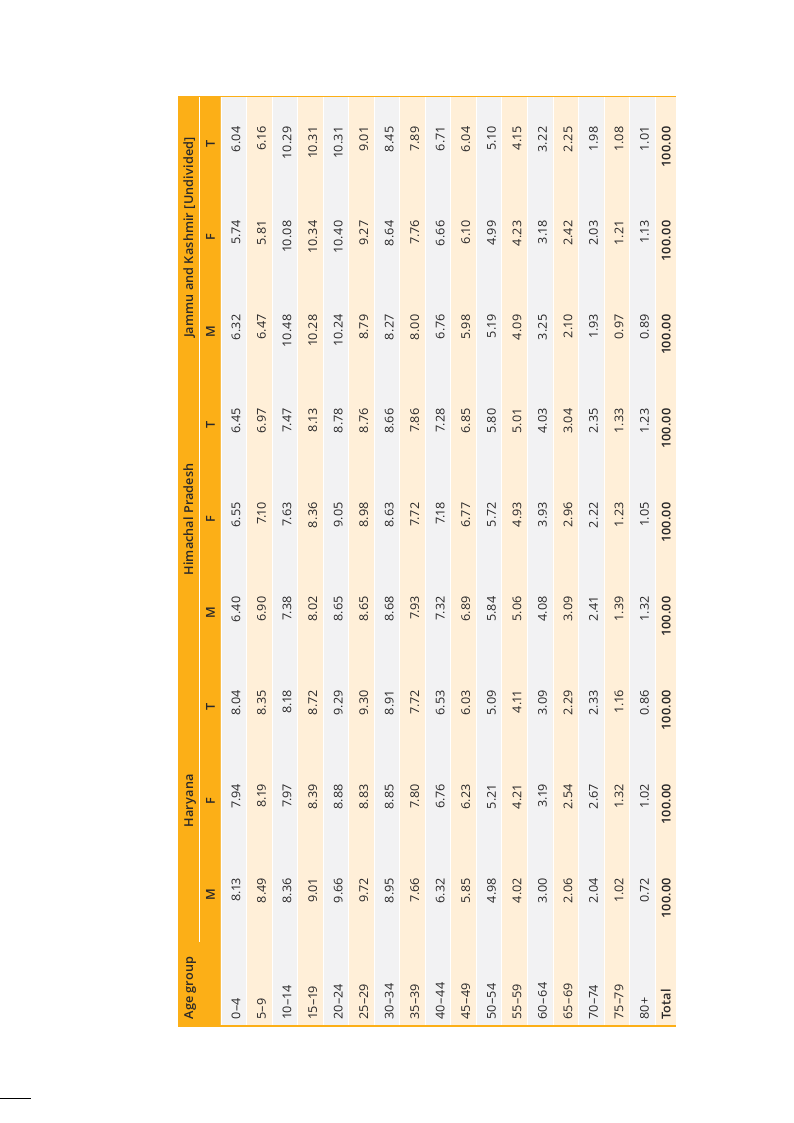
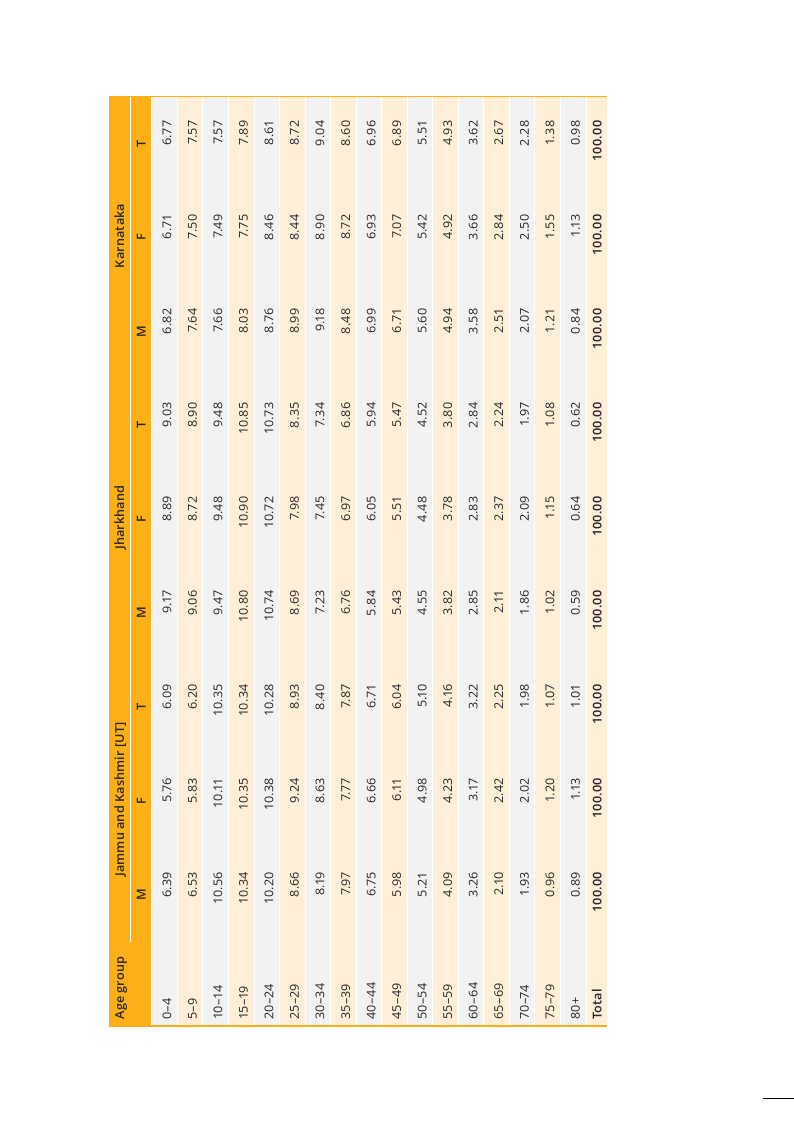
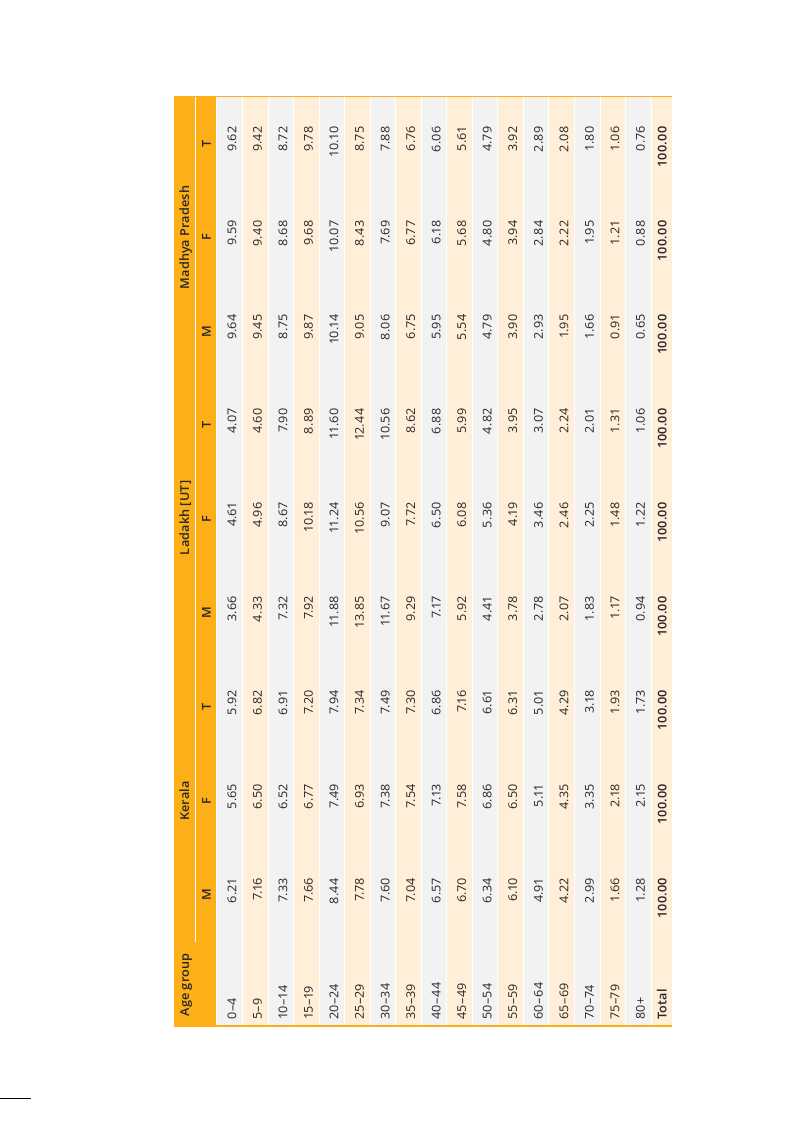
Appendix Table 1.9: Percentage distribution of population by age and gender at
the state level, 2021
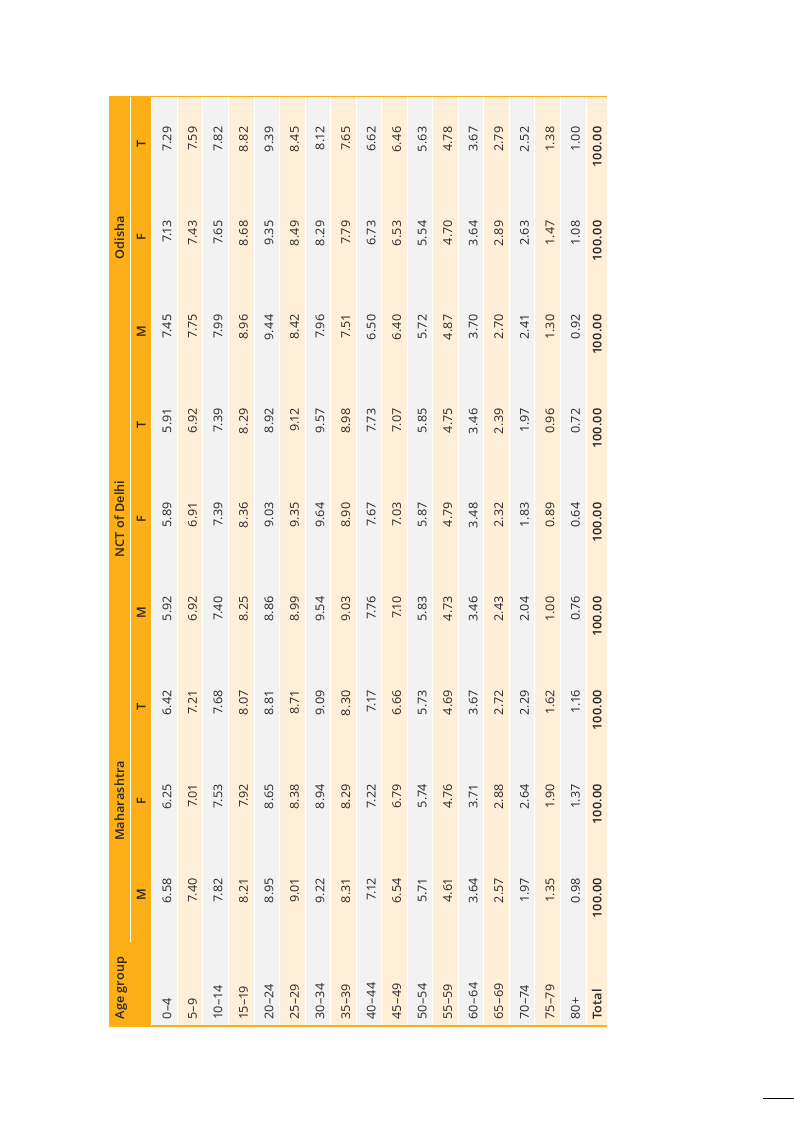
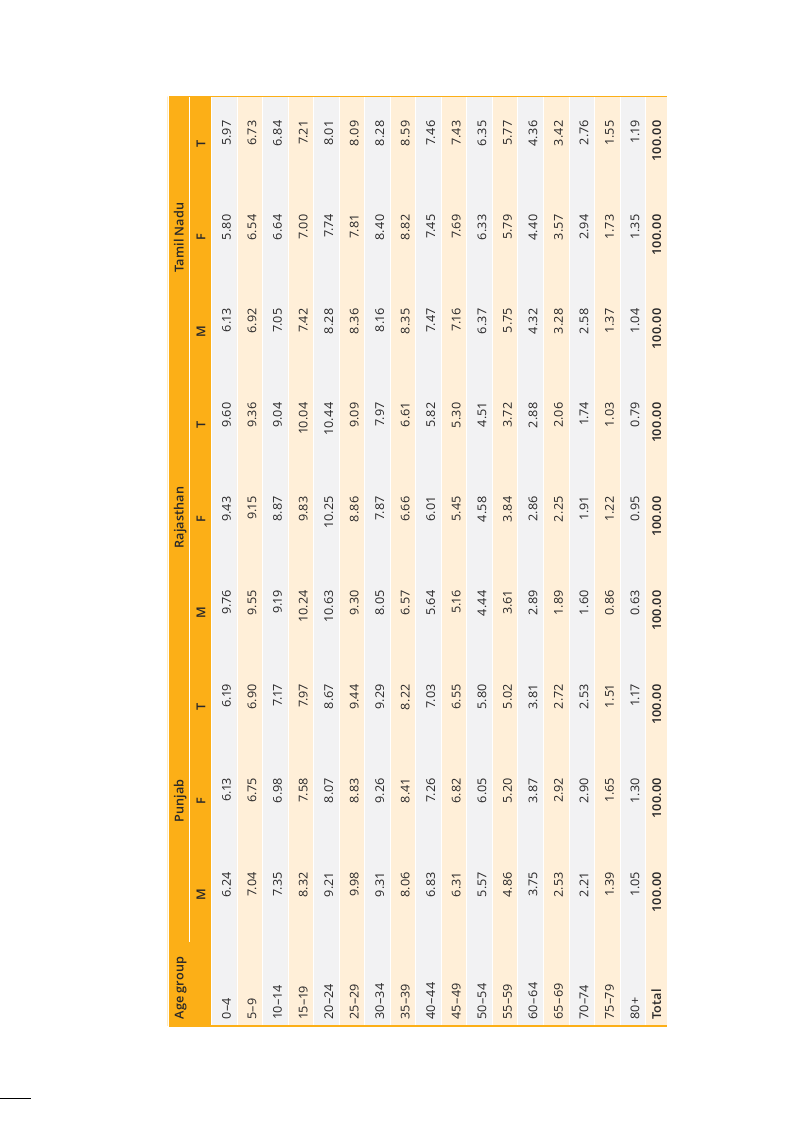
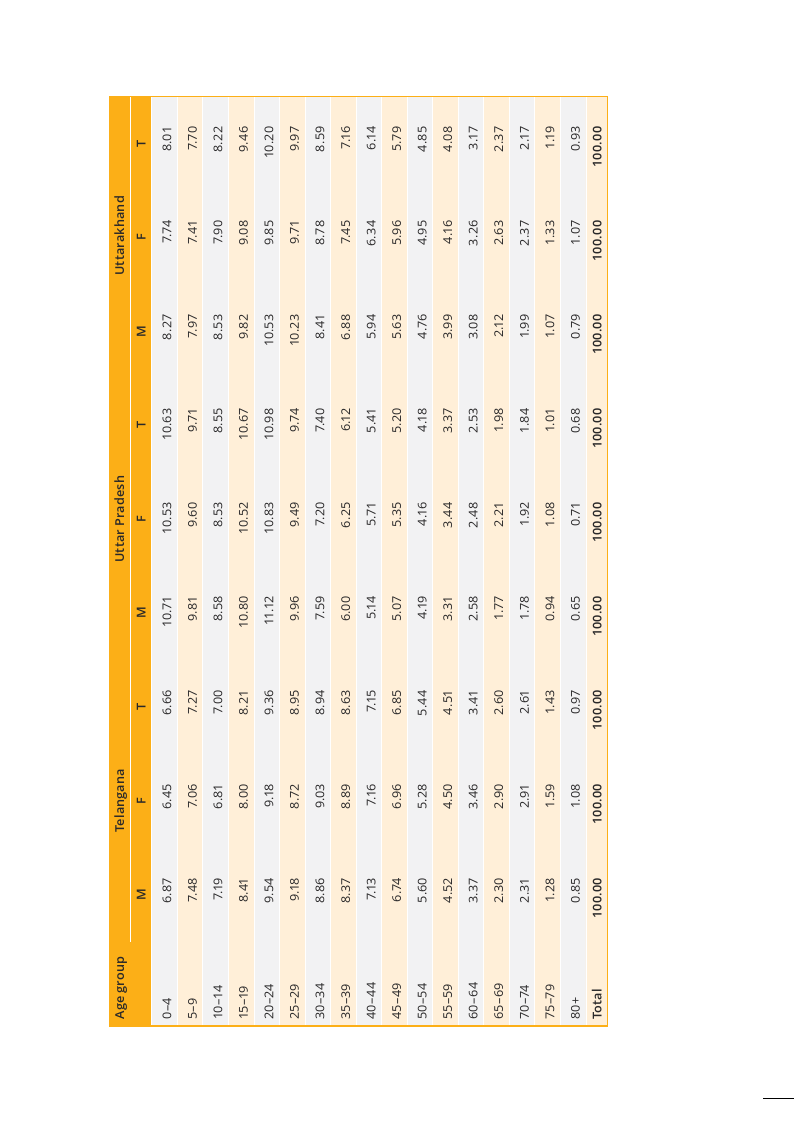
88
APPENDIX: II
Figures and Maps: Statistical Inputs for Model Estimation
97
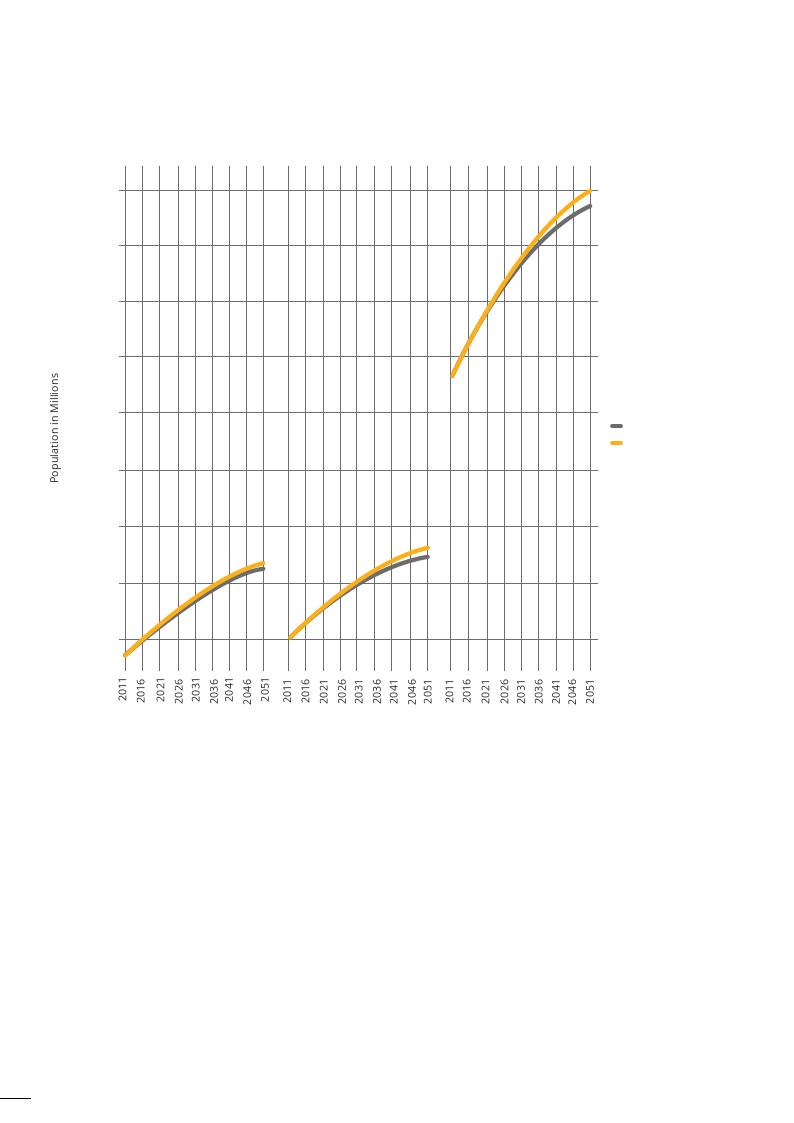
Appendix Figure 2.1: Gender-wise projected total population of India with and
without the impact of pandemic, 2011–2051 [in Million]
98
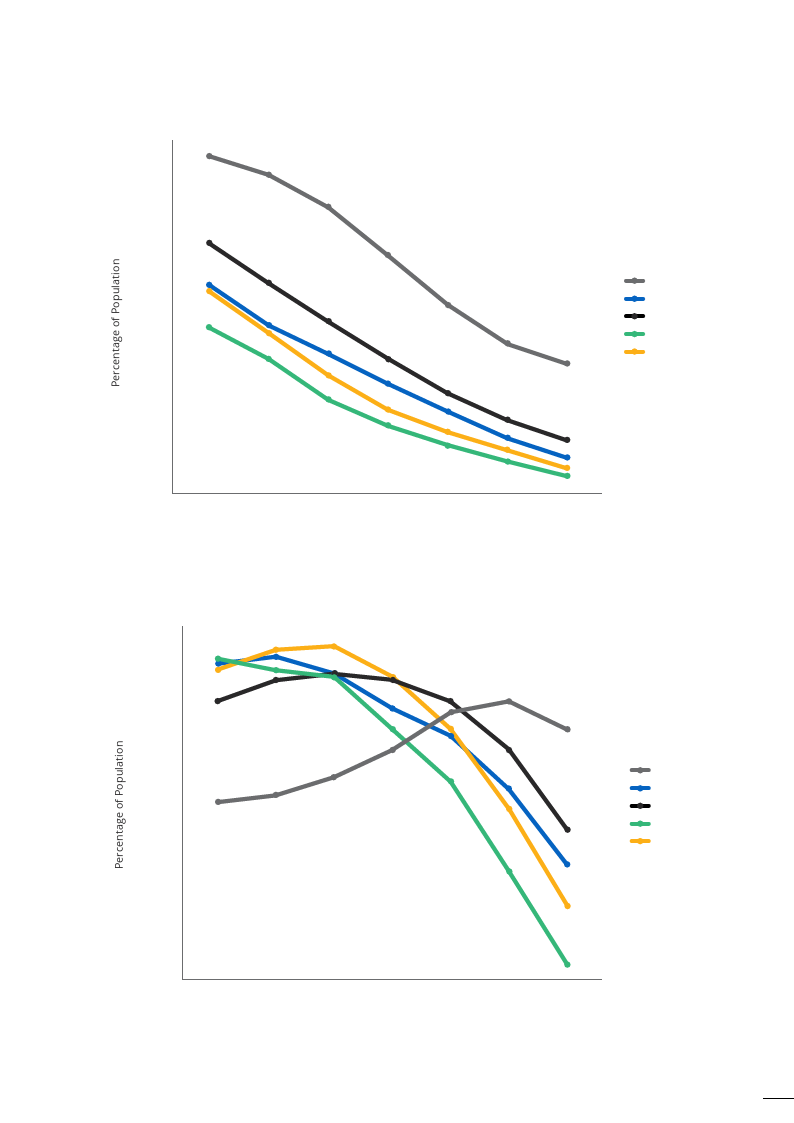
Appendix Figure 2.2: Projected proportion of child population [0–14] by region,
2021–2051
99
Appendix Figure 2.3: Projected proportion of working-age [15–59] population
99
by region, 2021–2051
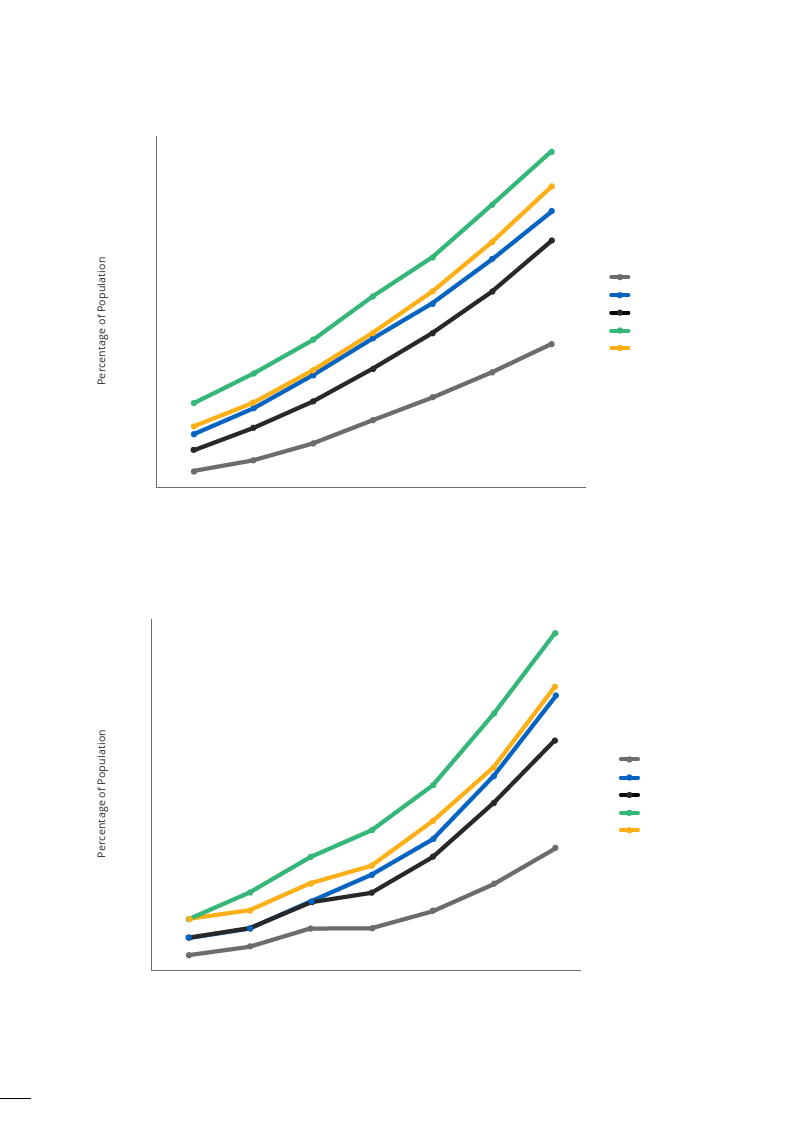
Appendix Figure 2.4: Projected proportion of elderly population [60 +] by
100
region, 2021–2051
Appendix Figure 2.5: Projected proportion of oldest old [80 +] by region,
2021–2051
100
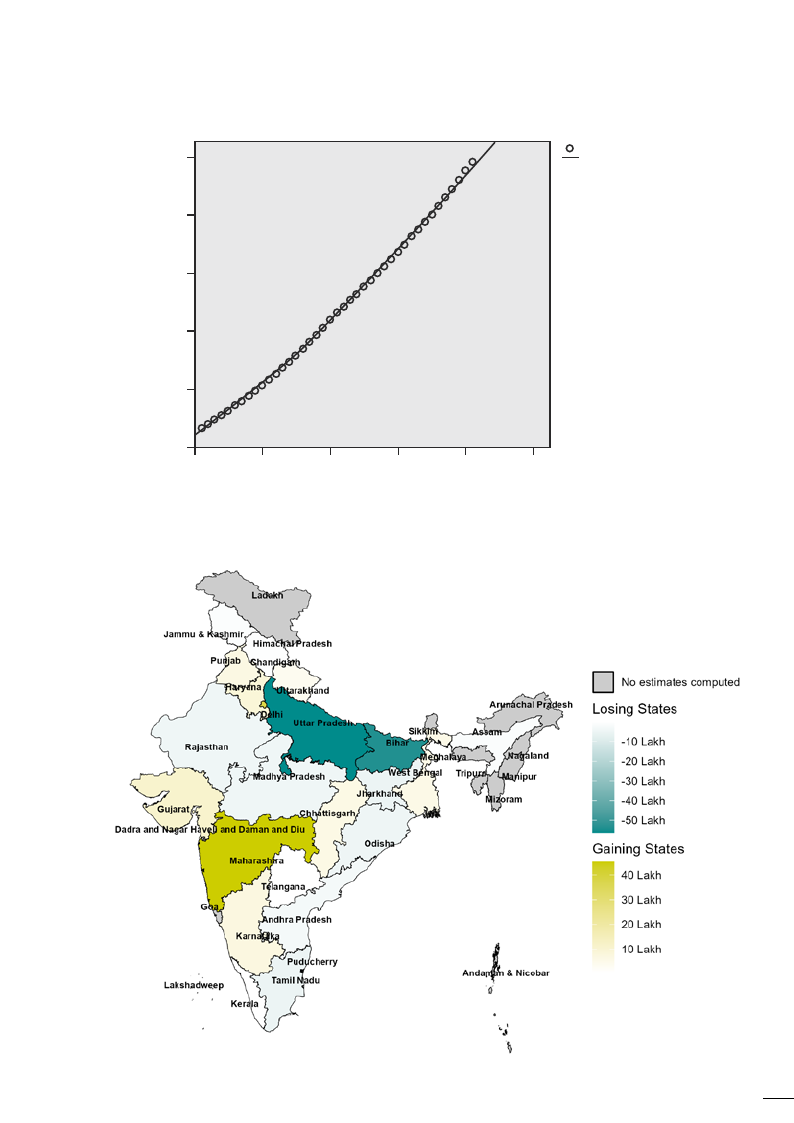
Appendix Figure 2.6: Observed and estimated population for
Arunachal Pradesh, 1971–2021
101
Section 4 Maps
Appendix Map 2.1: Net migration across states, NSSO 2007–08
101
Appendix Map 2.2: State-wise net male migrants, NSSO 2007–08
102
Appendix Map 2.3: State-wise net female migrants, NSSO 2007–08
102
Appendix Map 2.4: Net migration across states, Census 2011
103
Appendix Map 2.5: State-wise net male migrants, Census 2011
103
Appendix Map 2.6: State-wise net female migrants, Census 2011
104
Appendix Map 2.7: Net migration across states, MIS 2020–21
104
Appendix Map 2.8: State-wise net male migrants, MIS 2020–21
105
Appendix Map 2.9: State-wise net female migrants, MIS 2020–21
105
Appendix Map 2.10: Net migration across states, PLFS 2021–22
106
Appendix Map 2.11: State-wise net male migrants, PLFS 2021–22
106
Appendix Map 2.12: State-wise net female migrants, PLFS 2021–22
107
POPULATION FOUNDATION OF INDIA xvii

2.8 Page 18

▲back to top


APPENDIX: III
Section 5 Tables of major Output Indicators from the Population Projections
109
Appendix Table 3.1: Projections of Total Fertility Rates across Indian States,
2026–2051
110
Appendix Table 3.2: Projected percentage of fertility levels for India under
alternative variants, 2011–2051
112
Appendix Table 3.3: Projected life expectancy at the national and state levels in
India by gender, 2026–2051 [in years]
113
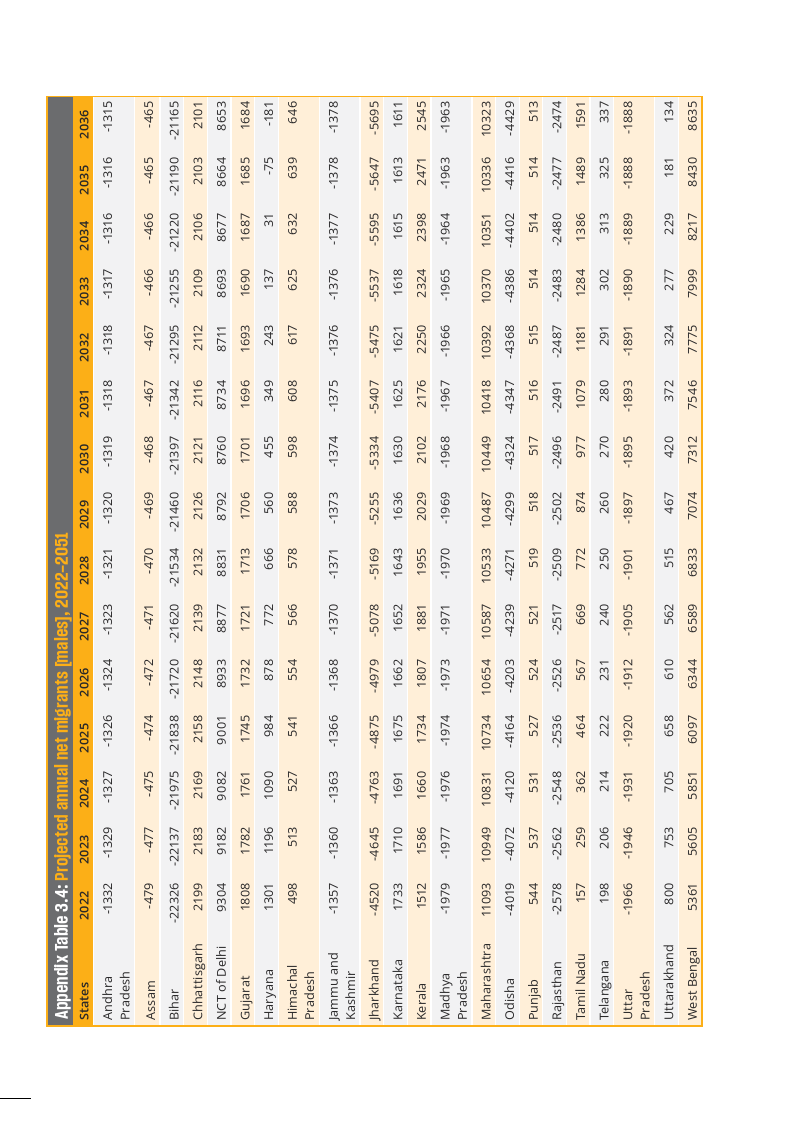
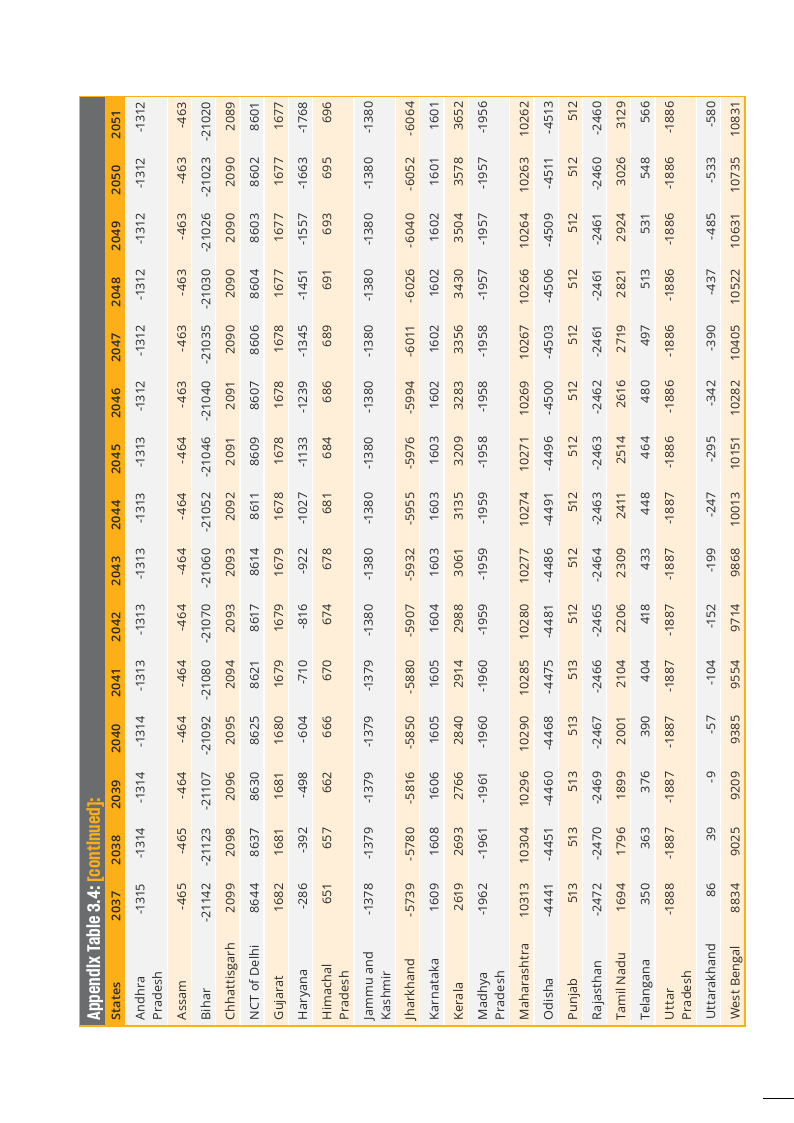
Appendix Table 3.4: Projected annual net migrants [males], 2022–2051
114
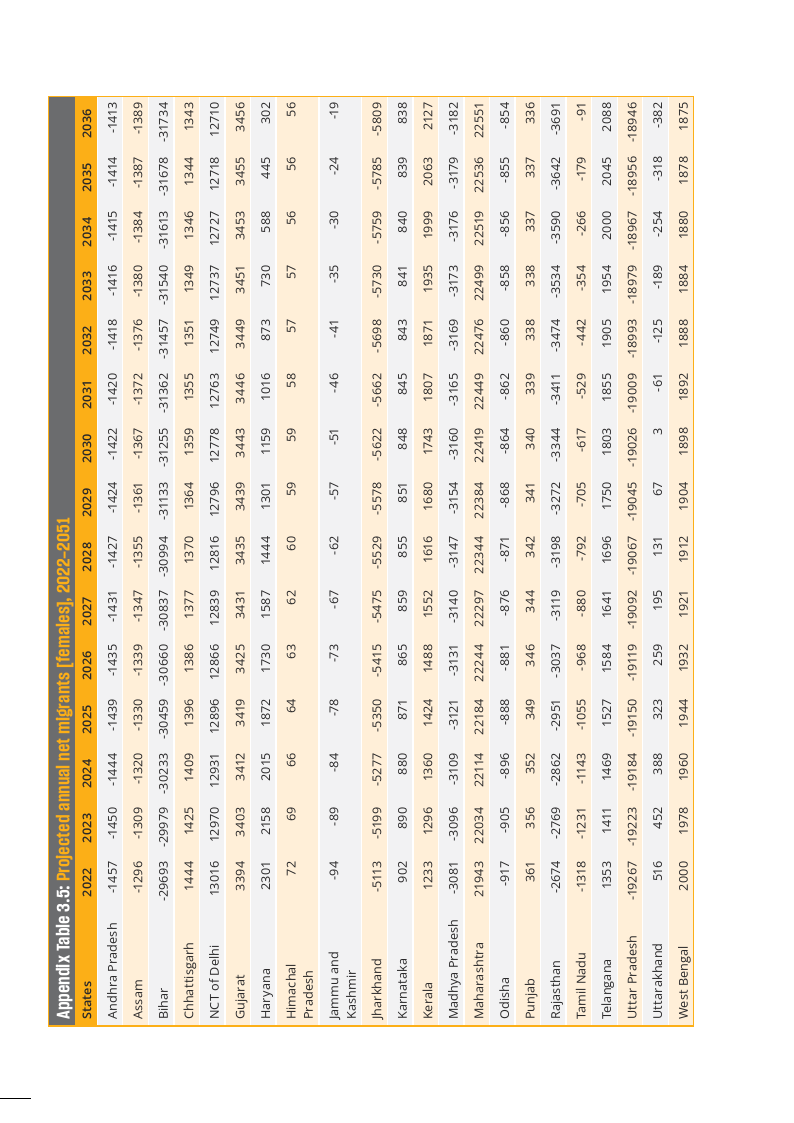
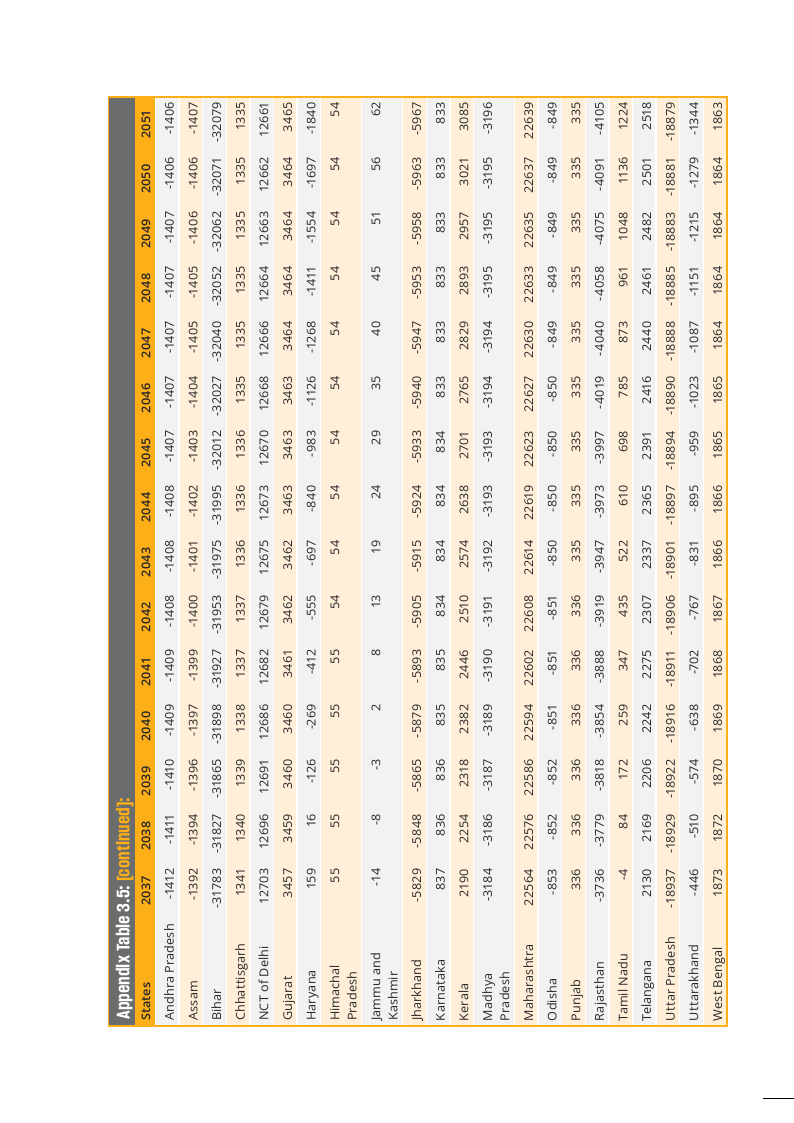
Appendix Table 3.5: Projected annual net migrants [females], 2022–2051
116
Appendix Table 3.6: Projected sex ratio at birth, 2016–2051
118
Appendix Table 3.7: Summary of projected demographic indicators for India,
[low-variant], 2026–2051
119
Appendix Table 3.8: Summary of projected demographic indicators for India,
[high-variant], 2026–2051
120
Appendix Table 3.9: State-wise projected population by gender [low-variant],
2026–2051 [in million]
121
Appendix Table 3.10: State-wise projected population by gender [medium-
variant], 2021–2051 [in million]
123
Appendix Table 3.11: State-wise projected population by gender [high-variant],
2021–2051 [in million]
125
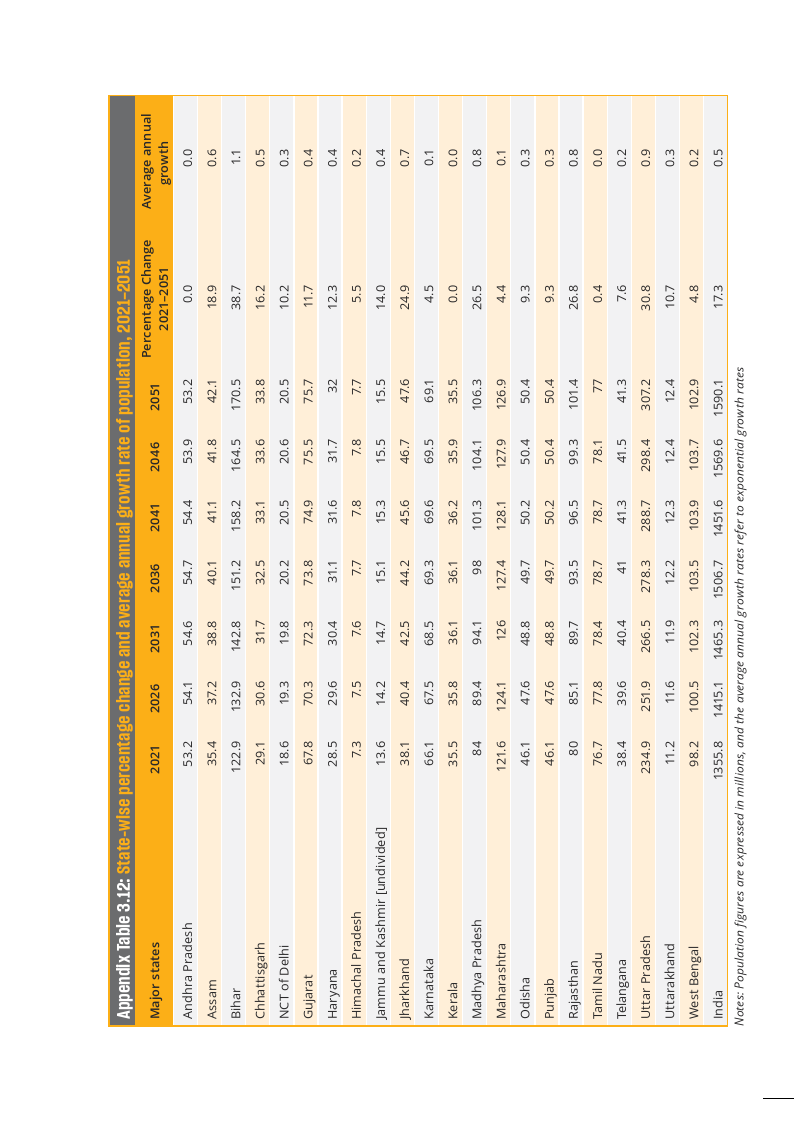
Appendix Table 3.12: State-wise percentage change and average annual growth
rate of population, 2021–2051
127
APPENDIX: IV
State-wise Detailed Report–Medium-variant Assumptions
129
Appendix Table 4.1: Projected summary of demographic indicators for
Andhra Pradesh, 2026–2051
130
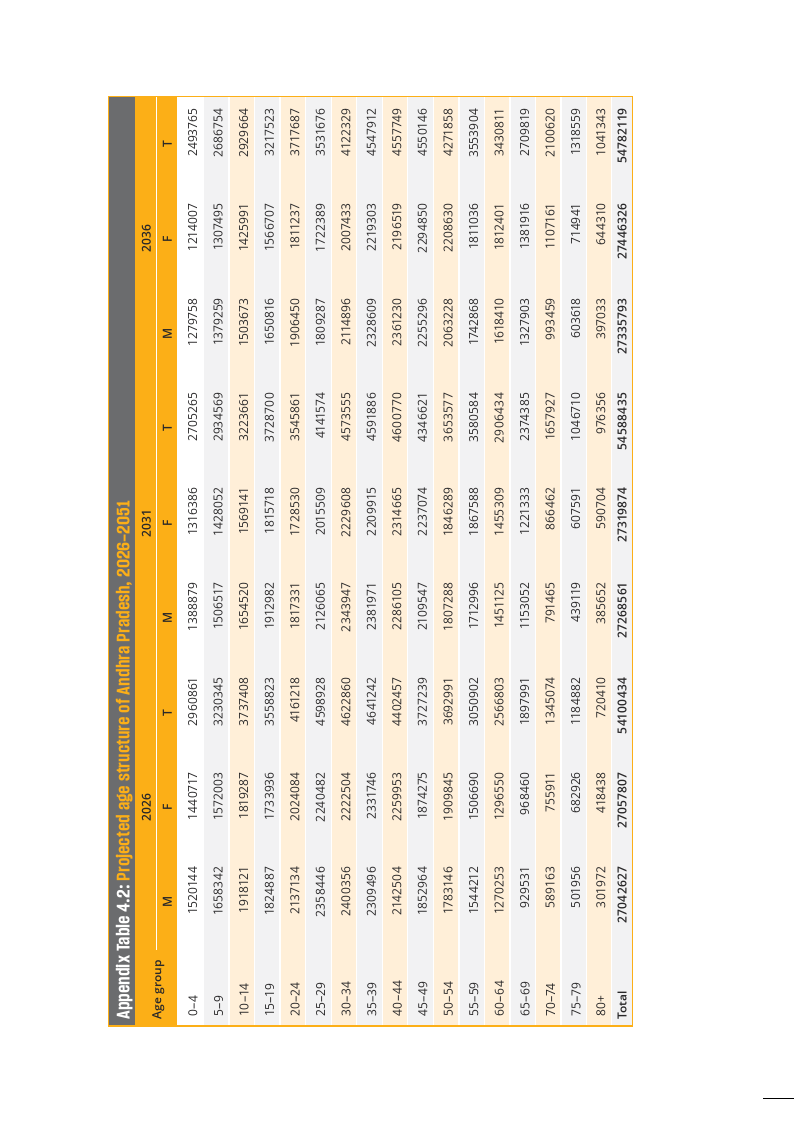
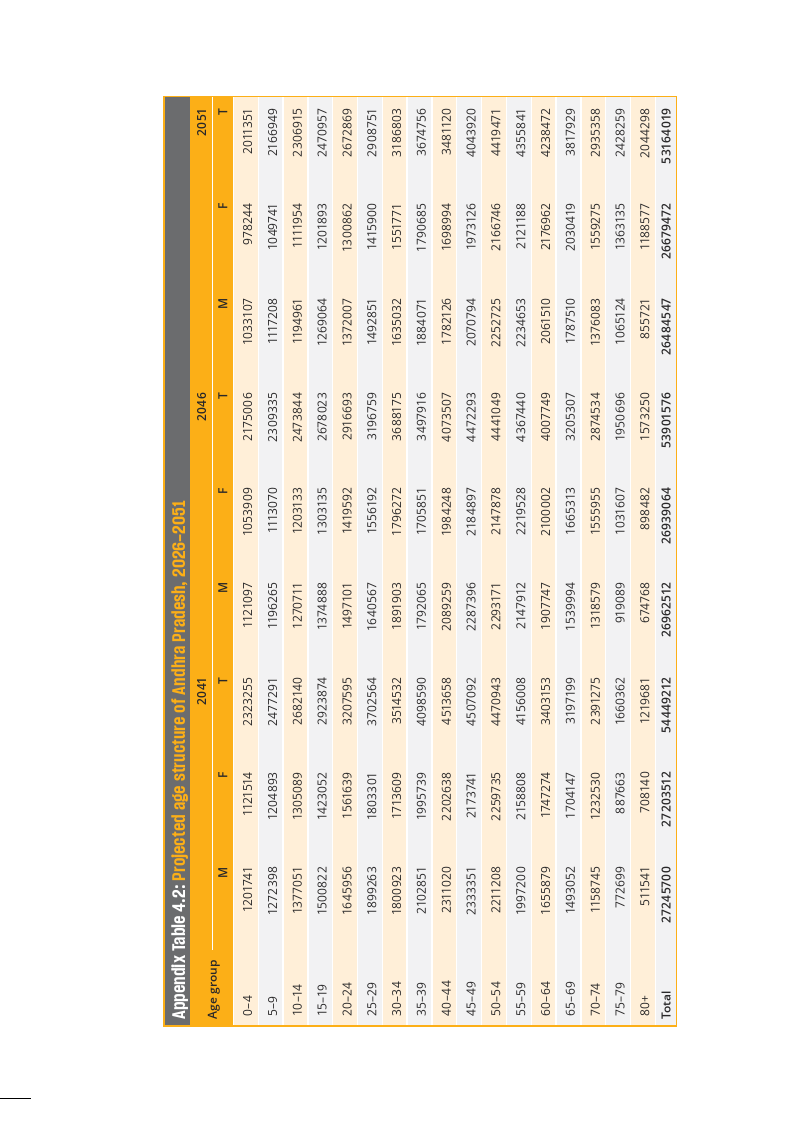
Appendix Table 4.2: Projected age structure of Andhra Pradesh, 2026–2051
131
Appendix Table 4.3: Projected percentage distribution of population by age and
gender for Andhra Pradesh, 2026–2051
133
Appendix Table 4.4: Projected summary of demographic indicators for Assam,
2026–2051
134
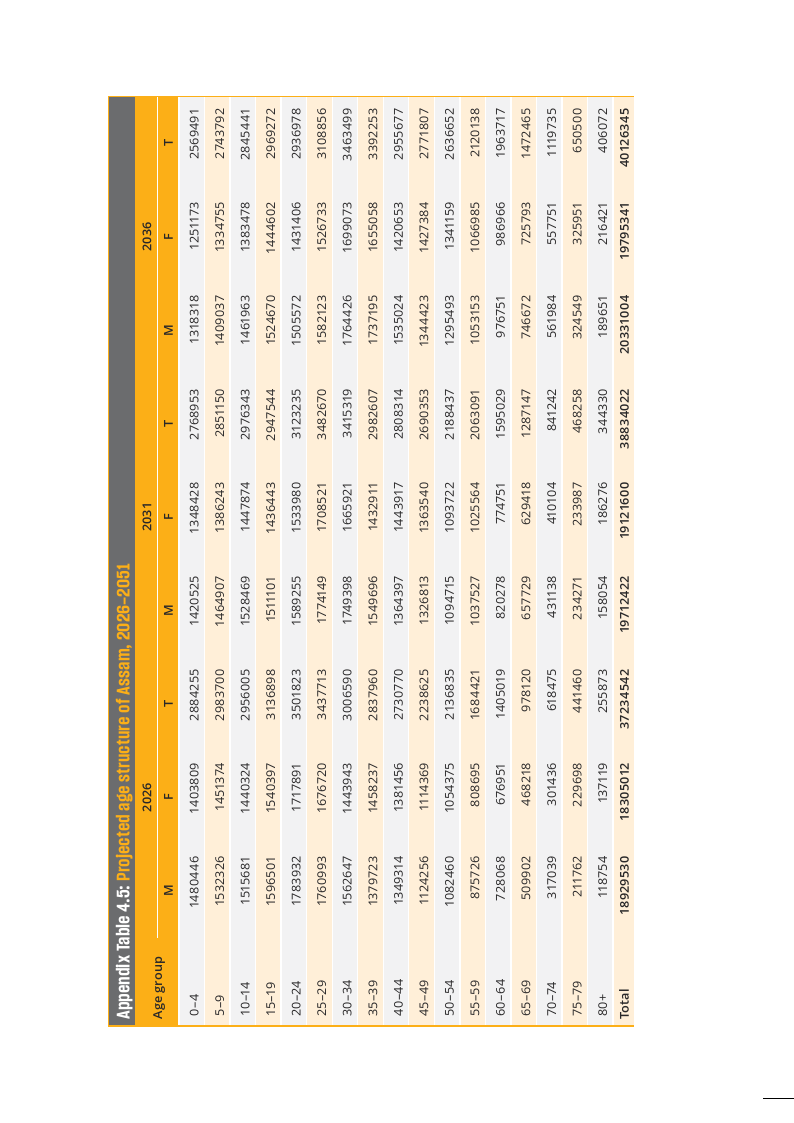
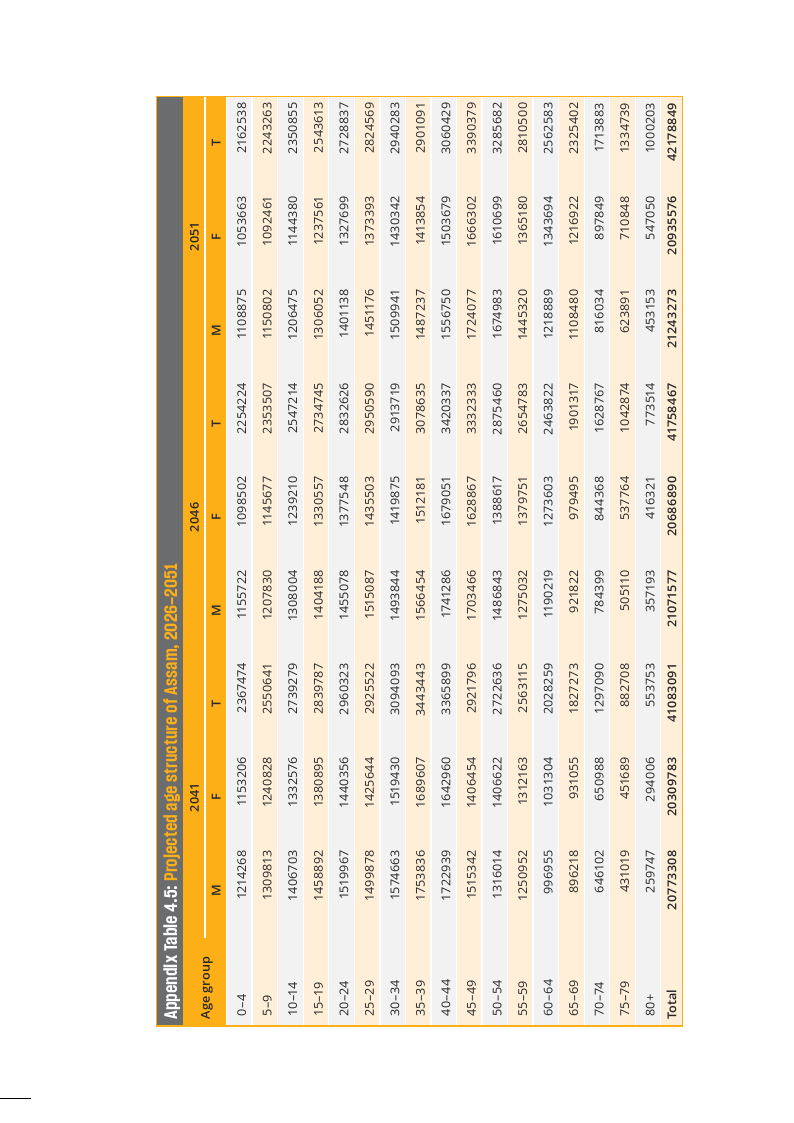
Appendix Table 4.5: Projected age structure of Assam,
2026–2051
135
Section 6 Appendix Table 4.6: Projected percentage distribution of population by age and
gender for Assam, 2026–2051
137
Appendix Table 4.7: Projected summary of demographic indicators for Bihar,
2026–2051
138
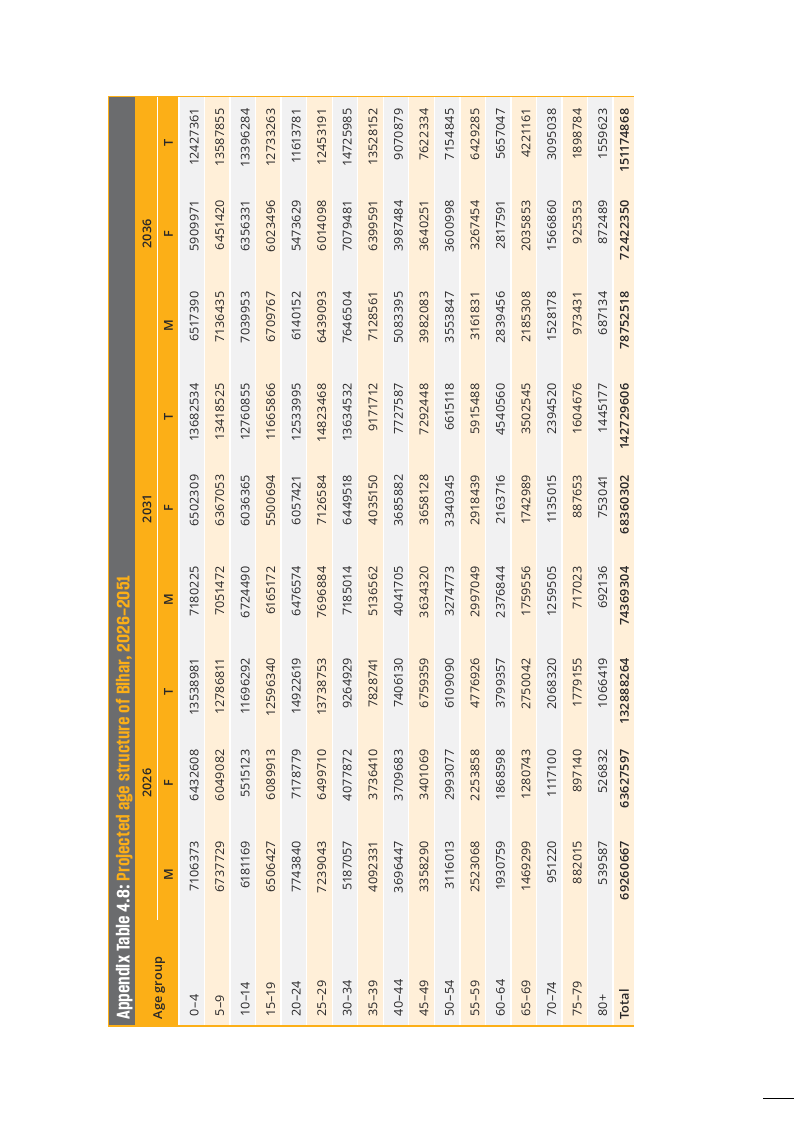
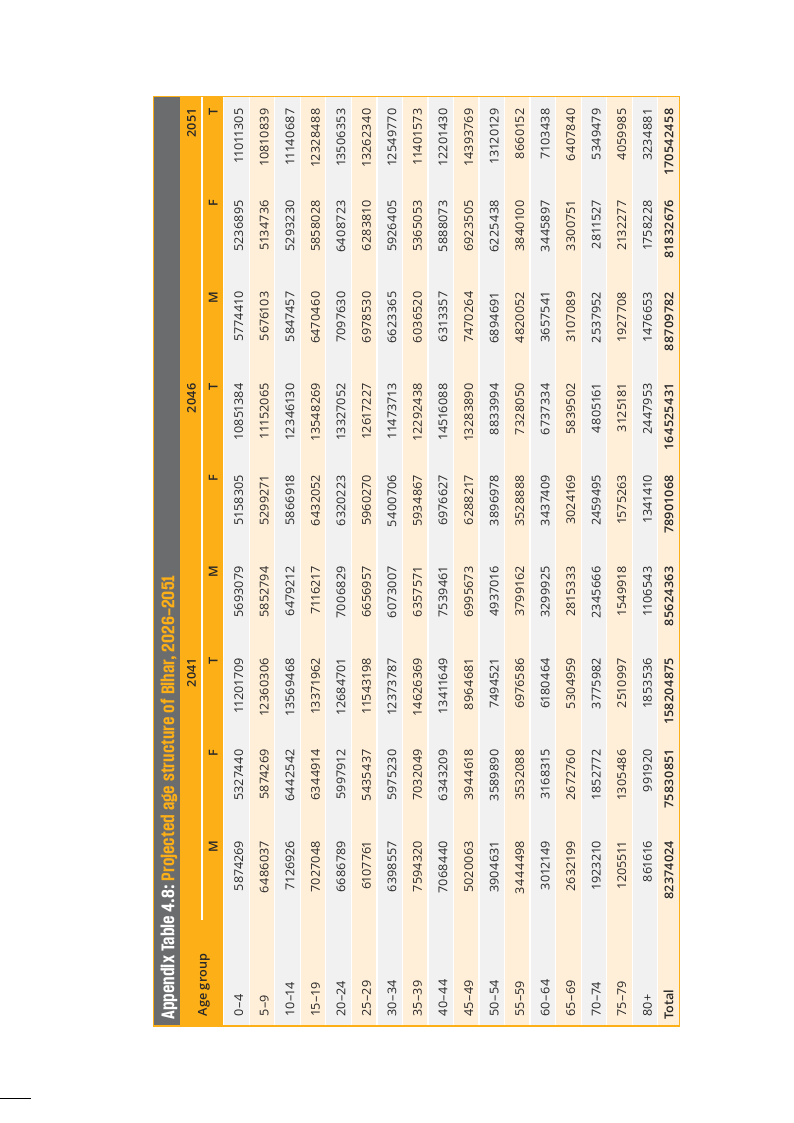
Appendix Table 4.8: Projected age structure of Bihar, 2026–2051
139
Appendix Table 4.9: Projected percentage distribution of population by age and
gender for Bihar, 2026–2051
141
Appendix Table 4.10: Projected summary of demographic indicators for
Chhattisgarh, 2026–2051
142
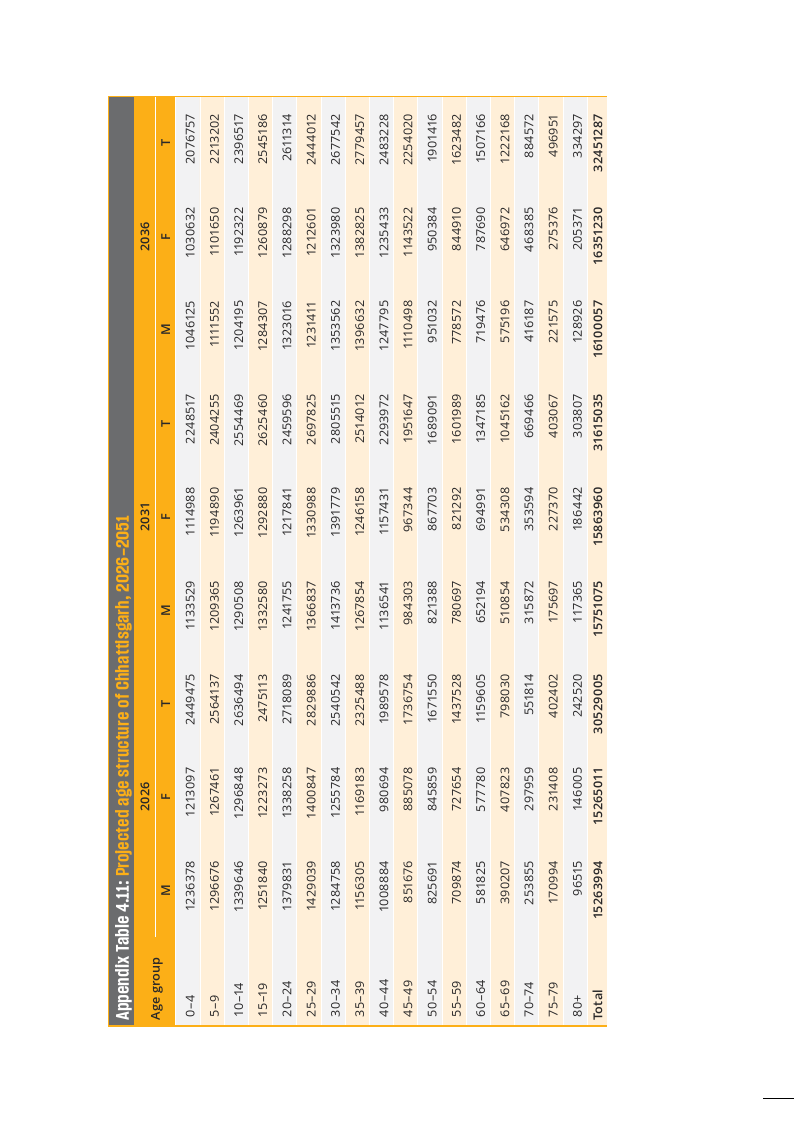
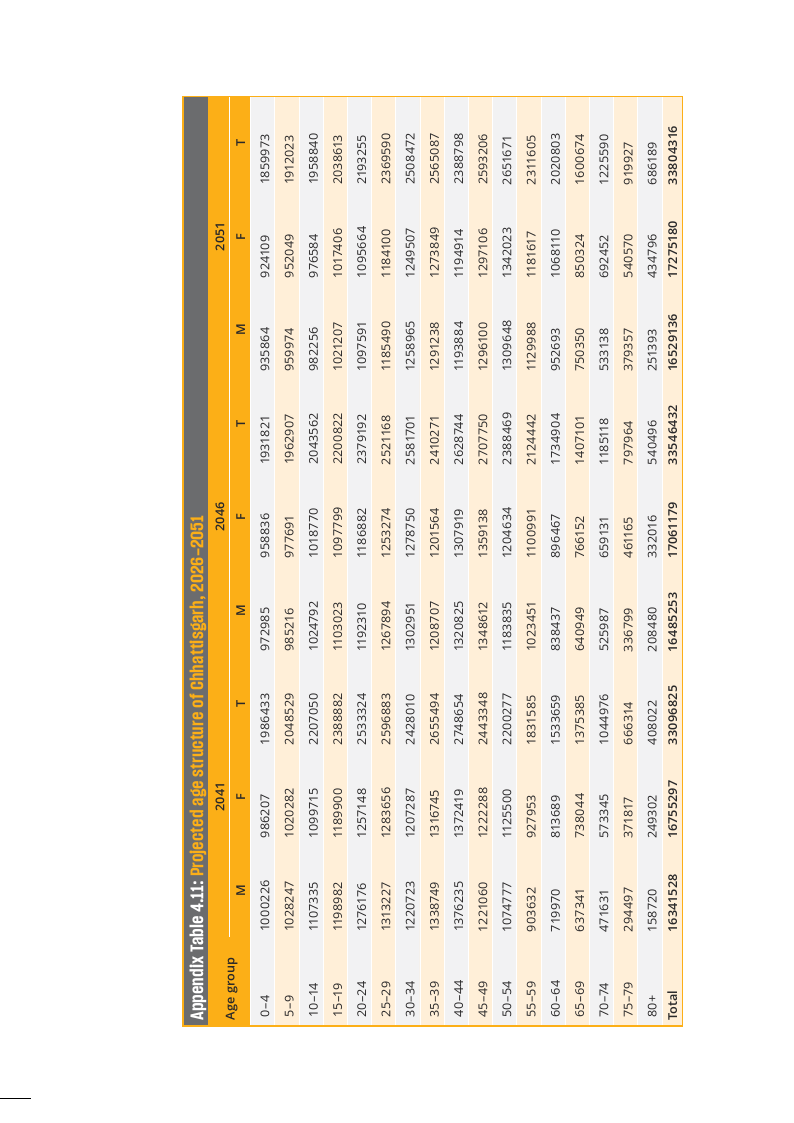
Appendix Table 4.11: Projected age structure of Chhattisgarh, 2026–2051
143
Appendix Table 4.12: Projected percentage distribution of population by age
and gender for Chhattisgarh, 2026–2051
145
xviii POPULATION FOUNDATION OF INDIA

2.9 Page 19

▲back to top


Appendix Table 4.13: Projected summary of demographic indicators for NCT of
Delhi, 2026–2051
146
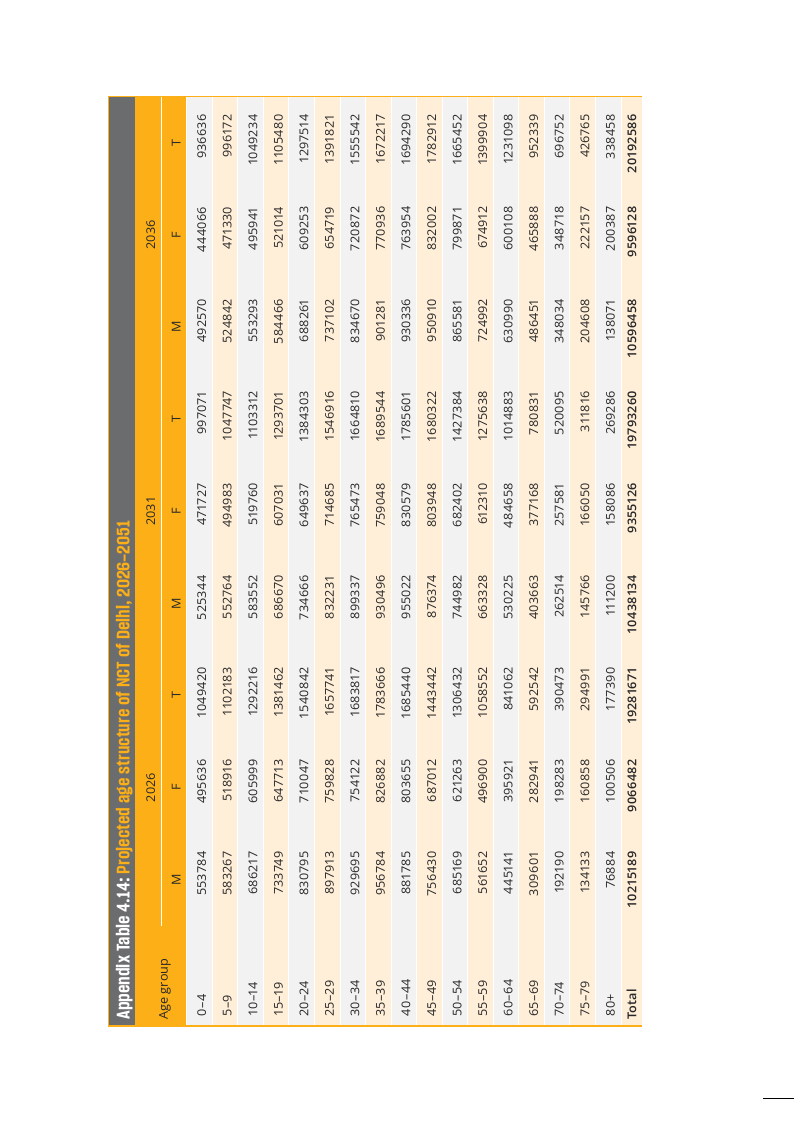
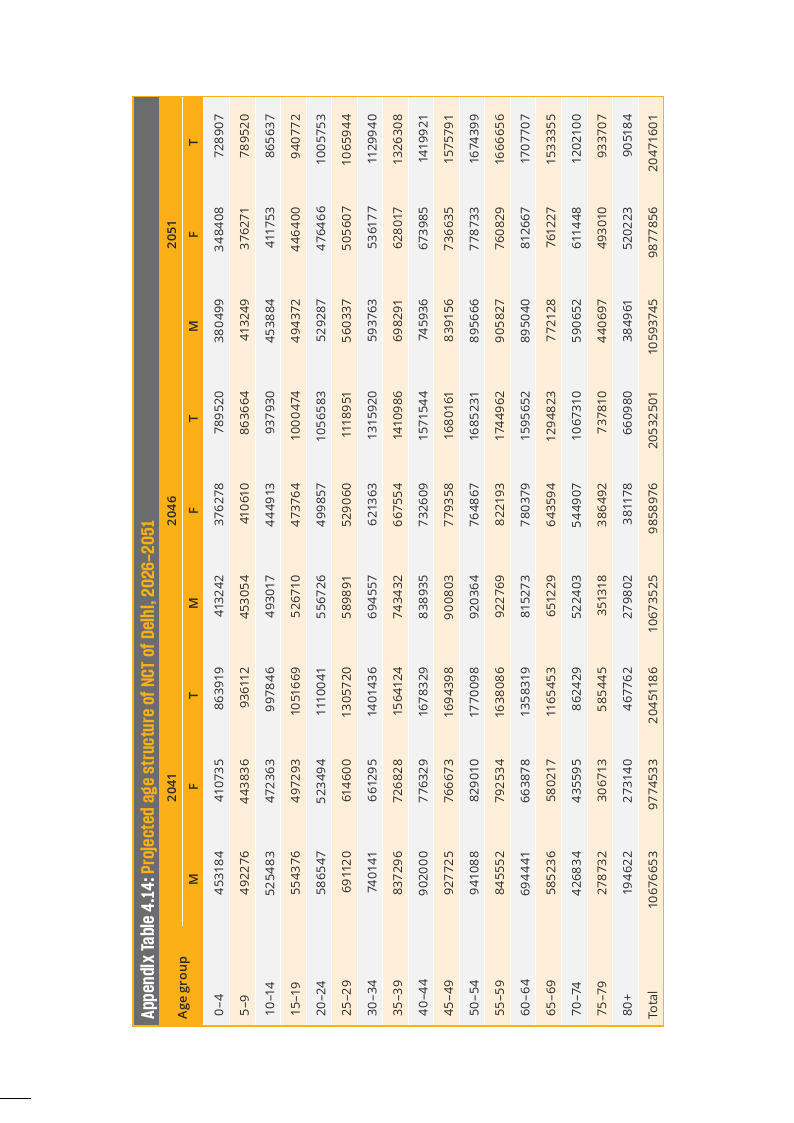
Appendix Table 4.14: Projected age structure of NCT of Delhi, 2026–2051
147
Appendix Table 4.15: Projected percentage distribution of population by age
and gender for NCT of Delhi, 2026–2051
149
Appendix Table 4.16: Projected Summary of demographic indicators for Gujarat,
2026–2051
150
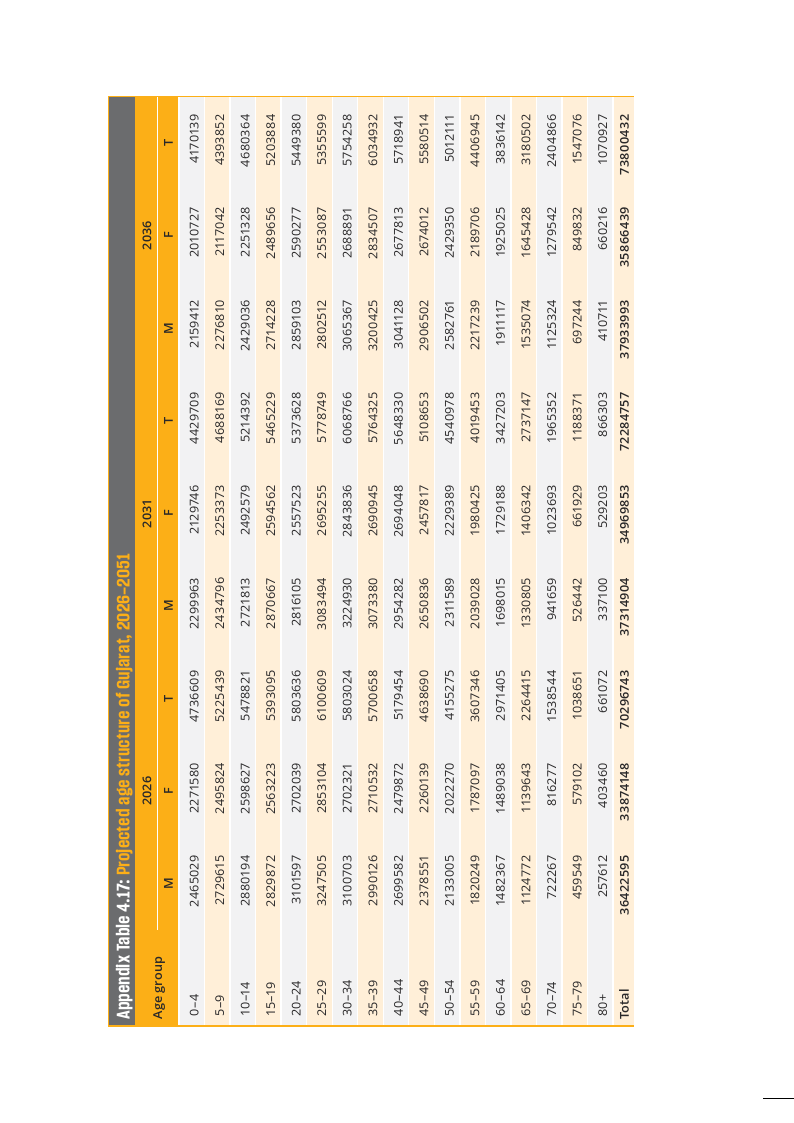
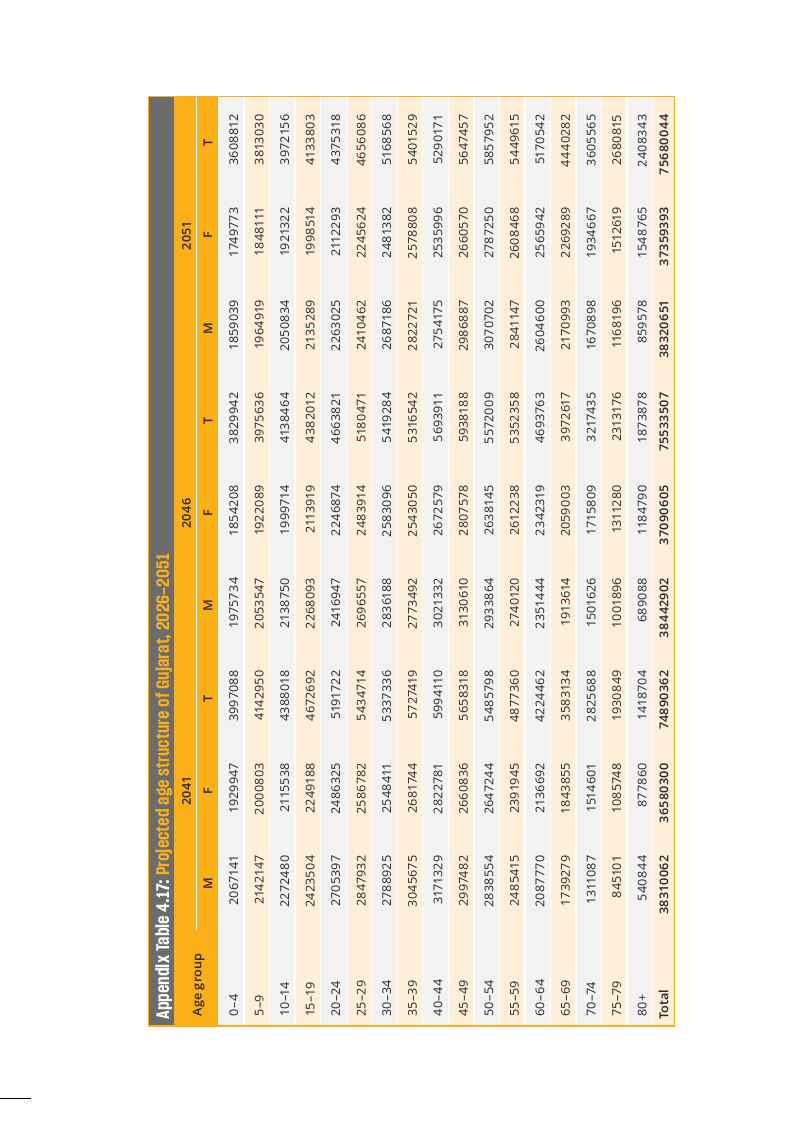
Appendix Table 4.17: Projected age structure of Gujarat,
2026–2051
151
Appendix Table 4.18: Projected percentage distribution of population by age
and gender for Gujarat, 2026–2051
153
Appendix Table 4.19: Projected summary of demographic indicators for
Haryana, 2026–2051
154
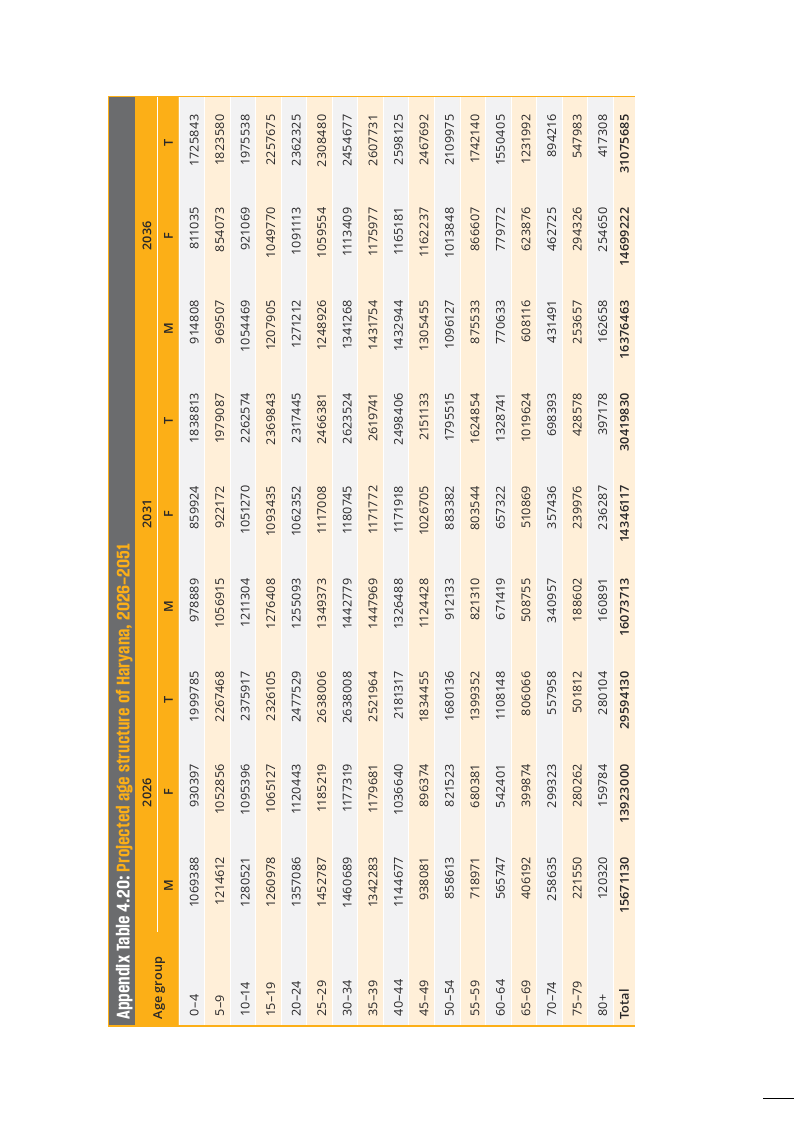
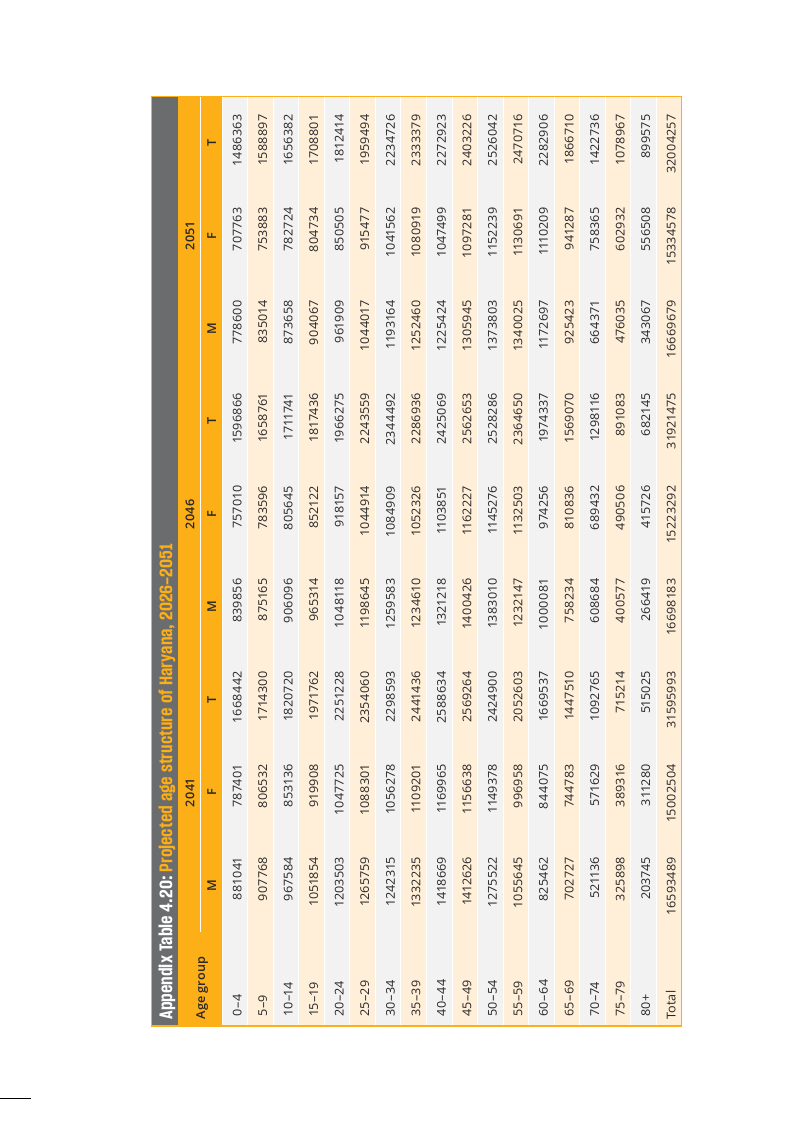
Appendix Table 4.20: Projected age structure of Haryana, 2026–2051
155
Appendix Table 4.21: Projected percentage distribution of population by age
and gender for Haryana, 2026–2051
157
Appendix Table 4.22: Projected summary of demographic indicators for
Himachal Pradesh, 2026–2051
158
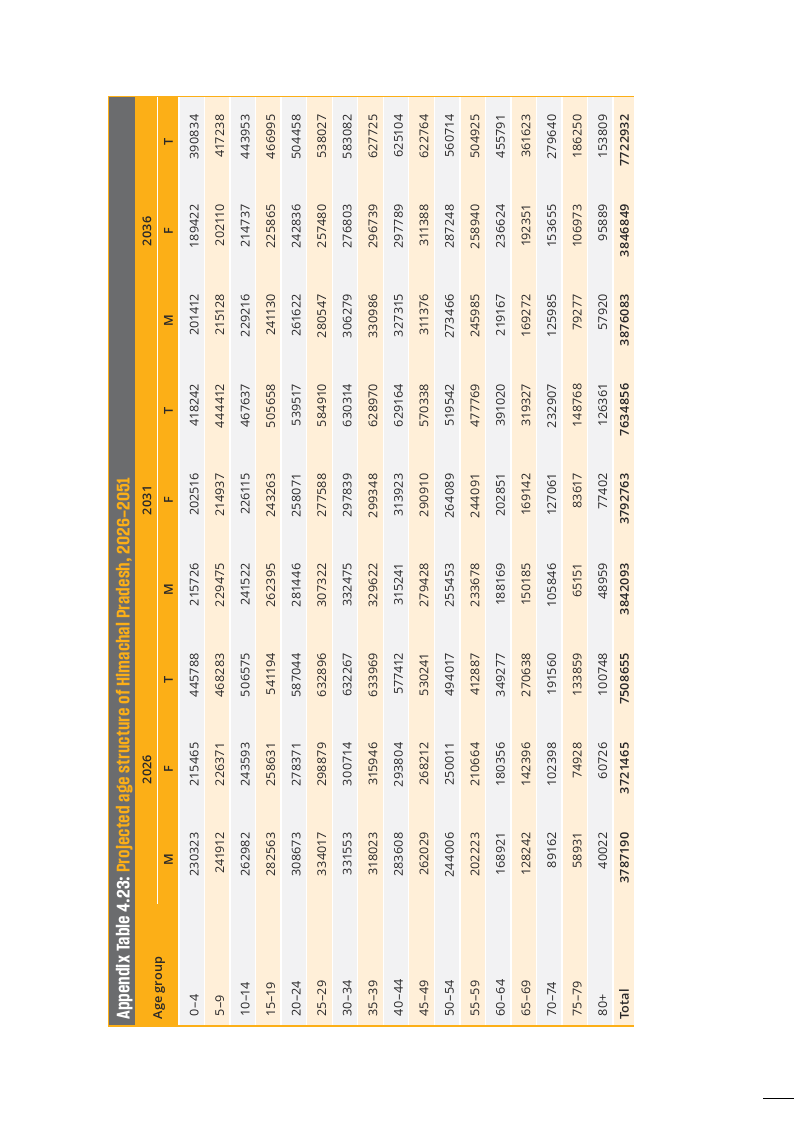
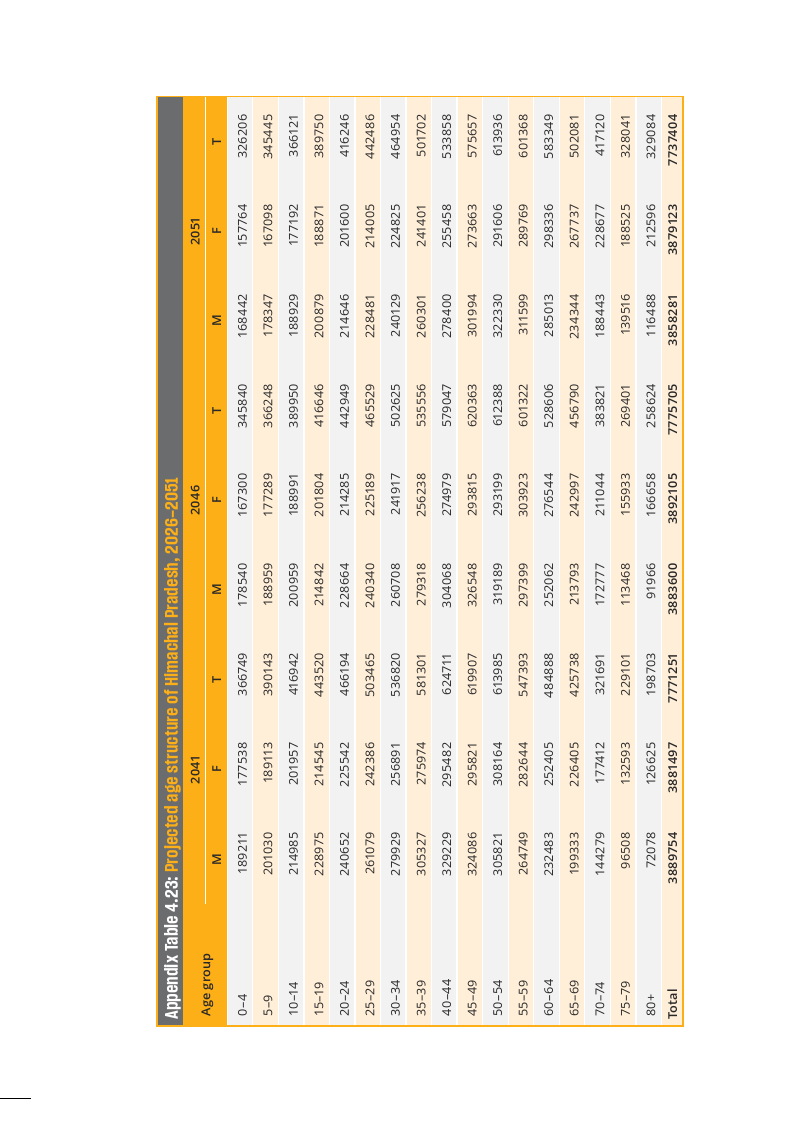
Appendix Table 4.23: Projected age structure of Himachal Pradesh, 2026–2051 159
Appendix Table 4.24: Projected percentage distribution of population by age and
gender for Himachal Pradesh, 2026–2051
161
Appendix Table 4.25 for Jammu and Kashmir, [Undivided], 2026–2051
162
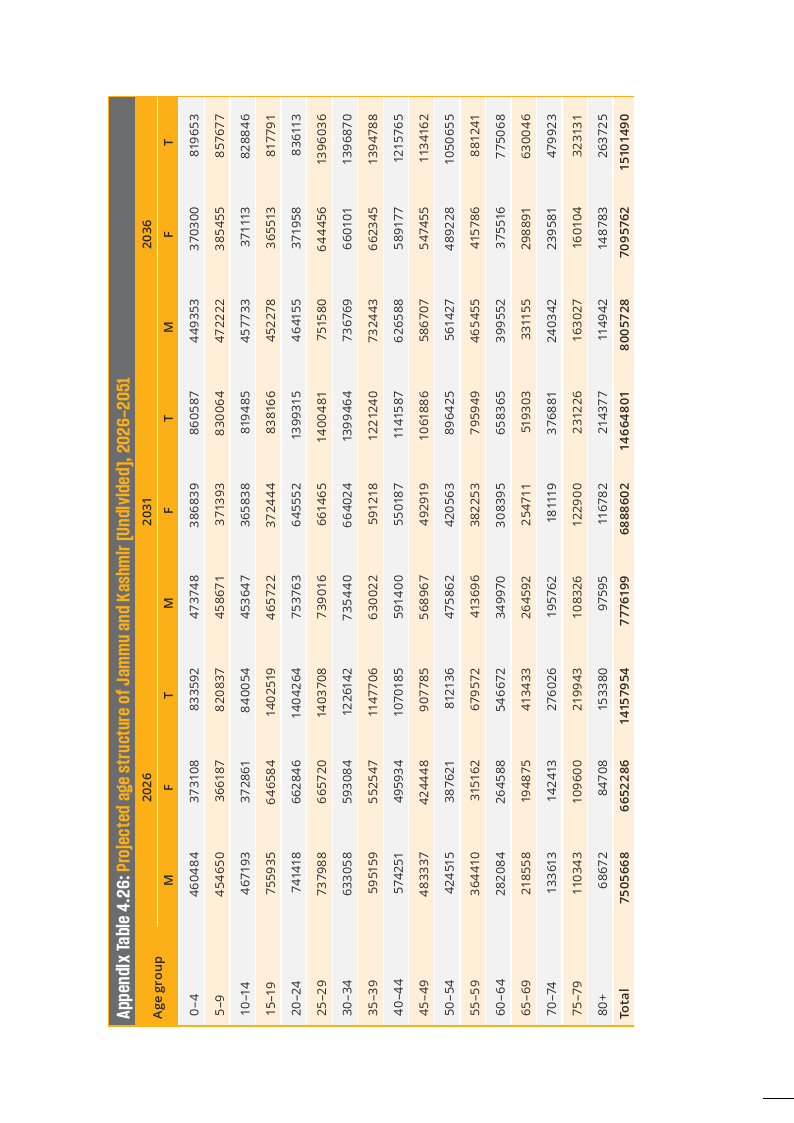
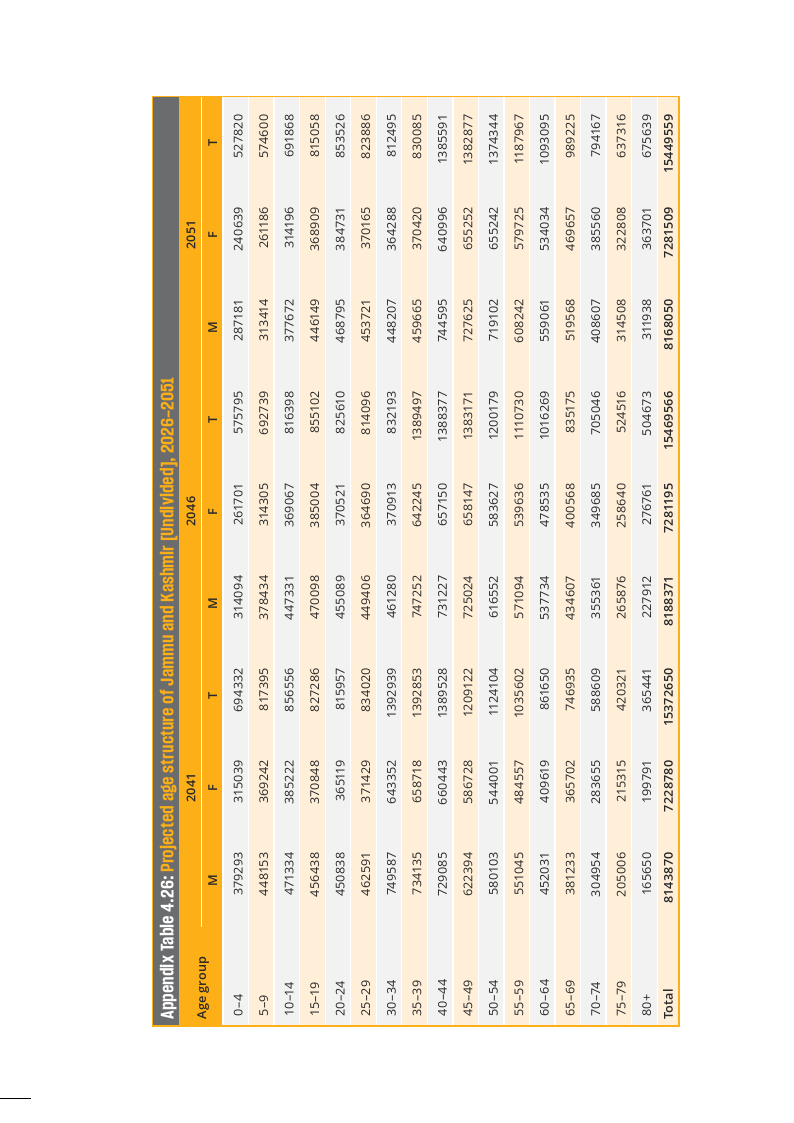
Appendix Table 4.26: Projected age structure of Jammu and Kashmir
[Undivided], 2026–2051
163
Appendix Table 4.27: Projected percentage distribution of population by age
and gender for Jammu and Kashmir [Undivided], 2026–2051
165
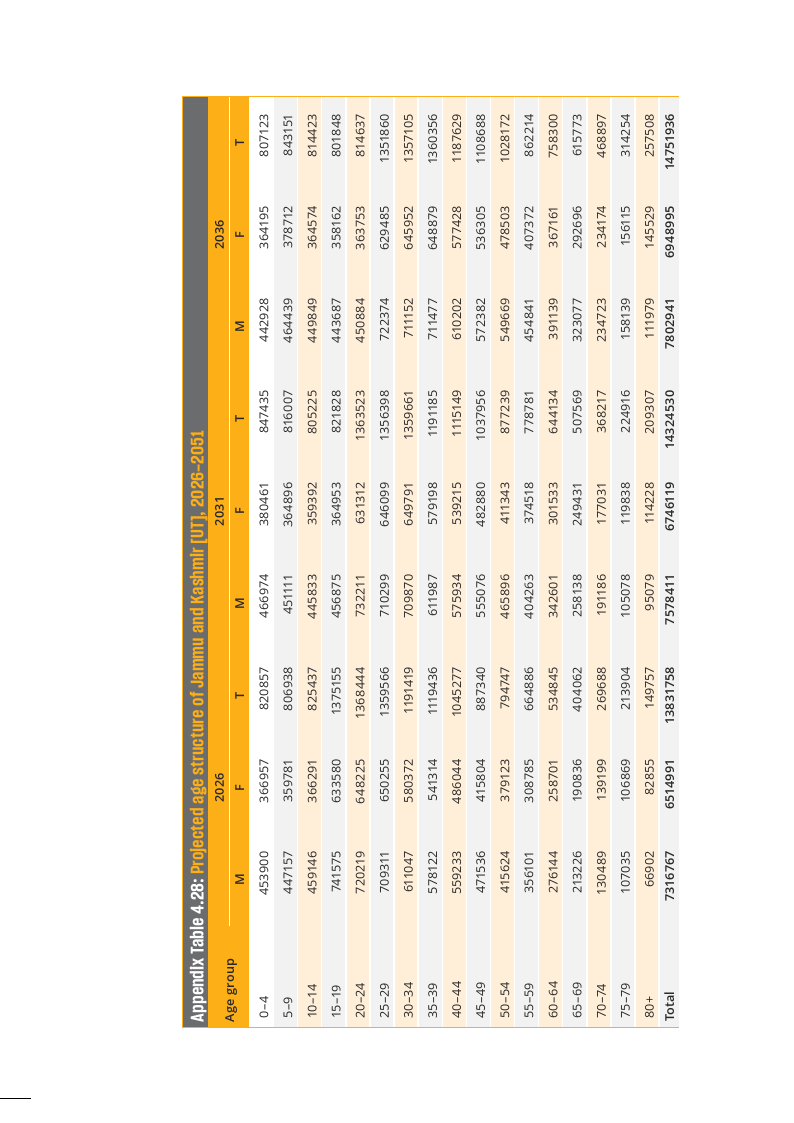
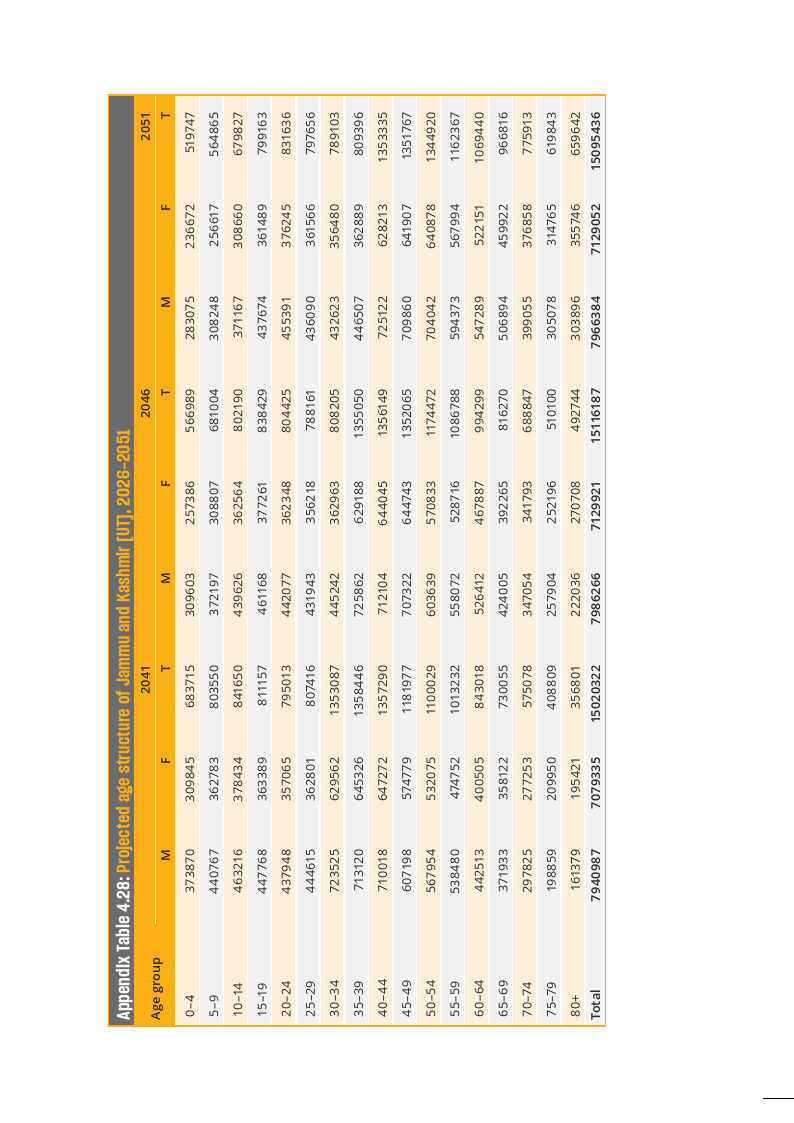
Appendix Table 4.28: Projected age structure of Jammu and Kashmir [UT],
2026–2051
166
Appendix Table 4.29: Projected percentage distribution of population by age
and gender for Jammu and Kashmir [UT], 2026–2051
168
Appendix Table 4.30: Projected summary of demographic indicators for
Jharkhand, 2026–2051
169
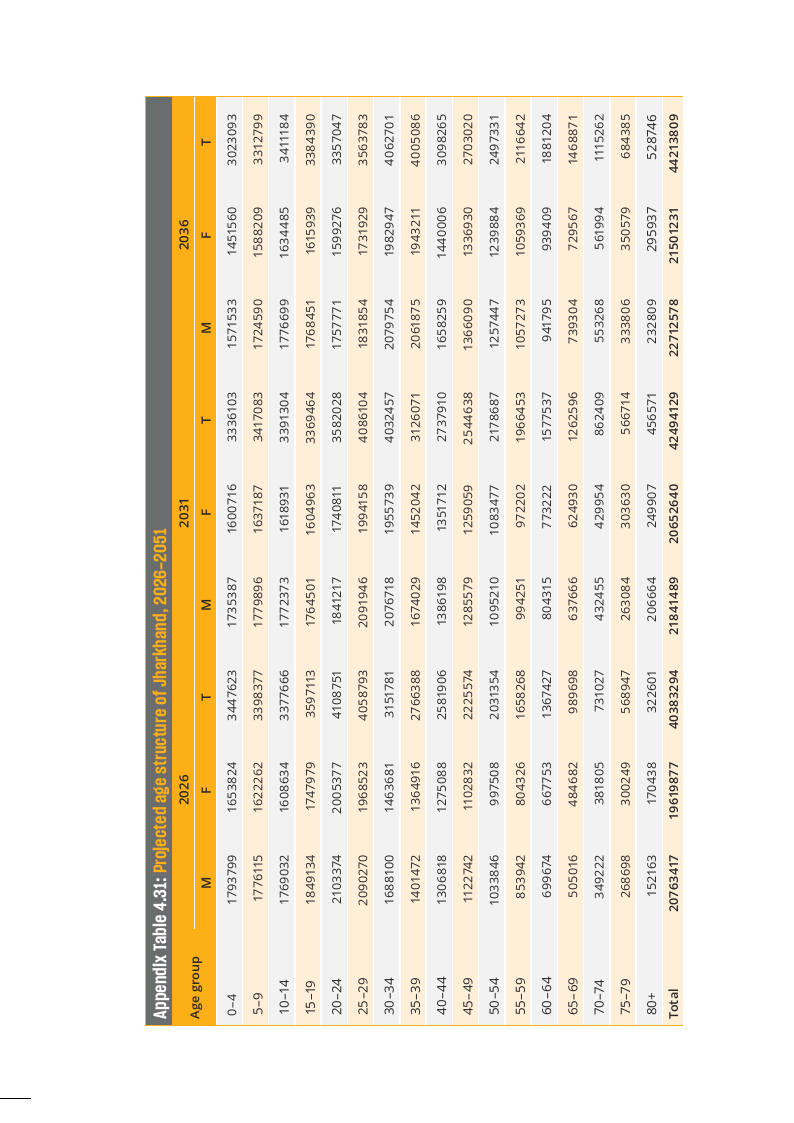
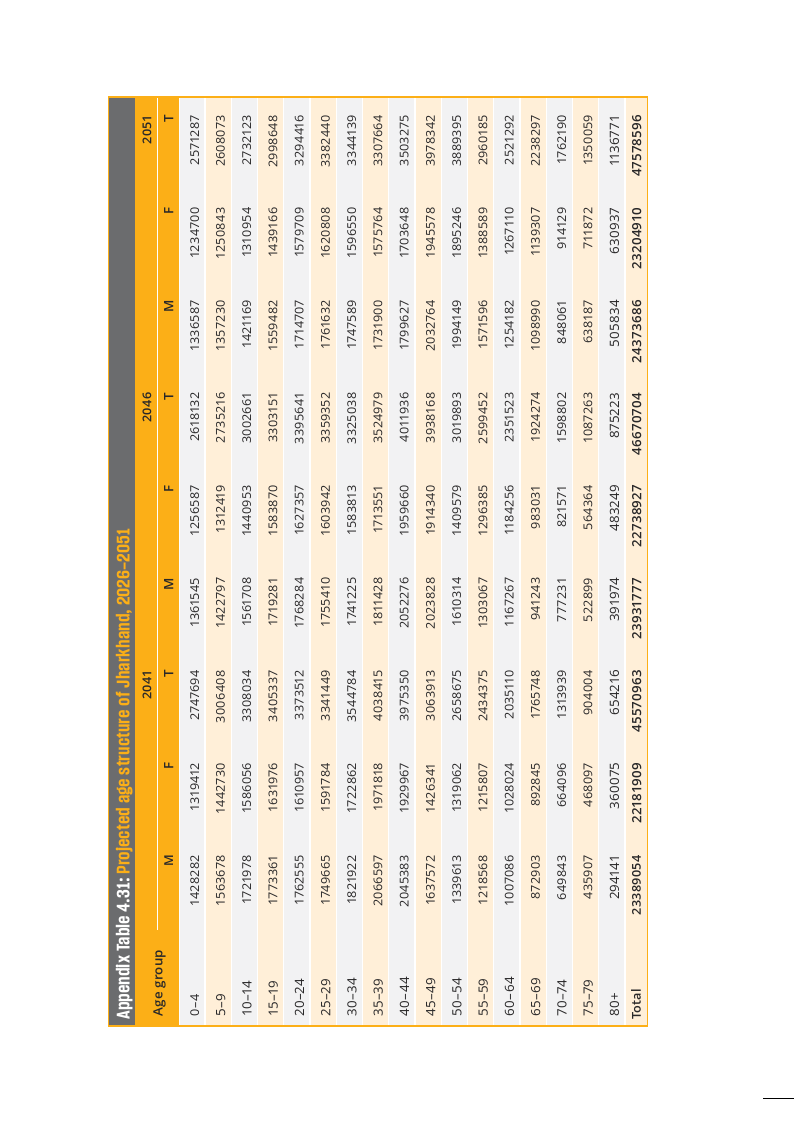
Appendix Table 4.31: Projected age structure of Jharkhand, 2026–2051
170
Appendix Table 4.32: Projected percentage distribution of population by age
and gender for Jharkhand, 2021–2051
172
Appendix Table 4.33: Projected summary of demographic indicators for
Karnataka, 2026–2051
173
Appendix Table 4.34: Projected age structure of Karnataka, 2026–2051
174
Appendix Table 4.35: Projected percentage distribution of population by age
and gender for Karnataka, 2026–2051
176
Appendix Table 4.36: Projected summary of demographic indicators for Kerala,
2026–2051
177
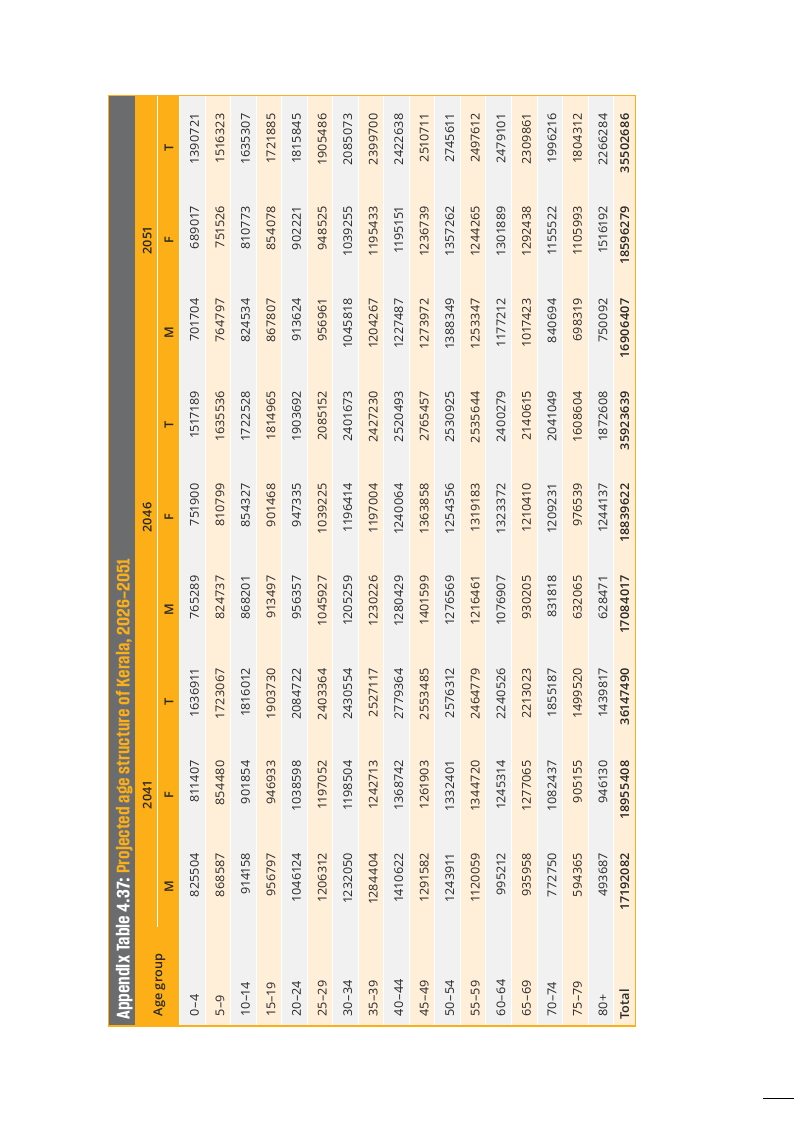
Appendix Table 4.37: Projected age structure of Kerala, 2026–2051
178
Appendix Table 4.38: Projected percentage distribution of population by age
and gender for Kerala, 2026–2051
180
Appendix Table 4.39: Projected age structure of Ladakh [UT], 2026–2051
181
Appendix Table 4.40: Projected percentage distribution of population by age for
Ladakh [UT], 2026–2051
182
POPULATION FOUNDATION OF INDIA xix

2.10 Page 20

▲back to top


Appendix Table 4.41: Projected summary of demographic indicators for
Madhya Pradesh, 2026–2051
183
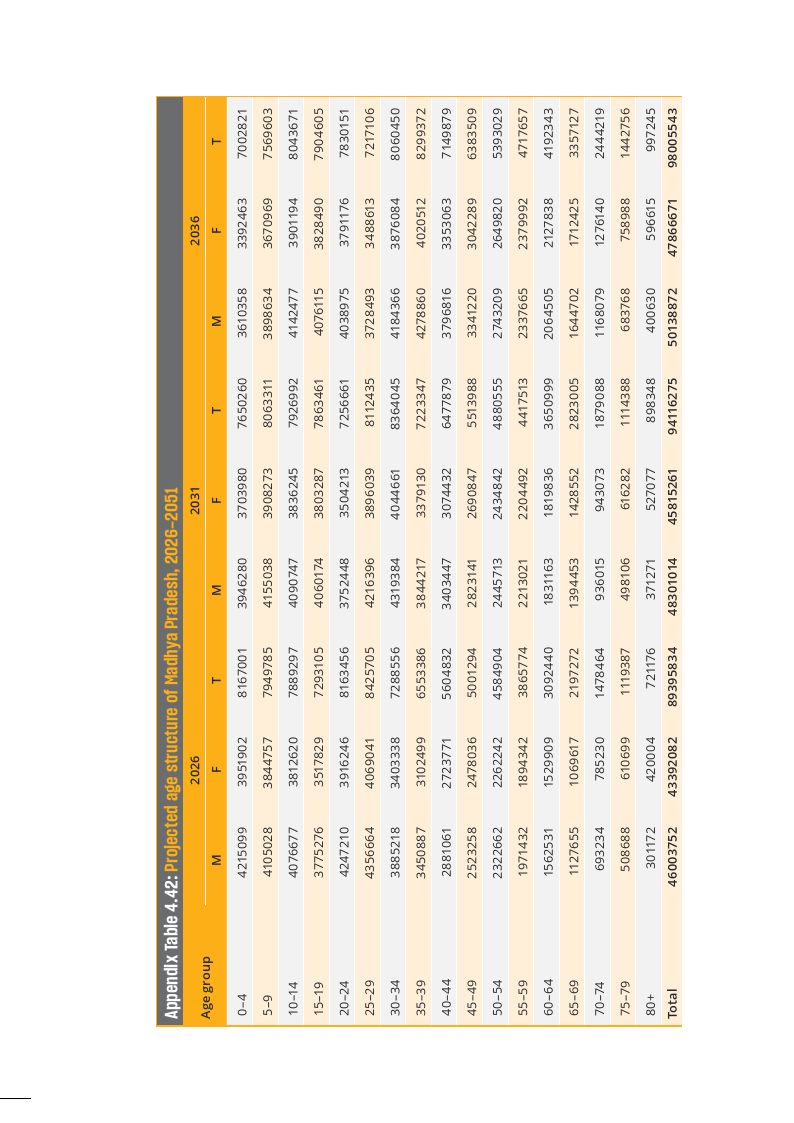
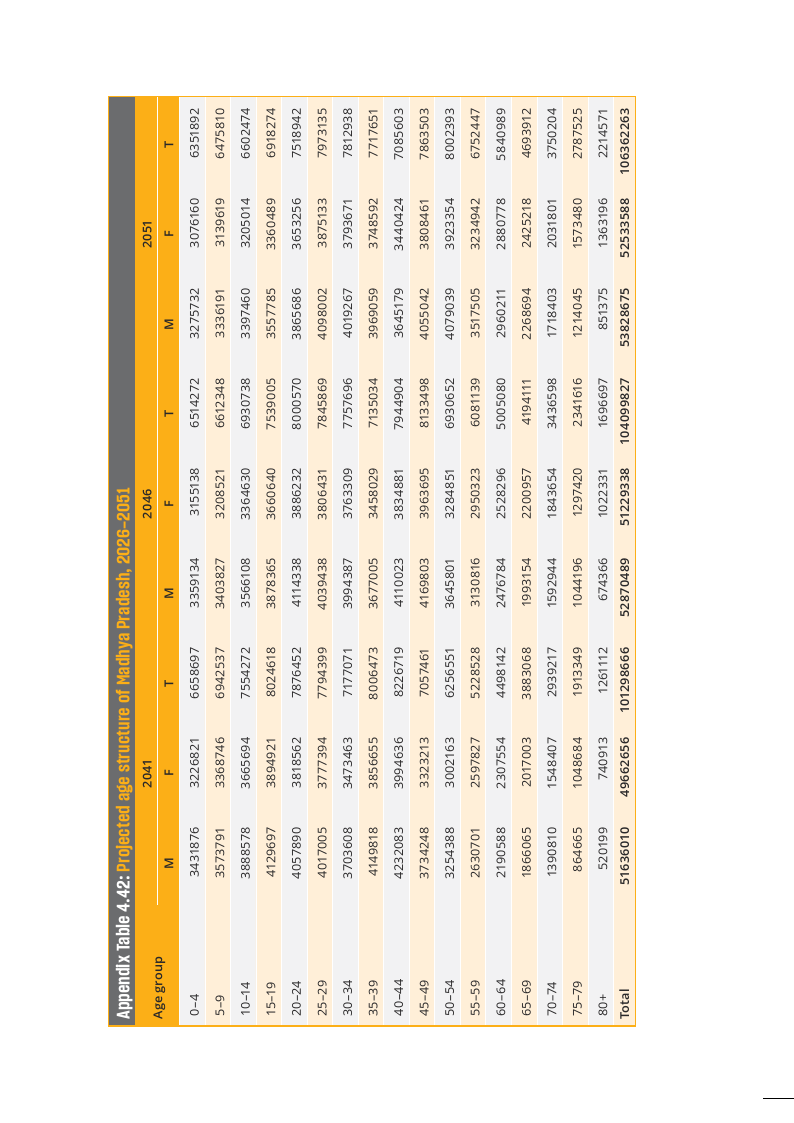
Appendix Table 4.42: Projected age structure of Madhya Pradesh, 2026–2051
184
Appendix Table 4.43: Projected percentage distribution of population by age
and gender for Madhya Pradesh, 2026–2051
186
Appendix Table 4.44: Projected summary of demographic indicators for
Maharashtra, 2026–2051
187
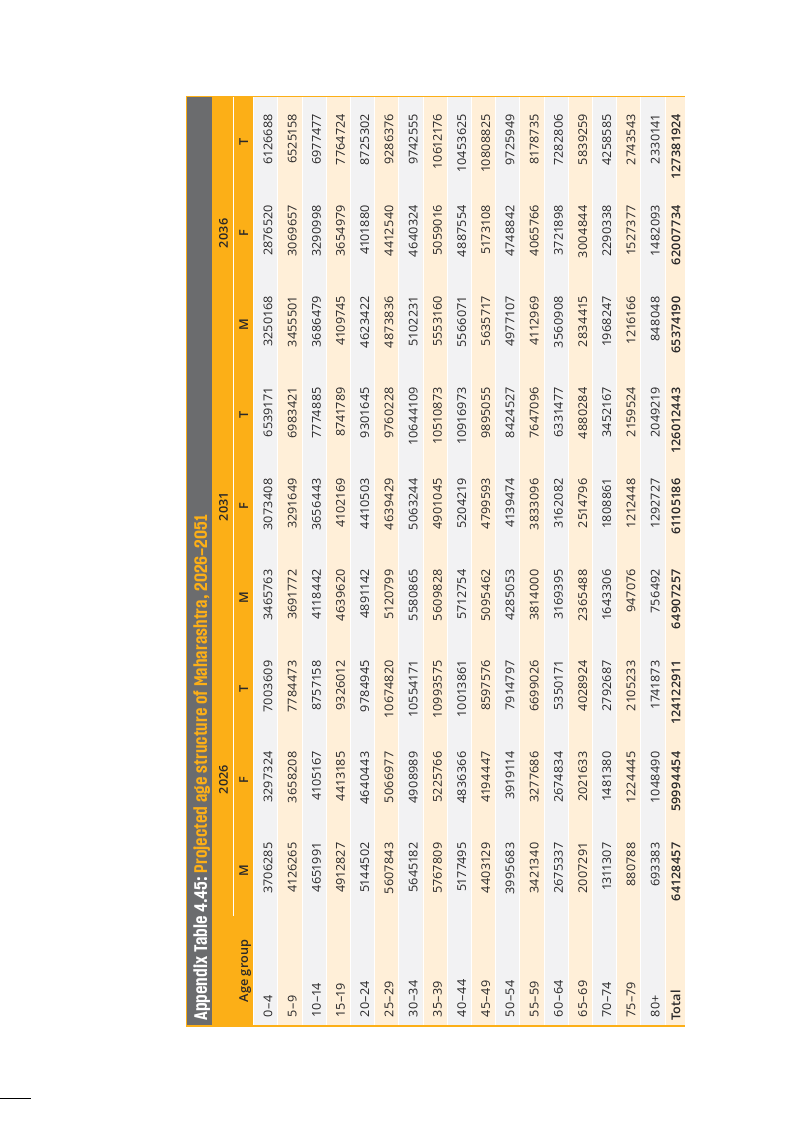
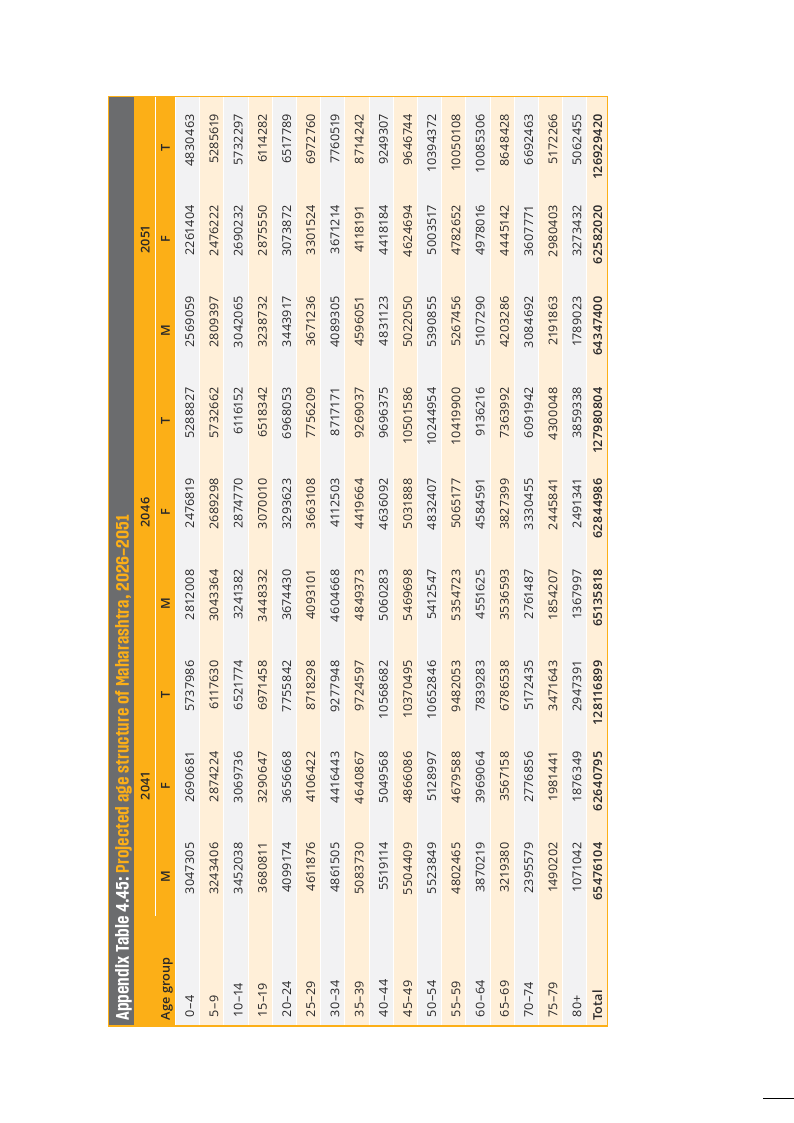
Appendix Table 4.45: Projected age structure of Maharashtra, 2026–2051
188
Appendix Table 4.46: Projected percentage distribution of population by age
and gender for Maharashtra, 2026–2051
190
Appendix Table 4.47: Projected summary of demographic indicators for Odisha,
2026–2051
191
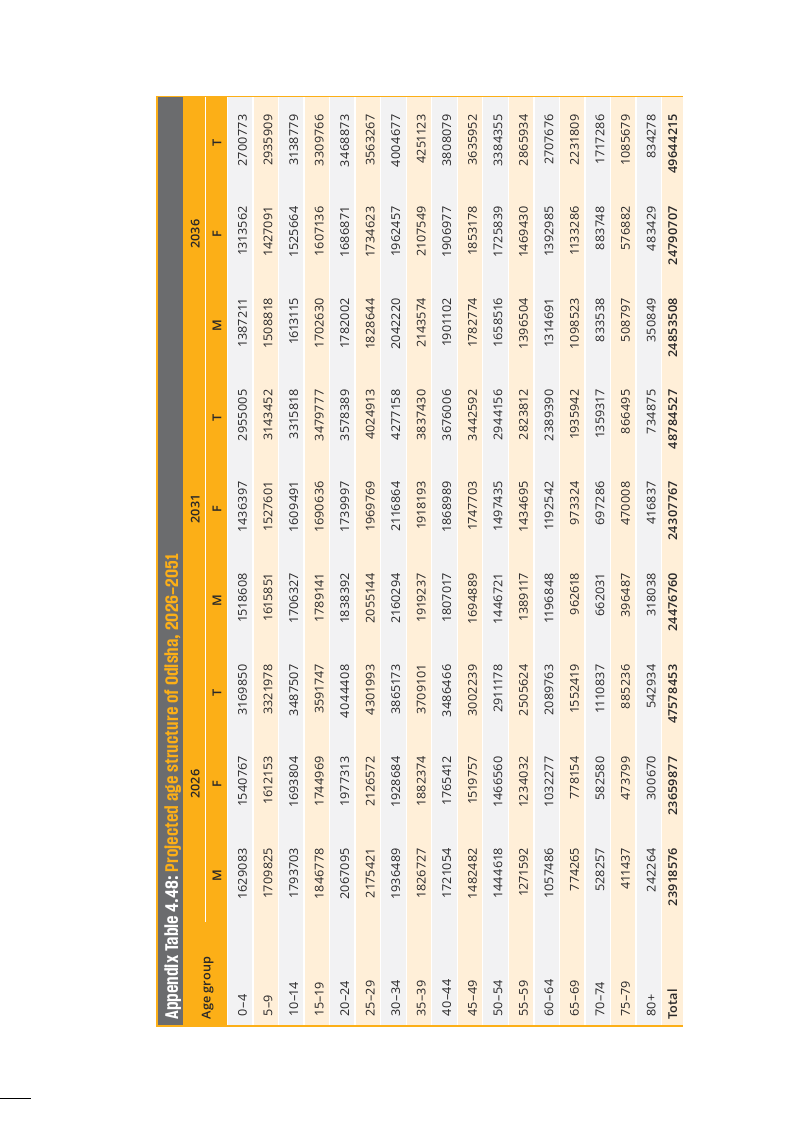
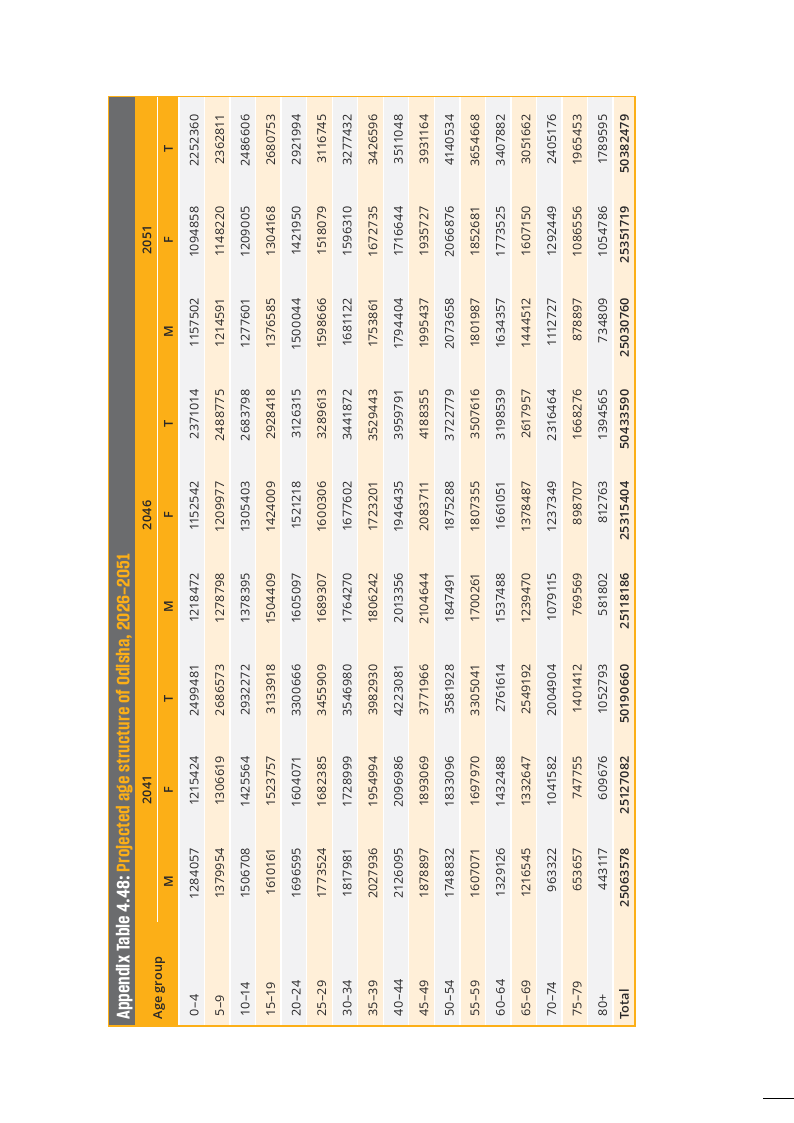
Appendix Table 4.48: Projected age structure of Odisha, 2026–2051
192
Appendix Table 4.49: Projected percentage distribution of population by age
and gender for Odisha, 2026–2051
194
Appendix Table 4.50: Projected summary of demographic indicators for Punjab,
2026–2051
195
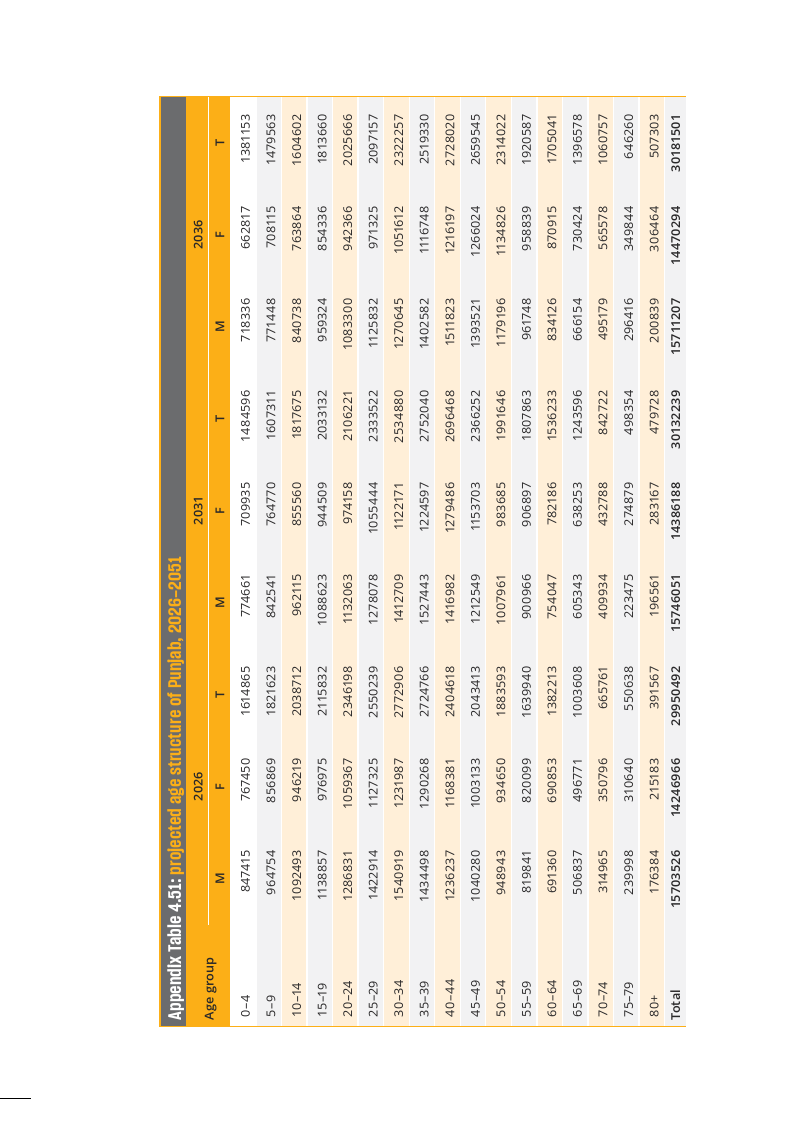
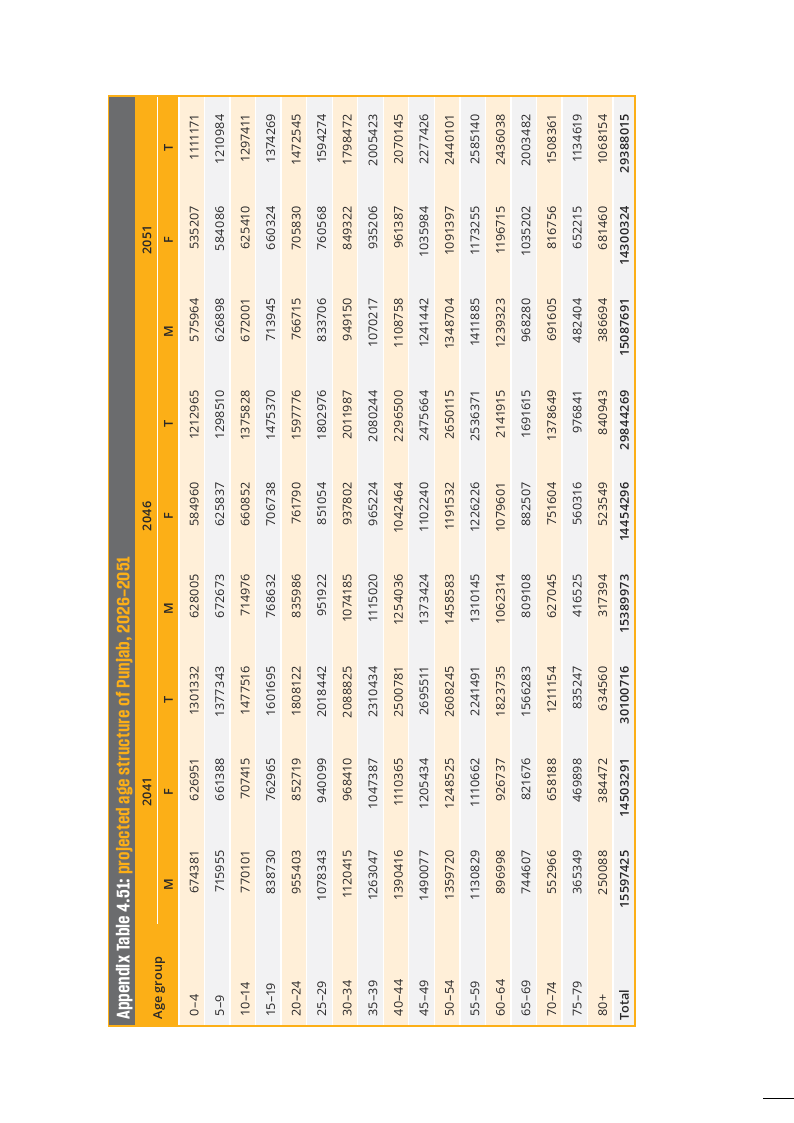
Appendix Table 4.51: projected age structure of Punjab, 2026–2051
196
Appendix Table 4.52: Projected percentage distribution of population by age
and gender for Punjab, 2026–2051
198
Appendix Table 4.53: Projected summary of demographic indicators for
Rajasthan, 2026–2051
199
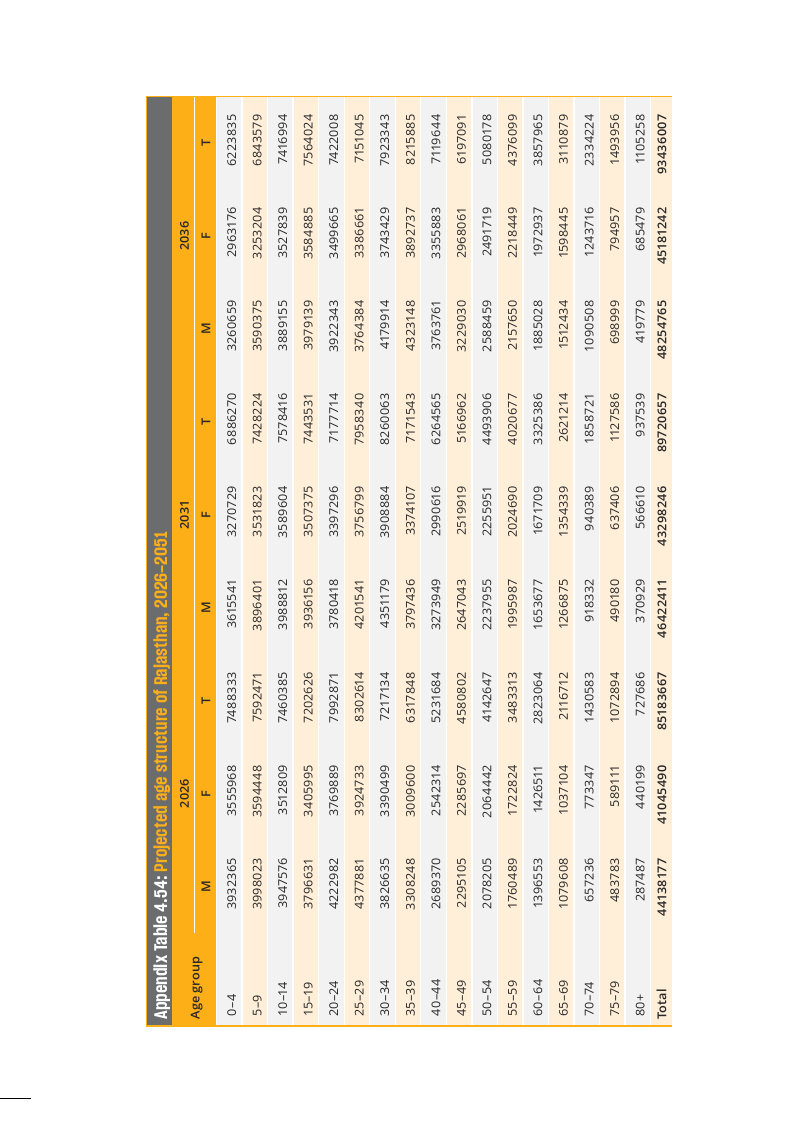
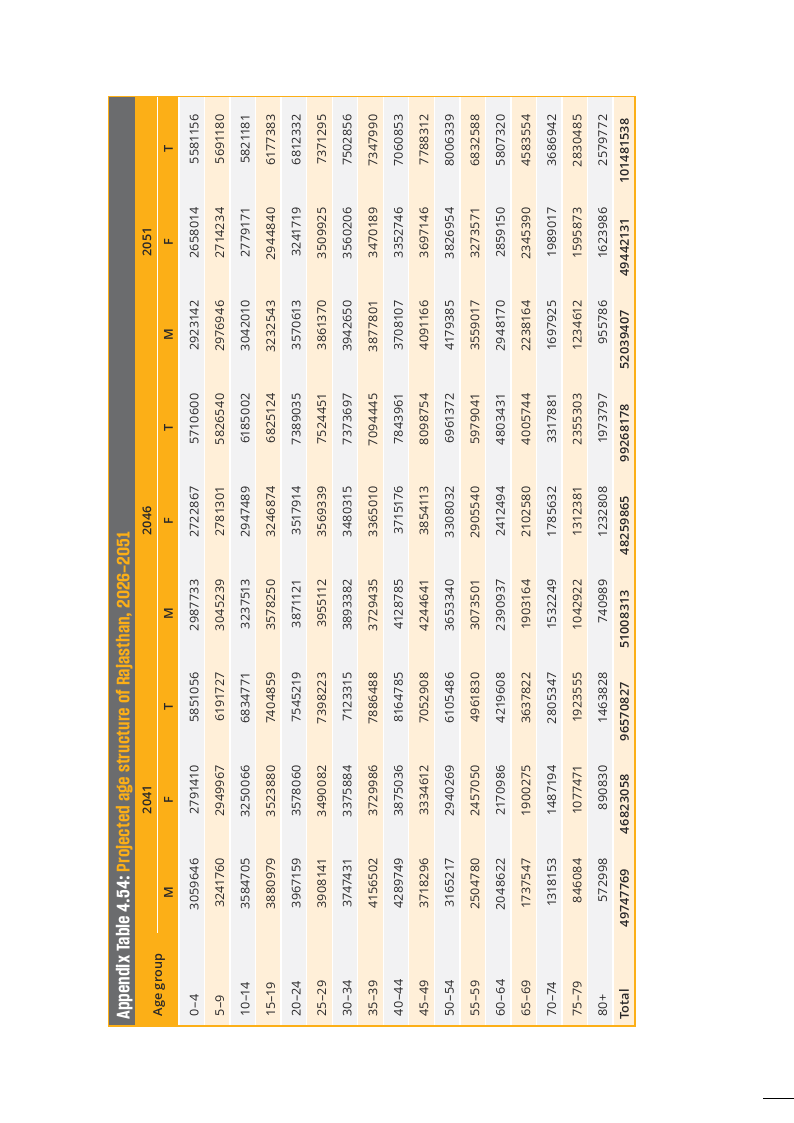
Appendix Table 4.54: Projected age structure of Rajasthan, 2026–2051
200
Appendix Table 4.55: Projected percentage distribution of population by age
and gender for Rajasthan, 2026–2051
202
Appendix Table 4.56: Projected summary of demographic indicators for
Tamil Nadu, 2026–2051
203
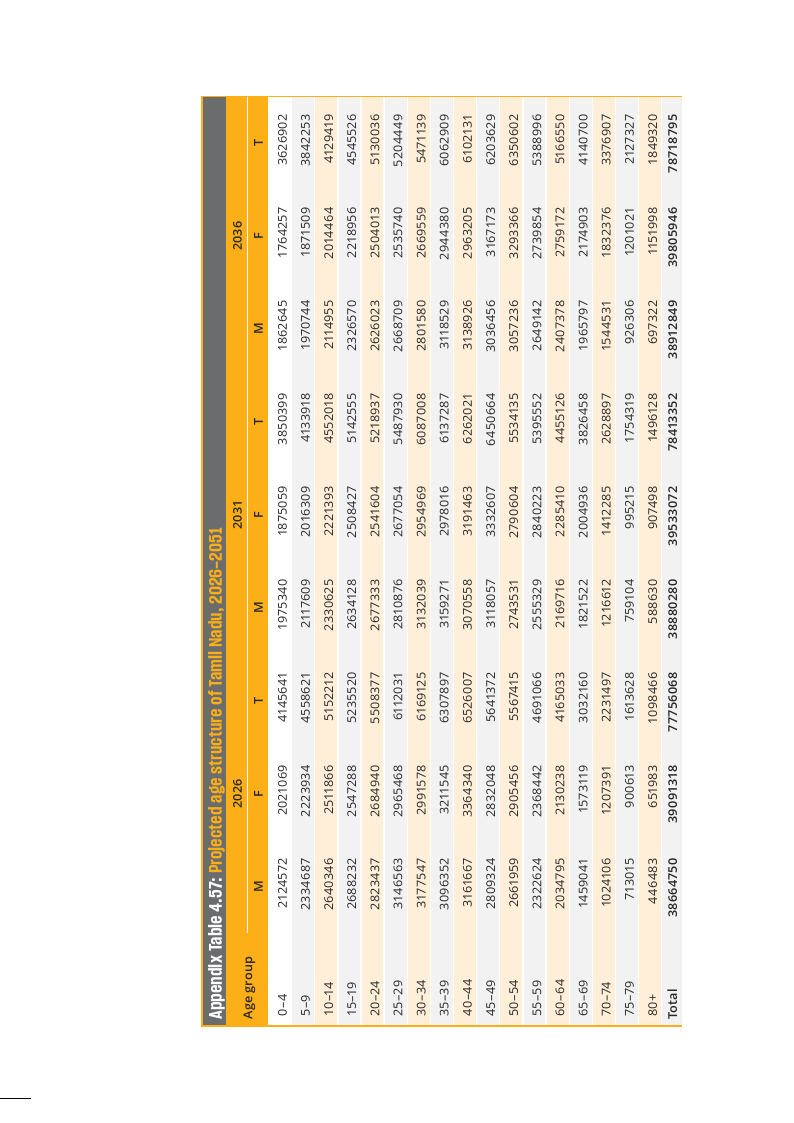
Appendix Table 4.57: Projected age structure of Tamil Nadu, 2026–2051
204
Appendix Table 4.58: Projected percentage distribution of population by age
and gender for Tamil Nadu, 2026–2051
206
Appendix Table 4.59: Projected summary of demographic indicators for
Telangana, 2026–2051
207
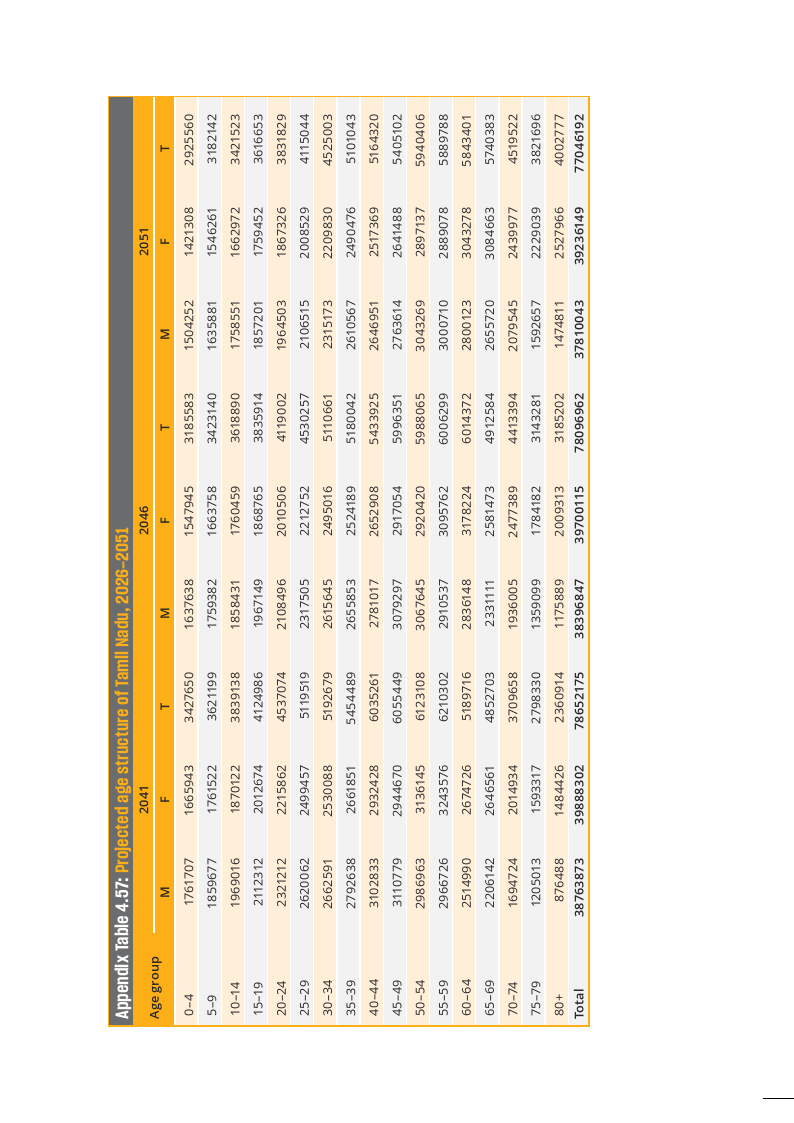
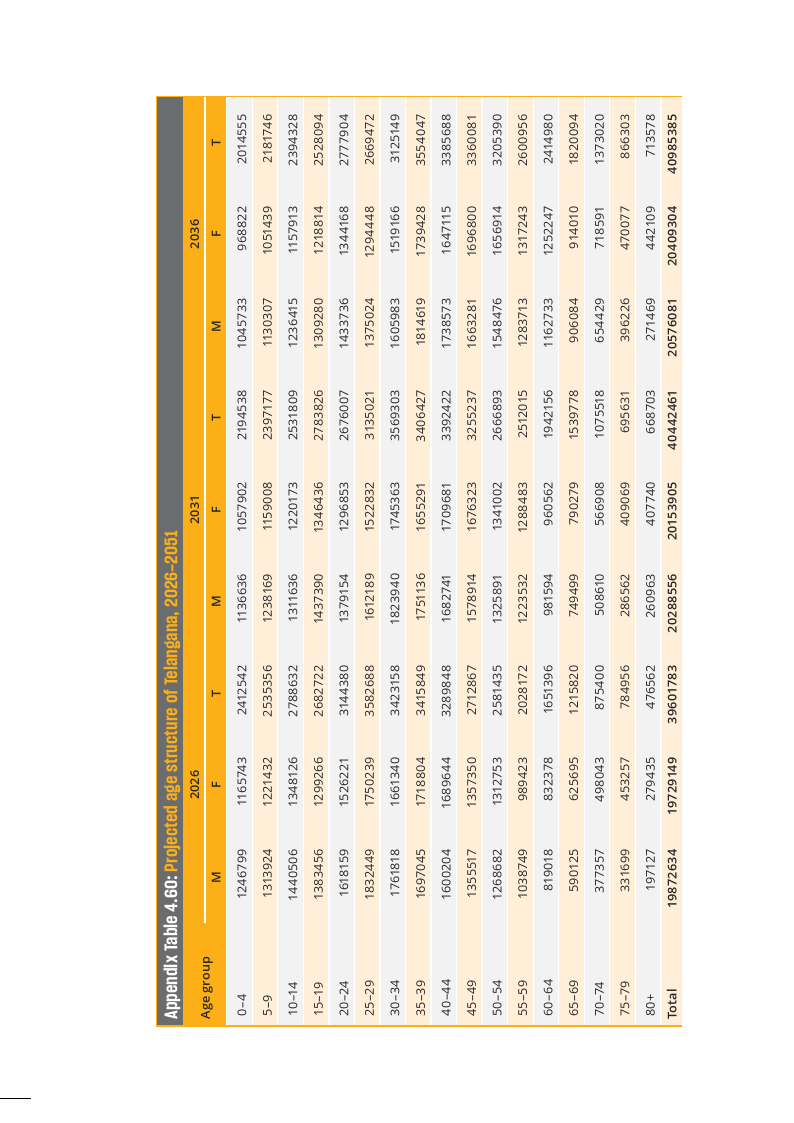
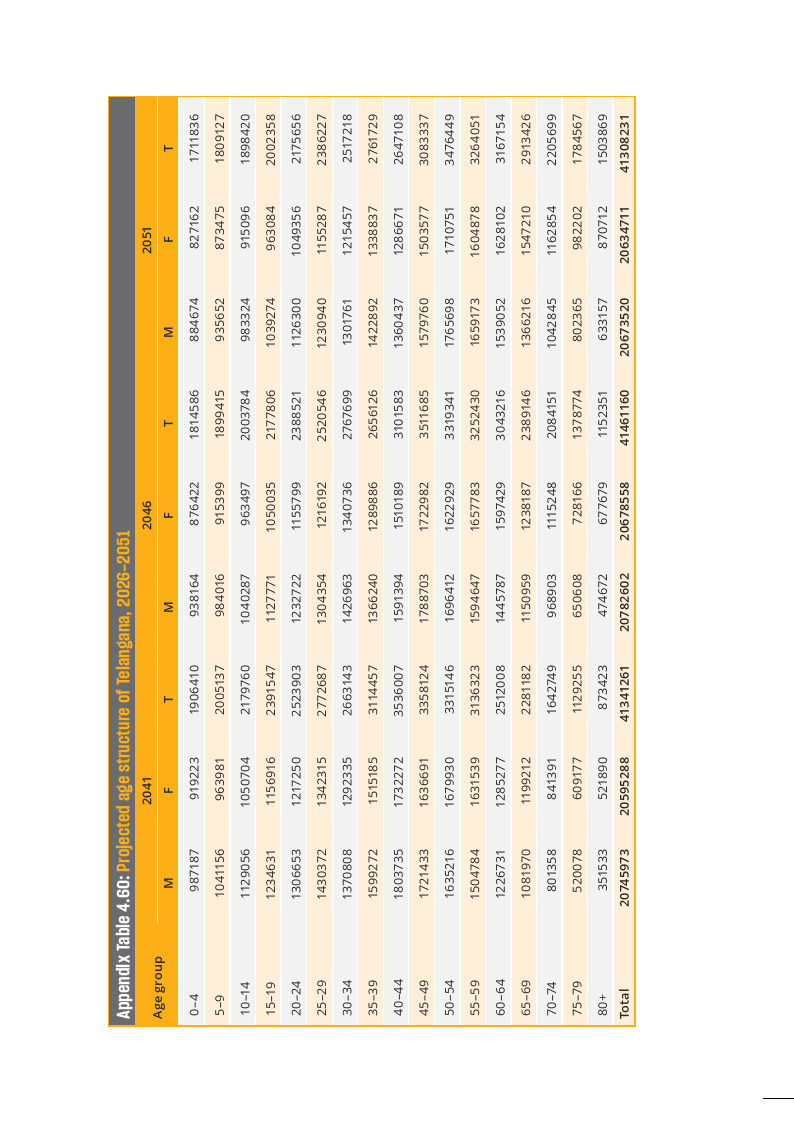
Appendix Table 4.60: Projected age structure of Telangana, 2026–2051
208
Appendix Table 4.61: Projected percentage distribution of population by age
and gender for Telangana, 2026–2051
210
Appendix Table 4.62: Projected summary of demographic indicators for
Uttar Pradesh, 2026– 2051
211
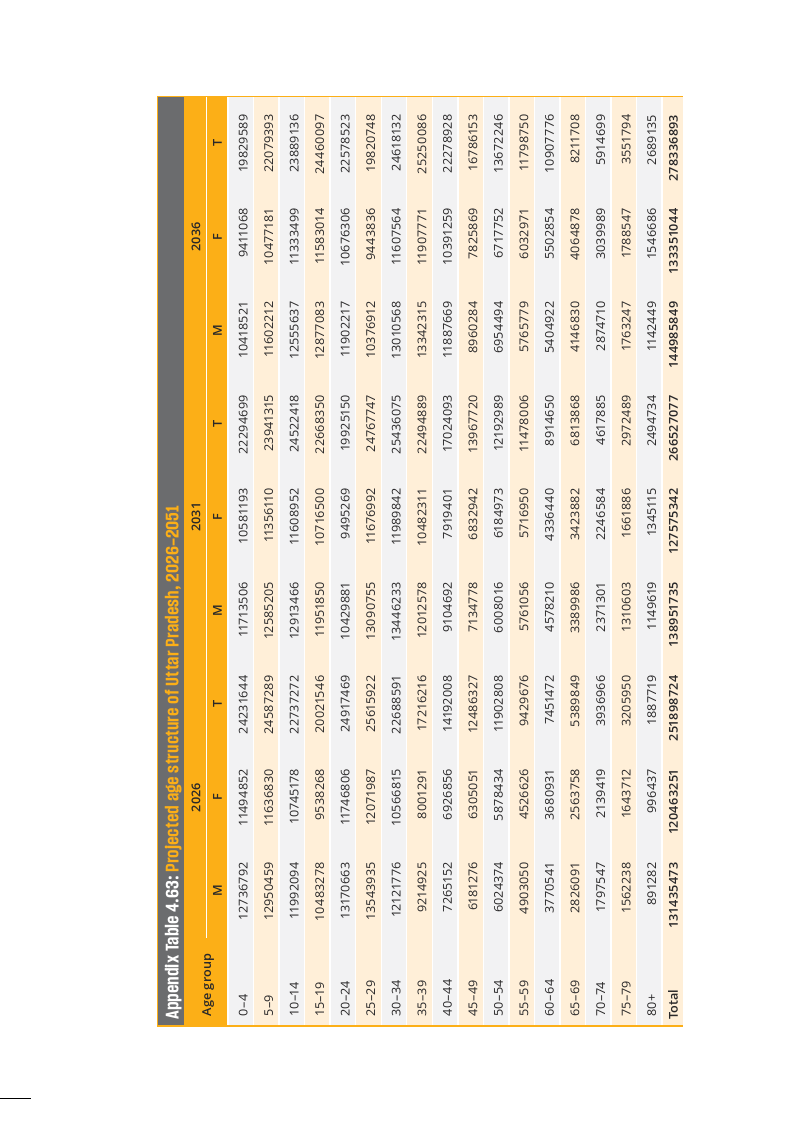
Appendix Table 4.63: Projected age structure of Uttar Pradesh, 2026–2051
212
Appendix Table 4.64: Projected percentage distribution of population by age
and gender for Uttar Pradesh, 2026–2051
214
Appendix Table 4.65: Projected summary of demographic indicators for
Uttarakhand, 2026– 2051
215
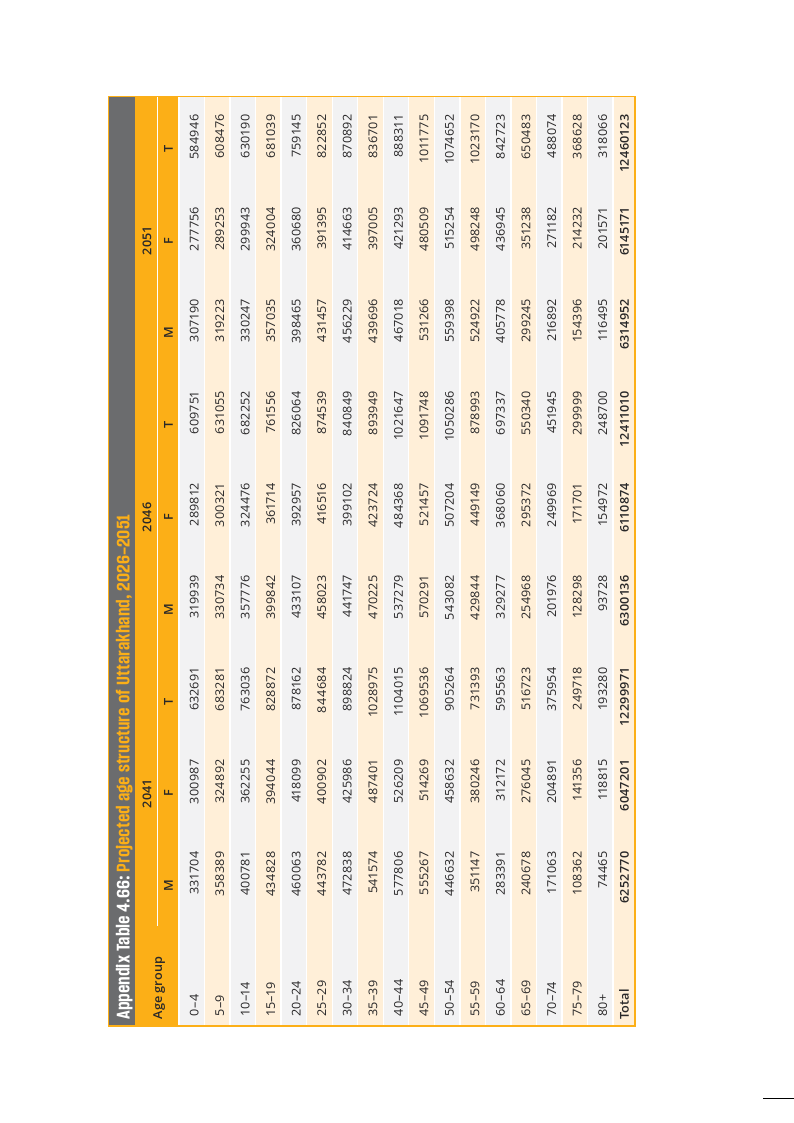
Appendix Table 4.66: Projected age structure of Uttarakhand, 2026–2051
216
Appendix Table 4.67: Projected percentage distribution of population by age
and gender for Uttarakhand, 2026–2051
218
Appendix Table 4.68: Projected summary of demographic indicators for
West Bengal, 2026–2051
219
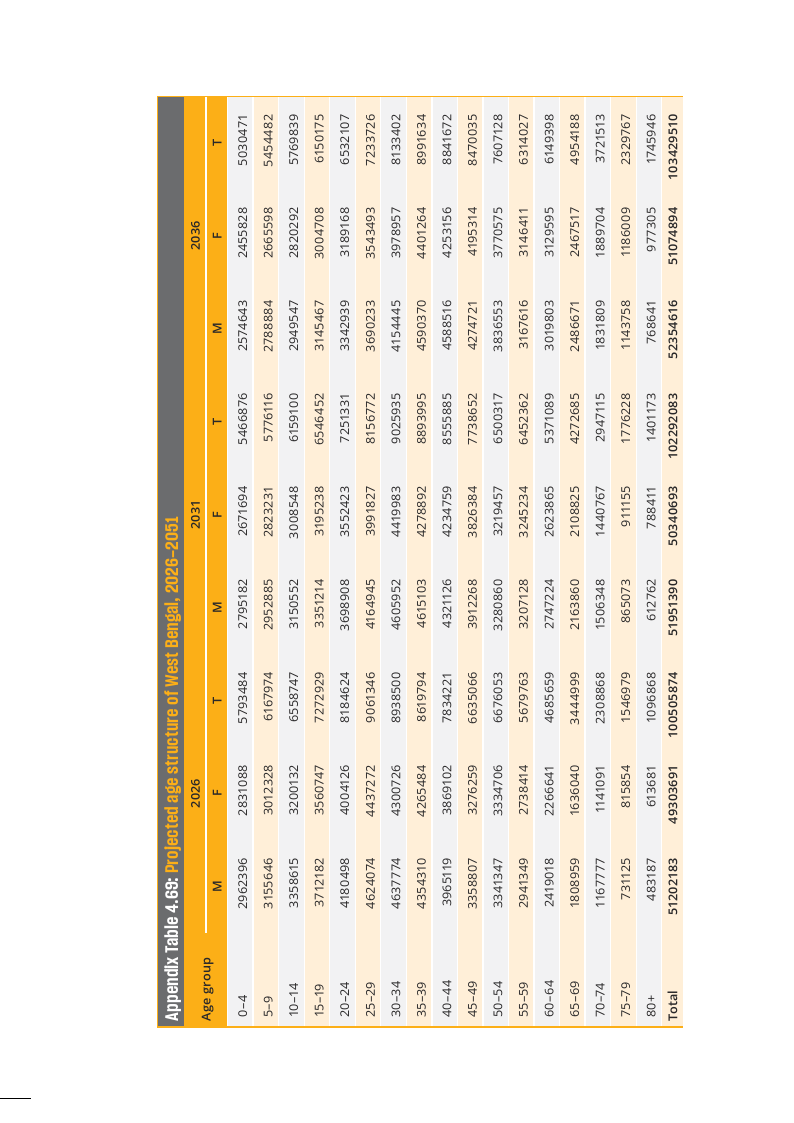
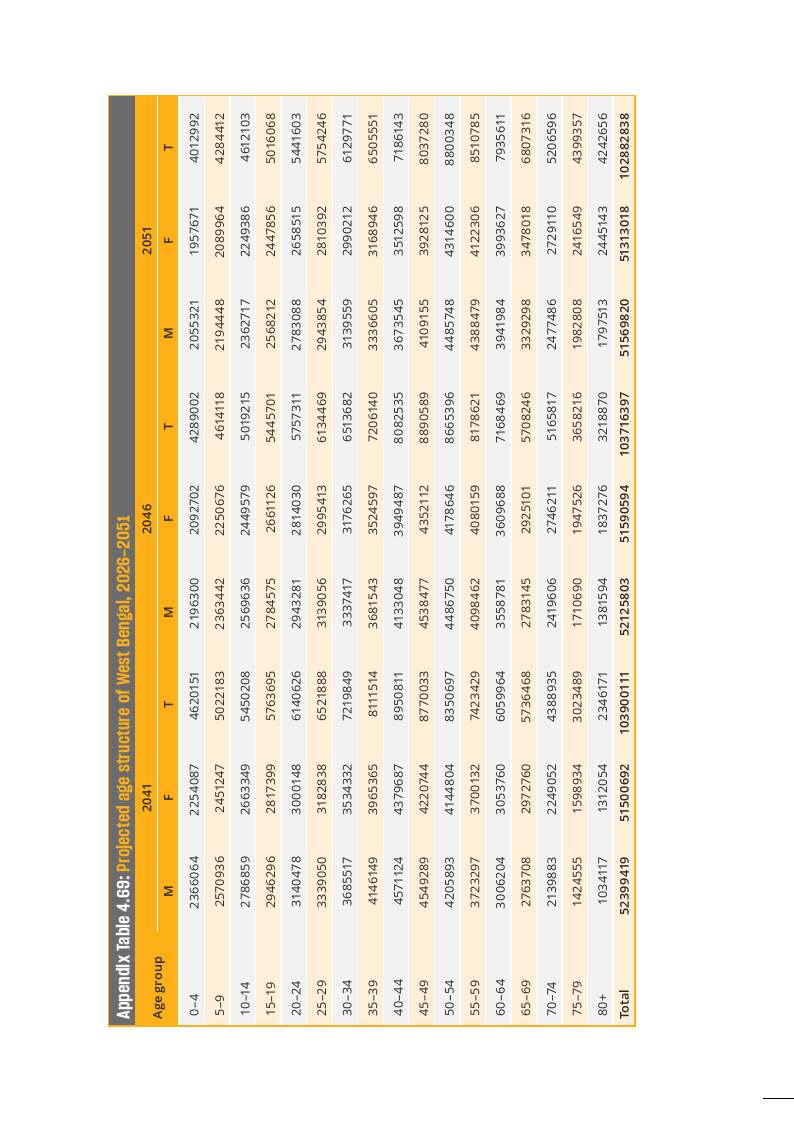
Appendix Table 4.69: Projected age structure of West Bengal, 2026–2051
220
Appendix Table 4.70: Projected percentage distribution of population by age
and gender for West Bengal, 2026–2051
222
xx POPULATION FOUNDATION OF INDIA

3 Pages 21-30

▲back to top


3.1 Page 21

▲back to top


Appendix Table 4.71: Ranking of states by their population size, 2011 and 2051
[in millions]
223
Appendix: Table 4.72: Projected state-wise dependency ratios for India, 2021–2051 224
Appendix Table 4.73: Share of regional population by gender and their
contribution to India’s total population, 1971–2011
228
Appendix Table 4.74: Projected regional distribution of total population and
percentage share by gender, 2021–2051
229
Appendix Table 4.75: Projected percentage distribution of population by region
and age groups, 2021–2051
231
Appendix Table 4.76: Projected age distribution of the regional population by
age groups within the total regional population, 2021–2051
232
Appendix Table 4.77: Projected regional distribution of population by gender,
2021–2051 [In million]
233
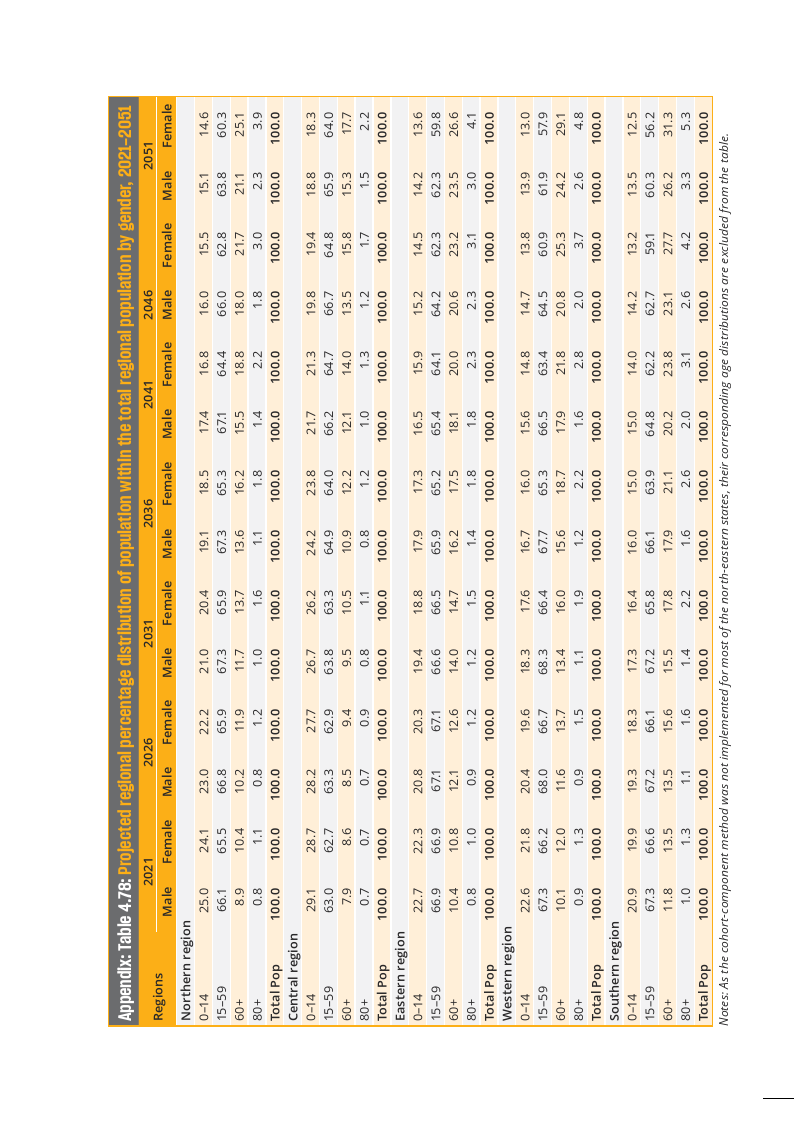
Appendix: Table 4.78: Projected regional percentage distribution of population
within the total regional population by gender, 2021–2051
235
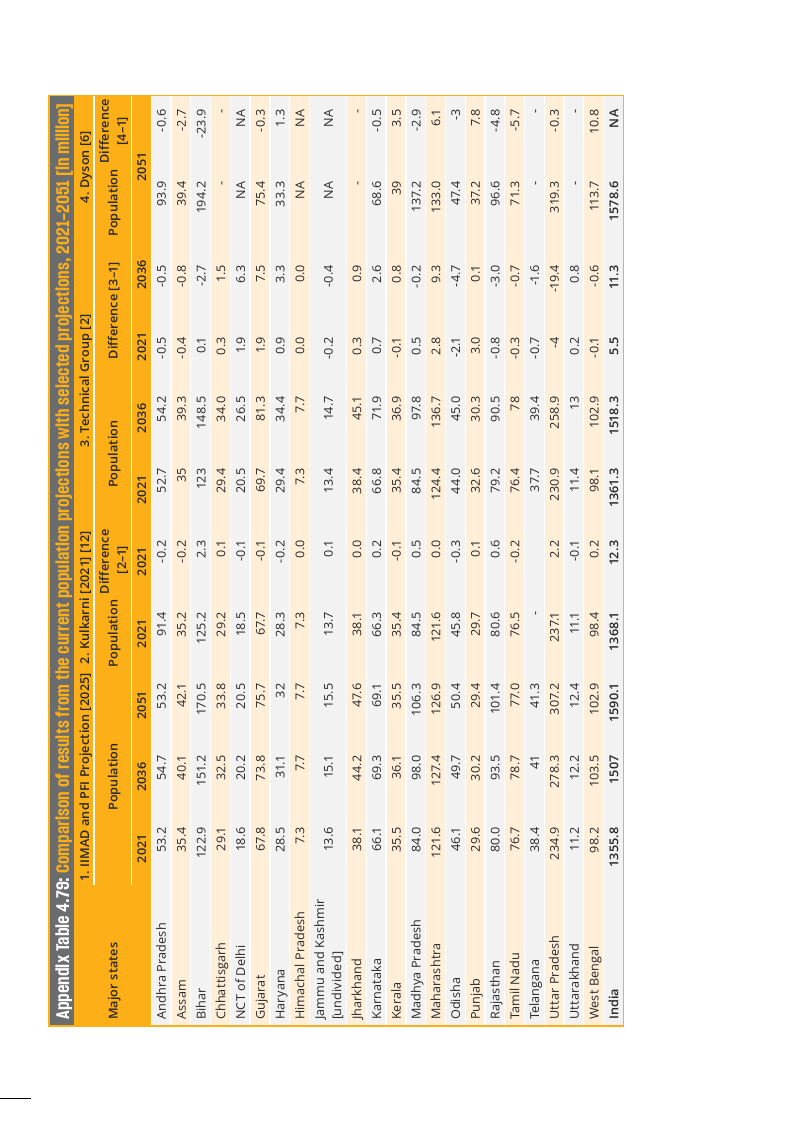
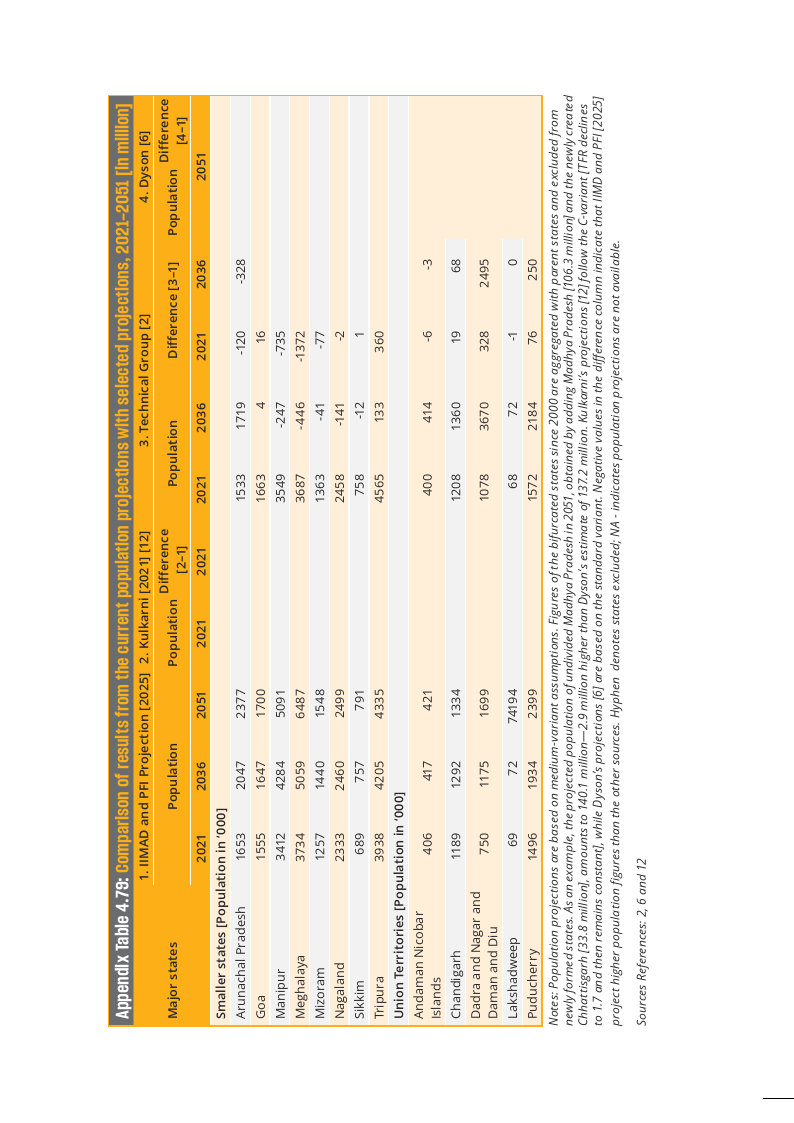
Appendix Table 4.79: Comparison of results from the current population
projections with selected projections, 2021–2051 [in million]
236
APPENDIX: V
Section 7 Output Tables for Urban Rural Population Projections
239
Appendix Table 5.1: State-level population projections and percentage
distribution by urban–rural population, 2011–2051
240
APPENDIX VI
Section 8 Output Figures for Urban-rural Population Projections
245
Appendix Figure 6.1: Projected urban-rural population, 2011–2051
246
APPENDIX: VII
Maps Of Projected Urban-Rural Population 2011–2051
247
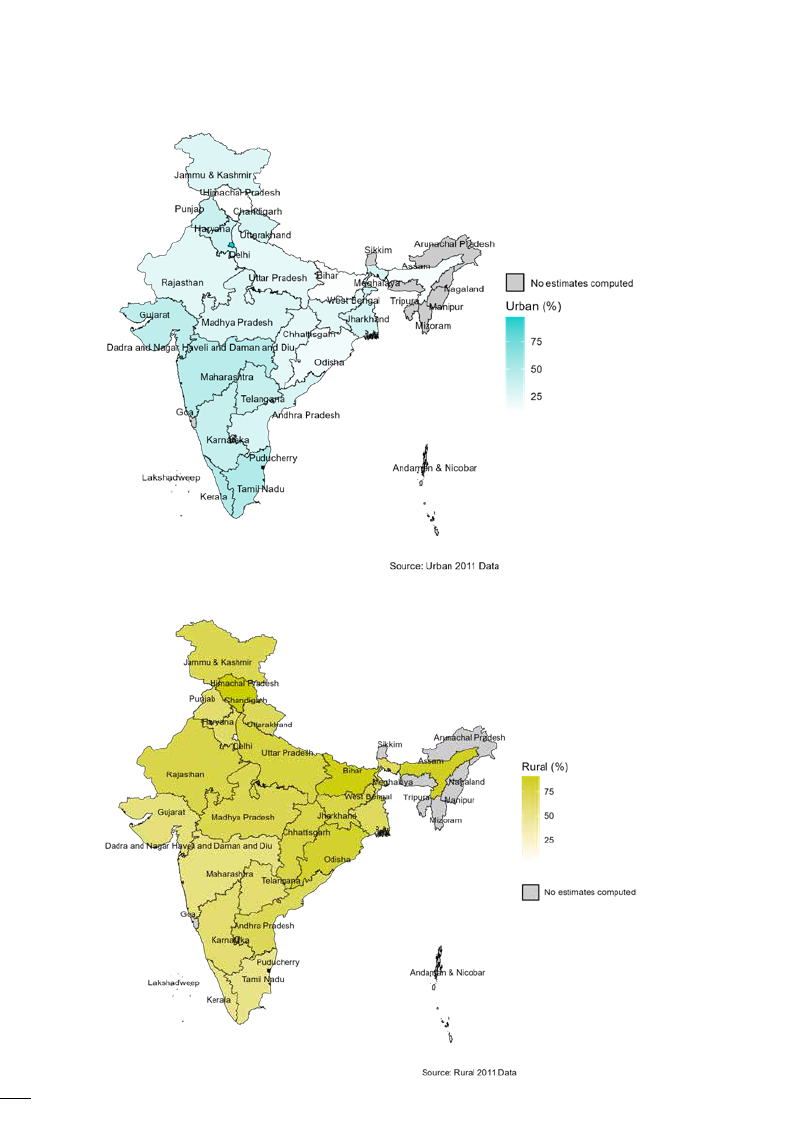
Appendix Map 7.1: Share of urban population, 2011
248
Section 9
Appendix Map 7.2: Share of rural population, 2011
248
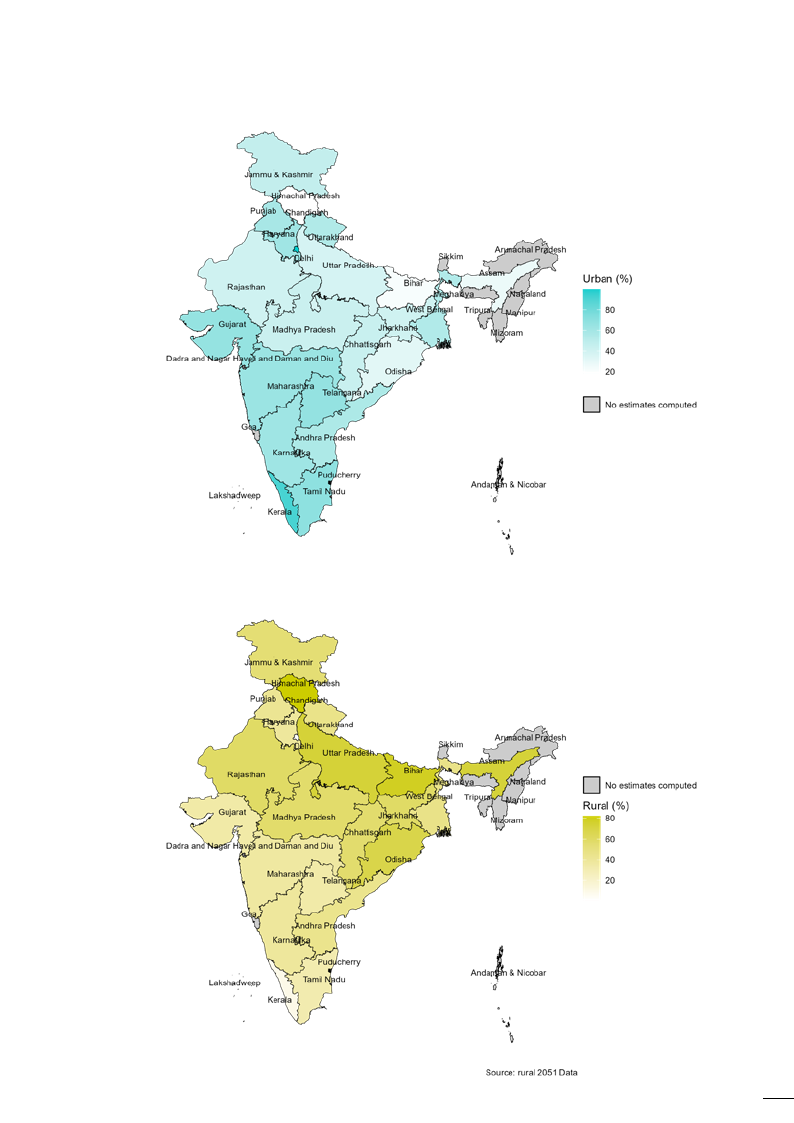
Appendix Map 7.3: Projected percentage share of urban population, 2051
249
Appendix Map 7.4: Projected percentage share of rural population, 2051
249
APPENDIX: VIII
Projected Population Figures for Smaller States
251
Section Appendix Table 8.1: Projected population of smaller states and Union
10
Territories, 2016–2051
252
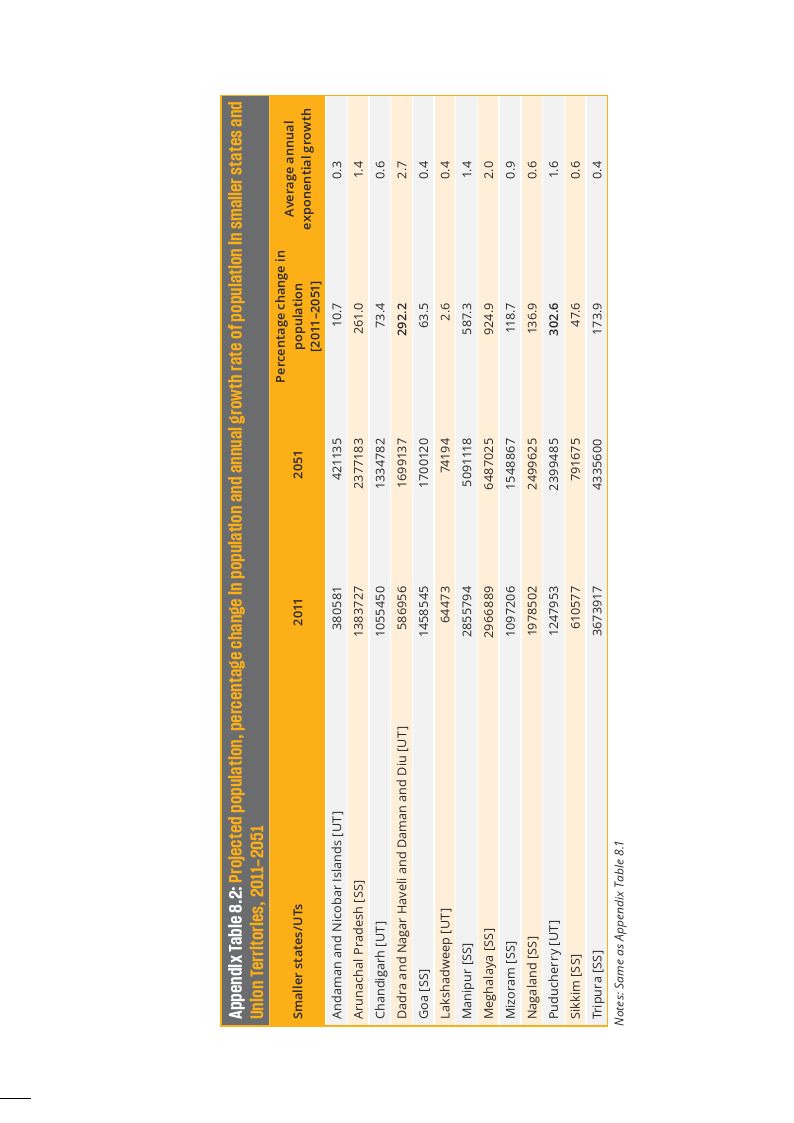
Appendix Table 8.2: Projected population, percentage change in population
and annual growth rate of population in smaller states and Union Territories,
2011–2051
254
POPULATION FOUNDATION OF INDIA xxi

3.2 Page 22

▲back to top


3.3 Page 23

▲back to top


GLOSSARY
Ageing Index: An index that measures the ratio of the elderly population [aged 60 years
and above] to the child population [aged 0–14 years], expressed per 100. It indicates the
number of elderly persons per 100 children in a given population.
Age-Sex Structure: The composition of a population as determined by the number
or proportion of males and females in each age category. The age-sex structure of a
population is the cumulative result of past trends in fertility, mortality, and migration.
Age-Specific Rate: Rate obtained for specific age groups.
Ageing of Population: A process in which the proportion of adults and the elderly
increase in a population, while the proportion of children and adolescents decrease. This
process results in a rise in the median age of the population. Ageing occurs when fertility
rates decline while life expectancy at birth remains constant or improves at older ages.
Birth Rate [or CBR]: The number of live births per 1000 population in a given year.
Census: A canvass of a given area, resulting in an enumeration of the entire population
and often the compilation of other demographic, social, and economic information
pertaining to that population at a specific time.
Childbearing Years: The reproductive age span of women, assumed for statistical
purposes to be 15-49 years of age.
Child-Woman Ratio: The number of children under age 5 per 1000 women aged 15–44
or 15–49 in a population in a given year. This crude fertility measure, based on basic
Census data, is sometimes used when more specific fertility information is not available.
Cohort: A group of people sharing a common temporal demographic experience who
are observed through time.
Crude Rate: Rate of any demographic event computed for an entire population.
Death Rate [or CDR]: The number of deaths per 1000 population in a given year.
Demographic Transition: The historical shift of birth and death rates from high to
low levels in a population. The mortality decline usually precedes the fertility decline,
resulting in rapid population growth during the transition period.
Dependency Ratio: Dependency ratio is the ratio of people in a dependent age group
[those under age 15 or age 65 and older] to those in the economically productive age
group [age 15 to 64] of a population.
Depopulation: The state of population decline.
Emigration: The process of leaving one country to take up permanent or semi-
permanent residence in another.
POPULATION FOUNDATION OF INDIA 1

3.4 Page 24

▲back to top


Family Planning: The conscious effort of couples to regulate the number and spacing of
births through artificial and natural methods of contraception. Family planning connotes
conception control to avoid pregnancy and abortion, but it also includes efforts of
couples to induce pregnancy.
Gender: Refers to the economic, social, political, and cultural attributes, constraints and
opportunities associated with being a woman or a man. The social definitions of what it
means to be a woman or a man vary among cultures and change over time. Gender is a
socio-cultural expression of particular characteristics and roles that are associated with
certain groups of people with reference to their sex and sexuality.
Gross Reproduction Rate [GRR]: The average number of daughters that would be born
alive to a woman [or group of women] during her lifetime if she passed through her
childbearing years conforming to the age-specific fertility rates of a given year.
Growth Rate: The number of people added to [or subtracted from] a population in a year
due to natural increase and net migration expressed as a percentage of the population
at the beginning of the time period.
Infant Mortality Rate: The number of deaths of infants under age 1 per 1000 live births
in a given year.
In-migration: The process of entering one administrative subdivision of a country from
another subdivision to take up residence.
Life Expectancy at Birth: The average number of additional years a person could expect
to live if current mortality trends were to continue for the rest of that person’s life.
Life Table: A tabular display of life expectancy and the probability of dying at each age
[or age group] for a given population, according to the age-specific death rates prevailing
at that time.
National Population Projection: Refers to all-India population projections.
Median Age: The age that divides a population into two numerically equal groups; that
is, half the people are younger than this age and half are older.
Urban Agglomerations: A large concentration of population, usually an area with
100000 or more people.
Migration: The movement of people across a specified boundary for the purpose of
establishing a new or semi-permanent residence and divided into international migration
[migration between countries] and internal migration [migration within a country].
Net Migration Rate: The net effect of immigration and emigration on an area’s
population, expressed as an increase or decrease per 1000 population of the area in a
given year.
Net Reproduction Rate [NRR]: The average number of daughters that would be born
to a woman [or a group of women] if she passed through her lifetime conforming to the
age-specific fertility and mortality rates of a given year.
2 POPULATION FOUNDATION OF INDIA

3.5 Page 25

▲back to top


Out-migration: The process of leaving one subdivision of a country to take up residence
in another.
Population: A group of objects or organisms of the same kind.
Population Distribution: The patterns of settlement and dispersal of a population.
Population Explosion [or Population Bomb]: Expressions used to describe the 20th
century worldwide trend of rapid population growth, resulting from a world birth rate
much higher than the world death rate.
Population Increase: The total population increase resulting from the interaction of
births, deaths, and migration in a population in a given period of time.
Population Momentum: The tendency for population growth to continue beyond the
time that replacement-level fertility has been achieved because of the relatively high
concentration of people in the childbearing years.
Population Policy: Explicit or implicit measures instituted by a government to influence
population size, growth, distribution, or composition.
Population Projection: Computation of future changes in population numbers, given
certain assumptions about future trends in the rates of fertility, mortality, and migration.
Population Pyramid: A bar chart, arranged vertically, that shows the distribution of
a population by age and sex. By convention, the younger ages are at the bottom, with
males on the left and females on the right.
Population Stabilisation: It denotes a demographic condition wherein the population
size remains steady over time, typically occurring when births and in-migration are
balanced by deaths and out-migration, resulting in zero population growth.
Public-funded Schools: Schools that rely primarily on government funding for their
day-to-day operations. This category includes [1] government schools—fully owned
and operated by the state governments—and [2] government-aided schools—privately
managed institutions where infrastructure and staff appointments are handled by private
entities, but teacher salaries and operational grants are provided by the government.
Rate of Natural Increase [RNI]: The rate at which a population is increasing [or
decreasing] in a given year due to a surplus [or deficit] of births over deaths, expressed
as a percentage of the base population.
Replacement–level Fertility: The level of fertility at which a couple has only enough
children to replace themselves, or about two children per couple.
Reproductive Age: The reproductive age span of women, assumed for statistical
purposes to be 15-44 or 15-49 years of age.
Sex Ratio at Birth: The number of girls born per 1000 boys in a given population.
Total Fertility Rate [TFR]: The average number of children that would be born alive
to a woman [or group of women] during her lifetime if she were to pass through her
POPULATION FOUNDATION OF INDIA 3

3.6 Page 26

▲back to top


childbearing years conforming to the age-specific fertility rates of a given year.
Urbanisation: Growth in the proportion of a population living in urban areas.
URGD Method: Urban Rural Growth Difference refers to a method used in population
projections to account for the different growth rates of urban and rural populations
within a region.
Vital Statistics: Demographic data on births, deaths, fatal deaths, marriages and
divorces.
Sources: Population Reference Bureau: https://www.prb.org/resources/glossary/. The term
public-funded schools are adopted from the source cited in Reference 26.
4 POPULATION FOUNDATION OF INDIA

3.7 Page 27

▲back to top


ABBREVIATIONS
AFSR
AI
ANMt
ASDR
ASER
CBR
CCM
CD
CMM
CRS
GC
GRR
IMR
LC
LCM
MEA
MIS
NFHS
NHM
NMR
NRIs
NRR
NSO
NSS
NSSO
ODR
PCOS
PCPNDT
PFI
PIOs
PLFS
PRB
Age-Specific Fertility Rates
Ageing Index
Annual Net Migrant
Age-Specific Death Rates
Annual Status of Education Report
Crude Birth Rate
Cohort Component Method
Crude Death Rate
Cohort-based Migration Metric
Civil Registration System
Gompertz Curve
Gross Reproduction Rate
Infant Mortality Rate
Logistic Curve
Logistic Converging Growth Model
Ministry of External Affairs
Multiple Indicator Survey
National Family Health Survey
National Health Mission
Net Migration Rate
Non-Resident Indians
Net Reproduction Rate
National Statistical Office
National Sample Survey
National Sample Survey Organization
Old Dependency Ratio
Polycystic Ovary Syndrome
Pre-Conception and Pre-Natal Diagnostic Techniques
Population Foundation of India
Persons of Indian Origin
Periodic Labour Force Survey
Population Reference Bureau
POPULATION FOUNDATION OF INDIA 5

3.8 Page 28

▲back to top


RNI
SDGs
SRB
SRS
STIs
TFR
TRAI
UN
UPR
URGD
URR
UTs
WHO
YDR
Rate of Natural Increase
Sustainable Development Goals
Sex Ratio at Birth
Sample Registration System
Sexually Transmitted Infections
Total Fertility Rate
Telecom Regulatory Authority of India
United Nations
Usual Place of Residence
Urban Rural Growth Difference
Urban-Rural Ratio
Union Territories
World Health Organization
Young Dependency Ratio
6 POPULATION FOUNDATION OF INDIA

3.9 Page 29

▲back to top


SECTION
1
UNRAVELLING INDIA’S DEMOGRAPHIC
FUTURE: POPULATION PROJECTIONS
FOR STATES AND UNION TERRITORIES,
2021–2051
POPULATION FOUNDATION OF INDIA 7

3.10 Page 30

▲back to top


The mortality
transition in India
commenced much
earlier than the
fertility transition,
primarily driven by
improvements in
healthcare and our
enhanced ability
to combat both
communicable and
non-communicable
diseases.
1.1 Introduction
The increase in India’s population from 238.4 million at the dawn
of the 20th century to 1028.7 million by its close represents an
unprecedented demographic surge over the span of a century. In the
first half of the 20th century [1901–1951], the population of the country
increased from 238.4 million to 361.6 million, with an average annual
exponential growth rate of 0.8 percent. In the second half of the
20th century [1951–2001], India’s population grew to 1028.7 million,
driven by an annual exponential growth rate of 2.1 percent. After
the peak annual growth rate of 2.2 percent between 1971 and 1981,
population growth has significantly declined in the subsequent
decades. To put it differently, population grew by over 1.4 times in the
first half of the century, whereas the second half witnessed a more than
2.8 times increase. In the first decade of the 21st century [2001–2011],
the average annual growth rate of population decreased to 1.6 percent,
signalling a pronounced acceleration in the demographic transition of
the nation. As demonstrated by the decrease in TFR and the increase
in longevity, this trend shows a more pronounced progression of
India’s demographic transition. The pattern exhibits not only a slowing
down in population growth rates, but also a transition towards a more
symmetrical demographic structure, largely driven by the collective
advancements in our socio-economic and health sectors.
The mortality transition in India commenced much earlier than the
fertility transition, primarily driven by improvements in healthcare
and our enhanced ability to combat both communicable and non-
communicable diseases. In contrast, the fertility transition in India
which began after 1971, gained substantial momentum during the
1981–1991 period, and has continued steadily in the decades that
followed, persisting into the present. India has attained a significant
demographic milestone, as indicated by the 2019 SRS report, achieving
a fertility rate below the replacement level of 2.1 children per woman
[TFR2.1]. Barring half a dozen states—Bihar, Chhattisgarh, Jharkhand,
Madhya Pradesh, Rajasthan, and Uttar Pradesh—most states in India
have attained fertility rates below the replacement level by 2021. Even
though modern-day couples both desire and have fewer children than
the earlier generations, the population will continue to grow for some
time due to population momentum.
1.2 A review of existing population projections for
national and state levels
The population of India has been projected by a number of
organisations and individual demographers for various time periods,
with the end year being 2300 [Technical group 2006; 2019, Natarajan
8 POPULATION FOUNDATION OF INDIA

4 Pages 31-40

▲back to top


4.1 Page 31

▲back to top


and Jayachandran 2001, Srinivasan and Shastri 2001, Visaria and
Visaria 2003, Dyson 2004, Bhat 2004, PFI and Population Reference
Bureau [PRB] 2007, United Nations, 2004; 2005; 2024, Kulkarni 2021,
Rajan and Retnakumar 2025]. Only those projections that project
the population through 2026 and beyond were taken here for
close review.
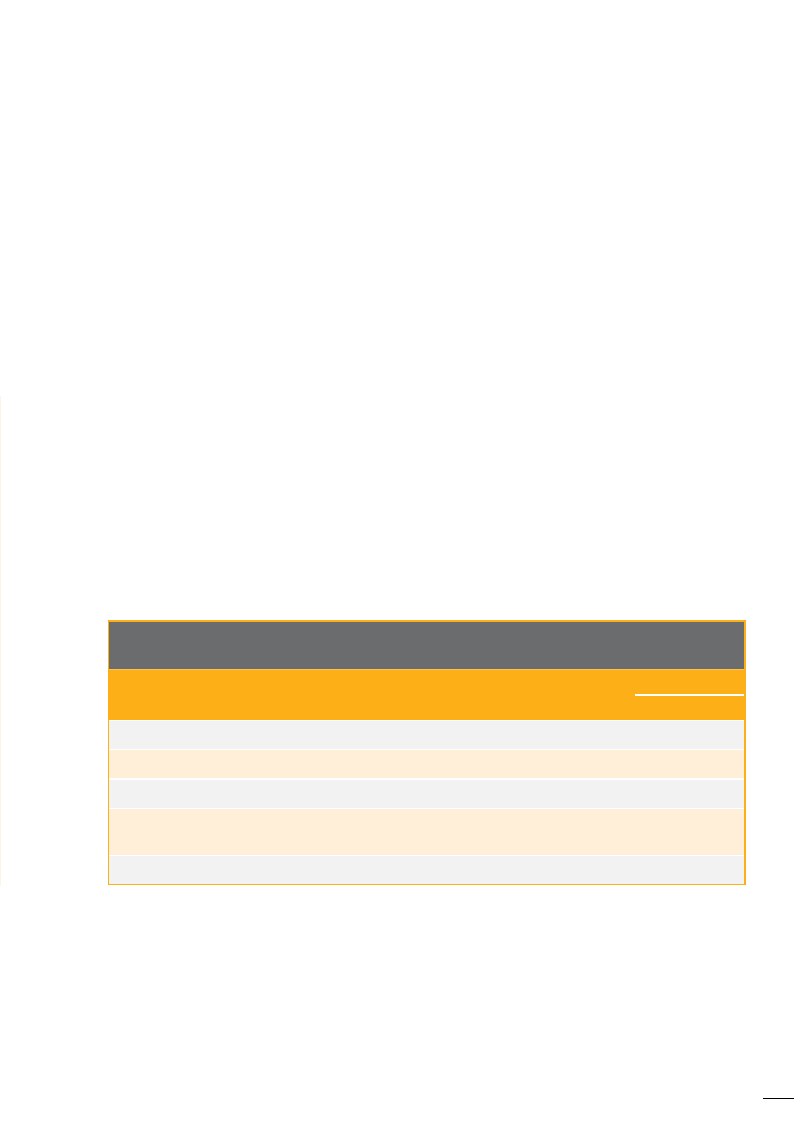
Table 1.1: Projected population for India by various sources, 2026–2300 [In million]
Authors/Institutions
Types of projections
2026
2051
2101 2300
1. Registrar General of India [2006]
2. Registrar General of India [2019]
3. Natarajan and Jayachandran [2001]
4. Srinivasan and Shastri [2001]
5. Visaria and Visaria [2003]
6. Dyson [2004]
7. Bhat [2004]
Alternative-1
Alternative-2
Alternative-3
Standard variant
High-variant
Standard variant
Low-variant
Optimistic scenario
1399
1423
1414
1409
1340
1330
-
1455
1419
1391
1380
-
-
1646
1628
1295
1416
1619
1730
1578
1458
-
-
-
-
-
-
-
-
-
-
-
-
-
1812 -
-
-
-
-
-
-
-
-
8. PFI and PRB [2007]
9. United Nations [2004]
10. United Nations [2005]
11. United Nations [2024]
12. United Nations [2024a]
13. Kulkarni [2021]
14. Rajan and Retnakumar [2025]
Realistic scenario
Scenario A
Scenario B
Medium-variant
Low-variant
Medium-variant
High-variant
Standard projection
Probabilistic method
[median]
Scenario-C [TFR=1.74]
1403
1464
1449
-
1314
1395
1476
1470
1476
-
1431
-
1823
1751
1531
1332
1592
1889
1681
1683
1640
1605
-
2181
1853
1458
-
-
-
1509
1505
-
-
-
1372
-
-
-
-
-
1492 -
Note: The projection horizon of the probabilistic method extends only until the year 2100. The IIMAD and PFI [2025]
projections differ from those reported by the same authors [14].
Sources: 1 and 2 Technical Group 2006; 2019, 3. Natarajan and Jayachandran 2001, 4. Srinivasan and Shastri 2001,
5. Visaria and Visaria 2003, 6. Dyson 2004, 7. Bhat 2004, 8. PFI and PRB 2007; 9,10, 11 and 12 United Nations, 2004;
2005; 2024; 2024a 13. Kulkarni 2021, 14. Rajan and Retnakumar 2025.
POPULATION FOUNDATION OF INDIA 9

4.2 Page 32

▲back to top


Some of these population projections are exclusive to the national
level, while others include estimates of the population at the national
[All India] and state level. In this report, national refers to India as an
aggregate unit. Table 1.1 exhibits a comprehensive overview of the
main population projections and their outcomes. These projections,
considering the various scenarios [alternatives/variants], indicate that
the population of India will be between 1314 and 1476 million in 2026.
In 2051, India is predicted to have a population of 1295–1889 million.
1.3 Rationale for a fresh population projection for India
India is positioned
to assume a central
role in shaping
global demographic
trends, underpinned
by its youth-
dominant age
structure and
the potential to
effectively leverage
demographic,
gender and silver
dividends for
sustained economic
development.
The rationale for a fresh population projection for India is driven by
several critical factors. The entire world has been closely following
India’s demographic trajectory, as the country has become the most
populous nation, surpassing China. India’s population was expected to
touch 1425.8 million in April 2023, thereby matching and subsequently
surpassing the population of mainland China [15]. As per the United
Nations [UN] estimate India’s population in 2025 is projected at
1457 million under the medium-variant, representing 17.7 percent
of the global total of 8231 million [16]. The working-age population
[15–59] constitutes 947.4 million—close to 65 percent of the total
population. India is witnessing a progressive shift towards old-age
structures, indicative of a rapidly ageing society. In 2022, the country
had an estimated 149 million persons in the 60 and above category—
roughly one in ten persons. By 2050, the proportion of older persons
is expected to double to more than two in ten or 20.8 percentage of
the population, with their absolute number soaring to 347 million
[17]. Thus, India is positioned to assume a central role in shaping
global demographic trends, underpinned by its youth-dominant
age structure and the potential to effectively leverage demographic,
gender and silver dividends for sustained economic development.
This accounts for an essential demographic milestone, wherein India’s
population growth is sustained by population momentum arising from
its underlying base population. Therefore, a nuanced understanding of
the likely structure, composition, and growth trajectories of national-
and state-level demographics is becoming increasingly vital. Given
their ability to anticipate future demographic changes, population
projections offer valuable insights for shaping medium-term planning
and policy-making strategies—a fact well documented in the scientific
literature.
Most importantly, many population projections currently in use are
based primarily on data from old censuses. Thus, it fails to reflect
recent demographic changes, including shifts in fertility, mortality,
10 POPULATION FOUNDATION OF INDIA

4.3 Page 33

▲back to top


and migration patterns. Although projections such as those by
Kulkarni [13] utilise data from the 2011 Census, their scope is limited
to only 21 states with populations exceeding five million. Thus,
the exclusion of several states diminishes the relevance of these
projections for formulating region-specific policies.
Migration is likely to play a pivotal role in structuring demographic
patterns at both ends of the migration corridor, yet its significance has
remained underexplored for close to one and half decade, notably
in the context of missing census data. As per the Periodic Labour
Force Survey [PLFS] [2020-21], the overall migration rate in India was
28.9 percent, with the rural population reporting a migration rate
of 26.5 percent. Among all the migrants, 10.8 percent account for
employment driven motivations as the reason for their migration [18].
Extensive evidences illustrate that significant migration flows have
persisted from the labour surplus northern states to the southern
states in the country [19, 20, 21]. There are demographic impacts of
large-scale migration on both sending and receiving states, yet they
are often inadequately addressed in population projections. With
the exception of the projections prepared by the Technical Group [2],
PFI [8] and Rajan and Retnakumar [14], all other population projections
have disregarded migration, treating it as an insignificant component
of demographic change. Most of them argue that in all the censuses,
data on duration of residence 0–9 years and the place of last residence
indicate that state-wise net-migration rates are insignificant. In the
backdrop of ongoing demographic transition, migration appears to
have become a key driver of population change, as reflected in the
substantial movement of in-migrants to the southern states and to
states such as Punjab, Maharashtra, and Gujarat from labour surplus
states across the country.
Migration is likely
to play a pivotal
role in structuring
demographic
patterns at
both ends of the
migration corridor,
yet its significance
has remained
underexplored
for close to one
and half decade,
notably in the
context of missing
census data.
In several existing population projections extending to 2051, the
anticipated pace of fertility decline at both national and state level
has not materialised as expected. For example, Natarajan and
Jayachandran [3] projected that the national TFR would reach 1.7
by 2021, alongside a TFR of 3.7 for Uttar Pradesh in the same year.
Contrary to the projections, the national TFR in 2021, as reported
by SRS, stood at 2, considerably higher than the estimated TFR.
Likewise, projections estimated a TFR of 3.7 in Uttar Pradesh for 2021;
however, actual fertility levels fell to 2.7 children per woman, exactly
one child less than the estimated figure. Misapprehending fertility
levels—whether through overestimation or underestimation—can
significantly twist the projected population figures, especially in the
heavily populated states, often leading to substantial irregularities
POPULATION FOUNDATION OF INDIA 11

4.4 Page 34

▲back to top


A fresh population
projection has
been undertaken,
incorporating
the revised
demographic
assumptions
and improved
methodologies to
facilitate evidence-
based decision-
making and
forward-looking
strategic planning.
from the actual demographic outcomes. Similarly, the assumptions
underlying the PFI and PRB projections [8] are increasingly at odds
with empirical evidence. Scenario-A posited that fertility levels in India
and most of its states would remain marginally below replacement for
an extended period, while Scenario-B set 1.85 as the lower limit over a
prolonged duration. Recent SRS data indicate that fertility rates have
already declined to an average of around 1.5 in nearly half a dozen
Indian states. Evidence from global studies highlights that India’s
TFR has declined to 1.9, with more developed regions recording an
average of approximately 1.5, while less developed regions report a
higher average of 2.4 children per woman [22]. This largely calls for an
updated population projection for India and states for better planning
and policy implementation.
Many nations, including India, postponed their census operations
due to the pandemic, leaving huge gaps in accurate population
estimates at the national and state level. This may have introduced
significant uncertainty into the demographic trends, especially in
longevity and age structure of the population. These projections are
essential to inform tailored policy interventions across sectors such
as healthcare, education, infrastructure development, sustainable
development, skills, migration, and governance, among others. The
current population projection is anticipated to deliver the most robust
assessment of India’s demographic dynamics over the next three
decades. For the most accurate and current population estimates,
the latest available death rates from the SRS were taken into account,
to reflect their influence on life expectancy at birth. In light of these
developments, a fresh population projection has been undertaken,
incorporating the revised demographic assumptions and improved
methodologies to facilitate evidence-based decision-making and
forward-looking strategic planning.
1.4 Organisation of the report
The report comprises ten broad thematic sections, each addressing a
key aspect of the population projection. The first two sections present
the report’s main theme, and the remaining sections are Appendix
Tables. More specifically, the first section exhibits the context, rationale,
data sources, a brief overview of the methodologies, and key findings.
In addition, this section also addresses the broader policy implications
arising from the population projections. The second section outlines
a comprehensive overview of the methodology and its application
within the context of this exercise. Sections three through ten consist
of Appendix Tables detailing the inputs used and outputs generated
from the projections.
12 POPULATION FOUNDATION OF INDIA

4.5 Page 35

▲back to top


1.5 Methodological approaches to population projections
To project the population of 22 states, each with a population
exceeding six million as per the 2011 Census, the cohort-component
method was employed. This approach enables systematic modelling
of future population change by incorporating fertility, mortality, and
migration components to the mid-21st century, specifically up to the
year 2051. The basic requirement for population projection is the
availability of a reliable base-year population. In the absence of a
more recent census, the smoothed age sex structure of 2011 Census
provided by the Technical Group [2], were carried forward to 2021
and used as the starting point in the projections. Subsequently, the
procedure entails the application of robust methodologies for the
formulation of future assumptions on each of the key demographic
inputs—fertility, mortality, migration, and SRB.
Mostly these assumptions were grounded in the principles of
historical trends, recent empirical evidences, and the judgement
based on the experience from the rest of the world. By adopting
these procedures, it is expected that population projections become
methodologically sound and provide estimates closely aligned with
future demographic realities. Fertility was projected using the SRS
data in conjunction with the Gompertz Curve—a parametric function
widely employed in modern demographic research. Most state-level
population projections, which account for varying levels of fertility,
typically assume zero net migration. However, when it comes to
mortality, most projections adopt only a single set of assumptions
regarding life expectancy. Most models continue to apply a uniform
convergence trajectory for fertility, despite marked regional
disparities in both current fertility levels and the pace of their decline.
For instance, in 2021, India has displayed stark regional disparities
in fertility levels, with rates ranging from 1.4 children per woman in
West Bengal and NCT of Delhi to 3.0 in Bihar. Such wide variations in
demographic inputs, especially fertility, introduce an added layer of
uncertainty to population projections.
The model
employed in the
present population
projection uses
differentiated
fertility
assumptions that
reflect the observed
variation in fertility
transitions across
states.
Therefore, depending on uniform assumptions in population
projections can be problematic, as it overlooks regional heterogeneity
and may result in inaccurate estimates. To overcome this limitation,
the model employed in the present population projection uses
differentiated fertility assumptions that reflect the observed variation
in fertility transitions across states. To project the future pattern of
age-specific fertility rates, the percentage distribution of age-specific
fertility observed in the 2021 SRS data was applied to the projected
POPULATION FOUNDATION OF INDIA 13

4.6 Page 36

▲back to top


Migration patterns
were projected
using multiple
datasets and
a variety of
methodologies,
including
convergence models
that capture
the dynamics of
internal migration
in the country.
TFR for 2051. This method largely ensures that the estimated age-
specific fertility rates align with the overall fertility decline expected
over the projection period.
Life expectancies were projected using both the existing and
newly generated abridged life tables derived from the SRS data,
complemented by the application of the Lee-Carter mortality
forecasting model. Model life tables were selected based on a careful
assessment of the prevailing demographic scenario in the states
under study, following a systematic evaluation of its suitability.
Migration patterns were projected using multiple datasets and
a variety of methodologies, including convergence models that
capture the dynamics of internal migration in the country. The SRB
was projected using convergence models, employing a methodology
similar to that applied for projecting the migration trends.
At both national and state level, population projections are presented
in three variants—low, medium, and high—to capture the range of
demographic scenarios to acknowledge the inherent uncertainties
in population projections. The low- and high-variants delineate
the lower and upper limits of the projected population, thereby
offering a range of the possible projected population. In contrast,
the medium-variant is expected to provide the realistic estimate
of the future population, reflecting demographic trends that are
most consistent with current trends. The distinction among the low,
medium, and high-variants is determined solely by the application
of three different sets of fertility assumptions, while assumptions
pertaining to mortality and migration remain constant across all
three scenarios. This is because fertility levels tend to be more
volatile and are shaped by policy interventions and shifts in societal
behaviour. Conversely, improvements in life expectancies occur
slowly and typically follow the predictable trajectories. One of the
primary challenges in formulating alternative population projection
scenarios is the lack of reliable migration data.
Projections of the rural and urban populations were conducted using
the census data from 2001 to 2011 and UN revised URGD method
[2018] to capture the distinct dynamics of spatial demographic change.
In contrast to the three variant national and state-level population
projections, the urban-rural projections use only a single set of
scenarios to illustrate the potential changes in the urban-rural mix.
A summary of each component in table below will enable the readers
to quickly identify the methodology and locate the corresponding
outputs generated from the population projections [Table 1.2].
14 POPULATION FOUNDATION OF INDIA

4.7 Page 37

▲back to top


Table 1.2: Detailed description of inputs and outputs related to population projections
Sl. Concepts/inputs used in the
No. projections
Detailed
description
[Section]
Output tables
1. Approach to population projection Section [2.1] National projections [low variant and high
for major states
variant] [Appendix Tables 3.7 and 3.8]
2. Establishing base year population Section [2.2] State-level projection tables [medium-
variant] [Appendix Tables 4.1 to 4.70]
3. Assumptions on fertility
Section [2.3] Appendix Table 3.1
4. Assumptions on mortality
Section [2.4] Appendix Table 3.3
5. Assumptions on migration
Section [2.5] Appendix Tables 3.4 and 3.5
6. Assumptions on SRB
Section [2.6] Appendix Table 3.6
7. URGD projection
Section [2.8] Appendix Table 5.1
8. Approach to population projection Section [2.9] Appendix Table 8.1
for smaller states
1.6 Sources of data
The main demographic data inputs used for population projections
are drawn from the Census, SRS, NFHS, National Sample Survey
Organisation [NSSO] or National Statistical Office [NSO], Multiple
Indicator Survey [MIS], CRS and various other secondary sources
such as state-level migration surveys conducted in 2023 in Kerala,
Odisha and Jharkhand. SRS provides time series data on the two
main demographic measures, such as fertility and mortality, at the
national and state levels. Data from the census and the PLFS serve as
the primary sources for assessing future migration trends. NFHS data
has been used in this study to understand the fertility preferences of
the women of reproductive age to assess how these preferences may
evolve in the future. It is also used to examine prospective trends in
the SRB in selected states. Data from these sources have been used at
various time points, depending on their availability and accessibility.
1.7 Methodological tribulations
In actual practice, population projections are carried out
independently at the national and state level, using distinct
demographic assumptions. This parallel approach, while necessary to
apprehend the local heterogeneity and national trends respectively,
often results in incongruity between the aggregated state-level
projections and the independently derived national population
totals. However, although state-level population estimates should
POPULATION FOUNDATION OF INDIA 15

4.8 Page 38

▲back to top


The accuracy
of population
projections is
contingent upon
the availability
of reliable
demographic
inputs, which
are equally
indispensable
for tracking
progress in health
outcomes and the
broader human
development
indices.
theoretically sum to the national total, this alignment rarely occurs
in practice—a common issue encountered and seldom addressed
in population projections. Consequently, the wide variation in state-
level differences in demographic indicators may be obscured when
viewed through national-level aggregates, especially given the
implications of divergent future trends in demographic inputs. Such
conflicting results arise from multiple factors, notably variations in
assumptions about the demographic components. The national-
level population projections often neglect internal or international
migration, whereas state-level projections tend to incorporate inter-
state migration, contributing to the mismatch between the two
estimates of the population. Consequently, we hypothesise that
the national population figures diverge significantly from the totals
derived by summing the projected populations of all the states and
the UTs, and we evaluate the magnitude of such deviation. In order to
mitigate this inconsistency, the national-level population estimates
are computed by aggregating the projected population figures of all
the states and UTs and compared with the national-level projections
to measure the magnitude of deviation.
1.8 Data quality considerations
Prior to developing the population projections, it is crucial to evaluate
the quality, reliability, and robustness of the underlying data and
the assumptions underpinning them. The accuracy of population
projections is contingent upon the availability of reliable demographic
inputs, which are equally indispensable for tracking progress in health
outcomes and the broader human development indices. The SRS
system has lacked a systematic mechanism to evaluate the quality
of key demographic inputs—such as fertility and mortality—since
the beginning of this century. For instance, between 2001 and 2010,
the SRS is estimated to have missed reporting around three percent
of births—accounting for nearly 0.8 million cases—an omission with
serious implications for demographic estimates. Over this period, the
SRS is estimated to have omitted approximately four percent of male
deaths and 11 percent of the female deaths among those aged five
and above, underscoring the magnitude of under-reporting and the
considerable variation across states in the completeness of the very
important vital rates [23]. The margin of error in data inputs holds
significant implications for policy and planning decisions, as well as for
the reliability of projected outcomes—a major limitation often driven
by factors beyond our control. Due to the unavailability of consistent
and reliable time-series data on demographic indicators from
alternative sources, SRS data remains the primary basis for population
projections. In certain contexts, within the study, data from other
reliable sources have also been utilised.
16 POPULATION FOUNDATION OF INDIA

4.9 Page 39

▲back to top


1.9 A word of caution
It is essential to frame realistic assumptions about demographic
trends that will influence future population size. Although we are
unable to foresee the magnitude of each variable’s influence on future
population size, we may be able to develop reasonably well and good
approximations of demographic inputs of historical data to arrive at
future trends. Fertility would be the most critical variable influencing
future population growth. It is important to keep in mind that the
population for the projected period, especially in a medium-term
projection, may differ from the actual population, given how rapidly
the socio-economic landscape is changing globally, including in India.
The assumptions could undergo dramatic changes due to unforeseen
events such as economic crises, migration, or political unrest. As noted
in the preceding section, data quality—such as the timeliness and
accuracy of the information—fundamentally shapes the veracity of the
projected outcomes.
Projecting demographic trajectories presents considerable challenges,
given that they are guided by a complex web of socio-economic and
cultural factors, whose cumulative and often nonlinear interactions
render such projections highly uncertain. Unforeseen events—such as
pandemics, conflict-induced displacement, and climate change—can
also profoundly shape future population and introduce considerable
uncertainties into population projections. Hence, caution must be
exercised when interpreting projected demographic outcomes, as they
are contingent upon various underlying assumptions made during the
projection process. In sum, this population projection involves a degree
of uncertainty in the formulation of assumptions.
1.10 The dynamics of demographic variations
Assessing the future demographic trends across India’s regions is
critically significant, given our vast geographical scale and pronounced
demographic diversity. Characterised by these heterogeneous traits—
embracing densely populated million+ cities to the thinly inhabited
remote rural villages and tribal inhabitants—our country presents
a highly complex web of geographic and demographic dynamics.
A layered understanding of regional dynamics of population growth,
demographic composition, age structures, and migration patterns are
pivotal for informed policy-making and for the pursuit of sustainable
development goals. In addition, it accentuates multiple transformative
constraints—such as the devolution of central government funds,
political representation, and balanced infrastructure development—
all of which increasingly hinge on demographic weight as a critical
variable in decision making.
It is important to
keep in mind that
the population
for the projected
period, especially
in a medium-term
projection, may
differ from the
actual population,
given how rapidly
the socio-economic
landscape is
changing globally,
including in India.
POPULATION FOUNDATION OF INDIA 17

4.10 Page 40

▲back to top


Region-wise
demographic
assessments are
necessary for
advancing equitable
and efficient
management within
India’s diverse
context, especially
as demographic
factors become
increasingly
important in policy
decisions.
In short, region-wise demographic assessments are necessary for
advancing equitable and efficient management within India’s diverse
context, especially as demographic factors become increasingly
important in policy decisions. For instance, as we have seen
earlier, states—particularly those in the southern region—which
invested in early family planning initiatives, girls’ education and
women’s empowerment were able to reduce population growth
rates. Subsequently, these states witnessed a gradual decline in
their relative share of the national population. Consequently, a
pronounced demographic divergence has emerged across various
regions in the country, driven by different trajectories of fertility and
mortality decline, and the population momentum. Demographic
disparities have continued to widen and are expected to persist,
especially between these regions, which are at different stages of
the demographic transition. It is widely acknowledged that the full
implications of demographic variations for socio-economic and
demographic frontiers are yet to be realised, as their long-term
effects on development, labour markets, and population dynamics
continue to unfold.
Variations in the trajectory of demographic transition across the
country have resulted in pronounced disparities between states,
situating them within markedly different demographic brackets.
Such a regional assessment is important since the regions are at
different stages of demographic transition. As an initial step, the
states were grouped into regions on the basis of their geographical
location to facilitate a regional assessment. A large number of studies
have classified India into regions comprising different states, and
there exists a great extent of unanimity in categorising states. For
categorising regions, India has been divided into six regions, such as
north, central, east, west, south, and north east. The classification of
states into regions follows the delineation provided in footnote 1 of
the executive summary.
1.11 Key insights from the national population projections
[2021–2051]
This section examines the projected population results of medium-
variant projections for the period 2026–2051. India’s demographic
transition over the next three decades will be characterised by a
steady decline in fertility and constant improvements in life
expectancy. The TFR is projected to decline from the current level
of two children per woman in 2021 to 1.67 by 2051 under medium-
variant assumptions [Table 1.3]. A summary of the state-wise
projected population by gender under the low, medium, and high
variants are presented in Appendix Tables 3.9, 3.10, and 3.11. These
18 POPULATION FOUNDATION OF INDIA

5 Pages 41-50

▲back to top


5.1 Page 41

▲back to top


results corroborate the broader fertility trajectories foreseen for the
majority of developing countries on the planet. Fertility is projected
to decline in all parts of the country, though at a varying pace. In
contrast to historical trends, northern states are expected to drive
the next phase of fertility decline in the country, given that most
of the southern states have already entered advanced stages of
fertility transition.
Table 1.3: Projected summary of demographic indicators for India, [medium-variant]
2026–2051
Indicators
2026
2031
2036
2041
2046
2051
Fertility indicators
Total Fertility Rate
1.85
1.75
1.70
1.68
1.67
1.67
Gross Reproduction Rate
0.88
0.83
0.81
0.80
0.80
0.80
Net Reproduction Rate
0.85
0.81
0.79
0.79
0.79
0.79
Mean Age of Childbearing
26.70
26.80
26.90
26.90
27.00
27.10
Child-Woman Ratio
0.29
0.26
0.24
0.23
0.23
0.24
Mortality indicators
Male Life Expectancy
68.1
69.7
71.2
72.7
74.1
75.4
Female Life Expectancy
72.9
74.9
76.6
78.3
79.8
81.4
Total Life Expectancy
70.5
72.2
73.8
75.4
76.9
78.4
Infant Mortality Rate
27.4
21.4
16.6
12.7
9.2
6.0
Under 5 Mortality Rate
33.1
25.1
19.1
14.5
10.3
6.4
Vital rates
Crude Birth Rate per 1000
15.5
13.8
12.6
11.9
11.3
10.8
Crude Death Rate per 1000
7.5
7.5
7.5
7.7
8.1
8.6
Natural Increase [percent]
0.79
0.63
0.51
0.42
0.32
0.22
Annual births and deaths [in million]
Births
21.90
20.18
18.96
18.35
17.79
17.11
Deaths
10.68
10.96
11.30
11.91
12.76
13.64
Population [in million]
Total
1415.1 1465.3 1506.7 1541.6 1569.6
1590.1
Male
726.2
750.6
770.1
786.0
798.3
806.8
Female
Percent 0–4
Percent 5–14
Percent 15–24
Percent 15–49
Percent 15–59
688.9
7.67
16.1
16.8
55.1
65.4
714.7
6.96
15.0
15.5
54.9
65.8
736.6
6.33
13.9
15.1
54.1
65.7
755.6
5.94
12.7
14.3
52.7
65.5
771.3
5.68
11.9
13.3
50.7
65.4
783.3
5.43
11.4
12.3
47.9
62.7
Percent 60 and above
Percent Females 15–49
10.8
54.7
12.9
54.2
14.0
53.1
15.8
51.6
18.0
49.7
20.4
46.8
Sex Ratio
105.4
105.0
104.5
104.0
103.5
103.0
Overall Dependency Ratio
52.8
52.0
52.2
52.8
55.3
59.3
Median Age
30.0
32.0
34.0
37.0
38.0
40.0
Source: Projected results
POPULATION FOUNDATION OF INDIA 19

5.2 Page 42

▲back to top


By 2051, six in
ten individuals
will remain in
the working-age
group, providing
considerable scope
for harnessing
human capital
for national
development.
The average number of daughters born per woman, technically termed
as the NRR, is expected to shrink from 0.85 in 2026 to 0.79 in 2036,
stabilising at that level thereafter. The CBR, another key indicator of
population growth, is projected to decline appreciably from 15.5 per
1000 population in 2026 to 10.8 by 2051. Consequently, the annual
number of births will fall from the current level of 21.9 million to
17.1 million during the same period. The primary driver behind such
demographic changes is the expected reduction in fertility rates likely
to happen over the next three decades. CDR, on the other hand, will
show a modest increase from 7.5 to 8.6 over the same period, reflecting
an increase in the ageing population and its consequences. As a result,
life expectancy is projected to record a modest increase, with male life
expectancy rising from 68.1 years in 2021 to 75.4 years in 2051, and
female life expectancy from 72.9 to 81.4 years. As a result, the rate of
natural increase in the population would fall from the current level of
0.79 percent to 0.22 percent [Table 1.3].
The share of children in ages 0–4 in the total population is projected
to decline from 9.3 percent in 2011 to 8.4 percent in 2021, and further
to 5.4 percent by 2051. Over the next three decades, the population
in the youngest age group will shrink more than 50 percent, reflecting
a sharp contraction at the base of the population pyramid. There will
also be a sharp decline in the proportion of children in the school-
age [5–14 years] from 21.4 percent to 16.8 percent and 11.4 percent
respectively. Beginning at 60.5 percent in 2011, the working
population [15-59] is projected to increase to the peak level of 65.8
percent in 2031, then gradually declining to 62.7 percent by the close
of the projection period. This will mark the beginning of decline of the
demographic dividend ushering in a new phase of demographic
transition with implications for the working-age population. Still, by
2051, six in ten individuals will remain in the working-age group,
providing considerable scope for harnessing human capital for
national development.
India’s total population is expected to reach 1590.1 million [2051] from
the current population [2021] of 1355.8 million, indicating an increase
of 17.3 percent or a 0.5 percent annual growth rate. This would be
more than three times lower than the 1.6 percent yearly population
growth recorded in 2001-2011 Census period. As a result, the
population projections we estimate for 2051 are considerably lower
than the medium-variant assumptions adopted in several other
projections, including those by Natarajan and Jayachandran [3],
Visaria and Visaria [5], PFI and PRB [8], and the United Nations [11]. A
key observation is that our current projected figures [IIMAD and
PFI-2025] are even lower than those of the latest estimates of the
20 POPULATION FOUNDATION OF INDIA

5.3 Page 43

▲back to top


United Nations [12], which employed probabilistic methodology2,
and Kulkarni [13], who used the traditional deterministic
approach3. Relative to our medium-variant projection of 1590.1
million for 2051, these projections are higher by 93 million and 50
million, respectively.
Figure 1.1: Projected population under different variants, 2021–2051
1600M
1500M
1400M
1300M
Years
High-variant
Medium-variant
Low-variant
1200M
2011
2016
2021
Source: Projected results
2026
2031
Years
2036
2041
2046
2051
2 Probabilistic population projections take a different approach from conventional deterministic
approach by building uncertainty directly into the key demographic inputs used for population
projections. Rather than offering a single set of estimates, they generate multiple possible
outcomes, expressed through probability intervals that indicate the likelihood of different future
scenarios. Applying Bayesian models or other stochastic techniques, this method blends country-
specific trends with global patterns, giving a more nuanced and realistic view of demographic
change.
3 The deterministic approach to population projection is the conventional cohort component
method applied in this report using the fixed assumptions regarding demographic inputs,
producing a single trajectory of population change without incorporating the element of
uncertainty in the demographic behaviour. For further discussion see Section: II [2.1].
POPULATION FOUNDATION OF INDIA 21

5.4 Page 44

▲back to top


This can be largely attributed to the use of updated fertility
assumptions. In contrast, our medium-variant projections are relatively
higher than the corresponding estimates by Srinivasan and Shastri
[4] and the United Nations [9]. A striking feature of our population
projections is that our estimates are broadly consistent with those of
Dyson [6], the United Nations [10], and Rajan and Retnakumar [14].
Despite a significant divergence between the low and high-variant
population projections, the difference between medium- and high-
variants appears to be very minimal [Figure 1.1]. Appendix Figure 2.1
exhibits India’s projected total population by gender from 2011 to 2051,
assessing scenarios with and without the impact of the pandemic.
Figure 1.2 presents the age structure of India’s population in 2011
and the projected age distribution for 2051, highlighting significant
demographic transitions over the four-decade period. In 2011, the
population pyramid had a classic youthful shape—wide at the base
and narrow at the top—reflecting high birth rates and a large number
of children, with relatively few elderly citizens. This pyramid reflects
the composition of a relatively young population—a hallmark of
the most developing nations across the globe. In contrast, by 2051,
Figure 1.2: Population pyramid for India, 2011 and 2051
80+
80+
75-79
75-79
70-74
66-69
70-74
66-69
60-64
60-64
55-59
55-59
50-54
45-49
4044
50-54
45-49
4044
35-39
35-39
30-34
30-34
25-29
25-29
20-24
20-24
15-19
15-19
10-14
10-14
5-9
5-9
0-4
80 60 40 20 0
0-4
20 40 60 80 80 60 40 20 0
20 40 60 80
Population in million
Male Female
Male Female
22 POPULATION FOUNDATION OF INDIA

5.5 Page 45

▲back to top


the population pyramid is expected to attain a more rectangular or
columnar shape. This anticipated age structure is an indication of a fall
in birth rate, resulting in a narrower base, while the middle segment—
representing the working-age adult population—becomes more
prominent. Additionally, the widening upper segment of the pyramid
signals a substantial increase in the elderly population. Overall, the
emerging demographic pattern exhibits a transformation from an
overwhelmingly young population to one increasingly characterised
by ageing, as a consequence of declining fertility rates and rising
longevity contributing to a more balanced, yet progressively older,
age distribution.
Based on the projected demographic trends, Uttar Pradesh is expected
to remain the most populous state in the country, consistently
maintaining this ranking from 2011 over the course of the subsequent
four decades. With a population share of close to 17 percent in 2011,
the state is projected to expand its demographic contribution to
19.3 percent over the next 40 years, corresponding to an estimated
population size of more than 307 million. [Figure 1.3].
Figure 1.3: Ranking of states by population size [medium-variant], 2011 and 2051 [in million]
Uttar Pradesh [1/1]
199.8
307.2
Maharashtra [2/3]
112.4
126.9
Bihar [3/2]
104.1
170.5
West Bengal [4/5]
91.3
102.9
Madhya Pradesh [5/4]
72.6
106.3
Tamil Nadu [6/7]
72.1
77
Rajasthan [7/6]
68.5
101.4
Karnataka [8/9]
61.1
69.1
Gujarat [9/8] 60.4
75.7
Andhra Pradesh [10/10]
Odisha [11/11]
Telangana [12/15]
Jharkhand [14/13]
49.4 53.2
42 50.4
35.2 41.3
33 47.6
Year
2051
2011
Punjab [16/12] 27.7 50.4
Kerala [13/16] 33.4 35.5
Assam [15/14] 31.2 42.1
Chhattisgarh [17/17] 25.5 33.8
Haryana [18/18] 25.4 32
NCT of Delhi [19/19] 16.8 20.5
Jammu and Kashmir UT [20/20]12.315.5
Uttarakhand [21/21]10.112.4
Himachal Pradesh [22/22] 6.97.7
0
100
200
300
400
500
Population [in million]
POPULATION FOUNDATION OF INDIA 23

5.6 Page 46

▲back to top


By 2051, the population rankings of the states are expected to change
dramatically compared with their positions in 2011, primarily due to
differences in population growth. With the exception of Uttar Pradesh,
the remaining four states among the five most populous—Maharashtra,
Bihar, West Bengal, and Madhya Pradesh—are expected to alter their
positions in terms of population rankings. Maharashtra, which was the
second most populous state in 2011, is projected to drop to third place
by 2051. Conversely, Bihar, which was third in 2011, is expected to rise
to the second position in terms of population size by the end of the
projection period. West Bengal, ranked fourth in 2011, is expected to
drop to fifth position, whereas Madhya Pradesh, which held the fifth
spot, is projected to rise to fourth place in the years ahead. Appendix
Table 4.71 presents the ranking of states based on their demographic
weight in 2011 as well as on projected population figures up to 2051.
Appendix Tables 3.9 to 3.11 present the state-wise gender-specific
population projections under the low, medium, and high-variants.
Appendix IV presents detailed state and gender-wise population
projections up to the mid of this century [2026–2051], based on the
medium-variant approach, presented in 70 tables numbered Appendix
Tables 4.1 to 4.70. Projections corresponding to the low-and high-
variant scenarios are not presented in comparable detail, given their
relatively limited use in policy and planning contexts.
Appendix Table 3.12 reviews the state-level population growth
projections over the coming decades, revealing stark contrasts among
them. All the southern states, along with Maharashtra and West Bengal,
are projected to record the lowest population growth rates over the
next three decades. As a result, they are nearing population
stabilisation—largely driven by the historically low and the below-
replacement fertility levels coupled with ageing population. Starting
in 2036, all major southern states are expected to enter a phase of
depopulation. In contrast, states such as Bihar, Uttar Pradesh, Rajasthan
and Madhya Pradesh are projected to maintain average annual growth
rates of 0.8 percent or higher. India’s annual population growth is
expected to plummet—dropping from 1.9 percent during 1981–2011 to
just 0.5 percent over the projected period, falling to roughly a quarter
of its previous value. However, population momentum will ensure a
slow march toward population stabilisation, as the existing legacy of the
age structure continues to drive the population growth for ages.
1.11.1 Projected trends in elderly population
The proportion of the elderly population [aged 60 and above] rises
substantially from 9.6 percent in 2021 to 20.4 percent in 2051, almost
double the proportion of elderly within the next 30 years. Additionally,
another indicator of ageing, the median age [divides the population
24 POPULATION FOUNDATION OF INDIA

5.7 Page 47

▲back to top


equally in terms of age] will increase from the 2021 level of 28 years
to 40 years, reinforcing the ongoing advanced stages of demographic
transition in the country [Table 1.3]
Three basic demographic indices are used to measure the ageing
process in the country: i] Ageing Index [AI] ii] Young Dependency
Ratio [YDR] and iii] Old Dependency Ratio [ODR]. AI measures the
comparative size of the elderly population to the young population
in a country. YDR measures the economic burden imposed by the
young population depending on the working-age group, while the
ODR assesses the magnitude to which the elderly population relies on
working-age population for economic support. In 2021, India’s AI score
was less than 40, indicating that there were approximately 40 elderly
persons [60+] for every 100 children [0–14]. This ratio is projected
to increase to 55 in 2031 and touch 122 by the end of the projection
period, indicating a transition from a skewed elderly-child population
ratio to a more balanced demographic structure between the two
age groups [Appendix Table 4.72]. In 2021, the YDR for India was 40,
closely corresponding with AI, pointing out that there were nearly
40 children per every 100 persons in the working-age groups. This ratio
is expected to decline to 33.5 in 2031, 28.6 in 2041 and 26.7 at the end
of the projection period, implying a sustained reduction in the child
dependency burden on the working segment. Conversely, the ODR in
2021 showed that approximately 15 elderly persons were supported
by every 100 persons in the working ages. This figure is estimated
to rise to 18.5 by 2031 and further increase to 33 by the end of the
projection period, reflecting a growing burden of elderly dependents
on the working-age population. Throughout the period under analysis,
all dependency ratios remain more favourable in the northern region
compared to the southern region, largely because the latter has
progressed at a more advanced point of the demographic transition.
Three basic
demographic
indices are used
to measure the
ageing process
in the country: i]
Ageing Index ii]
Young Dependency
Ratio and iii] Old
Dependency Ratio.
As an illustration, in 2021, Kerala—widely recognised as the most
demographically advanced state in the country—recorded an AI of
82, YDR of 31, and ODR of 25. These figures are projected to change
to 239, 23, and 54, respectively, by the end of the projection period.
In comparison, Bihar, which is advancing to the evolving stages of
demographic transition, reported significantly lower values in 2021, with
an AI of 27, YDR of 49, and ODR of 13. By the end of the projection period,
these figures are expected to change to 79, 30, and 24, respectively.
1.11.2 Major insights from the regional population projections
Region-specific population projections yield a granular view of
demographic shifts, providing indispensable guidance for equitable
growth, effective regional planning and resource sharing, among
others. Such an assessment reveals that the demographic composition
POPULATION FOUNDATION OF INDIA 25

5.8 Page 48

▲back to top


of the regions has undergone notable transformations over the past
four decades [1971–2011]. As the northern and central regions gained,
the eastern and southern regions correspondingly exhibited a decline
in their shares. Nevertheless, the western and north-eastern regions
registered only a marginal increase in their proportions. The central
region saw the largest demographic shift, with its share increasing
from 30.6 percent in 1971 to 33.2 percent in 2011, in contrast to the
southern region, whose share declined from 24.9 percent to 21 percent
during the same period [Appendix Table 4.73]. By the end of the
projection horizon, the eastern region is set to slip from 13.4 percent
to 12.6 percent, the southern region from 20.1 percent to 17.7 percent,
while the central region’s share is poised to climb from 34.6 percent to
38.8 percent [Appendix Table 4.74].
Looking ahead, the gap is expected to widen considerably: the central
region is expected to expand its share, while the share of the southern
states is projected to shrink steadily. By the closure of the projection
period, the northern and central regions together will account for more
than half of India’s population. Owing to its enduring demographic
dynamics, these regions continue to serve as the principal centre
of demographic gravity—a position it has historically held and is
projected to maintain in the coming decades.
The future age
composition of
a population is
largely shaped by
its present position
in the demographic
transition as well
as the pace at
which it converges
toward the more
advanced phases
of that transition.
Understanding the regional age structure of the future population
is also important in many respects to governments, programme
implementing agencies and business organisations in multiple
ways. In addition to the overarching goals of regional assessment
described earlier, a systematic assessment of the age-cohorts enables
us to evaluate current needs and anticipate emerging challenges—
particularly in the areas of education, labour market dynamics,
economic stability, and the social well-being of the citizens. The future
age composition of a population is largely shaped by its present
position in the demographic transition as well as the pace at which
it converges toward the more advanced phases of that transition. In
practice, age‑specific regional population tables yield marginally lower
population totals compared to the aggregate regional figures, since
age distributions are not estimated for the smaller states and the UTs.
Population projections for the next three decades [from 2021 to
2051] indicate a clear demographic transition unfolding across India’s
regions, as evidenced by evolving population structures across
broad age cohorts [Table 1.4]. The proportion of children [0–14] falls
significantly nationwide, most sharply in the central and northern
regions, while the south—at a more pronounced demographic
transition stage—sees only a relatively smaller decline. In all cases,
however, the decline is expected to be more than 35 percent [Appendix
Figure 2.2].
26 POPULATION FOUNDATION OF INDIA

5.9 Page 49

▲back to top


Table 1.4: Regional percentage share of population by broad age groups, 2021–2051
Region
Share of 0–14
Share of 15–59
Share of 60+
2021
2051
2021
2051
2021
2051
North
24.6
14.8
65.8
62.1
9.6
23.1
Central
28.9
18.6
62.9
65.0
8.2
16.4
East
22.5
13.9
66.9
61.1
10.6
25.0
West
22.2
13.4
66.7
59.9
11.1
26.6
South
20.4
13.0
67.0
58.2
12.6
28.8
Notes: No age-specific estimates have been computed for the north-eastern states.
Appendix Table 4.75 exhibits the projected demographic dynamics,
disaggregated by broad age groups, across major regions for the next
three decades from 2021 to 2051. The working-age population [15–59]
cohort will exhibit regional divergence: stability in the central region
contrasts with notable declines elsewhere, especially in the south. The
proportion of the working-age population in this region has followed
a sustained upward trajectory, reaching 62.9 percent in 2021 and
projected to rise further to 65 percent by the end of the projection
period, thereby reflecting the persistence of a demographic dividend.
In contrast, the southern region is experiencing a contraction in its
workforce, with the proportion—having reached its peak—anticipated
to decrease from 67 percent at present [2021] to 58.2 percent by
the end of the projection horizon [Appendix Figure 2.3]. The decline
in the working-age population is projected to unfold in a staggered
sequence across regions, beginning in the eastern region after 2026,
and subsequently in the northern and western regions after 2031. The
excess labour force in the northern region may trigger further labour
migration to the southern region in the years to come, where labour
shortages tend to keep wages high.
The proportion of the population of the elderly [60+] is projected to
increase across all regions, with the magnitude of growth ranging
from approximately 100 percent in the central region to nearly
140 percent in the northern region [Appendix Figure 2.4]. In short, the
central and northern regions are projected to maintain comparatively
youthful demographic structures, whereas the southern and western
regions will likely undergo relatively higher rate of population ageing
by 2050. However, the oldest-old population [80+] is projected to
grow at a considerably higher pace than the elderly population as a
whole, with a regional hike estimated to range from 171 percent in
the central region to nearly 300 percent in the eastern region over the
next three decades [Appendix Figure 2.5]. This trend highlights the
intensification of advanced population ageing and the corresponding
rise in the dependency burden of the working population. The projected
population by region, age and gender is provided in Appendix Tables
4.76, 4.77 and 4.78, respectively.
POPULATION FOUNDATION OF INDIA 27

5.10 Page 50

▲back to top


1.11.3 When parts don’t equal the whole: Comparative assessment
of the projected populations
In the first section [1.7], we hypothesised that the medium-variant
population projection at the national level would be significantly
different from the added-up population estimates of the states and
the UTs by the end of the projection period. However, the comparison
of our population projections at the national level is estimated to
be 1590.1 million, while the separately added-up total from the
state accounts for 1589.5 million in 2051 [Figure 1.4]. This highlights
that there is only a minimal difference of 0.6 million, equivalent to
0.03 percent of the population, suggesting an almost negligible
quantum of discrepancy between the projected figures.
Figure 1.4: Projected population of India using four different projection methods, 2021–2051
1600
1550
1500
1450
1400
1589.5
1590.1
1579.2
1572.4
1589.5
1569.6
1547.6
1546.4
1548.8
1571.6
1538.2
1516.2
1510.0 1518.8
1506.6
1473.4
1491.8
1466.9
1465.3
1457.1
Added-up population
High-variant
Low-variant
Medium-variant
1422.8
1415.4 1415.1
1422.3
1350
1355.8
1355.8
1355.8
1355.8
2021
2026
2031
2036
2041
2046
2051
Years
Source: Projected figures
Notes: The term ‘Added-up population’ expresses the aggregated population obtained by summing the
populations of all states and UTs in the country. The figures are in million.
28 POPULATION FOUNDATION OF INDIA

6 Pages 51-60

▲back to top


6.1 Page 51

▲back to top


Therefore, our hypothesis is rejected and we found that there is
no significant difference between the medium-variant population
projection at the national level and the added-up population
estimates at the states level. As the subtitle highlights, there are
possibilities of discrepancy between the aggregated populations of
the states compared to the national population totals, which are
always unlikely to align. However, contrary to the prevailing argument,
our findings exhibit that the parts and the whole are in strong
harmony, with the aggregated state populations being identical to the
national population estimates.
1.11.4 Validation of the population projection
Validating our projections [comparing against other estimates for
the same periods] is crucial, as it demonstrates the degree to which
the estimates align with other well-established benchmarks. This
section undertakes a validation of IIMAD and PFI [2025] projections
at the national level by systematically comparing them with other
major projections for the years 2026 and 2051 [Table 1.5]. Closeness
is showed up in two manners—positive indicating the current
projections are higher than earlier estimates or negative, meaning
they are lower estimates. Dyson’s [6] projections are the closest to our
2026 estimates, yet still exceed our figures by more than four million.
By contrast, the United Nations [12] projections present the greatest
deviation from our estimates, with a margin of about 61 million above
our figures.
Table 1.5: Population projections of IIMAD and PFI versus other selected sources,
2026–2051 [in million]
Authors/Institutions
Types of projections
2026 2051
Difference
2026 2051
Registrar General of India [2019][2]
1423
-
7.9
-
Dyson [2004][6]
Standard variant
1419 1578
3.9
-12.1
United Nations [2005][10]
Medium-variant
1395 1592 -20.1 1.9
United Nations [2024a][12]
Probabilistic method
[median]
1476 1683 60.9 92.9
Kulkarni [2021][13]
Scenario-C [TFR=1.74]
-
1640
-
49.9
Notes: The projected population figures of IIMD and PFI [2025] are 1415.1 million for 2026 and 1590.1 million for 2051,
respectively.
Source: Same as Table 1.1.
POPULATION FOUNDATION OF INDIA 29

6.2 Page 52

▲back to top


By 2051, the trend reverses, with only the United Nations [10] projection
aligning closely with ours, being less than two million above our estimate.
As the temporal horizon extends, the deviations between projections
amplify substantially; notably, the divergence from the United Nations
[12] projections increases to 93 million. Similar validation assessments
at the state level and UTs were attempted, and the results are presented
in Appendix Table 4.79. In a nutshell, most of the projections fail the test
of time, showing inconsistent results across a period within 25 years.
1.12 Population projections for the smaller states and UTs
As per the 2011 Census figures, Tripura—among the smaller states
considered here—had a population of 3.6 million, which is projected to
rise to 4.3 million by 2051. Similarly, Sikkim, the least populous state in
the smaller state category with 6.1 lakh people in 2011, is projected to
grow to 7.9 lakh by 2051. Among the UTs discussed here, Puducherry
with a population of 1.4 million in 2016 is projected to increase more
than 1.5 times and reach 2.4 million by 2051 [Appendix Table 8.1]. Over
the projection period, Meghalaya [924.9%] and Manipur [587.3%] are
projected to have the steepest demographic shifts among the smaller
states. Among the UTs, the most significant demographic changes are
projected in Daman and Diu with Dadra and Nagar Haveli [302.6%] and
in Puducherry [292.2%].
India’s national
demographic
trajectories are
predominantly
shaped by its larger
and most populous
states in the
country.
Meghalaya is projected to record the highest annual population growth
rate among the smaller states at 2 percent, followed by Manipur and
Arunachal Pradesh at 1.4 percent each. Dadra and Nagar Haveli and
Daman and Diu are expected to record the steepest population growth
among the UTs, at 2.7 percent per annum [Appendix Table 8.2]. Smaller
states and UTs, owing to their limited population bases, contribute
negligibly to India’s overall population growth. Consequently, India’s
national demographic trajectories are predominantly shaped by its
larger and most populous states in the country.
1.13 Summary results from urban-rural population
projections
30 POPULATION FOUNDATION OF INDIA
Urban-rural population projections are generated using the revised
URGD method, developed by the United Nations [2018]. Results
suggest that India’s urban population will increase from 377.1
million in 2011 to 828.4 million by the end of the projection period
[Appendix Table 5.1/Appendix Figure 6.1]. This represents more than
a doubling of the urban population in the aforementioned period.
As a consequence, for the first time in India’s demographic history,
slightly more than half of the population is projected to inhabit in
the urban agglomerations. Conversely, the share of rural population
declines to less than half, signifying a transformative milestone in the
course of urbanisation [Figure 1.5].

6.3 Page 53

▲back to top


Figure 1.5: Projected percentage of urban-rural population for India,
2011–2051
70
68.9
67.1
67
64.9
60
50
61.5
59.5
57.5
55.5
53.5
46.5
42.5 44.5
40.5
40
38.5
35.1
32.9 33
31.1
30
2011 2016 2021 2026 2031 2036 2041 2046 2051
Years
Rural percentage
Urban percentage
It was further noted that, by the end of the estimation period, more
than half of the population in states including Andhra Pradesh, NCT of
Delhi, Gujarat, Haryana, Karnataka, Kerala, Maharashtra, Punjab, Tamil
Nadu, Telangana, Uttarakhand and West Bengal will be residing in
urban areas. Similarly, NCT of Delhi, Kerala, Tamil Nadu, and Telangana
are anticipated to rank among the most urbanised states, with more
than two-thirds of their populations residing in urban settlements
[Appendix Table 5.1].
This URGD method of projection is ideal for presenting a more
balanced and realistic representation of how rural and urban
populations might shift across the country in the coming decades.
In addition, these results are closely aligning with the rural-urban
estimates offered by the Technical Committee [2]. These findings
corroborate the UN’s World Urbanisation Prospects estimate, which
anticipates that India’s urbanisation component would be close to
53 percent by 2050 [24]. Therefore, the revised UN method [2018] of
POPULATION FOUNDATION OF INDIA 31

6.4 Page 54

▲back to top


projecting the urban–rural population is considered to provide the
most likely indication of national- and state-level urbanisation trends
in India. Appendix Maps 7.1 and 7.3 present a compelling visual account
of progressive spatial expansion of urban areas across states over
the four-decade span from 2011 to 2051. When comparing Appendix
Maps 7.2 and 7.4, the declining share of rural areas becomes clearly
visible, underscoring the growing footprint of urban development.
Flipping through all the maps [Appendix Maps 7.1 to 7.4], reveal a
single, striking trend: once-rural territories across states are steadily
transforming into thriving urban agglomerations—engulfing former
countryside hubs in their expansion.
1.14 Policy implications
Fertility decline is
being witnessed
across all parts
of India, with
further reductions
anticipated in those
parts that currently
exhibit relatively
higher fertility
levels.
The projected population figures demonstrate that the probability of
population size attaining the so-called ‘population explosion’ levels
envisioned in popular discourse is virtually negligible, on account of
both sustained fertility decline and the ongoing progression towards
a more advanced stage of demographic transition. Fertility decline
is being witnessed across all parts of India, with further reductions
anticipated in those parts that currently exhibit relatively higher
fertility levels. Furthermore, our projections yield comparatively
lower projected population estimates than many existing population
projections, largely attributable to the expected higher pace of
fertility decline.
The projected results validate that there will be a substantial decline
in the proportion of children within the broader school going age
group [0–14 years]. In absolute terms, the children in school going ages
are expected to decline from 165.3 million in 2021 to 127.7 million by
2051, a reduction of 36 million over the next three decades. Findings
from the Annual Status of Education Report [ASER] 2024 indicate that
enrolment levels among rural children aged 6–14 have consistently
been exceeding 95 percentage for more than two decades [25].
Despite near-universal coverage of primary education, the dropout
rate at the primary and upper-primary levels remains around 7.1
percent. This may be addressed by improving the quality of education,
such as through better teaching methods, infrastructure, and student
support. The decline in the number of school going children is expected
to offer a better teacher–pupil ratio and expanded infrastructural
facilities in the schools. The structural transformation in this age
group may contribute to improved educational quality, better student
support and well-being, and ultimately should result in enhanced
learning outcomes among children and adolescents.
32 POPULATION FOUNDATION OF INDIA

6.5 Page 55

▲back to top


As states undergo demographic transition—with falling fertility
rates and rising household incomes—demand for publicly funded
schools is waning. Smaller families and greater financial flexibility
are prompting parents to prioritise educational quality, driving
a shift towards fee-charging private unaided schools, which are
widely perceived to deliver superior quality education [26].
The trends observed in India are part of a wider global demographic
transformation. Across much of the Global South, fertility rates are
falling faster than anticipated, even in countries that historically had
high population growth. Nations such as Bangladesh, Indonesia, and
Brazil have seen significant declines in fertility due to rising education
levels, urbanisation, and access to contraception. Yet, they already
face challenges of ageing populations and shrinking youth cohorts
earlier than expected. In contrast, sub-Saharan Africa continues to
experience relatively high fertility, reflecting gaps in access to
health services, education, and gender equality. Aligning India’s
population policy with this global context will ensure that
demographic management remains rooted in equity, preparedness,
and long-term sustainability.
The population in ages 15–59 years, comprising population as part
of labour force, peaks at 65.8 percent in 2031 before declining to
62.7 percent by 2051. This indicates an impending concern that our
demographic dividend may begin declining after 2031. The education
and skill development system should be revamped to ensure that
it can effectively respond to and absorb available opportunities
before they disappear. To tap the full potential of the demographic
dividend, much needs to be done to improve the skill of the
labour force and raise the level of employability and productivity of
our labourers. For India to leverage the demographic dividend,
investing in skill development should be accorded primacy—for
fuelling stronger economic growth and opening up brighter
prospects for the nation. In addition, India has the potential to
supply skilled labour force to countries facing acute shortage of
workforces and ageing populations.
Even a skilled and educated population cannot possibly realise
its potential unless it is healthy. With fertility levels stabilising,
continued investment is essential to meet unmet needs, prevent
To tap the full
potential of the
demographic
dividend, much
needs to be done
to improve the skill
of the labour force
and raise the level
of employability
and productivity of
our labourers.
POPULATION FOUNDATION OF INDIA 33

6.6 Page 56

▲back to top


The proportion of
elderly population,
particularly the
oldest-old [80+],
is rising steadily
across states—the
pattern being more
pronounced in the
southern region
compared to the
northern region.
early and unintended pregnancies, and ensure that the reproductive
health needs of the population are met. To tap the full potential of
the demographic dividend, much needs to be done to improve the
skill of the labour force that enhances their level of employability and
productivity. For instance, empirical evidence suggests that every
dollar allocated for family planning generates a minimum sixfold
saving in expenditures on programmes targeting development
outcomes such as poverty alleviation, educational attainment, and
child survival [27].
To sustain progress, governments must protect and expand funding
for family planning and adolescent health under the National Health
Mission [NHM], ensuring diverse contraceptive choices, privacy, and
quality counselling. Integrating family planning with primary healthcare
and social protection platforms can improve reach and efficiency.
Comprehensive sexuality education should be universalised to equip
young people with knowledge and agency.
The contrasting trajectories of population growth in the youngest
and oldest segments of the population clearly explain the structural
transformation of the population at the top and the bottom of
the population pyramid. As an instance, the number of children
[0–4] will decline from 113.5 million in 2021 to 86.3 million by 2051,
corresponding to an average annual exponential growth rate of
–0.9 percent. In contrast, the population of the oldest-old [80 +] is
expected to expand from 11.5 million to 37.3 million over the same
period, reflecting an average annual growth rate of 3.9 percent.
This demographic divergent pattern underscores the profound shift
toward population ageing and signals far reaching implications in
the socio-economic and healthcare perspectives. The proportion of
elderly population, particularly the oldest-old [80+], is rising steadily
across states—the pattern being more pronounced in the southern
region compared to the northern region.
The increasing proportion of elderly—comprising the retired
government pensioners and the elderly beneficiaries of other social
security schemes, is likely to exert additional pressures on the
state exchequer. Although a growing elderly population is generally
considered to be a fiscal and social burden, it can equally serve as
a catalyst for economic advancement through a process of second
demographic dividend—the silver economy. Re-skilling and skilling
people after retirement can enable them to work for a longer period
of time and can manage their livelihood as well as contribute to
economic growth. In response to population ageing, countries such
as Japan and Germany have implemented labour policies to ensure
34 POPULATION FOUNDATION OF INDIA

6.7 Page 57

▲back to top


active participation of the elderly population in economic activities4.
India too needs similar initiatives that enable the elderly to lead
productive and engaged lives. As elderly cohorts invest their savings in
both financial and physical capital, these resources can be channelised
toward productive investment, thereby facilitating capital formation,
enhancing productivity, and supporting sustained economic growth.
The decline in the population of working-age group results in a
shrinking tax base, thereby raising concerns about the sustainability of
funds required to support and protect the ever-expanding proportion
of elderly. It becomes mandatory to develop a comprehensive
healthcare policy for the elderly, both at the national and regional
levels—specifically in the southern region considering their relatively
higher share in the population. Its effective implementation can
ensure better health, financial stability, and basic living standards of
the elderly, who once played a pivotal role in driving our economy.
The states with ageing population may have migrant-friendly policies
and infrastructure to attract skilled labour from states with excess
labour force. Policies must support caregivers, especially women, with
caregiver allowances, training and parental leave reforms [expanding
parental leave policies and ensuring job security post-leave for both
parents] and male engagement in caregiving.
India’s gender dividend—its large and growing female population—
offers immense economic potential, yet remains under-realised.
Women’s labour force participation, though rising, remains low and
largely informal, while ageing trends show a growing share of elderly
women facing economic and health vulnerabilities. Investing in
women’s empowerment across their life course is therefore essential
for both growth and equity. Policy must prioritise expanding care
infrastructure, childcare, eldercare, and safe transport, to reduce
women’s unpaid workload and enable formal employment. Targeted
skilling, gender-responsive industrial incentives, and financial inclusion
can move women into higher-quality, better-paid jobs. Simultaneously,
social protection for elderly women, through pensions, health coverage,
and community-based care, must be strengthened.
As India’s population ages, reproductive health concerns are no
longer confined to the young. The country’s older population,
especially women, faces rising challenges related to menopause,
Women’s labour
force participation,
though rising,
remains low and
largely informal,
while ageing
trends show a
growing share of
elderly women
facing economic
and health
vulnerabilities.
4 Japan incentivises employers through tax benefits to retain or rehire seniors while redesigning
workplaces to reduce physical strain and support flexible or remote arrangements. Germany has
raised the statutory retirement age to 67, offers enhanced pension accrual for delayed retirement,
and invests in state-sponsored upskilling to ensure older workers remain technologically
competitive. These coordinated measures aim to alleviate pressure on public welfare systems by
sustaining the economic participation of the ageing population.
POPULATION FOUNDATION OF INDIA 35

6.8 Page 58

▲back to top


reproductive cancers, sexual health, and chronic conditions linked
to reproductive ageing. Yet these issues remain under-recognised
and under-funded within public health programmes that continue
to focus primarily on fertility control. Policymakers must integrate
reproductive health for older adults into the broader continuum
of care. This includes routine screening for cervical, breast,
and reproductive tract cancers; menopause management and
counselling. Strengthening primary healthcare systems to address
these emerging needs, through capacity building, inclusion in
essential health packages, and community-level awareness, will
be critical. Investing in the reproductive health of older adults,
particularly women, not only enhances quality of life and reduces
long-term healthcare costs but also upholds the principle of
reproductive rights and dignity across the life course.
Demographic
shifts are capable
of reshaping
consumer
demand, opening
new business
opportunities while
leading to a gradual
decline in certain
sectors.
Despite considerable uncertainty associated with migration—
another key determinant of future demographic dynamics—it is
likely to persist, particularly from the northern to the other regions.
The northern states currently possess a surplus of labour, which
is projected to diminish in the long run with the advancement in
demographic transition and urbanisation process in these regions.
While a large number of studies assess the influence of age structure
on economic growth, its implications for business realities remain
largely overlooked in academic discourse. Demographic shifts are
capable of reshaping consumer demand, opening new business
opportunities while leading to a gradual decline in certain sectors.
As an example, slumping birth rates may reduce demand for goods
and services that are children-oriented, such as clothing and toys,
while a greying population is expected to drive expansion in products
and services for older adults, including pharmaceuticals, hair dyes,
home care, and age-friendly housing retrofits. The shifting trends in
the age structure of the population provides invaluable insights into
the shifting concentration of population across age groups, enabling
scholars to establish connections with emerging market dynamics,
product-mix and guiding entrepreneurship tailored to the broader
predilections of the community.
Finding an amicable solution to resource sharing and sharing of
representation is the need of the hour to properly balance the federal
structure of the country. However, the broader socio-economic and
political implications of demographic divide in the country will only
manifest in the long run, highlighting the need for proactive policy
interventions to mitigate potential disparities and capitalise on
emerging opportunities. Although large-scale demographic shifts
are underway, our population projections indicate that the country
will fall short of achieving population stabilisation even by the middle
36 POPULATION FOUNDATION OF INDIA

6.9 Page 59

▲back to top


of the 21st century. Similar to several short- and medium-term targets
of the National Population Policy [2000], the long-term objective of
attaining population stabilisation at the national level by 2045 [28]
appears unlikely even by the close of this projection period. In fact,
considering the current demographic trajectories, this target is
unlikely to be achieved before 2055 and may require an additional
half-a-decade or more.
Finally, it is imperative to strengthen and modernise our existing
demographic data collection systems to effectively address the
contemporary challenges associated with data quality, reliability
and accuracy. Besides revamping SRS, an alternative approach lies
in enhancing the quality of CRS, thereby equipping programme-
implementing authorities to access the most accurate data in
alignment with their own requirements and professional discretion.
Without a recent census and due to the usual delays in releasing
data, especially related to migration, our ability to understand the
constantly evolving migration patterns in the country is further
impeded. Addressing these data deficiencies would require periodic,
large sample migration surveys led by the NSSO or any other
responsible agencies, thereby improving the accuracy of estimates
and maintaining timely information on migration trends.
POPULATION FOUNDATION OF INDIA 37

6.10 Page 60

▲back to top


38 POPULATION FOUNDATION OF INDIA

7 Pages 61-70

▲back to top


7.1 Page 61

▲back to top


SECTION
2
DETAILED
METHODOLOGICAL FRAMEWORK
POPULATION FOUNDATION OF INDIA 39

7.2 Page 62

▲back to top


2.1 Approaches to population projection for major states
The Cohort
Component Method
[CCM] was applied
for population
projection, given
its status as the
most robust tool
in demographic
forecasting.
The current population projection exercise is carried out in two
phases. The first step projects the 2011 Census base-year population
to 2021 by incorporating demographic inputs on fertility, mortality,
and migration observed during the intervening period. The second
phase entails projecting the population forward to the mid-century,
i.e., up to 2051. The Cohort Component Method [CCM] was applied
for population projection, given its status as the most robust tool
in demographic forecasting. This method works on the explicit
assumptions regarding future trends in fertility, mortality, and
migration, and applies these to the age-sex cohort of the base year
population. Each age cohort is projected forward to estimate the
future size, structure, and composition of the population, with the
annual changes in fertility, mortality, and migration incorporated for
every age and sex group. As this method accounts for the components
of change for each age cohort, this approach is commonly referred
to as the CCM. The DEMPROJ module of the SPECTRUM software
[Version 6.42] has been used here to apply this method, generating
projections by age and gender. The CCM can be mathematically
expressed as follows:
Pt+x = Pt + Bx – Dx + Mx
Where; Pt+x is the estimated total population at a particular date x
years after the census, Pt is the population at time t or at the time of
census enumeration, Dx and Bx represent the number of deaths and
births respectively, between the date of census and the date for which
the population is estimated. Finally, Mx is the number of net migrants
between the census period and the date of population projection.
The CCM has been applied to 22 states with populations exceeding
six million, as reported in the 2011 Census. The states in this category
includes Andhra Pradesh, Assam, Bihar, Chhattisgarh, NCT of Delhi,
Gujarat, Haryana, Himachal Pradesh, Jharkhand, Jammu and Kashmir
[undivided], Karnataka, Kerala, Madhya Pradesh, Maharashtra, Odisha,
Punjab, Rajasthan, Tamil Nadu, Telangana, Uttar Pradesh, Uttarakhand,
and West Bengal. Uttar Pradesh tops the list with a population of
199.8 million, whereas Himachal Pradesh ranks at the bottom with
a population of only 6.8 million. Two states that have undergone
bifurcation since the 2011 Census are Andhra Pradesh and Jammu and
Kashmir. The newly formed state, Telangana, was part of the erstwhile
Andhra Pradesh; the SRS estimates are available from 2014 onwards.
Although Ladakh had a population of 2.74 lakhs in 2001, its projected
population was estimated as the residual from the projection of
Jammu and Kashmir [undivided], with the results subsequently
40 POPULATION FOUNDATION OF INDIA

7.3 Page 63

▲back to top


disaggregated for each region. Dadra and Nagar Haveli and Daman
and Diu, previously two separate UTs, were unified into a single UT
bearing the same name. Thus, the CCM of population projection
encompasses 98.4 percent of India’s population and the mathematical
method covers the remaining 1.6 percent of the population based
on 2011 Census estimates. The methodological details of each input
variable employed in the population projections are presented in
their respective sections. All the projected population figures for the
major states using the CCM in India correspond to March 31st of the
relevant year.
2.2 Establishing the base year population
A key prerequisite for a new projection is determining an ideal base
year population. For the current projection, the smoothed age-sex
distribution prepared by the Technical Committee—based on the 2011
Census for major states with populations over six million—was employed
[2]. The updated state-level population estimates up to the year 2021
are provided in Appendix Table 1.8. The percentage distribution of the
population by age and gender for 2021 is presented in Appendix Table
1.9. Based on the updated demographic inputs from the SRS, the base
population has been carried forward to 2021, which now serves as the
base-year population for subsequent projections. The specific inputs
used to update the base population to 2021 and to project it through
the end of the projection horizon are outlined in the following sections.
2.3 Assumptions on fertility
Fertility assessment, among all the demographic components, has
the most significant impact on the precision of projected population
figures. Robust forecasting of future fertility trajectories entails
not only the extrapolation of historical trends, but also a holistic
understanding of the intrinsic reproductive preferences of couples,
particularly with respect to their desired family size and the capacity
to implement them. Fertility preferences can be examined through the
analysis of their desired number of children reported by the couples
in the contemporary fertility surveys, offering meaningful revelations
into the potential reproductive behaviour and intentions. Results
from the fifth round of NFHS [2019–21] indicate that about 23 percent
of currently married women in the reproductive ages [15–49 years]
reported a desire to have an additional child. Among the currently
married women who had at least one child, 57 percent expressed
the intention to have an additional child, either imminently or in the
distant future. Similarly, data show that only 9.8 percent of currently
married women aged 15–24 with one child reported no desire to have
additional children [29].
Fertility
assessment, among
all the demographic
components,
has the most
significant impact
on the precision
of projected
population figures.
POPULATION FOUNDATION OF INDIA 41

7.4 Page 64

▲back to top


The key conclusions underscore that a substantial share of women in the
reproductive cohorts who intend to have more children would profoundly influence
the evolution of future fertility. Nevertheless, reproductive preferences are
inherently heterogeneous, differing significantly across regional and socio-economic
contexts due to the interplay of cultural norms, structural conditions, and contextual
influences. Similar to SRS trends, data based on NFHS-5 reveal a sharp contrast in
fertility preferences between Kerala and Bihar, two states that stand at the polar ends
of the fertility transition spectrum. While only 58 percent of women with one child in
Kerala expressed a desire for an additional child sooner or later, the corresponding
proportion in Bihar is markedly higher at 77 percent. While only 10 percent of women
with two children in Kerala express a desire for an additional child now or any time
in the future, the corresponding figure in Bihar is more than 20 percent—twice as
high—highlighting a pronounced regional disparity in fertility preferences.
This evidence reinforces two key dimensions of India’s fertility transition. While the
nation is formally categorised as having reached below-replacement fertility, this
aggregate status conceals significant regional disparities and variations in reproductive
behaviour. Secondly, although fertility levels have been rapidly declining in India,
empirical evidence suggests that a substantial proportion of both men and women in
ages 15–49 still prefer to have relatively larger families, with an ideal family size of 2.1
children. In view of the apparent inter-state disparities in fertility levels and reproductive
preferences—disparities that are projected to prevail over time—state-specific fertility
assumptions are required, aligned with the heterogeneous trajectories and stages of
the fertility transition across the regions. In order to update the population estimates
from 2011 to 2021, the TFR data from the SRS corresponding to this period were utilised
[Appendix Table 1.1]. The SRS has systematically documented fertility trends across
most of the Indian states since 1971. Nevertheless, it has generally been accepted that
reliable estimates of the fertility indicators are available only from 1981 onwards [2].
Consequently, we use TFR data starting from 1981 to project future trends in fertility at
the national and state levels.
This study posits that the GC can be used for projecting future fertility patterns at
both the national and state level. The mathematical expression of the GC is given as,
_T_F_R__L_ = [α] b^t
U–L
where U and L are the Upper and Lower bounds respectively. Here, t represents time,
while a and b are constants. Using this equation, the TFR for a specific time t can be
projected as TFR = L + [U - L] ab^t. Future regional fertility patterns will be projected
by fitting TFR estimates from the SRS for the period 1981 to 2021 to the GC model.
In fitting the GC, the upper asymptote was calibrated according to the prevailing
fertility levels across different regions. States were classified into high, medium, or
low TFR categories based on their prevailing fertility levels. Accordingly, the upper
asymptote [U] was set at 6 for northern states, 5 for eastern and western states, and
4 for southern states. In order to capture the potential range of future population
42 POPULATION FOUNDATION OF INDIA

7.5 Page 65

▲back to top


outcomes, we prepared three fertility projection variants—high, medium, and low—
reflecting different scenarios at national and state level. To ensure comparability and
demographic consistency, the observed age-specific fertility patterns of the states
were calibrated against the projected age-specific fertility levels.
An examination of states highlights that, out of the 22 major states in the country for
which SRS data are available, only six have not yet achieved below-replacement fertility
levels, and these are predominantly the more densely populated regions [Figure 2.1]
Over the span of the last decade, Gujarat, Haryana, and Odisha also transitioned into the
category of states experiencing below-replacement fertility levels. Fertility projections
were undertaken with the underlying assumption that state fertility differentials will
persist until the mid-21st century. However, it is anticipated that these disparities will
progressively diminish over time.
Figure 2.1: Classification of the states based on TFR [2021] and their
year of replacement level of fertility status
Below Replacement
2030
2020
Haryana
India
Assam
Odisha Gujarat
Jammu & Kashmir
2010
Maharashtra Karnataka
Uttarakhand
West Bengal Punjab
2000
Andhra Pradesh Telangana
NCT of Delhi
Himachal Pradesh
1000
Tamil Nadu
Kerala
Above Replacement
Madhya Pradesh
Bihar
Rajasthan Uttar Pradesh
Jharkhand
Chhattisgarh
1.5
2.0
2.5
3.0
1.5
2.0
2.5
3.0
Total Fertility Rate
Source: Sample Registration System, 2021
To facilitate TFR projections, states were classified into three categories according to
their current fertility patterns: high, moderate, and low fertility states. The classification
of states based on their threshold levels of fertility are presented in Table 2.1.
Population projections often use the weighted TFR, where the percentage of women
in the reproductive age group serves as the weighting factor, to predict national
fertility trends. However, this approach has been excluded from the present analysis,
POPULATION FOUNDATION OF INDIA 43

7.6 Page 66

▲back to top


as the currently estimated weighted TFR diverges significantly from
the observed national fertility levels. Thus, two principal approaches
were employed here to generate national population projections: [1]
projecting the population at the national level using country-specific
demographic inputs, and [2] estimating the national population by
summing the projected population figures obtained independently for
states. The TFR projections based on the GC model, estimating the
likely year of achieving below-replacement fertility for states that have
not yet attained it, are presented in Table 2.2.
Table 2.1: State-wise range of asymptote values used to fit the Gompertz Curve
Fertility pattern
Category
States
Projection variants
Low Medium High
Low fertility
[TFR<=1.5]
Andhra Pradesh
NCT of Delhi
1.30
1.30
1.40
1.40
1.50
1.50
Jammu and Kashmir 1.30
1.40
1.50
Kerala
1.30
1.40
1.50
Maharashtra
1.30
1.40
1.50
Punjab
1.30
1.40
1.50
Tamil Nadu
1.30
1.40
1.50
Below Replacement of
Fertility
Moderate fertility
[TFR 1.6 to 2.1]
West Bengal
Assam
Gujarat
1.30
1.40
1.40
1.40
1.60
1.60
1.50
1.70
1.70
Haryana
1.40
1.60
1.70
Himachal Pradesh
1.40
1.50
1.60
Karnataka
1.40
1.50
1.60
Odisha
1.40
1.50
1.60
Above Replacement of
Fertility
High fertility
[TFR 2.2 to 2.6]
High fertility
[TFR>2.6]
Telangana
Uttarakhand
Chhattisgarh
Jharkhand
Madhya Pradesh
Rajasthan
Bihar
Uttar Pradesh
1.40
1.50
1.60
1.40
1.50
1.60
1.55
1.65
1.85
1.55
1.65
1.85
1.55
1.70
1.90
1.55
1.65
1.85
1.75
1.81
1.90
1.65
1.81
1.90
Source: Developed by the authors
44 POPULATION FOUNDATION OF INDIA

7.7 Page 67

▲back to top


Table 2.2: Expected timeframe for attaining below-replacement
fertility
States
TFR 2021
Year attaining below replacement
[TFR=2.1]
Low
Medium
High
Bihar
3.0
2033
2035
2037
Chhattisgarh
2.2
2022
2023
2024
Jharkhand
2.3
2024
2025
2026
Madhya Pradesh
2.6
2029
2032
2036
Rajasthan
2.4
2026
2027
2029
Uttar Pradesh
2.7
2029
2030
2032
Source: Figures for 2021 are from Sample Registration System
The pace of fertility decline is a key indicator that informs how fertility
trends may unfold in the future, expressed as the average annual
reduction in the number of children per woman. As an example, the
figures at the state level indicate a decline in the fertility rate by 0.04
children per woman annually during the period 2011–2021 [Appendix
Table 1.1]. It is clear from the analysis that the fertility rates in high-
fertility states remain considerably elevated compared to those in low-
fertility states, suggesting a potential for a swift decline in the former
regions. As a result, it is assumed that under the medium-variant,
fertility levels may decline to 1.6 over the next three decades, with
the low and high-variants set at 1.5 and 1.7, respectively. For states
with moderate-fertility levels, the medium-variant assumes a decline
to 1.5, with the low-and high-variants at 1.4 and 1.6, respectively. In
comparison, low-fertility states are expected to reach 1.4 under the
medium-variant, with a projected range of 1.3 to 1.5. In all three cases,
the intra category deviation in fertility is set at the minimum of ±0.1
points [Table 2.2].
As per the 2021 SRS estimates, 10 states exhibited a TFR of 1.6, while
two states had attained a TFR of 1.4. There is every possibility that
fertility levels in low-fertility states may reach the floor level of 1.3
in the coming decades. Emerging global patterns suggest towards
a more pronounced downturn in fertility across diverse regional
settings, though the scale and persistence of this trend remain
context-dependent. For instance, the recent estimates for the year
2025 indicate that 14 countries have reached a TFR of 1.4, while seven
countries report a TFR of 1.3, and nine countries have experienced a
further decline to 1.2. Countries falling within these broad categories
Emerging global
patterns suggest
towards a more
pronounced
downturn in fertility
across diverse
regional settings,
though the scale
and persistence of
this trend remain
context-dependent.
POPULATION FOUNDATION OF INDIA 45

7.8 Page 68

▲back to top


include Greece, Japan, Italy, Spain, Canada, Poland, Finland, Belgium,
Bhutan, Norway, and Sweden, among others. The Republic of Korea
currently records a TFR of 0.8 children per woman, representing one
of the lowest fertility levels globally [22]. The projected TFR at the state
level used in the population projections are presented in Appendix
Table 3.1.
The quantum of
fertility decline
varies from state
to state, with the
most significant
reductions expected
to occur in those
states currently
exhibiting higher
fertility rates.
2.3.1 Assumptions on age-specific fertility rates
As demonstrated earlier, the quantum of fertility decline varies
from state to state, with the most significant reductions expected to
occur in those states currently exhibiting higher fertility rates. The
variations in the proportion of women in the reproductive ages across
regions largely underscore the significance of precisely assigning Age-
Specific Fertility Rates [ASFR], as the component plays a critical role
in determining the dynamics of the projected population. Therefore,
understanding the trends in ASFR is of prodigious importance. The
ASFR of a region is often influenced by a multiplicity of factors, such
as age at marriage, age at childbearing, magnitude of abortions and
use of various spacing methods etc. Moreover, the age of the mothers
and the timing of childbearing are also influential in determining
the quantum and pace of future population growth. Alongside TFR
estimates, the SPECTRUM software also needs the input distribution
of fertility in percentage terms. To fulfil this criterion, the ASFR at
the state levels were transformed into a percentage distribution by
normalising each ASFR against the total sum of ASFR across all the
women of reproductive age.
The UN Population Division has designed a set of regional fertility
models—including those for Sub-Saharan Africa, Arab States, Asia,
and a global average—to capture the transitions in childbearing and
the fertility change. Most national and state population projections
for India assume that the country will follow the age-specific fertility
pattern of the South Asian model; however, this assumption may not
be empirically justified, given the significant diversities in fertility
behaviour. Therefore, it may be conceptually flawed to apply this
fertility pattern uniformly across all Indian states solely on the
basis that the country falls within the geographic boundaries of
the South Asian region. An assessment of the age-specific fertility
pattern in Bangladesh in 1975, when the TFR stood at 6.3, indicated
that the South Asian model provided the best fit. When the TFR
in Bangladesh declined to 5.1 by 1989, the South Asian model was
deemed unfit to reflect the age pattern of fertility, while the Sub-
Saharan African model demonstrated a closer alignment with the
observed distribution [30].
46 POPULATION FOUNDATION OF INDIA

7.9 Page 69

▲back to top


Figure 2.2: Age-specific fertility profiles corresponding to a TFR equals 2.40
40
30
Type
Arab
20
Asia
Avg
S-Saharan
SRS India
10
0
15-19
20-24
25-29
30-34
Age groups
35-39
40-44
45-49
None of the existing fertility models, however, adequately reflects the
age-specific fertility pattern reflected in India in 2011, when the TFR
was 2.40, as per the SRS data [Figure 2.2]. Even by 2021, the situation
remained largely unchanged from 2011, as none of the Indian states
exhibited age-specific fertility patterns that accurately mirrored
with the well-established regional fertility models. In addition to
the national level, states such as Andhra Pradesh, Gujarat, Haryana,
Karnataka, Madhya Pradesh, Maharashtra, and Telangana do not
adhere to any of the model regional fertility patterns. However, some
states reflect minor traits indicative of these models in the respective
regional fertility models.
The fertility patterns in states like Jharkhand, Kerala, Odisha, Punjab,
Rajasthan, Tamil Nadu, West Bengal, and Himachal Pradesh exhibit
correspondence with the global average model. Assam and Bihar
have similar fertility patterns that are far aligned with the Sub-Saharan
model, while Chhattisgarh shows greater similarity to the Arab model.
The NCT of Delhi, Jammu and Kashmir [undivided], Uttar Pradesh, and
POPULATION FOUNDATION OF INDIA 47

7.10 Page 70

▲back to top


Uttarakhand follow patterns more closely associated with the Asian
model. This could stem from the variability inherent in the regional
fertility distribution patterns, or alternatively, from limitations in the
quality of data provided by the SRS. It merits attention that India deviates
even from the average model pattern, underscoring the inadequacy of
existing models of fertility patterns in projecting our fertility trajectory.
Figure 2.3: Projected patterns of age-specific Fertility Rate [2011–2051]
High-variant
40
Low-variant
Medium-variant
30
Year
2011
2015
2021
2026
20
2031
2036
2041
2055
2051
10
0
15-19 20-24 25-29 30-34 35-39 40-44 45-49 15-19 20-24 25-29 30-34 35-39 40-44 45-49 15-19 20-24 25-29 30-34 35-39 40-44 45-49
Age groups
To compute future ASFR, the percentage distribution of fertility
obtained from the 2021 SRS data was projected to 2051, using the
projected TFR for that year. This exercise was carried out with the aid
of the Population Analysis System software [ASFRPATT], developed
by the US Census Bureau. An interpolation between the 2021 and
2051 figures was then performed to estimate age-specific fertility
distributions across the projection period. Similar attempts were
carried out at the state level across different projection variants to
project future trends in ASFR. For the newly formed state of Telangana,
the fertility distribution was derived from that of Andhra Pradesh and
projected forward using Telangana’s projected fertility levels. The
pattern of projected fertility schedules by reproductive age group
exhibits no significant divergence across the projected periods under
all three variants [Figure 2.3/Appendix Table 3.2].
48 POPULATION FOUNDATION OF INDIA

8 Pages 71-80

▲back to top


8.1 Page 71

▲back to top


2.4 Mortality assumptions
Before delving into the detailed methodological aspects of projecting
life expectancy, it is important to outline how the upper limits of life
expectancy have evolved over time. Further, it examines the probable
factors that are likely to influence future trajectories of life expectancy
in India, providing essential contextual background for understanding
the future trends.
2.4.1 Life expectancy trends in India: An analytical overview
To capture the changes in mortality improvements over time, model
life tables establish varying ceiling limits for life expectancy. One of the
earlier and the most widely accepted model life tables projected life
expectancy to reach a maximum of 77.3 years for males and 80 years
for females [31]. The UN has periodically adjusted its upper-bound
projections of life expectancy to reflect sustained advancements in
socio-economic development and public health indicators worldwide.
An assessment reveals that the UN model life tables assumed
maximum life expectancies of 77.5 years for women and 72.6 years for
men in the 1973 revision, which were subsequently revised upward to
87.5 years and 82.5 years, respectively, in the 1996 revision. Later on, it
was observed that the highest level of life expectancy of 81 years was
found for females in Iceland [1985] and Japan [1986]. Based on these
experiences, the UN decided to extend the highest life expectancy in
their working model to 87.5 years for females and 82.5 years for males.
In the 1998 revision, the UN projections assumed that all countries will
eventually reach a maximum life expectancy of 87.5 years for males
and 92.5 years for females [32]. In 2025, more than 20 countries have
attained life expectancies of 80 years or more for both males and
females [22].
The UN has
periodically
adjusted its upper-
bound projections
of life expectancy
to reflect sustained
advancements in
socio-economic
development
and public
health indicators
worldwide.
Utilising the canonical Lee-Carter mortality forecasting model,
subsequent demographic projections extended the anticipated upper
limit of life expectancy from 75 to 92.5 years for both males and females
[33]. The latest available life tables suggest that the life expectancies
can move up to the age of 100 for both sexes [34]. Excluding the effects
of the pandemic on mortality, life expectancy has shown a consistent
upward trend across countries. In 2001, there were 72 million people
aged 80 and above within a global population of 6100 million. By 2050,
this number is projected to soar to 379 million—more than a fivefold
increase—within a global population of 9300 million [35]. This dramatic
rise appears to be a clear indication of the unprecedented growth in
the global population within the oldest age group, primarily driven by
increasing life expectancies.
POPULATION FOUNDATION OF INDIA 49

8.2 Page 72

▲back to top


Improving life
expectancy,
particularly among
adults, is closely
linked to the
ability to prevent
widespread rise
of lifestyle-related
diseases.
Improvements in life expectancy in India in the coming years will
primarily hinge on two key factors: [1] the degree of progress we could
make in reducing adult mortality and [2] the potential for continued
decline in the Infant Mortality Rate [IMR]. There is ample evidence
that life expectancy at older ages is likely to increase. Data from
the Registrar General of India suggest that, between 1981–85 and
1991–95, life expectancy from age 5 increased by 2.1 years
[62.9–60.80] and between 1991 and 2001–05 it increased by
2.2 years [65.1–62.9]. Similarly, for individuals aged 80 and above,
the Technical Group suggests that the percentage in India, which was
0.63 percent according to the 2011 Census, is expected to nearly triple to
1.81 percent over the next 25 years [2].
Improving life expectancy, particularly among adults, is closely linked
to the ability to prevent widespread rise of lifestyle-related diseases.
Effective prevention and management of these conditions play a critical
role in mitigating their potentially devastating impact and in ensuring a
more stable and steadily increasing level of life expectancy. In addition,
data from several developed countries show that death rates at old ages
have been falling over the past several decades, and this improvement
has been accelerating, not decelerating as would be expected if a limit
were being approached [36, 37]. It is also possible that the overall socio-
economic development and improvements in medical advancements
could steadily increase life expectancies in all parts of the world.
Despite progress in extending adult life span, the IMR remained high
at 27 per 1000 live births in 2021, indicating substantial scope for
further improvement. IMR could be further reduced on account of
the increasing vaccinations, nutrition, educational improvements of
women, and improvements in healthcare systems. As per World Health
Organization [WHO] estimates, IMR in countries such as Denmark
[3.0], Canada [4.4], China [4.5], and Egypt [5.3] is approximately
80 percent lower than that of India [38]. The success stories of Kerala
[6], Tamil Nadu, and the NCT of Delhi [12 each in 2021] set a strong
precedent for other states to emulate. These experiences demonstrate
that both improving adult life expectancy and substantially reducing
IMR levels are critical to enhancing overall life expectancy in India.
It is assumed that any further improvements in mortality may result
in life expectancies at birth exceeding the projected life expectancies
at birth. Their effect on future population growth is likely to exert a
relatively small influence, especially when compared to the influence
of fertility trends.
2.4.2 Pandemic and life expectancy
The estimates of life expectancies at birth for India and states are
based on the abridged model life tables provided by the SRS division
50 POPULATION FOUNDATION OF INDIA

8.3 Page 73

▲back to top


of the Registrar General’s office. The life tables are available in
five-year age intervals, spanning from 1970–75 to 2018–2022. Life
expectancies for each period, beginning with 2011 [mid-year of the
2009–13 period] through to 2019 [mid-year of the 2017–21 period],
have been obtained from the SRS abridged life tables. A significant
challenge in population projection involves accounting for the impact
of pandemic on mortality across different regions of India during
the period in which it disrupted the otherwise gradual transition of
mortality patterns, particularly given the scarcity and inconsistency
of reliable data.
To attain this objective, separate life tables were constructed using
Age-Specific Death Rates [ASDR] from the SRS data to estimate life
expectancy for the years 2020 and 2021. The ASDR was converted
to nMx values for constructing life expectancies at the national
and state levels. Life expectancies reported in the 2011 abridged
life tables—65.8 years for males and 69.3 years for females—are
closely aligned with the estimates derived from ASDRs, which yield
65.7 years for males and 69.4 years for females, supporting the
accuracy in adopting this methodology in the current context. The
2021 life expectancy estimates are primarily assumed to account
for the effects of pandemic mortality experienced in that year.
Accordingly, the impact of pandemic led to a regression in national life
expectancy, bringing it roughly back to the levels observed for
males in 2013 and for females in 2017, with pronounced inter-
state variations. In the absence of adequate data, the impact of
pandemic-related deaths beyond 2021 could not be incorporated
into the estimation process. Detailed gender-wise life expectancy
estimates for the period 2011–2021, which were used in constructing
the base population for 2021, are provided in Appendix Table 1.2.
A significant
challenge in
population
projection involves
accounting for the
impact of pandemic
on mortality across
different regions
of India during the
period in which
it disrupted the
otherwise gradual
transition of
mortality patterns.
2.4.3 Fitting the model
As explained earlier, only a single path of mortality assumption or a
single set of projected life expectancy is used in this exercise. Fitting
the Logistic Curve for estimating future life expectancy seems to
be an ideal method, as it approximates the expected changes in life
expectancy. Unlike the declining trajectory captured by the logistic
function in fertility modelling—transitioning from high to low fertility
regimes—the LC applied to life expectancy projections assumes an
upward progression, consistent with the sustained improvements in
survival observed across diverse demographic settings over time. The
mathematical expression of the LC for projecting life expectancy is
given as:
  Yc  =1__+__e_x_p_[_L_m_a_x _[_t____β_]_]
POPULATION FOUNDATION OF INDIA 51

8.4 Page 74

▲back to top


The impact of
the pandemic on
the population—
especially among
females—may
have been more
pronounced than
what is reflected
in the current
statistical data.
Here, Yc represents the projected life expectancy, Lmax is the upper
asymptote of life expectancy, exp is the base of natural logarithms.
The other constant parameters ‘α’, deal with the growth rate [steepness
of the curve] of life expectancy, and ‘β’ shows the length of time to
the inflection point of life expectancy. In this study, we assume that
the future life expectancy of India and its states will gradually align
with the projections of the Lee-Carter mortality forecasting model,
which establishes an upper bound of 92.5 years for both males and
females [33].
The most appropriate model life tables were identified by comparing
the CDR and IMR derived from various model life tables with the
observed values. The model table that provided the closest match
was then used to approximate the corresponding life expectancy at
birth. A close examination of the mortality patterns between 2011 and
2019 points out that several states—Andhra Pradesh, Bihar, Gujarat,
Haryana, Jammu and Kashmir [undivided], Jharkhand, as well as India
as a whole, adhered to a transition. These states were realigned from
the Southern model life table pattern to the Western model pattern,
indicating a significant shift in the underlying age-specific mortality
structure. In 2019, the Southern model life table pattern of mortality
was observed only in Assam, Odisha, Rajasthan, Uttar Pradesh,
Chhattisgarh, and Madhya Pradesh, while all other states currently
follow the Western model mortality pattern.
2.4.4 Projected trends in life expectancies
Appendix Table 1.2 provides sex-disaggregated life expectancy at
birth figures [in years], sourced from the SRS Abridged Life Tables for
2011–2019, while the estimates for 2020 and 2021 have been assessed
by the authors. The table clearly designates that the pandemic led to
a temporary decline in life expectancy at birth across all regions of the
country, with the impact being particularly obvious in 2021 compared
to 2020. While male life expectancy at birth declined by about
1.4 years, the corresponding decline for females was considerably
lower at 0.5 years, with notable interstate variations. The impact of the
pandemic on the population—especially among females—may have
been more pronounced than what is reflected in the current statistical
data. The observed trends could be partially attributed to limitations
in the SRS data, particularly during the pandemic period, which may
have contributed to the underreporting of female deaths.
While making minor allowances to account for pandemic mortality,
these estimates are largely in line with the projections of Natarajan
and Jayachandran [3], who project male life expectancy to reach
73.5 years and female life expectancy to 80.4 years, exhibiting notable
52 POPULATION FOUNDATION OF INDIA

8.5 Page 75

▲back to top


variation across states. Data from the abridged life tables, along with
our own estimates for 2021, indicate that male life expectancy in India
increased marginally by about seven years in three decades—from
59.7 years in 1991–95 to 66.7 years in 2021. During the aforementioned
period, female life expectancy registered an increase of 10 years—
from 60.9 years in 1991–95 to 71 years in 2021.
In 2019, male life expectancy in Indian states ranged from 62.8 years in
Chhattisgarh to 73 years in NCT of Delhi, while female life expectancy
ranged from 66.4 years in Chhattisgarh to 77.9 years in Kerala. The
gender gap in life expectancy, which favoured women by 1.2 years
during 1991–95, showed consistent improvement, reaching a peak of
3.5 years in 2009–13, before declining to 2.5 years in 2014–18. The
current gender gap in life expectancy in India, which stood at 4.3 years
in 2021 [71.0 years for females versus 66.7 years for males], is projected
to widen to 5.7 years by the end of the projection period, with female
life expectancy reaching 81.3 years and male life expectancy reaching
75.6 years. This pattern is consistent with current global trends in
gender disparities in life expectancy, especially in less developed
countries, where the gap remains close to four years [39].
Figure 2.4: Projected life expectancy trends by gender with and without
pandemic, 2011–2051
Female
Male
80
75
70
65
Years
TTyyppee
India (wiitthhCCoOvVidID) )
India (wiitthhoouuttCCoOvVidI)D)
POPULATION FOUNDATION OF INDIA 53

8.6 Page 76

▲back to top


The relatively lower
mortality rates
reported among
females may
account for the
faster rebound in
their life expectancy
to pre- pandemic
levels, in contrast to
the longer recovery
period required for
males.
The widening gender gap in life expectancy may be partly explained
by the continuation of lower female mortality rates observed during
the pandemic, which have been factored into the future projections
[Figure 2.4]. The impact of pandemic has effectively reversed male life
expectancy to levels last observed in 2012, while female life expectancy
has regressed to levels seen around 2017 [Appendix Table 1.2]. It is
projected that male life expectancy will return to its pre-pandemic level
of 68.2 years [recorded in 2019] by 2026, while female life expectancy,
at 71.6 years, is expected to rebound to pre-pandemic levels as early
as 2022. The relatively lower mortality rates reported among females
may account for the faster rebound in their life expectancy to pre-
pandemic levels, in contrast to the longer recovery period required for
males. Appendix Table 3.3 presents the projected gender-specific life
expectancies for 2026–2051, which served as the basis for projecting
the population.
2.5 Assumptions on migration trends
The subsequent sections detail the methodologies used to project
migration trends in the country’s major states.
2.5.1 Magnitude of migration in India
As previously noted, census is the sole source that provides very
comprehensive information on migration, due to its coverage of
the entire population. Migration data are also sourced from sample
surveys and MISs conducted by NSSO/NSO, along with large-scale
migration surveys undertaken by research institutions and scholars.
NSSO incorporated migration modules in their previous surveys, such
as the 38th Round [January–December 1983], 43rd Round [July 1987–
June 1988], 49th Round [January–June 1993], 55th Round [July 1999–
June 2000], and 64th Round [July 2007–June 2008]. However, in the
absence of a census and delays in timely publishing census-related
information on migration often prevents us from understanding the
clear dynamics of migration from time to time.
Just before the 2011 Census, the 64th Round of NSSO [2007–2008]
was undertaken to provide detailed insights into employment,
unemployment, and migration patterns across the country. The survey
reported that migrants constitute around 33.3 million individuals,
making up 3.3 percent of India’s population. As per the 2011 Census,
India had a total of 456 million migrants, accounting for 38 percent of
the total population, compared to 315 million [31%] in 2001. During
the intercensal period, when the overall population grew close to
18 percent, migrant population increased by 45 percent. The
compound annual growth rate of migrants was 2.7 percent during
1991–2001, which rose to 3.7 percent in the subsequent decade,
54 POPULATION FOUNDATION OF INDIA

8.7 Page 77

▲back to top


2001–2011, indicating a notable acceleration in the size of the
migrant population. Parallelly, the proportion of migrants in the
aggregate workforce has increased from 8.1 percent to 9.3 percent
during the same period. In 2011, out of the total migrant population,
146.1 million were males [32%] and 309.6 million were females [68%].
Marriage acts as a significant driver of female dominant migration, as
women are often expected to relocate to live with their spouses. On
the other hand, while 11.4 percent of the male workforce consisted
of migrants, only 4.9 percent of the female workers were migrants.
In 2020–21, migration-related data was collected by NSO through two
major nationally representative surveys—PLFS and MIS. In the PLFS
Round, over 4.10 lakh persons were surveyed at the national level, while
the number of persons enumerated was almost three times higher,
exceeding 11.63 lakh. While the main thrust of MIS was to acquire
data for key national indicators of the Sustainable Development
Goals [SDGs], emphasis was also equally placed on collecting data
with respect to migration. The MIS reported that migrants constitute
39.9 million [3.5%] of the total population of 1140 million. The PLFS
[2020–21] records that there are 148.8 million migrants that adds up
to 3.37 percent of the population.
Besides the census, information on passenger volumes in the rail
transport system, combined with estimates using the Cohort-based
Migration Metric [CMM], indicates that average annual inter-state
migration during the 2011–2016 quinquennial period was approximately
9 million. The migration estimates derived from alternative sources such
as high frequency railway data surpass those reported by the census
on a comparable scale, highlighting a higher degree of labour mobility
than previously approximated [40]. A similar assessment, based on rail
passenger movement data and figures from the Telecom Regulatory
Authority of India [TRAI], found that the migration rate in 2023 was
28.87 percent—equivalent to 402.09 million migrants in the country
[41]. This rate was significantly lower than the estimate indicated in the
Economic Survey and indicates a decelerating trend in migration.
A study using sectoral work force data found that migrant workers are
estimated to be 100 million or 20 percent of the population [42]. Using
NSSO data [2007–2008], the number of migrant workers constitutes
70 million workers in the country, comprising only 17 percent of the
work force in the survey year [43]. These results highlight that there is
no consensus among scholars regarding the estimates of the migrant
population in the country. Regarding emigrants, at the time of drafting
this chapter [July 2025], statistics supplied by the Ministry of External
Affairs [MEA] indicate that there are 35.4 million overseas Indians,
comprising 15.8 million Non-Resident Indians [NRIs] and 19.6 million
The migration
estimates derived
from alternative
sources such as
high frequency
railway data
surpass those
reported by the
census on a
comparable scale,
highlighting a
higher degree of
labour mobility
than previously
approximated.
POPULATION FOUNDATION OF INDIA 55

8.8 Page 78

▲back to top


Persons of Indian Origin [PIOs][44]. This study, in line with the earlier
population projections, does not incorporate the effects of emigration
on the national population, as it entails substantial uncertainties.
2.5.2 Complexities in measuring migration
It is widely viewed that migration plays only a secondary role in
configuring the demographic landscape among the Indian states.
However, the effects of migration on population size could vary
significantly across states, cultural contexts, and specific circumstances.
Precisely capturing the effect of migration component in population
projections remains a challenge, primarily due to the lack of reliable
time-series estimates on human mobility. In a country as large and
diverse as India, the absence of a systematic mechanism to track the
volume of both internal and external migration—driven by various
factors—poses a significant barrier to accurately assessing the overall
impact of migration on demographic change over time.
Beyond the
traditionally
recognised drivers
of migration,
scholars
increasingly agree
that environmental
degradation, as
well as conflict
and violence, are
playing a growing
role in displacing
people from their
usual habitats.
However, the prolonged delay in the release of migration data from
the census hinders research initiatives; for instance, data collected in
the 2011 Census was released only in 2019, following a nine-year lag.
This limits the immediate utility of the data, reducing its effectiveness
in shaping targeted migration policies. Moreover, migration patterns
can shift dramatically—as has been the case over the past one and a
half decades—rendering the data outdated by the time it is published.
It is often argued that the census overlooks migration at the state level,
primarily because it fails to capture circular, short-term, and seasonal
migration of the population [40]. As a result, accurate migration
estimates cannot be ensured at the national or state level, and only the
largest migration streams are discernible. On the other hand, sample
surveys are based on a smaller population base; they remain valuable
for capturing the fluid and seasonal migration trends.
Beyond the traditionally recognised drivers of migration, scholars
increasingly agree that environmental degradation, as well as conflict
and violence, are playing a growing role in displacing people from
their usual habitats. Environmental hazardous events such as floods,
heatwaves, cyclones, coastal erosion, and sea-level rise linked to
climate change—have increasingly rendered many areas uninhabitable,
forcing societies to abandon their settlements. Climatic changes,
leading to water scarcity or severe floods, frequently cause crop
failures that undermine the economic stability of agrarian population,
ultimately compelling them to relocate in search of alternative means
of sustenance.
As per the latest statistics, India accounted for 5.4 million internal
displacements, ranking third globally after the United States
56 POPULATION FOUNDATION OF INDIA

8.9 Page 79

▲back to top


[11.0 million] and the Philippines [8.9 million], out of a total of
45.8 million internal displacements in 2024. The current events mark
the highest level of internal displacement India has endured in the past
12 years, with more than 60 percent of these movements triggered
by floods [45]. Studies at the micro-level exhibit that migration is
increasing in areas like the Sundarbans—the largest mangrove forest
globally—as families grapple with the erosion of their livelihoods
due to climate-related hazards [46]. Subsequently, a large number of
hinterland populations are being forced to migrate to urban centres,
as their once-fertile land is becoming saline due to the increasing
frequency of floods. Such push factors are anticipated to drive large-
scale temporary, seasonal, and permanent migration in the years
ahead. Studies have also projected that by the mid of this century,
more than 62 million people could be displaced across South Asian
countries, including Bangladesh, India, Nepal, Pakistan, and Sri Lanka
on account of the climatic-induced factors [47]. However, population
displacement caused by environmental hazards lies outside the scope
of our current population projection framework, as estimating its scale
involves significant uncertainties.
The historical trend of migration toward metropolitan regions has
become increasingly pronounced, with its scale and direction now
clearly visible towards the southern states, especially driven by the
influx of labourers from labour-surplus states in northern India.
Despite the ongoing attraction of smart cities and rapid urbanisation,
there remains a notable paucity of reliable data on the magnitude
and directional dynamics of migration. Similar to other variables
in population projections, migration is subject to considerable
uncertainty, which complicates the task of estimating its future
trajectories. Given these intricacies in projecting migration rates,
most population projections exclude migration as a component and
rely only on fertility and mortality. Others rely on the assumption
that net migration rates from the two preceding censuses will persist
unchanged even in the long term—a premise that is highly debatable,
especially in light of the uncertainties surrounding the dynamics of
migration over the last 10 years.
The historical trend
of migration toward
metropolitan
regions has become
increasingly
pronounced,
with its scale and
direction now
clearly visible
towards the
southern states,
especially driven
by the influx of
labourers from
labour-surplus
states in northern
India.
2.5.3 Three datasets, divergent approaches and compatibility
issues
Net migration rates are generally calculated from census data by
assessing the number of individuals who have moved into a region
with those who have moved out within a specified timeframe. The
estimation of net migration from census data is based on responses
regarding place of previous residence within nine years prior to the
census reference date. With no migration data available from the
past decennial census, relying on respondents’ place of last residence
POPULATION FOUNDATION OF INDIA 57

8.10 Page 80

▲back to top


With no migration
data available from
the past decennial
census, relying on
respondents’ place
of last residence
to estimate net
migration rates
proved inadequate,
complicating the
efforts to track
reliable migration
trends.
to estimate net migration rates proved inadequate, complicating
the efforts to track reliable migration trends. This presents a critical
impediment in producing baseline net migration rates, which are
mandatory for estimating future population. To gauge this gap, we
utilise three nationally representative sample surveys, beginning with
the NSSO 64th Round conducted in 2007–08, held shortly before the
2011 Census. The other two surveys are the MIS and the PLFS, both
conducted during 2020–21.
The 64th Round of NSSO serves as a comprehensive pre-pandemic
benchmark, offering invaluable insights into long-term migration
patterns across states. In contrast, MIS and PLFS 2020–21 capture
migration patterns of the population during and immediately after
the pandemic lockdown, including patterns of post-lockdown return
migration. Although PLFS excludes short-term migration data and
incorporates temporary visitor information due to the pandemic, the
sample surveys consistently define long-term migration as a change in
the Usual Place of Residence [UPR]. Bearing these limitations in mind,
all these datasets allow us to compare long-term interstate migration
over time, and also account for structural shifts in migration streams
across states. Most importantly, both the surveys are considered
nationally representative, using stratified multi-stage sampling
and offering unit-level data with sampling weights—thus serving as
credible sources for estimating and projecting net interstate migration
and gender flows [48].
On top of that, it is evident from the discussion in Section 2.5.1
that migration estimates from the three major sample surveys
are relatively consistent, unlike those provided by other migration
datasets. The inclusion of comparable migration-related questions
in these surveys permits us to estimate net migration rates based on
the survey data. The surveys categorised respondents as per their
last UPR across seven major categories, including the movement of
people from rural to urban areas within the same district, different
districts, different states, and emigration. In the current analysis,
only interstate migration is examined, specifically the movements
of populations from rural or urban areas of one state to various
locations in other states within India. In these surveys, a household
member is considered a migrant if their last UPR, at any point in the
past, was different from their current place of enumeration. The
UPR is described as the village/town where the person has resided
continuously for at least six months across states. To determine inter-
state migration, individuals whose last UPR differed from their current
state of enumeration were listed as interstate migrants. In-migrants
were classified on the basis of their current state of residence, while
out-migrants were labelled using their last usual state of residence.
58 POPULATION FOUNDATION OF INDIA

9 Pages 81-90

▲back to top


9.1 Page 81

▲back to top


Migration flags were created to distinguish in-migrants and out-
migrants by gender, and appropriate sampling weights were applied
to produce representative population estimates.
To assess state-level net migration estimates, states were categorised
into different groups based on their current migration trends, as
deemed appropriate. The first category including states such as
Andhra Pradesh, Assam, Bihar, Chhattisgarh, Gujarat, Haryana, Jammu
and Kashmir [undivided], Kerala, Madhya Pradesh, Maharashtra, and
Telangana were classified according to MIS 2020–21 data. In the next
category, comprising Jharkhand, Odisha, Tamil Nadu, and Uttarakhand,
net migration estimates were adjusted to account for recent shifts
in migration patterns. For the third category, which includes NCT
of Delhi, Himachal Pradesh, Karnataka, Punjab, Uttar Pradesh, and
West Bengal, estimates were based on PLFS 2020–21. The net annual
migration rates at the state level, derived from these sources, form
the basis for subsequent calculations and are applied in population
projections throughout the country. Detailed input data used for the
population projections are provided in Appendix Tables 1.3 to 1.6.
Migration estimates [inputs] from all the sources—including NSSO
[2007–08, Census [2011], MIS [2020–21], and PLFS [2021–22]—are
presented in Appendix Maps 2.1 to 2.12. Together, these maps provide
a comparative view of migration patterns and trends across different
data sources and time periods.
The net annual
migration rates
at the state level
form the basis
for subsequent
calculations
and are applied
in population
projections
throughout the
country.
2.5.4 Approaches in estimating net-migrants
The initial step is to compute the net migration rate [NMR] for the
baseline survey year [2008] and for the most recent year for which
survey data are available [2021]. The NMRs expressed as percentages,
were computed separately for each state and gender using the formula.
NMR =__N_1_
     Po
*
100.
Here, NMR is the net migration rate and N1 is the net migrant
population and P0 is the total population. To facilitate comparison,
net migrants derived from the NSSO survey [2007–2008] were
converted into net migration rates by normalising with the 2008
population, interpolated from the 2001 and 2011 Census data.
A comparable approach was employed using the net migrant figures
reported in the PLFS surveys [2020–2021], wherein the NMRs were
calculated by dividing these figures by the 2021 projected population,
as reported by Rajan and Retnakumar [14].
To determine the annual net migrants for the inter-survey period
[2009–2021], a combination of exponential growth rate and
interpolation methods was utilised. The average annual exponential
POPULATION FOUNDATION OF INDIA 59

9.2 Page 82

▲back to top


For drawing the
observed trends in
NMR in the initial
and final survey
years, two distinct
interpolation
algorithms were
employed for the
periods spanning
2009 to 2021.
growth rate [r] of the NMR for the reference interval was computed
applying the formula,
[ ] r=  _t1_ * In
N__M__R_2_0_2_1_
NMR2008
     
where NMR is the Net Migration Rate indicated for respective years
and t is the number of years between 2008 and 2021 [i.e., 13]. This rate
was used to interpolate the NMRs for intervening years for which data
are not presently accessible, and assuming a monotonic trend in the
absence of disruptive shocks. For drawing the observed trends in NMR
in the initial and final survey years, two distinct interpolation algorithms
were employed for the periods spanning 2009 to 2021. Exponential
interpolation method was employed in cases where the NMR values
for 2008 and 2021 exhibited the same direction of change, indicating
either positive or negative values over the period. In such a case,
NMRt = NMR2008 * e–r*[t–2008] is the formula used for estimations. In this
context, NMRt refers to the net migration rate at time t, while r denotes
the estimated annual exponential growth rate, as defined earlier.
On the other hand, when the NMR values for a state changed its sign
of direction between the survey periods [i.e., from positive to negative
or vice versa], linear interpolation was applied, as the exponential
interpolation techniques are ill-suited for modelling zero or negative
values. Under such a scenario, the NMR at time t was estimated using
the linear interpolation formula:
[[ ] ] N  MRt=  NM  R2008+   N__M[_2_R0_2_20_21_1__N2_0_M_0_R8_2]_0_0_8 * [t – 2008]
        
where t represents each year from 2009 to 2021. Following the
interpolation of NMRt values for each year, the Annual Net Migrant
[ANMt] counts were calculated by applying these rates to the projected
population [14] of the respective years using the formula:
[ ] ANMt =N_1M_0_0R__t * Pt .
    
Although the definitions used in the Census and NSSO surveys
differ widely—making direct comparison of net migrant estimates
methodologically inappropriate—the data nonetheless offer a
comprehensive indication of the trends in migration [Appendix
Table 1.3/1.4]. The table also provides the estimates of total internal
migrants reported in various surveys [NSO/Census and PLFS].
The estimated net annual male migrants and female migrants are
presented in Appendix Tables 1.5 and 1.6.
60 POPULATION FOUNDATION OF INDIA

9.3 Page 83

▲back to top


2.5.6 Modelling of net migrant population in projections
As mentioned previously, the projected net migration figures for
2022 to 2051 constitute an indispensable component in the current
population projections. Future patterns of net migration were
estimated using two separate curve-fitting approaches, appropriate
on the basis of historical migration trajectories of the respective
states. For those states exhibiting a consistent net migration trend—
either positive or negative—the Logistic Converging Growth Model
[LCM] was found to be the most compatible approach. The model is
expressed by the equation, Pt= Pc + [P1 - Pc] * e–r*[t-t1]. Pt denotes
the projected number of net migrants in year t [covering the period
2022 to 2051], P1 refers to the net migrant count in the base year 2011,
Pc is the assumed convergence level of net migration expected to
stabilise from 2021 onward, and r represents the convergence rate.
The parameters -t1 and t represent the base year [2011] and the year
for which the population projection is carried out, respectively. The r
component is calculated using the formula.
[ ] Pt = _[t_1_t1_]*  ln   [_[P_Pt_1__PP_CC_]]
  
This method assumes that the migration values asymptotically
approach a saturation level, rather than exhibiting unbounded growth
or decline. Once converging growth rates were estimated, the LCM was
applied to the project annual net migration for the projection period.
However, this model was deemed inappropriate for states, where
net migration trends shifted and its pattern changed from negative
to positive by 2021, or vice-versa. In such cases, Linear Convergence
models were applied using the formula
[ [ ]] Pt =Pc +[P0 PC] *  1 –
[_t __t_0 _]
[T t0]
           
Here, Pt refers to the projected net migration in year t; P0 is the size of
net migrants in the base year [2011]; Pc is the assumed convergence
level in 2021. The elements, t0 and T refers to the base year and the
end year of convergence [2051] respectively.
Future patterns of
net migration were
estimated using
two separate curve-
fitting approaches,
appropriate
on the basis of
historical migration
trajectories of the
respective states.
Few studies signal that overall tempo of inter-state migration in the
country is slowing down. On the other hand, substantial changes
have been observed in migration patterns, as evidenced by declining
migration levels in Maharashtra and Assam, alongside notable
increases in southern states, particularly Kerala and Tamil Nadu.
Concurrently, out-migration has been escalated in conventionally key
sending states such as Madhya Pradesh, Bihar, and Uttar Pradesh [41].
While the precise extent of interstate migration is unclear, there has
POPULATION FOUNDATION OF INDIA 61

9.4 Page 84

▲back to top


Most of the
states currently
experiencing
high levels of
net migration—
whether in the form
of in-migration or
out-migration—
are expected to
gradually move
toward stabilisation
in a phased
manner in terms
of population
mobility.
been a noticeable shift from traditional migration routes between
neighbouring states—such as from Tamil Nadu to Kerala—to longer
distance movements from northern to southern states. This trend
indicates the emergence of new migration corridors across the country.
Migration is often understood through the lens of push-pull dynamics,
where economically disadvantaged and labour-surplus regions push
individuals to migrate, while economically affluent, labour-deficit regions
that normally offer better wages and employment opportunities pull
them in. Most of the states currently experiencing high levels of net
migration—whether in the form of in-migration or out-migration—are
expected to gradually move toward stabilisation in a phased manner
in terms of population mobility. It is also argued that economic growth
often drives the diffusion of its benefits to rural and semi-urban areas,
which typically act as the centres of outmigration, thereby leading to
the development of these regions as well. Thus, the wider distribution
of economic opportunities, combined with enhanced infrastructure
facilities—such as better roads, education, healthcare, and public
transport—stimulates people to limit their migration and stay in their
home towns or only travel over shorter distances [49, 50]. For instance,
states such as Uttar Pradesh and Bihar, which presently witness high
levels of out-migration, are generally typified by lower levels of economic
development and population expansion. Conversely, most of the
urbanised and industrialised states such as Maharashtra, Karnataka,
Tamil Nadu, and NCT of Delhi, are likely to maintain their status quo as
major destinations for migrants even in the years to come.
Most importantly, as the labour force in the current sending states
declines due to ongoing fertility transitions, improved wage prospects
in these regions may arise, potentially reducing the scope for further
migration in the long run. These paradigm shifts in demographics of
the larger states could lead to higher wages and reduce the need for
long-distance travel, allowing individuals to find employment without
leaving their families behind. As a result, local employment may
become more attractive, thereby decreasing the likelihood of further
out-migration in the years to come. Similarly, as urbanisation and
economic development extend to currently less-developed regions,
migration pressure on the more urbanised states may decline, leading
to a more balanced spatial distribution of migration flows over time.
The sex-wise projected annual net migrants for 2022–2051 at the state
level are presented in Appendix Table 3.4 and 3.5.
2.6 Estimates of sex ratio at birth
Like other inputs used in population projections, the SRB projection is
inherently uncertain, as it may follow various possible trajectories—
62 POPULATION FOUNDATION OF INDIA

9.5 Page 85

▲back to top


including improvement, deterioration, or stability—over the projection
period. Owing to the volatility of its future trends, SRBs are typically
assumed to remain constant in most projection models. In India,
the SRB is systematically documented across multiple data sources,
including the Census, SRS, NFHS, and official vital statistics records.
In population projection models, the SRB is usually calculated as per
international norms—as the ratio of male to female births, expressed
in percentages [M/F*100]. As per the estimates based on the 2011 data,
the national-level SRB is estimated at 110 male births per 100 female
births [Appendix Table 1.7]. Based on the definition of SRB as the
number of female births per 100 male births [F/M*100], the estimates
stand at 90.6 in the SRS [2009–11], 90.9 from civil registration records
[2011], and 91.9 in NFHS–4 [2015–16]. Global evidence suggests that,
among human populations, the SRB is largely governed by biological
determinants and generally ranges between 105 and 107 male births
per 100 female births.
Regardless of the method of measurement or standardisation, the
trend broadly aligns with the national SRB reported in the 2011 Census
and highlights the persistent deficit of girl children in our society.
A continued deficit of girl children will distort the sex composition of the
population, with far-reaching demographic and social consequences.
In the absence of the 2021 Census, we lack reliable estimates of the
SRB from a comprehensive and nationally representative data source.
The relatively small sample of births captured in NFHS surveys limits
the reliability of state-level SRB estimates, and findings should be
interpreted with caution [6]. Conversely, doubts remain about the
reliability of vital statistics, owing to gaps in both coverage and data
quality in some states. In this exercise, the Census data—though
slightly outdated—are considered the preferred source for SRB
projections due to its comprehensive coverage.
A continued deficit
of girl children
will distort the sex
composition of
the population,
with far-reaching
demographic
and social
consequences.
2.6.1 Is it possible for the sex ratio at birth to converge?
The SRB in India was similar to the natural trend during the 1950s
and 1960s, before the sex-selective testing and abortions became
rampant [51]. Owing to its predominantly patriarchal social structure,
India demonstrates markedly elevated SRB levels across most states,
with the northern region showing particularly pronounced imbalances
[Appendix Table 1.7]. This has resulted in a distinctly masculine
demographic profile in India. This trend may be attributed to several
interrelated factors, such as higher female mortality, the prevalence
of sex-selective abortions favouring male foetuses, and the systematic
underreporting of female births [6]. Nonetheless, recent trends
outlined in the preceding table indicate a gradual normalisation of
the SRB, which may mitigate the existing demographic masculinity
and align the ratio more closely with biologically determined levels
POPULATION FOUNDATION OF INDIA 63

9.6 Page 86

▲back to top


Persistent son
preference,
patriarchal
inheritance
norms, and the
undervaluation of
women’s unpaid
work continue
to influence
reproductive
choices and family
planning decisions.
over time. In support of this observation, Kerala was the only state
to exhibit an improving SRB trend during 1991–2001; however, this
number increased to seven out of the 22 regions considered in the
subsequent decade. Of particular note are the improvements in states
such as Punjab, which are especially encouraging given their historically
imbalanced SRB levels.
Various factors contribute to the growing expectation that the value
accorded to female children will rise in the years ahead, even within
deeply entrenched patriarchal contexts like that of India. Studies
have shown that societies with high rates of sex-selective abortions
are likely to suffer shortage of women in a couple of decades at
marriageable age leading to substantial marriage squeeze in the
society that can trigger a variety of social menace [52]. The initiatives
of the government have the potential to regulate the abnormalities
in SRB and uplift the status of women—including a ban on sex-
selective abortions and large-scale initiatives, such as ‘Beti Bachao,
Beti Padhao’ [Save the daughter, educate the daughter]. The effective
and sustained enforcement of the Pre-Conception and Pre-Natal
Diagnostic Techniques [PCPNDT] Act of 1994 has a pivotal role to play
in reducing the incidence of this unlawful practice over time.
However, policy interventions alone cannot overturn deeply rooted
gender biases. Despite the enforcement of the PCPNDT Act and the
visibility of campaigns like Beti Bachao, Beti Padhao, progress in
improving the SRB has been uneven across states. Persistent son
preference, patriarchal inheritance norms, and the undervaluation
of women’s unpaid work continue to influence reproductive
choices and family planning decisions. Addressing these structural
drivers—through education, media engagement, and targeted
social behaviour change communication [SBCC]—is essential to
complement legal and policy measures. Other key contributing
factors include anticipated shortages of females in the labour
force—resulting from historically skewed sex ratios—alongside
rising female educational attainment, and broader progress in
gender-related development metrics etc.
Furthermore, the strengthening of health infrastructure is anticipated
to narrow sex-based differentials in childhood mortality, which in
turn may contribute to a more balanced SRB. Therefore, it is assumed
that the SRB will gradually converge toward the biologically plausible
range of 105 to 107 male births per 100 female births, with significant
inter-state variations expected over the projection horizon. It is
anticipated that states, which in the past decades had a particularly
large imbalance of baby boys to girls, now seem to gradually converge
toward the natural level. In contrast, when fertility declines rapidly and
64 POPULATION FOUNDATION OF INDIA

9.7 Page 87

▲back to top


couples limit their family size, they may be forced to prefer at least one
male child, which could lead to a widening of the SRB.
2.6.2 Projection of Sex ratio at birth
Two methodological approaches were adopted to project the SRB at
the state level, recognising that time series data on the topic display
diverse patterns across regions and over time. States that have
exhibited a constant SRB across consecutive censuses, as well as those
currently displaying unfavourable SRB levels, are assumed to follow
the same trajectory—given the innate unpredictability associated
with the gender combination in the future population. To guide future
projections, states have been grouped into four categories, each
representing a distinct pattern of SRB progression. To begin with, all
the states that are currently well-ranked in terms of SRB [≤105] are
exempted from the analysis, as it is assumed that these states—Kerala,
West Bengal, Chhattisgarh, Assam, and Karnataka—will continue to
follow their current SRB patterns in the future as well.
The second category comprises states—such as Himachal Pradesh,
Gujarat, NCT of Delhi, Punjab and Haryana—that demonstrated a
consistent improvement in SRB across the two preceding censuses.
Therefore, these states are assumed to be on a trajectory towards
convergence with biologically normative levels of the SRB over
time. The SRB projections for these states are generated using a
logarithmic convergence model. This model is often employed in
demographic modelling to represent processes in which variables
exhibit asymptotic convergence toward a predefined equilibrium. The
mathematical expression of this model is SRBt = SRBC + [SRB0 SRBC] *
e–r[t–t0]. In this equation SRBt refers to the projected SRB at time t SRBC,
denotes the convergence level of SRB; SRB0 is the SRB in the base year,
r represents the convergence rate; and t - t0 indicates the time interval
between the base year and the projected year.
Two methodological
approaches were
adopted to project
the sex ratio at
birth at the state
level, recognising
that time series
data on the topic
display diverse
patterns across
regions and over
time.
The pace at which states approach the biologically normative SRB is
influenced by multiple factors, with the convergence rate from the
prevailing level to the equilibrium being the most critical. Therefore,
the attainment of this equilibrium is expected to occur at different
times across states, reflecting their distinct convergence trajectories.
While Himachal Pradesh is projected to attain the optimal SRB of 107
by 2031, Punjab may not reach this benchmark until well beyond the
mid-21st century. On the flip side, Haryana trails considerably and may
require several more decades to reach the stipulated optimal SRB level
[Appendix Table 3.6].
However, this model is unsuitable for projecting SRB in states that
were categorised as third-tier states, as it overlooks the continued
POPULATION FOUNDATION OF INDIA 65

9.8 Page 88

▲back to top


The observed SRB
trends show an
upward trajectory
toward a higher
baseline, conflicting
with the underlying
assumption of
SRB improvement
nationwide.
deterioration in sex ratio trends. The observed SRB trends show
an upward trajectory toward a higher baseline, conflicting with the
underlying assumption of SRB improvement nationwide. This includes
the third category, comprising the largest number of states—including
Tamil Nadu, Andhra Pradesh, Jharkhand, Telangana, Bihar, Rajasthan,
Maharashtra, Uttarakhand, and Jammu and Kashmir [undivided] —as
well as India as a whole, which has exhibited a secular decline in the SRB.
In fact, data from the fourth [2015–16] and fifth [2019–21] rounds of
the NFHS indicate favourable trends in the SRB across states such as
Jammu and Kashmir, Uttarakhand, Rajasthan, Telangana, as well as at
the all-India level, reflecting a positive shift in favour of the girl child.
In such cases, the convergence rate [r] is calculated using the formula:
[ ] r
=
  
_1_* ln *  _S_R_B__t_1___S_R_B_c__
t–t0      SRBt – SRBc
Here, SRBt refers to the base year for which the SRB is available
[2015–16] and SRBt–1 denotes the final year for which data is available
[2019–21].
The term SRBc represents the long-run convergent level of the SRB
and t-t0 indicates the time span between the two survey periods. The
logarithmic convergence model is then used to project SRB values,
assuming a gradual adjustment toward the convergent level over time.
The remaining states in this category—Tamil Nadu, Andhra Pradesh,
Jharkhand, Bihar, and Maharashtra—were also excluded from the
analysis and assumed to continue along their current SRB trends into
the future. The fourth category, consisting of Uttar Pradesh, Odisha,
and Madhya Pradesh, was excluded from the analysis, as these states
exhibited no change in the SRB between the 2001 and 2011 Censuses.
2.7 Issues in projecting urban-rural population
India is often characterised as an agrarian economy, with the 2011
Census reporting that more than two-third [68.9%] of its population
lived in rural areas, while less than one-third [31.1%] inhabited in urban
centres. Over the next one and a half decades, this trend may have
become even more pronounced. Conversely, there are arguments that
India’s urbanisation would slow down on account of its exclusionary
nature and its limited capacity to facilitate rural-to-urban migration [53].
In India, areas are designated as urban or rural depending on
demographic and economic parameters. As per the broad definition
66 POPULATION FOUNDATION OF INDIA

9.9 Page 89

▲back to top


of the 2011 Census, an area is designated as urban if it falls under a
municipality, corporation, cantonment board, or notified town area
committee. For other areas, three criteria are followed for classifying
urban areas; 1] area should have a minimum population of 5,000, 2] at
least three-fourth of the male population in the working ages should
be engaged in non-farm activities 3] population density of a minimum
of 400 persons per square kilometre.
Besides the natural increase in urban population, net rural-to-urban
migration and reclassification of areas [especially rural to urban
areas] drives the urban population growth. As people move from
rural to urban areas, population growth in the former decreases
while it increases in the latter. The urban population growth alone
cannot speed up urbanisation, but more importantly, if urbanisation
has to occur, the urban population growth rate should exceed the
rural population growth rate. Thus, in real terms, the urban-rural
population growth differential is critical to the process of urbanisation
[54]. Another significant factor influencing the urbanisation process
could be the definitional changes in the jurisdictional boundaries of
regions. Such definitional changes could potentially alter the projected
rural and urban population figures presented in this report.
2.8. Methodologies for urban-rural population projections
Population projections for urban and rural areas across major states
have been computed using only one set of population projection.
After examining a wide range of methodologies for projecting urban–
rural populations, the revised URGD method developed by the UN
[2018] proved to be the most appropriate and robust framework.
This procedure is anchored in empirical observations of shifts in
the proportion of the population residing in urban areas, with the
procedural details systematically outlined in the UN methodological
guidelines [55]. Its suitability is further reinforced by consistency with
urbanisation patterns highlighted in other studies, making it suitable
for generating projections at both the national and state levels in
India. Thus, unlike the national- and state-level projections, which
incorporate multiple variants, the URGD approach is implemented
with only a single projection variant [Figure 1.10].
Besides the natural
increase in urban
population, net
rural-to-urban
migration and
reclassification of
areas [especially
rural to urban
areas] drives the
urban population
growth.
The first step in projecting urban-rural population is the calculation of
urban-rural ratio [URRt], defined as the ratio of the urban to the rural
population expressed as:
URt =_UR_tt ... ... .. [1].
POPULATION FOUNDATION OF INDIA 67

9.10 Page 90

▲back to top


Here, Ut and Rt denote the size of the urban and the rural populations,
respectively at time t. The urban-rural ratio at time t is directly related
to the percentage urban [PUt] because:
PUt = _U_t_ =  _U_R_R_t__ -------[2].
The growth rate of urban-rural ratio between time t and t+n [nrurt]
is estimated with the formula
[ ] nrurt= _[n1_] _*
U_R_R_t+_n
URR t
………[3].
Then substituting URRt for its equivalent according to equation [1],
it follows that
[ [ ] [ ]] nrurt= _[n1_] _*
In
_U_t+_n_  – In _U_t_
Rt+n   
Rt
= _[1n_]_* [In [Ut+n] – In [Rt+n] – In [Ut] + In [Rt]]
[ [ ] [ ]] = _[1n_]_*
In
U_t_+_n_  – In
Ut   
Rt_+_n_
Rt
[ [ ]] [ [ ]] = _[_n1]_*In
_U_t_+n_  
Ut   
_1_
[n]
* In
_Rt_+_n
Rt
= nutnrt
  
Here nut and n rt are the urban and rural growth rate of population
respectively between times t and t+n. Therefore, the growth rate
of the urban-rural ratio is equivalent to the difference between the
growth rates of the urban and the rural populations. So, nrurt [urban-
rural growth difference] is used as the basis for interpolation and
extrapolation of the urban proportion. If we assume a constant growth
rate in the Urban Rural Ratio [URR] and if T is any time point within the
intercensal period [t, t+n], URR at time T can be computed with the
formula URRt = URRt * e (nrurt*(T–t)) …….[5]. The same equation can be used
to obtain extrapolated values of URR even when T stands outside the
intercensal period and [t, t+n]. Using the equation five, interpolation
and extrapolation can be carried out assuming that the nrur remains
constant for the projected period. Once we compute the value of URRT
it can be transformed to PUT with equation two.
68 POPULATION FOUNDATION OF INDIA

10 Pages 91-100

▲back to top


10.1 Page 91

▲back to top


Generally, the extrapolation method presumes that the Logistic Curve
implies that the urban-rural growth difference would remain unaltered
for the entire projection period. However, as urbanisation progresses,
urban growth decreases as a fraction of the urban population, while
it increases as a fraction of the rural population. To overcome this,
the UN has developed a hypothetical urban-rural growth difference,
denoted by hrur and that can be estimated with the help of a regression
equation nhrurt=0.032561-0.0153693* PU[t+n/2] ……...[6]; where PU[t+n/2]
is the proportion urban for the mid-point of the intercensal period
between times t and t+n.
As urbanisation
progresses, urban
growth decreases
as a fraction of the
urban population,
while it increases
as a fraction of the
rural population.
2.9 Approach to population projection for smaller states
The decadal growth rates of population in most of the smaller states
and UTs are erratic and no clear trend in the growth rates is discernible
[1]. Moreover, the SRS does not consistently provide the essential
demographic inputs needed for population projections for these
territories. Due to this limitation, mathematical methods—specifically
curve fitting using logistic methods—were employed to project the
populations of these states. There are eight smaller states for which
this method of projection was employed. These include Arunachal
Pradesh, Goa, Manipur, Meghalaya, Mizoram, Nagaland, Sikkim, and
Tripura. The five UTs in this category include Andaman and Nicobar
Islands, Chandigarh, Dadra and Nagar Haveli and Daman and Diu,
Lakshadweep, and Puducherry.
T  h  e L  C f  ol  low  s   the  s  tan  d  ard  fo  rm  ofYt  = 1_+_e_xp_[K__[t_-β_]] ;
where α, β, and k are constants and b<0. Yt is the value of the time
series at time ‘t’. Here, the R Studio software programme is used for
projecting the population using the SSlogis function given in the stats
package. Appendix Figure 2.6 illustrates how closely the LC fits the
observed and estimated population of Arunachal Pradesh. A similar
procedure was followed for all smaller states and UTs included in this
category. Population projections for the smaller states are detailed in
Appendix VIII [Appendix Table 8.1].
POPULATION FOUNDATION OF INDIA 69

10.2 Page 92

▲back to top


10.3 Page 93

▲back to top


SECTION
3
APPENDIX: I
APPENDIX TABLES:
STATISTICAL INPUTS FOR
MODEL ESTIMATION
POPULATION FOUNDATION OF INDIA 71

10.4 Page 94

▲back to top


Appendix Table 1.1: State-wise trends and absolute decline in TFR, 2011–2021
States/India
2011
2014
2017
2021
Absolute decline in fertility
[2011–2021]
Andhra Pradesh
1.8
1.8
1.6
1.5
0.03
Assam
2.4
2.3
2.3
2.1
0.03
Bihar
3.6
3.2
3.2
3.0
0.06
Chhattisgarh
2.7
2.6
2.4
2.2
0.05
Gujarat
2.4
2.3
2.2
2.0
0.04
Haryana
2.3
2.3
2.2
2.0
0.03
Himachal Pradesh
1.8
1.7
1.6
1.6
0.02
Jammu and Kashmir
1.9
1.7
1.6
1.5
0.04
Jharkhand
2.9
2.8
2.5
2.3
0.06
Karnataka
1.9
1.8
1.7
1.6
0.03
Kerala
1.8
1.9
1.7
1.5
0.03
Madhya Pradesh
3.1
2.8
2.7
2.6
0.05
Maharashtra
NCT of Delhi
Odisha
Punjab
Rajasthan
Tamil Nadu
Telangana
Uttarakhand
Uttar Pradesh
West Bengal
India
1.8
1.8
1.7
1.5
1.8
1.7
1.5
1.4
2.2
2.1
1.9
1.8
1.8
1.7
1.6
1.5
3.0
2.8
2.6
2.4
1.7
1.7
1.6
1.5
-
1.8
1.7
1.6
2.1
2.0
1.9
1.8
3.4
3.2
3.0
2.7
1.7
1.6
1.6
1.4
2.4
2.3
2.2
2.0
0.03
0.04
0.04
0.03
0.06
0.02
NA
0.03
0.07
0.03
0.04
Source: SRS Statistical Reports
72 POPULATION FOUNDATION OF INDIA

10.5 Page 95

▲back to top


Appendix Table 1.2: Life expectancy at the national and state level by gender in India,
2011–2021 [in years]
States/India
2011
2015
2019
2020
2021
M
F
M
F
M
F
M
F
M
F
Andhra Pradesh
65.5 70.4 68.3 71.2 68.5 72.4 68.2 71.2 66.7 69.9
Assam
61.9 65.1 65.4 67.3 67.0 69.4 67.0 68.7 65.9 67.2
Bihar
67.3 68.0 69.2 68.6 69.1 69.3 69.1 69.2 67.6 69.1
Chhattisgarh
-
- 63.8 66.6 62.8 66.4 62.6 66.3 60.5 65.8
NCT of Delhi
-
- 73.3 76.3 73.0 77.2 72.6 77.0 70.6 74.9
Gujarat
66.0 70.5 67.6 72.0 67.4 72.9 66.8 72.1 64.7 70.3
Haryana
65.8 70.9 67.6 72.3 66.3 72.1 66.3 72.1 65.0 69.7
Himachal Pradesh
69.0 73.1 69.8 75.6 69.9 77.2 69.5 75.8 68.5 73.6
Jammu and Kashmir
70.6 74.0 72.1 76.7 72.9 75.7 73.0 77.3 72.2 75.0
Jharkhand
-
- 68.8 68.4 69.5 69.3 69.5 69.2 67.6 69.1
Karnataka
66.4 70.8 67.7 70.8 67.5 71.7 67.8 71.6 65.7 70.8
Kerala
71.8 77.8 72.5 77.8 71.7 77.9 70.8 78.1 70.4 75.9
Madhya Pradesh
62.3 65.5 64.2 67.9 65.3 69.4 66.0 69.3 63.7 68.1
Maharashtra
69.4 73.4 71.2 73.9 70.8 74.5 70.0 74.4 67.8 73.7
Odisha
63.8 65.9 67.1 69.9 69.2 71.5 69.3 71.4 67.2 70.1
Punjab
69.1 73.4 71.0 74.0 69.3 73.6 68.8 72.9 66.5 71.2
Rajasthan
65.4 70.0 66.3 70.9 67.1 71.9 67.0 71.8 66.6 71.6
Tamil Nadu
68.2 72.3 69.9 73.7 70.6 75.2 70.5 76.4 69.4 74.2
Telangana
-
-
-
- 68.5 72.0 68.4 71.9 68.0 70.2
Uttar Pradesh
62.5 65.2 64.3 65.6 65.5 67.7 65.9 67.6 65.0 67.5
Uttarakhand
-
- 68.0 74.2 67.5 73.8 67.5 72.7 66.2 70.3
West Bengal
68.5 71.6 70.4 72.2 70.7 73.6 70.6 73.4 69.3 72.3
India
65.8 69.3 67.8 70.4 68.2 71.6 68.1 71.5 66.7 71.0
Source: Figures for the period 2011 to 2019 are drawn from the SRS Abridged Life Tables, while the estimates for 2020
and 2021 have been computed by the authors.
POPULATION FOUNDATION OF INDIA 73

10.6 Page 96

▲back to top


74 POPULATION FOUNDATION OF INDIA

10.7 Page 97

▲back to top


POPULATION FOUNDATION OF INDIA 75

10.8 Page 98

▲back to top


76 POPULATION FOUNDATION OF INDIA

10.9 Page 99

▲back to top


POPULATION FOUNDATION OF INDIA 77

10.10 Page 100

▲back to top


Appendix Table 1.7: State-level trends in sex ratio at birth, 1991–2011
States/India
1991 2001 2011 Status [1991–2001]
Status [2001–2011]
Andhra Pradesh
103
104
106 Declining
Declining
Assam
105
105
105 Constant
Constant
Bihar
108
109
110 Declining
Declining
Chhattisgarh
104
104 -
Constant
Gujarat
109
116
113 Declining
Improving
Haryana
115
124
120 Declining
Improving
Himachal Pradesh
108
115
110 Declining
Improving
Jammu and Kashmir
-
114
128 -
Declining
Jharkhand
-
105
108 -
Declining
Karnataka
104
106
105 Declining
Improving
Kerala
104
103
102 Improving
Improving
Madhya Pradesh
104
108
108 Declining
Constant
Maharashtra
107
111
114 Declining
Declining
NCT of Delhi
110
117
114 Declining
Improving
Odisha
103
106
106 Declining
Constant
Punjab
117
129
118 Declining
Improving
Rajasthan
108
112
114 Declining
Declining
Tamil Nadu
103
105
106 Declining
Declining
Telangana
-
103
108 -
Declining
Uttarakhand
-
113
114 -
Declining
Uttar Pradesh
109
111
111 Declining
Constant
West Bengal
104
104
105 Constant
Declining
India
106
109
110 Declining
Declining
Notes: The figures for India in 1991 exclude data from Jammu and Kashmir. SRB is expressed as the number of male
births per 100 female births, calculated as [M/F] *100.
Source: Estimated by the authors from Census
78 POPULATION FOUNDATION OF INDIA

11 Pages 101-110

▲back to top


11.1 Page 101

▲back to top


POPULATION FOUNDATION OF INDIA 79

11.2 Page 102

▲back to top


80 POPULATION FOUNDATION OF INDIA

11.3 Page 103

▲back to top


POPULATION FOUNDATION OF INDIA 81

11.4 Page 104

▲back to top


82 POPULATION FOUNDATION OF INDIA

11.5 Page 105

▲back to top


POPULATION FOUNDATION OF INDIA 83

11.6 Page 106

▲back to top


84 POPULATION FOUNDATION OF INDIA

11.7 Page 107

▲back to top


POPULATION FOUNDATION OF INDIA 85

11.8 Page 108

▲back to top


86 POPULATION FOUNDATION OF INDIA

11.9 Page 109

▲back to top


Age group
0–4
5–9
10–14
15–19
20–24
25–29
30–34
35–39
40–44
45–49
50–54
55–59
60–64
65–69
70–74
75–79
80+
All ages
M
3169171
3365832
3722893
4200344
4647860
4662431
4382571
4003589
3413960
3435591
3082554
2612573
2047306
1427731
1013453
582907
412546
50183312
West Bengal
F
3024681
3205784
3568322
4017198
4456091
4323193
4294038
3904790
3321544
3405914
2828001
2383610
1778699
1320226
1051067
654058
505745
48042961
T
6193852
6571616
7291215
8217542
9103951
8985624
8676609
7908379
6735504
6841505
5910555
4996183
3826005
2747957
2064520
1236965
918291
98226273
POPULATION FOUNDATION OF INDIA 87

11.10 Page 110

▲back to top


88 POPULATION FOUNDATION OF INDIA

12 Pages 111-120

▲back to top


12.1 Page 111

▲back to top


POPULATION FOUNDATION OF INDIA 89

12.2 Page 112

▲back to top


90 POPULATION FOUNDATION OF INDIA

12.3 Page 113

▲back to top


POPULATION FOUNDATION OF INDIA 91

12.4 Page 114

▲back to top


92 POPULATION FOUNDATION OF INDIA

12.5 Page 115

▲back to top


POPULATION FOUNDATION OF INDIA 93

12.6 Page 116

▲back to top


94 POPULATION FOUNDATION OF INDIA

12.7 Page 117

▲back to top


POPULATION FOUNDATION OF INDIA 95

12.8 Page 118

▲back to top


Age group
0–4
5–9
10–14
15–19
20–24
25–29
30–34
35–39
40–44
45–49
50–54
55–59
60–64
65–69
70–74
75–79
80+
Total
M
6.32
6.71
7.42
8.37
9.26
9.29
8.73
7.98
6.80
6.85
6.14
5.21
4.08
2.85
2.02
1.16
0.82
100.00
West Bengal
F
6.30
6.67
7.43
8.36
9.28
9.00
8.94
8.13
6.91
7.09
5.89
4.96
3.70
2.75
2.19
1.36
1.05
100.00
T
6.31
6.69
7.42
8.37
9.27
9.15
8.83
8.05
6.86
6.97
6.02
5.09
3.90
2.80
2.10
1.26
0.93
100.00
96 POPULATION FOUNDATION OF INDIA

12.9 Page 119

▲back to top


SECTION
4
APPENDIX: II
FIGURES AND MAPS:
STATISTICAL INPUTS FOR
MODEL ESTIMATION
POPULATION FOUNDATION OF INDIA 97

12.10 Page 120

▲back to top


Appendix Figure 2.1: Gender-wise projected total population of India with and without the impact of
pandemic, 2011–2051 [in Million]
Female
Male
Total
1500M
1200M
1000M
Population Type
Population with COVID
Population without COVID
750M
Years
98 POPULATION FOUNDATION OF INDIA

13 Pages 121-130

▲back to top


13.1 Page 121

▲back to top


Appendix Figure 2.2: Projected proportion of child population [0–14] by region, 2021–2051
28.9
28
25
24.6
26.4
24
22.5
22.6
22.2
20.4 20.5
20
20.1
18.8
15
2021
2026
20.7
19.1
18
16.8
18.8
17.6
16.3
15.5
2031
2036
21.5
19.6
18.6
17.1
16.2
15.2
14.5
2041
15.8
14.9
14.3
13.7
2046
14.8
13.9
13.4
13
2051
Year
Central
East
North
South
West
Appendix Figure 2.3: Projected proportion of working-age [15–59] population by region,
2021–2051
67.5
65.0
62.5
60.0
67.3
67
66.9
67.1
66.7
66.7
65.8
66.4
67.4
66.6
66.6
66.5
66.5
66.4
65.8
65.6
65.5
65
65.8
65
64.8
65
62.9
63.4
63.1
64.4
64.4
63.5
63.3
62.7
62.1
60.9 61.1
59.9
Central
East
North
South
West
2021
2026
2031
2036
Year
2041
2046
58.2
2051
POPULATION FOUNDATION OF INDIA 99

13.2 Page 122

▲back to top


Appendix Figure 2.4: Projected proportion of elderly population [60 +] by region, 2021–2051
28.8
25
20
15
14.5
12.6
11.1
10
10.6
9.6
8.2
2021
12.6
12.3
11
8.9
2026
16.7
14.7
14.4
12.7
10
2031
19.5
17.1
16.8
14.8
11.5
2036
Year
25.4
22
19.8
19
17.1
23
21.9
19.8
14.6
13
2041
2046
26.6
25
23.1
16.4
2051
Central
East
North
South
West
Appendix Figure 2.5: Projected proportion of oldest old [80 +] by region, 2021–2051
4
3
2
1.4
1.2
1.1
1
1.1
0.9 0.9
1
1
0.8
0.7
2021
2026
1.8
1.5
1.3
1.3
1
2.1
1.7
1.6
1.4
1
2031
2036
Year
4.3
2.6
2.2
2
1.8
1.2
3.4
2.8
2.7
2.4
1.5
3.7
3.6
3.1
1.9
2041
2046
2051
Central
East
North
South
West
100 POPULATION FOUNDATION OF INDIA

13.3 Page 123

▲back to top


Appendix Figure 2.6: Observed and estimated population for Arunachal Pradesh, 1971–2021
1400000.00
Observed Logistic
1200000.00
1000000.00
800000.00
600000.00
400000.00
1970.00
1980.00
1990.00 2000.00
Year
2010.00
2020.00
Appendix Map 2.1: Net migration across states, NSSO 2007–08
POPULATION FOUNDATION OF INDIA 101

13.4 Page 124

▲back to top


Appendix Map 2.2: State-wise net male migrants, NSSO 2007–08
Appendix Map 2.3: State-wise net female migrants, NSSO 2007–08
102 POPULATION FOUNDATION OF INDIA

13.5 Page 125

▲back to top


Appendix Map 2.4: Net migration across states, Census 2011
Appendix Map 2.5: State-wise net male migrants, Census 2011
POPULATION FOUNDATION OF INDIA 103

13.6 Page 126

▲back to top


Appendix Map 2.6: State-wise net female migrants, Census 2011
Appendix Map 2.7: Net migration across states, MIS 2020–21
104 POPULATION FOUNDATION OF INDIA

13.7 Page 127

▲back to top


Appendix Map 2.8: State-wise net male migrants, MIS 2020–21
Appendix Map 2.9: State-wise net female migrants, MIS 2020–21
POPULATION FOUNDATION OF INDIA 105

13.8 Page 128

▲back to top


Appendix Map 2.10: Net migration across states, PLFS 2021–22
Appendix Map 2.11: State-wise net male migrants, PLFS 2021–22
106 POPULATION FOUNDATION OF INDIA

13.9 Page 129

▲back to top


Appendix Map 2.12: State-wise net female migrants, PLFS 2021–22
POPULATION FOUNDATION OF INDIA 107

13.10 Page 130

▲back to top


108 POPULATION FOUNDATION OF INDIA

14 Pages 131-140

▲back to top


14.1 Page 131

▲back to top


SECTION
5
APPENDIX: III
TABLES OF MAJOR OUTPUT
INDICATORS FROM THE POPULATION
PROJECTIONS
POPULATION FOUNDATION OF INDIA 109

14.2 Page 132

▲back to top


Appendix Table 3.1: Projections of Total Fertility Rates across Indian States, 2026–2051
States/India
Variants of projection 2026 2031 2036 2041 2046 2051
L
1.37 1.32 1.31 1.30 1.30 1.30
Andhra Pradesh
M
1.43 1.41 1.40 1.40 1.40 1.40
H
1.52 1.50 1.50 1.50 1.50 1.50
L
1.83 1.69 1.58 1.51 1.46 1.43
Assam
M
1.90 1.78 1.71 1.65 1.63 1.61
H
1.94 1.84 1.77 1.74 1.72 1.71
L
2.47 2.19 1.99 1.86 1.79 1.76
Bihar
M
2.50 2.24 2.05 1.94 1.88 1.86
H
2.53 2.28 2.12 2.02 1.97 1.96
L
1.94 1.77 1.66 1.60 1.57 1.56
Chhattisgarh
M
1.96 1.81 1.72 1.68 1.66 1.65
H
2.02 1.92 1.87 1.86 1.85 1.85
L
1.33 1.30 1.30 1.30 1.30 1.30
NCT of Delhi
M
1.41 1.40 1.40 1.40 1.40 1.40
H
1.50 1.50 1.50 1.50 1.50 1.50
L
1.70 1.58 1.50 1.45 1.42 1.41
Gujarat
M
1.79 1.70 1.65 1.62 1.61 1.60
H
1.84 1.77 1.73 1.71 1.70 1.70
L
1.70 1.57 1.49 1.44 1.42 1.41
Haryana
M
1.79 1.70 1.65 1.62 1.61 1.60
H
1.84 1.77 1.73 1.71 1.70 1.70
L
1.46 1.43 1.41 1.40 1.40 1.40
Himachal Pradesh
M
1.53 1.51 1.50 1.50 1.50 1.50
H
1.61 1.60 1.60 1.60 1.60 1.60
L
1.33 1.30 1.30 1.30 1.30 1.30
Jammu and Kashmir
M
1.41 1.40 1.40 1.40 1.40 1.40
H
1.50 1.50 1.50 1.50 1.50 1.50
L
2.01 1.80 1.67 1.60 1.57 1.55
Jharkhand
M
2.03 1.85 1.74 1.68 1.66 1.65
H
2.08 1.95 1.88 1.86 1.85 1.85
L
1.54 1.48 1.44 1.42 1.41 1.40
Karnataka
M
1.59 1.54 1.52 1.51 1.50 1.50
H
1.65 1.62 1.61 1.60 1.60 1.60
L
1.40 1.36 1.33 1.32 1.31 1.30
Kerala
M
1.46 1.43 1.42 1.41 1.40 1.40
H
1.53 1.51 1.51 1.50 1.50 1.50
110 POPULATION FOUNDATION OF INDIA

14.3 Page 133

▲back to top


Appendix Table 3.1: Projections of Total Fertility Rates across Indian States, 2026–2051
States/India
Variants of projection 2026 2031 2036 2041 2046 2051
L
2.24 2.04 1.88 1.76 1.68 1.62
Madhya Pradesh
M
2.27 2.09 1.95 1.85 1.79 1.74
H
2.32 2.17 2.06 1.99 1.94 1.92
L
1.37 1.32 1.30 1.30 1.30 1.30
Maharashtra
M
1.44 1.41 1.40 1.40 1.40 1.40
H
1.52 1.50 1.50 1.50 1.50 1.50
L
1.59 1.50 1.44 1.42 1.41 1.40
Odisha
M
1.64 1.57 1.53 1.51 1.50 1.50
H
1.70 1.64 1.61 1.60 1.60 1.60
L
1.35 1.32 1.30 1.30 1.30 1.30
Punjab
M
1.43 1.41 1.40 1.40 1.40 1.40
H
1.51 1.50 1.50 1.50 1.50 1.50
L
2.08 1.86 1.71 1.62 1.58 1.56
Rajasthan
M
2.11 1.91 1.78 1.71 1.67 1.66
H
2.18 2.02 1.93 1.88 1.86 1.85
L
1.36 1.33 1.31 1.30 1.30 1.30
Tamil Nadu
M
1.43 1.41 1.40 1.40 1.40 1.40
H
1.51 1.50 1.50 1.50 1.50 1.50
L
1.45 1.41 1.40 1.40 1.40 1.40
Telangana
M
1.52 1.50 1.50 1.50 1.50 1.50
H
1.60 1.60 1.60 1.60 1.60 1.60
L
2.24 1.98 1.80 1.71 1.67 1.65
Uttar Pradesh
M
2.30 2.07 1.92 1.85 1.82 1.81
H
2.34 2.12 1.99 1.93 1.91 1.90
L
1.62 1.52 1.46 1.43 1.41 1.40
Uttarakhand
M
1.64 1.57 1.53 1.51 1.50 1.50
H
1.68 1.63 1.61 1.60 1.60 1.60
L
1.33 1.31 1.30 1.30 1.30 1.30
West Bengal
M
1.40 1.40 1.40 1.40 1.40 1.40
H
1.50 1.50 1.50 1.50 1.50 1.50
L
1.77 1.64 1.57 1.53 1.51 1.50
India
M
1.85 1.75 1.70 1.68 1.67 1.67
H
1.86 1.78 1.73 1.71 1.70 1.70
Notes: L- Low -Variant, M- Medium-Variant, H- High-variant
POPULATION FOUNDATION OF INDIA 111

14.4 Page 134

▲back to top


Appendix Table 3.2: Projected percentage of fertility levels for India under alternative
variants, 2011–2051
High Variant
Age group
2011 2016 2021 2026 2031 2036 2041 2046 2051
15–19
6.29
6.52
6.74
6.97
7.2
7.43
7.65
7.88
8.11
20–24
40.27 38.71 37.15 35.58 34.02 32.46
30.9 29.34 27.78
25–29
31.39 32.22 33.05 33.89 34.72 35.55 36.38 37.21 38.05
30–34
14.3 14.81 15.32 15.83 16.34 16.85 17.36 17.87 18.38
35–39
5.4
5.48
5.56
5.64
5.72
5.8
5.88
5.96
6.04
40–44
1.77
1.73
1.69
1.65
1.61
1.57
1.53
1.49
1.45
45–49
0.58
0.53
0.48
0.44
0.39
0.34
0.29
0.25
0.2
Age group
15–19
20–24
25–29
30–34
35–39
40–44
45–49
Age group
15–19
20–24
25–29
30–34
35–39
40–44
45–49
2011
6.29
40.27
31.39
14.3
5.4
1.77
0.58
2011
6.29
40.27
31.39
14.3
5.4
1.77
0.58
2016
6.51
38.69
32.25
14.81
5.47
1.73
0.53
2016
6.47
38.59
32.45
14.79
5.45
1.72
0.53
2021
6.73
37.12
33.12
15.31
5.55
1.69
0.48
2021
6.66
36.91
33.52
15.27
5.49
1.67
0.48
Medium Variant
2026 2031
6.95
7.17
35.54 33.96
33.98 34.84
15.82 16.32
5.63
5.7
1.65
1.6
0.44
0.39
Low Variant
2026 2031
6.84
7.03
35.23 33.55
34.59 35.65
15.76 16.24
5.54
5.58
1.62
1.56
0.43
0.38
2036
7.4
32.38
35.71
16.83
5.78
1.56
0.34
2036
7.21
31.88
36.72
16.73
5.63
1.51
0.33
2041
7.62
30.8
36.57
17.34
5.85
1.52
0.29
2041
7.39
30.2
37.78
17.21
5.67
1.46
0.28
2046
7.84
29.23
37.44
17.84
5.92
1.48
0.25
2046
7.58
28.52
38.84
17.7
5.71
1.41
0.23
2051
8.06
27.65
38.3
18.35
6
1.44
0.2
2051
7.76
26.84
39.91
18.18
5.76
1.36
0.18
112 POPULATION FOUNDATION OF INDIA

14.5 Page 135

▲back to top


Appendix Table 3.3: Projected life expectancy at the national and state levels in India by
gender, 2026–2051 [in years]
2026
2031
2036
2041
2046
2051
States/India
MFMFMFMFMFMF
Andhra Pradesh
68.3 71.9 69.9 73.7 71.4 75.5 72.9 71.1 74.3 78.6 75.6 80.0
Assam
67.4 69.0 68.9 70.8 70.4 72.4 71.9 74.0 73.2 75.5 74.5 77.0
Bihar
69.3 71.0 70.9 72.9 72.4 74.6 73.9 76.2 75.4 77.7 76.7 79.2
Chhattisgarh
61.6 67.6 62.6 69.2 63.7 70.8 64.7 72.3 65.7 73.2 66.7 75.2
NCT of Delhi
72.5 77.0 74.3 79.0 75.9 80.7 77.4 82.3 78.9 82.6 80.2 85.0
Gujarat
66.2 72.3 67.6 74.2 69.0 75.9 70.3 77.6 71.6 79.1 72.9 80.5
Haryana
66.5 71.6 67.9 73.5 69.4 75.3 70.7 76.9 72.0 78.4 73.3 79.9
Himachal Pradesh
70.3 75.7 71.9 77.7 73.5 79.4 75.0 81.0 76.5 82.4 77.9 83.7
Jammu and Kashmir
74.2 77.1 75.9 79.0 77.6 80.8 79.2 82.4 80.7 83.8 81.9 85.0
Jharkhand
69.3 71.0 70.9 72.9 72.4 74.6 73.9 76.2 75.4 77.7 76.7 79.2
Karnataka
67.2 72.8 68.7 74.7 70.2 76.4 71.6 76.0 72.9 79.6 74.2 80.4
Kerala
72.3 78.0 74.0 79.9 75.7 81.7 77.2 83.2 78.6 84.5 80.0 85.7
Madhya Pradesh
65.1 70.0 66.4 71.7 67.7 73.5 69.0 75.1 70.3 76.6 71.4 78.0
Maharashtra
69.5 75.8 71.1 77.8 72.7 79.5 74.2 81.1 75.6 82.5 77.0 83.8
Odisha
68.9 72.1 70.5 73.9 72.0 75.7 73.5 77.4 74.8 78.8 76.2 80.2
Punjab
68.1 73.2 69.6 75.2 71.1 76.9 72.5 78.6 73.9 80.0 75.3 81.4
Rajasthan
68.2 73.6 69.8 75.6 71.3 77.3 72.7 79.3 74.1 80.5 75.4 81.8
Tamil Nadu
71.2 76.3 73.0 78.3 74.6 80.0 76.1 81.6 77.6 83.0 78.9 84.3
Telangana
69.7 76.0 71.4 74.0 72.9 75.9 74.4 77.5 75.9 79.0 77.2 80.4
Uttar Pradesh
66.5 69.3 67.9 71.0 69.4 72.7 70.7 74.4 72.0 75.9 73.3 77.3
Uttarakhand
67.8 72.3 69.3 74.2 70.8 75.9 72.2 77.6 73.6 79.1 74.9 80.5
West Bengal
India
71.1 74.4 72.8 76.3 74.4 78.0 75.9 79.7 77.4 81.2 78.7 82.5
68.3 73.0 69.9 74.9 71.4 76.7 72.9 78.4 74.3 79.9 75.6 81.3
POPULATION FOUNDATION OF INDIA 113

14.6 Page 136

▲back to top


114 POPULATION FOUNDATION OF INDIA

14.7 Page 137

▲back to top


POPULATION FOUNDATION OF INDIA 115

14.8 Page 138

▲back to top


116 POPULATION FOUNDATION OF INDIA

14.9 Page 139

▲back to top


POPULATION FOUNDATION OF INDIA 117

14.10 Page 140

▲back to top


Appendix Table 3.6: Projected sex ratio at birth, 2016–2051
States/India
2011
Ceiling limit of
SRB
2016
2021
2026
2031
2036
2041
2046
2051
Andhra Pradesh 106
NA
106 106 106 106 106 106 106 106
Assam
105
NA
105 105 105 105 105 105 105 105
Bihar
110
NA
110 110 110 110 110 110 110 110
Chhattisgarh
104
NA
104 104 104 104 104 104 104 104
Gujarat
113
107
112 111 110 110 109 109 108 108
Haryana
120
107
118 117 116 115 114 113 112 111
Himachal
Pradesh
110
107
109 108 108 107 107 107 107 107
Jammu and
Kashmir
128
107
125 124 123 122 121 120 120 119
Jharkhand
108
NA
108 108 108 108 108 108 108 108
Karnataka
105
NA
105 105 105 105 105 105 105 105
Kerala
102
NA
102 102 102 102 102 102 102 102
Madhya Pradesh 108
NA
108 108 108 108 108 108 108 108
Maharashtra
NCT of Delhi
Odisha
Punjab
Rajasthan
Tamil Nadu
114
NA
114
107
106
NA
118
107
114
107
106 NA
114
113
106
115
114
106
114
112
106
113
112
106
114
111
106
111
112
106
114
110
106
110
112
106
114
110
106
109
111
106
114
109
106
108
111
106
114
109
106
108
111
106
114
109
106
108
111
106
Telangana
Uttarakhand
108 105
114 107
108 108 108 108 108 107 107 107
113 112 112 112 111 111 111 111
Uttar Pradesh
111 NA
111 111 111 111 111 111 111 111
West Bengal
105 NA
105 105 105 105 105 105 105 105
India
110 107
110 110 110 110 110 110 110 110
Notes: The projected figures are rounded off, NA-Not Applicable
118 POPULATION FOUNDATION OF INDIA

15 Pages 141-150

▲back to top


15.1 Page 141

▲back to top


Appendix Table 3.7: Summary of projected demographic indicators for India, [low-variant],
2026–2051
Indicators
2026 2031 2036 2041 2046 2051
Fertility indicators
Total Fertility Rate
1.77
1.64
1.57
1.53
1.51
1.50
Gross Reproduction Rate
0.84
0.78
0.75
0.73
0.72
0.71
Net Reproduction Rate
0.81
0.76
0.73
0.72
0.71
0.71
Mean Age of Childbearing
26.7
26.8
26.9
27
27
27.1
Child-Woman Ratio
Mortality indicators
0.28
0.25
0.23
0.22
0.21
0.21
Male Life Expectancy
68.1
69.7
71.2
72.7
74.1
75.4
Female Life Expectancy
72.9
74.9
76.6
78.3
79.8
81.4
Total Life Expectancy
70.5
72.2
73.8
75.4
76.9
78.4
Infant Mortality Rate
27.4
21.4
16.6
12.7
9.2
6
Under Five Mortality Rate
Vital rates
33.1
25.1
19.1
14.5
10.3
6.4
Crude Birth Rate per 1000
14.8
13
11.7
11
10.4
9.7
Crude Death Rate per 1000
7.5
7.5
7.6
7.8
8.3
8.8
Rate of Natural Increase [percent]
Annual births and deaths [in million]
0.73
0.55
0.42
0.32
0.21
0.09
Births
20.97 18.93 17.50 16.68 15.94 14.97
Deaths
Population [in million]
10.65 10.93 11.27 11.88 12.73 13.62
Total
1412.3 1457.1 1491.9 1518.8 1538.3 1548.8
Male
724.8 746.3 762.4 774.1 782.0 785.3
Female
687.5 710.8 729.5 744.7 756.3 763.5
Percent 0–4
7.5
6.6
5.9
5.5
5.2
4.9
Percent 5–14
16.2
15.0
13.5
12.1
11.2
10.6
Percent 15–24
16.8
15.5
15.2
14.3
13.1
11.9
Percent 15–49
55.2
55.2
54.6
53.3
51.2
48.2
Percent 15–59
65.5
66.2
66.4
66.3
65.2
63.5
Percent 60 and above
10.8
12.2
14.2
16.8
18.4
21.0
Percent Females 15–49
54.8
54.5
53.7
52.2
50.2
47.1
Sex Ratio
105.4 105.0 104.5 104.0 103.4 102.9
Overall Dependency Ratio
52.6
51.1
50.7
50.9
53.4
57.5
Median Age
30.0
32.0
35.0
37.0
39.0
41.0
POPULATION FOUNDATION OF INDIA 119

15.2 Page 142

▲back to top


Appendix Table 3.8: Summary of projected demographic indicators for India, [high-variant],
2026–2051
Indicators
2026
2031
2036
2041
2046
2051
Fertility indicators
Total Fertility Rate
1.86
1.78
1.73
1.71
1.70
1.70
Gross Reproduction Rate
0.89
0.85
0.82
0.81
0.81
0.81
Net Reproduction Rate
0.85
0.83
0.81
0.80
0.80
0.81
Mean Age of Childbearing
26.70
26.80
26.90
26.90
27.00
27.10
Child-Woman Ratio
Mortality indicators
0.29
0.27
0.25
0.24
0.24
0.24
Male Life Expectancy
68.1
69.7
71.2
72.7
74.1
75.4
Female Life expectancy
72.9
74.9
76.6
78.3
79.8
81.4
Total Life Expectancy
70.5
72.2
73.8
75.4
76.9
78.4
Infant Mortality Rate
27.4
21.4
16.6
12.7
9.2
6.0
Under five Mortality Rate
Vital rates
33.1
25.1
19.1
14.5
10.3
6.4
Crude Birth Rate per 1000
15.6
14
12.8
12.1
11.5
11
Crude Death Rate per 1000
7.5
7.5
7.5
7.7
8.1
8.5
Rate of Natural
Increase[percent]
0.8
Annual births and deaths [in million]
0.65
0.53
0.44
0.34
0.24
Births
22.02
20.52
19.30
18.68
18.13
17.51
Deaths
Population [in million]
10.68
10.97
11.31
11.91
12.76
13.64
Total
1415.4
1466.9
1510.0 1546.4
1576.2
1598.5
Male
726.4
751.4
771.8
788.5
801.7
811.2
Female
689.0
715.5
738.2
757.9
774.5
787.3
Percent 0–4
7.7
7.0
6.4
6.0
5.8
5.5
Percent 5–14
16.1
15.1
14.0
12.9
12.0
11.5
Percent 15–24
16.8
15.4
15.1
14.2
13.4
12.5
Percent 15–49
55.1
54.8
54.0
52.6
50.6
47.8
Percent 15–59
65.4
65.5
65.7
65.5
65.3
64.2
Percent 60 and above
10.7
12.1
14.3
15.8
17.9
20.3
Percent Females 15–49
54.7
54.1
53.0
51.5
49.6
46.8
Sex Ratio
105.4
105.0
104.6
104.0
103.5
103.0
Overall Dependency Ratio
52.8
52.2
52.5
53.2
55.6
59.6
Median Age
30.0
32.0
34.0
36.0
38.0
40.0
120 POPULATION FOUNDATION OF INDIA

15.3 Page 143

▲back to top


Appendix Table 3.9: State-wise projected population by gender [low-variant], 2026–2051
[in million]
States/India
Gender
2026
2031
2036
2041
2046
2051
Male
27.0
27.1
27.1
26.9
26.6
26.0
Andhra Pradesh
Female
27.0
27.2
27.2
26.9
26.6
26.2
Total
54.0
54.3
54.3
53.8
53.2
52.2
Male
18.9
19.6
20.1
20.5
20.7
20.7
Assam
Female
18.3
19.0
19.6
20.0
20.3
20.4
Total
37.2
38.6
39.7
40.5
41.0
41.1
Male
69.2
74.2
78.4
81.8
84.8
87.6
Bihar
Female
63.6
68.2
72.1
75.3
78.2
80.8
Total
132.8
142.4
150.5
157.1
163.0
168.4
Male
15.3
15.7
16.0
16.2
16.3
16.3
Chhattisgarh
Female
15.3
15.8
16.3
16.7
16.9
17.1
Total
30.6
31.5
32.3
32.9
33.2
33.4
Male
10.2
10.4
10.6
10.6
10.5
10.4
NCT of Delhi
Female
9.0
9.3
9.5
9.7
9.7
9.7
Total
19.2
19.7
20.1
20.3
20.2
20.1
Male
36.3
37.1
37.5
37.7
37.6
37.2
Gujarat
Female
33.8
34.7
35.5
36.0
36.3
36.3
Total
70.1
71.8
73.0
73.7
73.9
73.5
Male
15.6
16.0
16.2
16.3
16.3
16.2
Haryana
Female
13.9
14.3
14.5
14.8
14.9
14.9
Total
29.5
30.3
30.7
31.1
31.2
31.1
Male
3.8
3.8
3.8
3.8
3.8
3.8
Himachal Pradesh
Female
3.7
3.8
3.8
3.8
3.8
3.8
Total
7.5
7.6
7.6
7.6
7.6
7.6
Jammu and Kashmir
[undivided]
Male
Female
Total
7.5
7.7
7.9
8.0
8.1
8.0
6.6
6.8
7.0
7.1
7.2
7.1
14.1
14.5
14.9
15.1
15.3
15.1
Male
20.8
21.8
22.6
23.2
23.7
24.1
Jharkhand
Female
19.6
20.6
21.4
22.0
22.5
22.9
Total
40.4
42.4
44.0
45.2
46.2
47.0
Male
33.9
34.3
34.4
34.4
34.1
33.6
Karnataka
Female
33.4
34.0
34.5
34.6
34.6
34.5
Total
67.3
68.3
68.9
69.0
68.7
68.1
Male
17.1
17.1
17.1
17.0
16.9
16.6
Kerala
Female
18.6
18.8
18.8
18.8
18.6
18.3
Total
35.7
35.9
35.9
35.8
35.5
34.9
POPULATION FOUNDATION OF INDIA 121

15.4 Page 144

▲back to top


Appendix Table 3.9: State-wise projected population by gender [low-variant], 2026–2051
[in million]
States/India
Gender
2026
2031
2036
2041
2046
2051
Male
46.0
48.2
49.9
51.2
52.3
53.0
Madhya Pradesh
Female
43.3
45.7
47.6
49.3
50.7
51.7
Total
89.3
93.9
97.5
100.5
103.0
104.7
Male
64.0
64.6
64.8
64.7
64.1
63.1
Maharashtra
Female
59.9
60.8
61.5
61.9
62.0
61.5
Total
123.9
125.4
126.3
126.6
126.1
124.6
Male
23.9
24.4
24.7
24.8
24.8
24.6
Odisha
Female
23.6
24.2
24.6
24.9
25.0
25.0
Total
47.5
48.6
49.3
49.7
49.8
49.6
Male
15.7
15.7
15.6
15.4
15.2
14.8
Punjab
Female
14.2
14.3
14.3
14.3
14.2
14.0
Total
29.9
30.0
29.9
29.7
29.4
28.8
Male
44.1
46.3
48.0
49.4
50.5
51.3
Rajasthan
Female
41.0
43.2
45.0
46.5
47.8
48.8
Total
85.1
89.5
93.0
95.9
98.3
100.1
Male
38.6
38.7
38.6
38.3
37.8
37.1
Tamil Nadu
Female
39.0
39.3
39.5
39.5
39.2
38.6
Total
77.6
78.0
78.1
77.8
77.0
75.7
Male
19.8
20.2
20.4
20.5
20.5
20.3
Telangana
Female
19.7
20.1
20.2
20.4
20.4
20.3
Total
39.5
40.3
40.6
40.9
40.9
40.6
Male
131.2
138.3
143.7
148.2
152.2
155.6
Uttar Pradesh
Female
120.2
127.0
132.2
136.7
140.9
144.5
Total
251.4
265.3
275.9
284.9
293.1
300.1
Male
5.9
6.0
6.1
6.2
6.2
6.2
Uttarakhand
Female
5.7
5.8
5.9
6.0
6.1
6.1
Total
11.6
11.8
12.0
12.2
12.3
12.3
Male
51.1
51.7
51.9
51.8
51.3
50.6
West Bengal
Female
49.2
50.1
50.6
50.9
50.8
50.4
India
Total
Male
Female
Total
100.3
724.8
687.5
1412.3
101.8
746.3
710.8
1457.1
102.5
762.4
729.5
1491.9
102.7
774.1
744.7
1518.8
102.1
782.0
756.3
1538.3
101.0
785.3
763.5
1548.8
122 POPULATION FOUNDATION OF INDIA

15.5 Page 145

▲back to top


Appendix Table 3.10: State-wise projected population by gender [medium-variant],
2021–2051 [in million]
States/India
Gender
2026
2031
2036
2041
2046
2051
Male
27.0
27.3
27.3
27.2
27.0
26.5
Andhra Pradesh
Female
27.1
27.3
27.4
27.2
26.9
26.7
Total
54.1
54.6
54.7
54.4
53.9
53.2
Male
18.9
19.7
20.3
20.8
21.1
21.2
Assam
Female
18.3
19.1
19.8
20.3
20.7
20.9
Total
37.2
38.8
40.1
41.1
41.8
42.1
Male
69.3
74.4
78.8
82.4
85.6
88.7
Bihar
Female
63.6
68.4
72.4
75.8
78.9
81.8
Total
132.9
142.8
151.2
158.2
164.5
170.5
Male
15.3
15.8
16.1
16.3
16.5
16.5
Chhattisgarh
Female
15.3
15.9
16.4
16.8
17.1
17.3
Total
30.6
31.7
32.5
33.1
33.6
33.8
Male
10.2
10.4
10.6
10.7
10.7
10.6
NCT of Delhi
Female
9.1
9.4
9.6
9.8
9.9
9.9
Total
19.3
19.8
20.2
20.5
20.6
20.5
Male
36.4
37.3
37.9
38.3
38.4
38.3
Gujarat
Female
33.9
35.0
35.9
36.6
37.1
37.4
Total
70.3
72.3
73.8
74.9
75.5
75.7
Male
15.7
16.1
16.4
16.6
16.7
16.7
Haryana
Female
13.9
14.3
14.7
15.0
15.2
15.3
Total
29.6
30.4
31.1
31.6
31.9
32.0
Male
3.8
3.8
3.9
3.9
3.9
3.9
Himachal Pradesh
Female
3.7
3.8
3.8
3.9
3.9
3.9
Total
7.5
7.6
7.7
7.8
7.8
7.8
Jammu and Kashmir
[undivided]
Male
Female
Total
7.5
7.8
8.0
8.1
8.2
8.2
6.7
6.9
7.1
7.2
7.3
7.3
14.2
14.7
15.1
15.3
15.5
15.5
Male
20.8
21.8
22.7
23.4
23.9
24.4
Jharkhand
Female
19.6
20.7
21.5
22.2
22.7
23.2
Total
40.4
42.5
44.2
45.6
46.6
47.6
Male
34.0
34.4
34.6
34.7
34.5
34.1
Karnataka
Female
33.5
34.1
34.7
34.9
35.0
35.0
Total
67.5
68.5
69.3
69.6
69.5
69.1
Male
17.1
17.2
17.2
17.2
17.1
16.9
Kerala
Female
18.7
18.9
18.9
19.0
18.8
18.6
Total
35.8
36.1
36.1
36.2
35.9
35.5
POPULATION FOUNDATION OF INDIA 123

15.6 Page 146

▲back to top


Appendix Table 3.10: State-wise projected population by gender [medium-variant],
2021–2051 [in million]
States/India
Gender
2026
2031
2036
2041
2046
2051
Male
46.0
48.3
50.1
51.6
52.9
53.8
Madhya Pradesh
Female
43.4
45.8
47.9
49.7
51.2
52.5
Total
89.4
94.1
98.0
101.3
104.1
106.3
Male
64.1
64.9
65.4
65.5
65.1
64.3
Maharashtra
Female
60.0
61.1
62.0
62.6
62.8
62.6
Total
124.1
126.0
127.4
128.1
127.9
126.9
Male
23.9
24.5
24.9
25.1
25.1
25.0
Odisha
Female
23.7
24.3
24.8
25.1
25.3
25.4
Total
47.6
48.8
49.7
50.2
50.4
50.4
Male
15.7
15.7
15.7
15.6
15.4
15.1
Punjab
Female
14.2
14.4
14.5
14.5
14.5
14.3
Total
29.9
30.1
30.2
30.1
29.8
29.9
Male
44.1
46.4
48.3
49.7
51.0
52.0
Rajasthan
Female
41.0
43.3
45.2
46.8
48.3
49.4
Total
85.1
89.7
93.5
96.5
99.3
101.4
Male
38.7
38.9
38.9
38.8
38.4
37.8
Tamil Nadu
Female
39.1
39.5
39.8
39.9
39.7
39.2
Total
77.8
78.4
78.7
78.7
78.1
77.0
Male
19.9
20.3
20.6
20.7
20.8
20.7
Telangana
Female
19.7
20.2
20.4
20.6
20.7
20.6
Total
39.6
40.5
41.0
41.3
41.5
41.3
Male
131.4
139.0
145.0
150.2
155.0
159.4
Uttar Pradesh
Female
120.5
127.6
133.4
138.5
143.4
147.9
Total
251.9
266.6
278.4
288.7
298.4
307.3
Male
5.9
6.1
6.2
6.3
6.3
6.3
Uttarakhand
Female
5.7
5.8
6.0
6.0
6.1
6.1
Total
11.6
11.9
12.2
12.3
12.4
12.4
Male
51.2
52.0
52.4
52.4
52.1
51.6
West Bengal
Female
49.3
50.3
51.1
51.5
51.6
51.3
India
Total
Male
Female
Total
100.5
726.2
688.9
1415.1
102.3
750.6
714.7
1465.3
103.5
770.1
736.6
1506.7
103.9
786.0
755.6
1541.6
103.7
798.3
771.3
1569.6
102.9
806.8
783.3
1590.1
124 POPULATION FOUNDATION OF INDIA

15.7 Page 147

▲back to top


Appendix Table 3.11: State-wise projected population by gender [high-variant],
2021–2051 [in million]
States/India
Gender
2026
2031
2036
2041
2046
2051
Male
27.1
27.4
27.6
27.6
27.4
27.0
Andhra Pradesh
Female
27.1
27.5
27.7
27.5
27.3
27.2
Total
54.2
54.9
55.3
55.1
54.7
54.2
Male
19.0
19.8
20.4
20.9
21.3
21.5
Assam
Female
18.3
19.2
19.9
20.5
20.9
21.2
Total
37.3
39.0
40.3
41.4
42.2
42.7
Male
69.3
74.6
79.1
83.0
86.5
89.9
Bihar
Female
63.7
68.5
72.7
76.4
79.7
82.9
Total
133.0
143.1
151.8
159.4
166.2
172.8
Male
15.3
15.8
16.3
16.6
16.9
17.0
Chhattisgarh
Female
15.3
15.9
16.5
17.0
17.4
17.8
Total
30.6
31.7
32.8
33.6
34.3
34.8
Male
10.3
10.5
10.7
10.8
10.8
10.8
NCT of Delhi
Female
9.1
9.4
9.7
9.9
10.0
10.1
Total
19.3
19.9
20.4
20.7
20.8
20.9
Male
36.5
37.5
38.2
38.7
38.9
38.9
Gujarat
Female
33.9
35.1
36.1
36.9
37.5
37.9
Total
70.4
72.6
74.3
75.6
76.4
76.8
Male
15.7
16.1
16.5
16.7
16.9
16.9
Haryana
Female
13.9
14.4
14.8
15.1
15.4
15.6
Total
29.6
30.5
31.3
31.8
32.3
32.5
Male
3.8
3.9
3.9
3.9
3.9
3.9
Himachal Pradesh
Female
3.7
3.8
3.9
3.9
4.0
4.0
Total
7.5
7.7
7.8
7.8
7.9
7.9
Jammu and Kashmir
[undivided]
Male
Female
Total
7.5
7.8
8.1
8.3
8.3
8.3
6.7
6.9
7.2
7.3
7.4
7.4
14.2
14.7
15.3
15.6
15.7
15.7
Male
20.8
21.9
22.9
23.7
24.5
25.1
Jharkhand
Female
19.7
20.7
21.7
22.5
23.2
23.9
Total
40.5
42.6
44.6
46.2
47.7
49.0
Male
34.1
34.6
34.9
35.1
35.0
34.8
Karnataka
Female
33.6
34.3
34.9
35.3
35.5
35.6
Total
67.7
68.9
69.8
70.4
70.5
70.4
POPULATION FOUNDATION OF INDIA 125

15.8 Page 148

▲back to top


Appendix Table 3.11: State-wise projected population by gender [high-variant],
2021–2051 [in million]
Male
17.2
17.3
17.4
17.4
17.3
17.2
Kerala
Female
18.7
18.9
19.1
19.1
19.1
18.9
Total
35.9
36.2
36.5
36.5
36.4
36.1
Male
46.1
48.5
50.5
52.2
53.7
55.0
Madhya Pradesh
Female
43.4
46.0
48.2
50.2
52.0
53.6
Total
89.5
94.5
98.7
102.4
105.7
108.6
Male
64.3
65.3
66.0
66.3
66.2
65.7
Maharashtra
Female
60.2
61.5
62.6
63.4
63.8
63.8
Total
124.5
126.8
128.6
129.7
130.0
129.5
Male
24.0
24.6
25.0
25.3
25.5
25.5
Odisha
Female
23.7
24.4
25.0
25.4
25.6
25.8
Total
47.7
49.0
50.0
50.7
51.1
51.3
Male
15.7
15.8
15.9
15.8
15.6
15.4
Punjab
Female
14.3
14.5
14.6
14.7
14.7
14.6
Total
30.0
30.3
30.5
30.5
30.3
30.0
Male
44.2
46.7
48.8
50.5
52.1
53.6
Rajasthan
Female
41.1
43.5
45.6
47.5
49.3
50.8
Total
85.3
90.2
94.4
98.0
101.4
104.4
Male
38.8
39.1
39.3
39.2
39.0
38.6
Tamil Nadu
Female
39.2
39.7
40.1
40.3
40.3
40.0
Total
78.0
78.8
79.4
79.5
79.3
78.6
Male
19.9
20.4
20.8
21.0
21.1
21.1
Telangana
Female
19.8
20.3
20.6
20.8
21.0
21.0
Total
39.7
40.7
41.4
41.8
42.1
42.1
Male
131.6
139.3
145.7
151.3
156.7
161.6
Uttar Pradesh
Female
120.6
127.9
134.0
139.5
144.9
149.9
Total
252.2
267.3
279.7
290.8
301.6
311.5
Male
5.9
6.1
6.2
6.3
6.4
6.4
Uttarakhand
Female
5.7
5.9
6.0
6.1
6.2
6.2
Total
11.6
12.0
12.2
12.4
12.6
12.6
Male
51.4
52.4
52.9
53.2
53.1
52.7
West Bengal
Female
49.5
50.7
51.6
52.2
52.5
52.4
India
Total
Male
Female
Total
100.9
726.4
689.0
1415.4
103.1
751.4
715.5
1466.9
104.5
771.8
738.2
1510.0
105.4
788.5
757.9
1546.4
105.6
801.7
774.5
1576.2
105.1
811.2
787.3
1598.5
126 POPULATION FOUNDATION OF INDIA

15.9 Page 149

▲back to top


POPULATION FOUNDATION OF INDIA 127

15.10 Page 150

▲back to top


128 POPULATION FOUNDATION OF INDIA

16 Pages 151-160

▲back to top


16.1 Page 151

▲back to top


SECTION
6
APPENDIX: IV
STATE-WISE DETAILED REPORT–
MEDIUM VARIANT ASSUMPTION
POPULATION FOUNDATION OF INDIA 129

16.2 Page 152

▲back to top


Appendix Table 4.1: Projected summary of demographic indicators for Andhra Pradesh,
2026–2051
Indicators
2026
2031
2036
2041
2046
2051
Fertility indicators
Total Fertility Rate
1.43
1.41
1.40
1.40
1.40
1.40
Gross Reproduction Rate
0.69
0.68
0.68
0.68
0.68
0.68
Net Reproduction Rate
0.64
0.64
0.64
0.62
0.65
0.66
Mean Age of Childbearing
25.30
25.70
26.10
26.40
26.80
27.10
Child-Woman Ratio
Mortality indicators
0.20
0.19
0.18
0.18
0.18
0.18
Male Life Expectancy
68.2
69.9
71.3
72.8
74.2
75.5
Female Life Expectancy
71.8
73.6
75.4
71
78.5
80
Total Life Expectancy
70
71.8
73.4
71.9
76.4
77.8
Infant Mortality Rate
55
48.4
42.2
46.3
32.5
27.8
Under Five Mortality Rate
67.1
57.6
49.7
56.7
37.1
31.9
Average annual net migration rate
Male
-1324
-1318
-1315
-1313
-1312
-1312
Female
-1435
-1420
-1413
-1409
-1407
-1406
Total
Vital rates
-2759
-2738
-2728
-2722
-2719
-2718
Crude Birth Rate per 1000
11.2
10.0
9.3
8.7
8.1
7.5
Crude Death Rate per 1000
8.5
8.8
8.9
11
9.9
10.8
Rate of Natural Increase [percent]
0.27
0.13
0.04
-0.23
-0.18
-0.33
GR percent
0.26
0.12
Annual births and deaths [in million]
0.04
-0.23
-0.19
-0.33
Births
0.61
0.55
0.51
0.48
0.44
0.40
Deaths
Population [in million]
0.46
0.48
0.49
0.60
0.53
0.58
Total
54.1
54.6
54.7
54.4
53.9
53.2
Male
27.0
27.3
27.3
27.2
27.0
26.5
Female
27.1
27.3
27.4
27.2
26.9
26.7
Percent 0–4
5.5
5.0
4.6
4.3
4.0
3.8
Percent 5–14
12.9
11.3
10.3
9.5
8.9
8.4
Percent 15–24
14.3
13.3
12.7
11.3
10.4
9.7
Percent 15–49
54.9
54.1
51.6
48.6
45.5
42.2
Percent 15–59
67.4
67.3
65.8
64.5
61.8
58.7
Percent 60 and above
14.3
16.4
19.4
21.8
25.3
29.1
Percent Females 15–49
54.3
53.3
50.4
47.3
44.4
41.0
Sex Ratio
99.9
99.8
99.6
100.2
100.1
99.3
Overall Dependency Ratio
47.8
48.4
48.5
51.9
55.1
61.7
Median Age
35.0
38.0
40.0
43.0
45.0
47.0
130 POPULATION FOUNDATION OF INDIA

16.3 Page 153

▲back to top


POPULATION FOUNDATION OF INDIA 131

16.4 Page 154

▲back to top


132 POPULATION FOUNDATION OF INDIA

16.5 Page 155

▲back to top


Appendix Table 4.3: Projected percentage distribution of population by age and gender for
Andhra Pradesh, 2026–2051
Age
2026
2031
2036
group
M
F
T
M
F
T
M
F
T
0–4
5.62
5.32
5.47
5.09
4.82
4.96
4.68
4.42
4.55
5–9
6.13
5.81
5.97
5.52
5.23
5.38
5.05
4.76
4.90
10–14
7.09
6.72
6.91
6.07
5.74
5.91
5.50
5.20
5.35
15–19
6.75
6.41
6.58
7.02
6.65
6.83
6.04
5.71
5.87
20–24
7.90
7.48
7.69
6.66
6.33
6.50
6.97
6.60
6.79
25–29
8.72
8.28
8.50
7.80
7.38
7.59
6.62
6.28
6.45
30–34
8.88
8.21
8.54
8.60
8.16
8.38
7.74
7.31
7.52
35–39
8.54
8.62
8.58
8.74
8.09
8.41
8.52
8.09
8.30
40–44
7.92
8.35
8.14
8.38
8.47
8.43
8.64
8.00
8.32
45–49
6.85
6.93
6.89
7.74
8.19
7.96
8.25
8.36
8.31
50–54
6.59
7.06
6.83
6.63
6.76
6.69
7.55
8.05
7.80
55–59
5.71
5.57
5.64
6.28
6.84
6.56
6.38
6.60
6.49
60–64
4.70
4.79
4.74
5.32
5.33
5.32
5.92
6.60
6.26
65–69
3.44
3.58
3.51
4.23
4.47
4.35
4.86
5.03
4.95
70–74
2.18
2.79
2.49
2.90
3.17
3.04
3.63
4.03
3.83
75–79
1.86
2.52
2.19
1.61
2.22
1.92
2.21
2.60
2.41
80+
Total
Age
group
1.12
100.00
M
1.55
100.00
2041
F
1.33
100.00
T
1.41
100
M
2.16
100
2046
F
1.79
1.45
2.35
1.90
100
100
100
100
2051
T
M
F
T
0–4
4.41
4.12
4.27
4.16
3.91
4.04
3.90
3.67
3.78
5–9
4.67
4.43
4.55
4.44
4.13
4.28
4.22
3.93
4.08
10–14
5.05
4.80
4.93
4.71
4.47
4.59
4.51
4.17
4.34
15–19
5.51
5.23
5.37
5.10
4.84
4.97
4.79
4.50
4.65
20–24
6.04
5.74
5.89
5.55
5.27
5.41
5.18
4.88
5.03
25–29
6.97
6.63
6.80
6.08
5.78
5.93
5.64
5.31
5.47
30–34
6.61
6.30
6.45
7.02
6.67
6.84
6.17
5.82
5.99
35–39
7.72
7.34
7.53
6.65
6.33
6.49
7.11
6.71
6.91
40–44
8.48
8.10
8.29
7.75
7.37
7.56
6.73
6.37
6.55
45–49
8.56
7.99
8.28
8.48
8.11
8.30
7.82
7.40
7.61
50–54
8.12
8.31
8.21
8.51
7.97
8.24
8.51
8.12
8.31
55–59
7.33
7.94
7.63
7.97
8.24
8.10
8.44
7.95
8.19
60–64
6.08
6.42
6.25
7.08
7.80
7.44
7.78
8.16
7.97
65–69
5.48
6.26
5.87
5.71
6.18
5.95
6.75
7.61
7.18
70–74
4.25
4.53
4.39
4.89
5.78
5.33
5.20
5.84
5.52
75–79
2.84
3.26
3.05
3.41
3.83
3.62
4.02
5.11
4.57
80+
Total
1.88
2.60
2.24
2.50
3.34
2.92
3.23
4.46
3.85
100.00 100.00 100.00 100.00 100.00 100.00 100.00 100.00 100.00
POPULATION FOUNDATION OF INDIA 133

16.6 Page 156

▲back to top


Appendix Table 4.4: Projected summary of demographic indicators for Assam, 2026–2051
Indicators
2026
2031
2036
2041
2046
2051
Fertility indicators
Total Fertility Rate
1.90
1.78
1.71
1.65
1.63
1.61
Gross Reproduction Rate
0.93
0.87
0.83
0.80
0.80
0.79
Net Reproduction Rate
0.84
0.80
0.77
0.75
0.75
0.75
Mean Age of Childbearing
27.00
27.00
27.00
27.10
27.10
27.10
Child-Woman Ratio
Mortality indicators
0.28
0.26
0.24
0.23
0.22
0.22
Male Life Expectancy
67.3
68.8
70.4
71.8
73.1
74.5
Female Life Expectancy
69
70.7
72.3
73.9
75.4
76.9
Total Life Expectancy
68.1
69.8
71.3
72.9
74.3
75.6
Infant Mortality Rate
62
55.6
49.5
43.8
38.6
34
Under Five Mortality Rate
Annual net migration rate
77.5
67.9
59.5
51.9
45.3
39.4
Male
-472
-467
-465
-464
-463
-463
Female
-1,339 -1,372 -1,389 -1,399 -1,404 -1,407
Total
Vital rates
-1,811 -1,839 -1,854 -1,863 -1,867 -1,870
Crude Birth Rate per 1000
16.5
14.8
13.1
11.8
11.1
10.5
Crude Death Rate per 1000
7.0
7.1
7.3
7.7
8.3
8.9
Rate of Natural Increase [percent]
0.95
0.77
0.59
0.41
0.28
0.16
Annual births and deaths [in million]
Births
0.61
0.57
0.53
0.48
0.46
0.44
Deaths
Population [in million]
0.26
0.27
0.29
0.32
0.35
0.37
Total
37.2
38.8
40.1
41.1
41.8
42.1
Male
18.9
19.7
20.3
20.8
21.1
21.2
Female
18.3
19.1
19.8
20.3
20.7
20.9
Percent 0–4
7.8
7.1
6.4
5.8
5.4
5.1
Percent 5–14
16.0
15.0
13.9
12.9
11.7
10.9
Percent 15–24
17.8
15.6
14.7
14.1
13.3
12.5
Percent 15–49
56.1
55.2
53.8
52.5
50.9
48.3
Percent 15–59
66.4
66.2
65.7
65.3
64.2
62.8
Percent 60 and above
9.9
11.7
14.0
16.0
18.7
21.3
Percent Females 15–49
56.5
55.4
53.6
51.7
50.2
47.5
Sex Ratio
103.4
103.1
102.7
102.3
101.9
101.5
Overall Dependency Ratio
0.4
0.4
0.4
0.4
0.4
0.5
Median Age
30.0
32.0
34.0
37.0
39.0
41.0
134 POPULATION FOUNDATION OF INDIA

16.7 Page 157

▲back to top


POPULATION FOUNDATION OF INDIA 135

16.8 Page 158

▲back to top


136 POPULATION FOUNDATION OF INDIA

16.9 Page 159

▲back to top


Appendix Table 4.6: Projected percentage distribution of population by age and gender for
Assam, 2026–2051
Age
group
2026
2031
2036
M
F
T
M
F
T
M
F
T
0–4
7.82
7.67
7.75
7.21
7.05
7.13
6.48
6.32
6.40
5–9
8.09
7.93
8.01
7.43
7.25
7.34
6.93
6.74
6.84
10–14
8.01
7.87
7.94
7.75
7.57
7.66
7.19
6.99
7.09
15–19
8.43
8.42
8.42
7.67
7.51
7.59
7.50
7.30
7.40
20–24
9.42
9.38
9.40
8.06
8.02
8.04
7.41
7.23
7.32
25–29
9.30
9.16
9.23
9.00
8.94
8.97
7.78
7.71
7.75
30–34
8.26
7.89
8.07
8.87
8.71
8.79
8.68
8.58
8.63
35–39
7.29
7.97
7.62
7.86
7.49
7.68
8.54
8.36
8.45
40–44
7.13
7.55
7.33
6.92
7.55
7.23
7.55
7.18
7.37
45–49
5.94
6.09
6.01
6.73
7.13
6.93
6.61
7.21
6.91
50–54
5.72
5.76
5.74
5.55
5.72
5.64
6.37
6.78
6.57
55–59
4.63
4.42
4.52
5.26
5.36
5.31
5.18
5.39
5.28
60–64
3.85
3.70
3.77
4.16
4.05
4.11
4.80
4.99
4.89
65–69
2.69
2.56
2.63
3.34
3.29
3.31
3.67
3.67
3.67
70–74
1.67
1.65
1.66
2.19
2.14
2.17
2.76
2.82
2.79
75–79
1.12
1.25
1.19
1.19
1.22
1.21
1.60
1.65
1.62
80+
Total
Age
group
0.63
100.00
M
0.75
100.00
F
0.69
100.00
2041
T
0.80
100.00
M
0.97
100.00
F
0.89
100.00
2046
T
0.93
100.00
M
1.09
100.00
F
1.01
100.00
2051
T
0–4
5.85
5.68
5.76
5.48
5.31
5.40
5.22
5.03
5.13
5–9
6.31
6.11
6.21
5.73
5.54
5.64
5.42
5.22
5.32
10–14
6.77
6.56
6.67
6.21
5.99
6.10
5.68
5.47
5.57
15–19
7.02
6.80
6.91
6.66
6.43
6.55
6.15
5.91
6.03
20–24
7.32
7.09
7.21
6.91
6.66
6.78
6.60
6.34
6.47
25–29
7.22
7.02
7.12
7.19
6.94
7.07
6.83
6.56
6.70
30–34
7.58
7.48
7.53
7.09
6.86
6.98
7.11
6.83
6.97
35–39
8.44
8.32
8.38
7.43
7.31
7.37
7.00
6.75
6.88
40–44
8.29
8.09
8.19
8.26
8.12
8.19
7.33
7.18
7.26
45–49
7.29
6.93
7.11
8.08
7.87
7.98
8.12
7.96
8.04
50–54
6.34
6.93
6.63
7.06
6.71
6.89
7.88
7.69
7.79
55–59
6.02
6.46
6.24
6.05
6.67
6.36
6.80
6.52
6.66
60–64
4.80
5.08
4.94
5.65
6.16
5.90
5.74
6.42
6.08
65–69
4.31
4.58
4.45
4.37
4.73
4.55
5.22
5.81
5.51
70–74
3.11
3.21
3.16
3.72
4.08
3.90
3.84
4.29
4.06
75–79
2.07
2.22
2.15
2.40
2.60
2.50
2.94
3.40
3.16
80+
Total
1.25
100.00
1.45
100.00
1.35
100.00
1.70
100.00
2.01
100.00
1.85
100.00
2.13
100.00
2.61
100.00
2.37
100.00
POPULATION FOUNDATION OF INDIA 137

16.10 Page 160

▲back to top


Appendix Table 4.7: Projected summary of demographic indicators for Bihar, 2026–2051
Indicators
2026
2031
2036
2041
2046
2051
Fertility indicators
Total Fertility Rate
2.50
2.24
2.05
1.94
1.88
1.86
Gross Reproduction Rate
1.19
1.07
0.98
0.92
0.90
0.89
Net Reproduction Rate
1.09
0.99
0.92
0.88
0.85
0.85
Mean Age of Childbearing
27.50
27.40
27.30
27.20
27.10
27.10
Child-Woman Ratio
Mortality indicators
0.39
0.37
0.32
0.27
0.25
0.26
Male Life Expectancy
69.3
70.8
72.3
73.8
75.4
76.6
Female Life Expectancy
70.9
72.8
74.6
76.1
77.5
79.1
Total Life Expectancy
70.1
71.8
73.4
74.9
76.4
77.8
Infant Mortality Rate
54.2
47.8
41.9
36.3
31.3
27.4
Under Five Mortality Rate
Annual net migration rates
65.9
57.1
49.2
42.3
36.3
31.6
Male
-21720
-21342
-21165
-21080
-21040
-21020
Female
-30660
-31362
-31734
-31927
-32027
-32079
Total
Vital rates
-52380 -52704 -52899 -53007 -53067 -53099
Crude Birth Rate per 1000
22.3
19.8
16.5
14.5
13.7
13.5
Crude Death Rate per 1000
6.5
6.2
5.7
5.7
5.9
6.2
Rate of Natural Increase
[percent]
1.58
1.36
1.08
0.88
0.79
0.73
Annual births and deaths [in million]
Births
2.94
2.81
2.48
2.28
2.25
2.29
Deaths
Population [in million]
0.86
0.87
0.86
0.89
0.96
1.05
Total
132.9
142.8
151.2
158.2
164.5
170.5
Male
69.3
74.4
78.8
82.4
85.6
88.7
Female
63.6
68.4
72.4
75.8
78.9
81.8
Percent 0–4
10.2
9.6
8.2
7.1
6.6
6.5
Percent 5–14
18.4
18.3
17.9
16.4
14.3
12.9
Percent 15–24
20.7
17.0
16.1
16.5
16.3
15.2
Percent 15–49
54.6
53.8
54.1
55.0
55.4
52.6
Percent 15–59
62.8
63.0
63.2
64.1
65.2
65.3
Percent 60 and above
8.6
9.4
10.9
12.4
14
15.3
Percent Females 15–49
54.5
53.4
53.3
54.2
54.9
52.1
Sex Ratio
108.9
108.8
108.7
108.6
108.5
108.4
Overall Dependency Ratio
62.3
59.3
59.7
58.6
55.9
53.4
Median Age
25.0
27.0
30.0
32.0
34.0
35.0
138 POPULATION FOUNDATION OF INDIA

17 Pages 161-170

▲back to top


17.1 Page 161

▲back to top


POPULATION FOUNDATION OF INDIA 139

17.2 Page 162

▲back to top


140 POPULATION FOUNDATION OF INDIA

17.3 Page 163

▲back to top


Appendix Table 4.9: Projected percentage distribution of population by age and gender for
Bihar, 2026–2051
2026
Age group
M
F
T
2031
M
F
T
2036
M
F
T
0–4
10.26 10.11 10.19
9.65
9.51
9.59
8.28
8.16
8.22
5–9
9.73
9.51
9.62
9.48
9.31
9.40
9.06
8.91
8.99
10–14
8.92
8.67
8.80
9.04
8.83
8.94
8.94
8.78
8.86
15–19
9.39
9.57
9.48
8.29
8.05
8.17
8.52
8.32
8.42
20–24
11.18 11.28 11.23
8.71
8.86
8.78
7.80
7.56
7.68
25–29
10.45 10.22 10.34 10.35 10.43 10.39
8.18
8.30
8.24
30–34
7.49
6.41
6.97
9.66
9.43
9.55
9.71
9.78
9.74
35–39
5.91
5.87
5.89
6.91
5.90
6.43
9.05
8.84
8.95
40–44
5.34
5.83
5.57
5.43
5.39
5.41
6.45
5.51
6.00
45–49
4.85
5.35
5.09
4.89
5.35
5.11
5.06
5.03
5.04
50–54
4.50
4.70
4.60
4.40
4.89
4.63
4.51
4.97
4.73
55–59
3.64
3.54
3.59
4.03
4.27
4.14
4.01
4.51
4.25
60–64
2.79
2.94
2.86
3.20
3.17
3.18
3.61
3.89
3.74
65–69
2.12
2.01
2.07
2.37
2.55
2.45
2.77
2.81
2.79
70–74
1.37
1.76
1.56
1.69
1.66
1.68
1.94
2.16
2.05
75–79
1.27
1.41
1.34
0.96
1.30
1.12
1.24
1.28
1.26
80+
Total
Age group
0.78
100.00
M
0.83
100.00
2041
F
0.80
100.00
T
0.93
1.10
100.00 100.00
2046
M
F
1.01
100.00
T
0.87
100.00
M
1.20
100.00
2051
F
1.03
100.00
T
0–4
7.13
7.03
7.08
6.65
6.54
6.60
6.51
6.40
6.46
5–9
7.87
7.75
7.81
6.84
6.72
6.78
6.40
6.27
6.34
10–14
8.65
8.50
8.58
7.57
7.44
7.50
6.59
6.47
6.53
15–19
8.53
8.37
8.45
8.31
8.15
8.23
7.29
7.16
7.23
20–24
8.12
7.91
8.02
8.18
8.01
8.10
8.00
7.83
7.92
25–29
7.41
7.17
7.30
7.77
7.55
7.67
7.87
7.68
7.78
30–34
7.77
7.88
7.82
7.09
6.84
6.97
7.47
7.24
7.36
35–39
9.22
9.27
9.25
7.42
7.52
7.47
6.80
6.56
6.69
40–44
8.58
8.36
8.48
8.81
8.84
8.82
7.12
7.20
7.15
45–49
6.09
5.20
5.67
8.17
7.97
8.07
8.42
8.46
8.44
50–54
4.74
4.73
4.74
5.77
4.94
5.37
7.77
7.61
7.69
55–59
4.18
4.66
4.41
4.44
4.47
4.45
5.43
4.69
5.08
60–64
3.66
4.18
3.91
3.85
4.36
4.10
4.12
4.21
4.17
65–69
3.20
3.52
3.35
3.29
3.83
3.55
3.50
4.03
3.76
70–74
2.33
2.44
2.39
2.74
3.12
2.92
2.86
3.44
3.14
75–79
1.46
1.72
1.59
1.81
2.00
1.90
2.17
2.61
2.38
80+
Total
1.05
1.31
1.17
1.29
1.70
1.49
1.66
2.15
1.90
100.00 100.00 100.00 100.00 100.00 100.00 100.00 100.00 100.00
POPULATION FOUNDATION OF INDIA 141

17.4 Page 164

▲back to top


Appendix Table 4.10: Projected summary of demographic indicators for Chhattisgarh,
2026–2051
Indicators
2026
2031
2036
2041
2046
2051
Fertility indicators
Total Fertility Rate
1.96
1.81
1.72
1.68
1.66
1.65
Gross Reproduction Rate
0.96
0.89
0.84
0.82
0.81
0.81
Net Reproduction Rate
0.86
0.8
0.77
0.76
0.76
0.76
Mean Age of Childbearing
26.4
26.5
26.7
26.8
26.9
27.1
Child-Woman Ratio
Mortality indicators
0.3
0.26
0.23
0.22
0.22
0.22
Male Life Expectancy
61.5
62.5
63.6
64.7
65.7
66.6
Female Life Expectancy
67.5
69.2
70.7
72.2
73.1
75.2
Total Life Expectancy
64.5
65.9
67.2
68.5
69.5
71
Infant Mortality Rate
77.1
72
66.5
61.5
57.7
52.2
Under Five Mortality Rate
Annual net migration rates
101.5
93.1
84.6
77
71.6
63.7
Male
2148
2116
2101
2094
2091
2089
Female
1386
1355
1343
1337
1335
1335
Total
Vital rates
3534
3471
3444
3431
3426
3424
Crude Birth Rate per 1000
17.1
14.9
13.5
12.8
12.2
11.4
Crude Death Rate per 1000
8.9
8.9
9
9.4
10.1
10.4
Rate of Natural Increase [percent] 0.82
0.6
0.46
0.34
0.21
0.1
Annual births and deaths [in million]
Births
0.52
0.47
0.44
0.42
0.41
0.39
Deaths
Population [in million]
0.27
0.28
0.29
0.31
0.34
0.35
Total
30.5
31.6
32.5
33.1
33.5
33.8
Male
15.3
15.8
16.1
16.3
16.5
16.5
Female
15.3
15.9
16.4
16.8
17.1
17.3
Percent 0–4
8.0
7.1
6.4
6.0
5.8
5.5
Percent 5–14
17.0
15.7
14.2
12.9
11.9
11.5
Percent 15–24
17.0
16.1
15.9
14.9
13.7
12.5
Percent 15–49
54.4
54.9
54.8
53.8
52.0
49.3
Percent 15–59
64.5
65.0
65.1
65.1
64.4
63.0
Percent 60 and above
10.3
11.9
13.7
15.2
16.9
19.1
Percent Females 15–49
54.1
54.2
54.1
52.8
50.9
48.1
Sex Ratio
100.0
99.3
98.5
97.5
96.6
95.7
Overall Dependency Ratio
55.4
54.8
53.2
52.2
51.6
52.9
Median Age
29.0
31.0
34.0
36.0
37.0
39.0
142 POPULATION FOUNDATION OF INDIA

17.5 Page 165

▲back to top


POPULATION FOUNDATION OF INDIA 143

17.6 Page 166

▲back to top


144 POPULATION FOUNDATION OF INDIA

17.7 Page 167

▲back to top


Appendix Table 4.12: Projected percentage distribution of population by age and gender for
Chhattisgarh, 2026–2051
Age
2026
2031
2036
group
M
F
T
M
F
T
M
F
T
0–4
8.10
7.95
8.02
7.20
7.03
7.11
6.50
6.30
6.40
5–9
8.49
8.30
8.40
7.68
7.53
7.60
6.90
6.74
6.82
10–14
8.78
8.50
8.64
8.19
7.97
8.08
7.48
7.29
7.38
15–19
8.20
8.01
8.11
8.46
8.15
8.30
7.98
7.71
7.84
20–24
9.04
8.77
8.90
7.88
7.68
7.78
8.22
7.88
8.05
25–29
9.36
9.18
9.27
8.68
8.39
8.53
7.65
7.42
7.53
30–34
8.42
8.23
8.32
8.98
8.77
8.87
8.41
8.10
8.25
35–39
7.58
7.66
7.62
8.05
7.86
7.95
8.67
8.46
8.57
40–44
6.61
6.42
6.52
7.22
7.30
7.26
7.75
7.56
7.65
45–49
5.58
5.80
5.69
6.25
6.10
6.17
6.90
6.99
6.95
50–54
5.41
5.54
5.48
5.21
5.47
5.34
5.91
5.81
5.86
55–59
4.65
4.77
4.71
4.96
5.18
5.07
4.84
5.17
5.00
60–64
3.81
3.78
3.80
4.14
4.38
4.26
4.47
4.82
4.64
65–69
2.56
2.67
2.61
3.24
3.37
3.31
3.57
3.96
3.77
70–74
1.66
1.95
1.81
2.01
2.23
2.12
2.59
2.86
2.73
75–79
1.12
1.52
1.32
1.12
1.43
1.27
1.38
1.68
1.53
80+
Total
Age
group
0.63
100.00
M
0.96
100.00
2041
F
0.79
100.00
T
0.75
100.00
M
1.18
100.00
2046
F
0.96
100.00
T
0.80
100.00
M
1.26
100.00
2051
F
1.03
100.00
T
0–4
6.12
5.89
6.00
5.90
5.62
5.76
5.66
5.35
5.50
5–9
6.29
6.09
6.19
5.98
5.73
5.85
5.81
5.51
5.66
10–14
6.78
6.56
6.67
6.22
5.97
6.09
5.94
5.65
5.79
15–19
7.34
7.10
7.22
6.69
6.43
6.56
6.18
5.89
6.03
20–24
7.81
7.50
7.65
7.23
6.96
7.09
6.64
6.34
6.49
25–29
8.04
7.66
7.85
7.69
7.35
7.52
7.17
6.85
7.01
30–34
7.47
7.21
7.34
7.90
7.50
7.70
7.62
7.23
7.42
35–39
8.19
7.86
8.02
7.33
7.04
7.18
7.81
7.37
7.59
40–44
8.42
8.19
8.30
8.01
7.67
7.84
7.22
6.92
7.07
45–49
7.47
7.29
7.38
8.18
7.97
8.07
7.84
7.51
7.67
50–54
6.58
6.72
6.65
7.18
7.06
7.12
7.92
7.77
7.84
55–59
5.53
5.54
5.53
6.21
6.45
6.33
6.84
6.84
6.84
60–64
4.41
4.86
4.63
5.09
5.25
5.17
5.76
6.18
5.98
65–69
3.90
4.40
4.16
3.89
4.49
4.19
4.54
4.92
4.74
70–74
2.89
3.42
3.16
3.19
3.86
3.53
3.23
4.01
3.63
75–79
1.80
2.22
2.01
2.04
2.70
2.38
2.30
3.13
2.72
80+
Total
0.97
100.00
1.49
100.00
1.23
100.00
1.26
100.00
1.95
100.00
1.61
100.00
1.52
100.00
2.52
100.00
2.03
100.00
POPULATION FOUNDATION OF INDIA 145

17.8 Page 168

▲back to top


Appendix Table 4.13: Projected summary of demographic indicators for NCT of Delhi,
2026–2051
Indicators
2026
2031
2036
2041
2046
2051
Fertility indicators
Total Fertility Rate
1.41
1.40
1.40
1.40
1.40
1.40
Gross Reproduction Rate
0.66
0.66
0.66
0.67
0.67
0.67
Net Reproduction Rate
0.65
0.65
0.65
0.66
0.66
0.66
Mean Age of Childbearing
26.90
26.90
27.00
27.00
27.10
27.10
Child-Woman Ratio
Mortality indicators
0.20
0.19
0.19
0.19
0.18
0.18
Male Life Expectancy
72.4
74.2
75.8
77.2
78.7
80.2
Female Life Expectancy
76.8
78.9
80.6
82.1
82.4
85.0
Total Life Expectancy
74.5
76.4
78.1
79.5
80.5
82.5
Infant Mortality Rate
16.9
13.1
10.5
9.0
8.0
6.3
Under Five Mortality Rate
Annual net migration rates
19.7
15
12.1
10.4
9.2
7.3
Male
8933
8734
8653
8621
8607
8601
Female
12866
12763
12710
12682
12668
12661
Total
Vital rates
21799
21497
21363
21303
21275
21262
Crude Birth Rate per 1000
10.9
10
9.1
8.2
7.5
7.0
Crude Death Rate per 1000
6.0
6.4
6.7
7.4
8.5
9.0
Rate of Natural Increase [percent]
0.49
0.36
0.24
0.09
-0.1
-0.2
Annual births and deaths [in million]
Births
0.21
0.20
0.18
0.17
0.15
0.14
Deaths
Population [in million]
0.12
0.13
0.14
0.15
0.17
0.18
Total
19.3
19.8
20.2
20.5
20.5
20.5
Male
10.2
10.4
10.6
10.7
10.7
10.6
Female
9.1
9.4
9.6
9.8
9.9
9.9
Percent 0–4
5.4
5.0
4.6
4.2
3.9
3.6
Percent 5–14
12.4
10.9
10.1
9.5
8.8
8.1
Percent 15–24
15.2
13.5
11.9
10.6
10.0
9.5
Percent 15–49
58.0
55.8
52.0
48.0
44.6
41.4
Percent 15–50
70.0
69.0
66.5
64.1
61.0
57.5
Percent 60 and above
11.9
14.6
18.1
21.7
26.1
30.7
Percent Females 15–49
57.2
54.8
50.8
46.7
43.7
40.5
Sex Ratio
112.7
111.6
110.4
109.2
108.3
107.3
Overall Dependency Ratio
42.7
42.4
44.0
48.9
54.8
63.2
Median Age
35.0
38.0
40.0
43.0
46.0
48.0
146 POPULATION FOUNDATION OF INDIA

17.9 Page 169

▲back to top


POPULATION FOUNDATION OF INDIA 147

17.10 Page 170

▲back to top


148 POPULATION FOUNDATION OF INDIA

18 Pages 171-180

▲back to top


18.1 Page 171

▲back to top


Appendix Table 4.15: Projected percentage distribution of population by age and gender for
NCT of Delhi, 2026–2051
Age
2026
2031
2036
group
M
F
T
M
F
T
M
F
T
0–4
5.42
5.47
5.44
5.03
5.04
5.04
4.65
4.63
4.64
5–9
5.71
5.72
5.72
5.30
5.29
5.29
4.95
4.91
4.93
10–14
6.72
6.68
6.70
5.59
5.56
5.57
5.22
5.17
5.20
15–19
7.18
7.14
7.16
6.58
6.49
6.54
5.52
5.43
5.47
20–24
8.13
7.83
7.99
7.04
6.94
6.99
6.50
6.35
6.43
25–29
8.79
8.38
8.60
7.97
7.64
7.82
6.96
6.82
6.89
30–34
9.10
8.32
8.73
8.62
8.18
8.41
7.88
7.51
7.70
35–39
9.37
9.12
9.25
8.91
8.11
8.54
8.51
8.03
8.28
40–44
8.63
8.86
8.74
9.15
8.88
9.02
8.78
7.96
8.39
45–49
7.40
7.58
7.49
8.40
8.59
8.49
8.97
8.67
8.83
50–54
6.71
6.85
6.78
7.14
7.29
7.21
8.17
8.34
8.25
55–59
5.50
5.48
5.49
6.35
6.55
6.44
6.84
7.03
6.93
60–64
4.36
4.37
4.36
5.08
5.18
5.13
5.95
6.25
6.10
65–69
3.03
3.12
3.07
3.87
4.03
3.94
4.59
4.85
4.72
70–74
1.88
2.19
2.03
2.51
2.75
2.63
3.28
3.63
3.45
75–79
1.31
1.77
1.53
1.40
1.77
1.58
1.93
2.32
2.11
80+
Total
Age
group
0.75
100.00
M
1.11
100.00
2041
F
0.92
100.00
T
1.07
100.00
M
1.69
100.00
2046
F
1.36
100.00
T
1.30
100.00
M
2.09
100.00
2051
F
1.68
100.00
T
0–4
4.24
4.20
4.22
3.87
3.82
3.85
3.59
3.53
3.56
5–9
4.61
4.54
4.58
4.24
4.16
4.21
3.90
3.81
3.86
10–14
4.92
4.83
4.88
4.62
4.51
4.57
4.28
4.17
4.23
15–19
5.19
5.09
5.14
4.93
4.81
4.87
4.67
4.52
4.60
20–24
5.49
5.36
5.43
5.22
5.07
5.15
5.00
4.82
4.91
25–29
6.47
6.29
6.38
5.53
5.37
5.45
5.29
5.12
5.21
30–34
6.93
6.77
6.85
6.51
6.30
6.41
5.60
5.43
5.52
35–39
7.84
7.44
7.65
6.97
6.77
6.87
6.59
6.36
6.48
40–44
8.45
7.94
8.21
7.86
7.43
7.65
7.04
6.82
6.94
45–49
8.69
7.84
8.29
8.44
7.91
8.18
7.92
7.46
7.70
50–54
8.81
8.48
8.66
8.62
7.76
8.21
8.45
7.88
8.18
55–59
7.92
8.11
8.01
8.65
8.34
8.50
8.55
7.70
8.14
60–64
6.50
6.79
6.64
7.64
7.92
7.77
8.45
8.23
8.34
65–69
5.48
5.94
5.70
6.10
6.53
6.31
7.29
7.71
7.49
70–74
4.00
4.46
4.22
4.89
5.53
5.20
5.58
6.19
5.87
75–79
2.61
3.14
2.86
3.29
3.92
3.59
4.16
4.99
4.56
80+
Total
1.82
100.00
2.79
100.00
2.29
100.00
2.62
100.00
3.87
100.00
3.22
100.00
3.63
100.00
5.27
100.00
4.42
100.00
POPULATION FOUNDATION OF INDIA 149

18.2 Page 172

▲back to top


Appendix Table 4.16: Projected Summary of demographic indicators for Gujarat, 2026–2051
Summary demographic indicators
Indicators
2026
2031
2036
2041
2046
2051
Fertility indicators
Total Fertility Rate
1.79
1.70
1.65
1.62
1.61
1.60
Gross Reproduction Rate
0.85
0.81
0.79
0.78
0.77
0.77
Net Reproduction Rate
0.79
0.76
0.75
0.74
0.74
0.74
Mean Age of Childbearing
26.70
26.80
26.80
26.90
27.00
27.10
Child-Woman Ratio
Mortality indicators
0.26
0.24
0.23
0.22
0.22
0.22
Male Life Expectancy
66.1
67.5
69
70.3
71.5
72.8
Female Life Expectancy
72.2
74.1
75.8
77.4
79
80.4
Total Life Expectancy
69.1
70.7
72.3
73.8
75.2
76.6
Infant Mortality Rate
58.9
52.5
46.5
41.2
36.5
32.1
Under Five Mortality Rate
Annual net migration rates
72.8
63.7
55.6
48.7
42.8
37.4
Male
1732
1696
1684
1679
1678
1677
Female
3425
3446
3456
3461
3463
3465
Total
Vital rates
5157
5142
5140
5140
5141
5142
Crude Birth Rate per 1000
14
12.6
11.7
11
10.3
9.6
Crude Death Rate per 1000
7.6
7.8
8.1
8.6
9.2
9.8
Rate of Natural Increase [percent]
0.64
0.48
0.36
0.24
0.11
-0.02
Annual births and deaths [in million]
Births
0.98
0.91
0.86
0.82
0.78
0.73
Deaths
Population [in million]
0.53
0.56
0.60
0.64
0.69
0.74
Total
70.3
72.3
73.8
74.9
75.5
75.7
Male
36.4
37.3
37.9
38.3
38.4
38.3
Female
33.9
35.0
35.9
36.6
37.1
37.4
Percent 0–4
6.7
6.1
5.7
5.3
5.1
4.8
Percent 5–14
15.2
13.7
12.3
11.4
10.7
10.3
Percent 15–24
15.9
15.0
14.4
13.2
12.0
11.2
Percent 15–49
54.9
54.2
53.0
50.8
48.5
45.8
Percent 15–59
66.0
66.1
65.7
64.6
62.9
60.8
Percent 60 and above
12.1
14.1
16.3
18.7
21.3
24.2
Percent Females 15–49
53.9
53.0
51.6
49.3
47.1
44.5
Sex Ratio
107.5
106.7
105.8
104.7
103.7
102.6
Overall Dependency Ratio
52.0
51.6
51.3
52.1
54.8
59.0
Median Age
32.0
34.0
37.0
39.0
41.0
43.0
150 POPULATION FOUNDATION OF INDIA

18.3 Page 173

▲back to top


POPULATION FOUNDATION OF INDIA 151

18.4 Page 174

▲back to top


152 POPULATION FOUNDATION OF INDIA

18.5 Page 175

▲back to top


Appendix Table 4.18: Projected percentage distribution of population by age and gender for
Gujarat, 2026–2051
Age
2026
2031
2036
group
M
F
T
M
F
T
M
F
T
0–4
6.77
6.71
6.74
6.16
6.09
6.13
5.69
5.61
5.65
5–9
7.49
7.37
7.43
6.52
6.44
6.49
6.00
5.90
5.95
10–14
7.91
7.67
7.79
7.29
7.13
7.21
6.40
6.28
6.34
15–19
7.77
7.57
7.67
7.69
7.42
7.56
7.16
6.94
7.05
20–24
8.52
7.98
8.26
7.55
7.31
7.43
7.54
7.22
7.38
25–29
8.92
8.42
8.68
8.26
7.71
7.99
7.39
7.12
7.26
30–34
8.51
7.98
8.26
8.64
8.13
8.40
8.08
7.50
7.80
35–39
8.21
8.00
8.11
8.24
7.70
7.97
8.44
7.90
8.18
40–44
7.41
7.32
7.37
7.92
7.70
7.81
8.02
7.47
7.75
45–49
6.53
6.67
6.60
7.10
7.03
7.07
7.66
7.46
7.56
50–54
5.86
5.97
5.91
6.19
6.38
6.28
6.81
6.77
6.79
55–59
5.00
5.28
5.13
5.46
5.66
5.56
5.84
6.11
5.97
60–64
4.07
4.40
4.23
4.55
4.94
4.74
5.04
5.37
5.20
65–69
3.09
3.36
3.22
3.57
4.02
3.79
4.05
4.59
4.31
70–74
1.98
2.41
2.19
2.52
2.93
2.72
2.97
3.57
3.26
75–79
1.26
1.71
1.48
1.41
1.89
1.64
1.84
2.37
2.10
80+
Total
Age
group
0.71
100.00
M
1.19
100.00
2041
F
0.94
100.00
T
0.90
100.00
M
1.51
100.00
2046
F
1.20
100.00
T
1.08
100.00
M
1.84
100.00
2051
F
1.45
100.00
T
0–4
5.40
5.28
5.34
5.14
5.00
5.07
4.85
4.68
4.77
5–9
5.59
5.47
5.53
5.34
5.18
5.26
5.13
4.95
5.04
10–14
5.93
5.78
5.86
5.56
5.39
5.48
5.35
5.14
5.25
15–19
6.33
6.15
6.24
5.90
5.70
5.80
5.57
5.35
5.46
20–24
7.06
6.80
6.93
6.29
6.06
6.17
5.91
5.65
5.78
25–29
7.43
7.07
7.26
7.01
6.70
6.86
6.29
6.01
6.15
30–34
7.28
6.97
7.13
7.38
6.96
7.17
7.01
6.64
6.83
35–39
7.95
7.33
7.65
7.21
6.86
7.04
7.37
6.90
7.14
40–44
8.28
7.72
8.00
7.86
7.21
7.54
7.19
6.79
6.99
45–49
7.82
7.27
7.56
8.14
7.57
7.86
7.79
7.12
7.46
50–54
7.41
7.24
7.33
7.63
7.11
7.38
8.01
7.46
7.74
55–59
6.49
6.54
6.51
7.13
7.04
7.09
7.41
6.98
7.20
60–64
5.45
5.84
5.64
6.12
6.32
6.21
6.80
6.87
6.83
65–69
4.54
5.04
4.78
4.98
5.55
5.26
5.67
6.07
5.87
70–74
3.42
4.14
3.77
3.91
4.63
4.26
4.36
5.18
4.76
75–79
2.21
2.97
2.58
2.61
3.54
3.06
3.05
4.05
3.54
80+
Total
1.41
100.00
2.40
100.00
1.89
100.00
1.79
100.00
3.19
100.00
2.48
100.00
2.24
100.00
4.15
100.00
3.18
100.00
POPULATION FOUNDATION OF INDIA 153

18.6 Page 176

▲back to top


Appendix Table 4.19: Projected summary of demographic indicators for Haryana, 2026–2051
Indicators
2026
2031
2036
2041
2046
2051
Fertility indicators
Total Fertility Rate
1.79
1.7
1.65
1.62
1.61
1.6
Gross Reproduction Rate
0.83
0.79
0.77
0.76
0.76
0.76
Net Reproduction Rate
0.76
0.74
0.73
0.72
0.73
0.73
Mean Age of Childbearing
26.2
26.4
26.6
26.7
26.9
27.1
Child-Woman Ratio
Mortality indicators
0.26
0.24
0.22
0.22
0.22
0.22
Male Life Expectancy
66.4
67.8
69.4
70.7
71.9
73.2
Female Life Expectancy
71.5
73.4
75.3
76.8
78.3
79.9
Total Life Expectancy
68.8
70.5
72.2
73.6
74.9
76.4
Infant Mortality Rate
59.5
53.1
46.7
41.6
36.9
32.2
Under Five Mortality Rate
Annual net migration rates
73.7
64.6
55.5
49
43.2
37.3
Male
878
349
-181
-710
-1239
-1768
Female
1730
1016
302
-412
-1126
-1840
Total
Vital rates
2608
1365
121
-1122
-2365
-3608
Crude Birth Rate per 1000
14
12.5
11.6
10.9
10.2
9.3
Crude Death Rate per 1000
7.5
7.6
7.6
8
8.6
9.3
Rate of Natural Increase [percent]
0.65
0.48
0.4
0.29
0.15
0.0
Annual births and deaths [in million]
Births
0.41
0.38
0.36
0.34
0.32
0.30
Deaths
Population [in million]
0.22
0.23
0.24
0.25
0.28
0.30
Total
29.6
30.4
31.1
31.6
31.9
32.0
Male
15.7
16.1
16.4
16.6
16.7
16.7
Female
13.9
14.3
14.7
15.0
15.2
15.3
Percent 0–4
6.8
6.0
5.6
5.3
5.0
4.6
Percent 5–14
15.7
13.9
12.2
11.2
10.6
10.1
Percent 15–24
16.2
15.4
14.9
13.4
11.9
11.0
Percent 15–49
56.2
56.0
54.9
52.1
49.0
46.0
Percent 15–59
66.6
67.3
67.1
66.3
64.3
61.6
Percent 60 and above
11
12.7
14.9
17.2
20.1
23.6
Percent Females 15–49
55.0
54.5
53.2
50.3
47.4
44.6
Sex Ratio
112.6
112.0
111.4
110.6
109.7
108.7
Overall Dependency Ratio
52.2
50.2
48.6
48.6
50.8
55.4
Median Age
31.0
34.0
36.0
39.0
41.0
43.0
154 POPULATION FOUNDATION OF INDIA

18.7 Page 177

▲back to top


POPULATION FOUNDATION OF INDIA 155

18.8 Page 178

▲back to top


156 POPULATION FOUNDATION OF INDIA

18.9 Page 179

▲back to top


Appendix Table 4.21: Projected percentage distribution of population by age and gender for
Haryana, 2026–2051
Age
2026
group
M
F
T
2031
M
F
T
2036
M
F
T
0–4
6.82
6.68
6.76
6.09
5.99
6.04
5.59
5.52
5.55
5–9
7.75
7.56
7.66
6.58
6.43
6.51
5.92
5.81
5.87
10–14
8.17
7.87
8.03
7.54
7.33
7.44
6.44
6.27
6.36
15–19
8.05
7.65
7.86
7.94
7.62
7.79
7.38
7.14
7.27
20–24
8.66
8.05
8.37
7.81
7.41
7.62
7.76
7.42
7.60
25–29
9.27
8.51
8.91
8.39
7.79
8.11
7.63
7.21
7.43
30–34
9.32
8.46
8.91
8.98
8.23
8.62
8.19
7.57
7.90
35–39
8.57
8.47
8.52
9.01
8.17
8.61
8.74
8.00
8.39
40–44
7.30
7.45
7.37
8.25
8.17
8.21
8.75
7.93
8.36
45–49
5.99
6.44
6.20
7.00
7.16
7.07
7.97
7.91
7.94
50–54
5.48
5.90
5.68
5.67
6.16
5.90
6.69
6.90
6.79
55–59
4.59
4.89
4.73
5.11
5.60
5.34
5.35
5.90
5.61
60–64
3.61
3.90
3.74
4.18
4.58
4.37
4.71
5.30
4.99
65–69
2.59
2.87
2.72
3.17
3.56
3.35
3.71
4.24
3.96
70–74
1.65
2.15
1.89
2.12
2.49
2.30
2.63
3.15
2.88
75–79
1.41
2.01
1.70
1.17
1.67
1.41
1.55
2.00
1.76
80+
Total
Age
group
0.77
100.00
M
1.15
100.00
2041
F
0.95
100.00
T
1.00
100.00
M
1.65
100.00
2046
F
1.31
100.00
T
0.99
100.00
M
1.73
100.00
2051
F
1.34
100.00
T
0–4
5.31
5.25
5.28
5.03
4.97
5.00
4.67
4.62
4.64
5–9
5.47
5.38
5.43
5.24
5.15
5.20
5.01
4.92
4.96
10–14
5.83
5.69
5.76
5.43
5.29
5.36
5.24
5.10
5.18
15–19
6.34
6.13
6.24
5.78
5.60
5.69
5.42
5.25
5.34
20–24
7.25
6.98
7.13
6.28
6.03
6.16
5.77
5.55
5.66
25–29
7.63
7.25
7.45
7.18
6.86
7.03
6.26
5.97
6.12
30–34
7.49
7.04
7.27
7.54
7.13
7.34
7.16
6.79
6.98
35–39
8.03
7.39
7.73
7.39
6.91
7.16
7.51
7.05
7.29
40–44
8.55
7.80
8.19
7.91
7.25
7.60
7.35
6.83
7.10
45–49
8.51
7.71
8.13
8.39
7.63
8.03
7.83
7.16
7.51
50–54
7.69
7.66
7.67
8.28
7.52
7.92
8.24
7.51
7.89
55–59
6.36
6.65
6.50
7.38
7.44
7.41
8.04
7.37
7.72
60–64
4.97
5.63
5.28
5.99
6.40
6.18
7.03
7.24
7.13
65–69
4.23
4.96
4.58
4.54
5.33
4.92
5.55
6.14
5.83
70–74
3.14
3.81
3.46
3.65
4.53
4.07
3.99
4.95
4.45
75–79
1.96
2.60
2.26
2.40
3.22
2.79
2.86
3.93
3.37
80+
Total
1.23
100.00
2.07
100.00
1.63
100.00
1.60
100.00
2.73
100.00
2.14
100.00
2.06
100.00
3.63
100.00
2.81
100.00
POPULATION FOUNDATION OF INDIA 157

18.10 Page 180

▲back to top


Appendix Table 4.22: Projected summary of demographic indicators for Himachal Pradesh,
2026–2051
Indicators
2026
2031
2036
2041
2046
2051
Fertility indicators
Total Fertility Rate
1.53
1.51
1.50
1.50
1.50
1.50
Gross Reproduction Rate
0.74
0.73
0.72
0.72
0.72
0.72
Net Reproduction Rate
0.71
0.71
0.71
0.71
0.71
0.72
Mean Age of Childbearing
26.30
26.50
26.60
26.80
27.00
27.10
Child-Woman Ratio
Mortality indicators
0.22
0.21
0.20
0.20
0.20
0.20
Male Life Expectancy
70.3
71.8
73.4
75
76.3
77.7
Female Life Expectancy
75.6
77.5
79.3
80.9
82.2
83.5
Total Life Expectancy
72.9
74.6
76.3
77.9
79.3
80.6
Infant Mortality Rate
20.8
17.2
13.8
10.9
9.5
8.1
Under Five Mortality Rate
Annual net migration rates
24.4
20.1
16
12.5
10.9
9.3
Male
554
608
646
670
686
696
Female
63
58
56
55
54
54
Total
Vital rates
617
666
702
725
740
750
Crude Birth Rate per 1000
11.9
10.9
10
9.3
8.8
8.3
Crude Death Rate per 1000
8
8
8.2
8.6
9.2
9.8
Rate of Natural Increase [percent]
0.39
0.28
0.18
0.07
-0.04
-0.15
Annual births and deaths [in million]
Births
0.09
0.08
0.08
0.07
0.07
0.06
Deaths
Population [in million]
0.06
0.06
0.06
0.07
0.07
0.08
Total
7.5
7.6
7.7
7.8
7.8
7.7
Male
3.8
3.8
3.9
3.9
3.9
3.9
Female
3.7
3.8
3.8
3.9
3.9
3.9
Percent 0–4
5.9
5.5
5.1
4.7
4.5
4.2
Percent 5–14
13.0
12.0
11.2
10.4
9.7
9.2
Percent 15–24
15.0
13.7
12.6
11.7
11.1
10.4
Percent 15–49
55.1
53.6
51.4
48.6
45.8
43.0
Percent 15–59
67.1
66.6
65.2
63.5
61.4
58.7
Percent 60 and above
13.9
16
18.6
21.4
24.4
27.9
Percent Females 15–49
54.1
52.2
49.6
46.5
43.9
41.2
Sex Ratio
101.8
101.3
100.8
100.2
99.8
99.5
Overall Dependency Ratio
49.2
48.9
50.1
53.4
57.4
62.8
Median Age
35.0
37.0
39.0
41.0
44.0
46.0
158 POPULATION FOUNDATION OF INDIA

19 Pages 181-190

▲back to top


19.1 Page 181

▲back to top


POPULATION FOUNDATION OF INDIA 159

19.2 Page 182

▲back to top


160 POPULATION FOUNDATION OF INDIA

19.3 Page 183

▲back to top


Appendix Table 4.24: Projected percentage distribution of population by age and gender for
Himachal Pradesh, 2026–2051
Age
2026
2031
2036
group
M
F
T
M
F
T
M
F
T
0–4
6.08
5.79
5.94
5.61
5.34
5.48
5.20
4.92
5.06
5–9
6.39
6.08
6.24
5.97
5.67
5.82
5.55
5.25
5.40
10–14
6.94
6.55
6.75
6.29
5.96
6.13
5.91
5.58
5.75
15–19
7.46
6.95
7.21
6.83
6.41
6.62
6.22
5.87
6.05
20–24
8.15
7.48
7.82
7.33
6.80
7.07
6.75
6.31
6.53
25–29
8.82
8.03
8.43
8.00
7.32
7.66
7.24
6.69
6.97
30–34
8.75
8.08
8.42
8.65
7.85
8.26
7.90
7.20
7.55
35–39
8.40
8.49
8.44
8.58
7.89
8.24
8.54
7.71
8.13
40–44
7.49
7.89
7.69
8.20
8.28
8.24
8.44
7.74
8.09
45–49
6.92
7.21
7.06
7.27
7.67
7.47
8.03
8.09
8.06
50–54
6.44
6.72
6.58
6.65
6.96
6.80
7.06
7.47
7.26
55–59
5.34
5.66
5.50
6.08
6.44
6.26
6.35
6.73
6.54
60–64
4.46
4.85
4.65
4.90
5.35
5.12
5.65
6.15
5.90
65–69
3.39
3.83
3.60
3.91
4.46
4.18
4.37
5.00
4.68
70–74
2.35
2.75
2.55
2.75
3.35
3.05
3.25
3.99
3.62
75–79
1.56
2.01
1.78
1.70
2.20
1.95
2.05
2.78
2.41
80+
Total
Age
group
1.06
100.00
M
1.63
100.00
2041
F
1.34
100.00
T
1.27
100.00
M
2.04
100.00
2046
F
1.66
100.00
T
1.49
100.00
M
2.49
100.00
2051
F
1.99
100.00
T
0–4
4.86
4.57
4.72
4.60
4.30
4.45
4.37
4.07
4.22
5–9
5.17
4.87
5.02
4.87
4.56
4.71
4.62
4.31
4.46
10–14
5.53
5.20
5.37
5.17
4.86
5.01
4.90
4.57
4.73
15–19
5.89
5.53
5.71
5.53
5.18
5.36
5.21
4.87
5.04
20–24
6.19
5.81
6.00
5.89
5.51
5.70
5.56
5.20
5.38
25–29
6.71
6.24
6.48
6.19
5.79
5.99
5.92
5.52
5.72
30–34
7.20
6.62
6.91
6.71
6.22
6.46
6.22
5.80
6.01
35–39
7.85
7.11
7.48
7.19
6.58
6.89
6.75
6.22
6.48
40–44
8.46
7.61
8.04
7.83
7.07
7.45
7.22
6.59
6.90
45–49
8.33
7.62
7.98
8.41
7.55
7.98
7.83
7.05
7.44
50–54
7.86
7.94
7.90
8.22
7.53
7.88
8.35
7.52
7.93
55–59
6.81
7.28
7.04
7.66
7.81
7.73
8.08
7.47
7.77
60–64
5.98
6.50
6.24
6.49
7.11
6.80
7.39
7.69
7.54
65–69
5.12
5.83
5.48
5.51
6.24
5.87
6.07
6.90
6.49
70–74
3.71
4.57
4.14
4.45
5.42
4.94
4.88
5.90
5.39
75–79
2.48
3.42
2.95
2.92
4.01
3.46
3.62
4.86
4.24
80+
Total
1.85
100.00
3.26
100.00
2.56
100.00
2.37
100.00
4.28
100.00
3.33
100.00
3.02
100.00
5.48
100.00
4.25
100.00
POPULATION FOUNDATION OF INDIA 161

19.4 Page 184

▲back to top


Appendix Table 4.25 for Jammu and Kashmir, [Undivided], 2026–2051
Indicators
2026
2031
2036
2041
2046
2051
Fertility indicators
Total Fertility Rate
1.41
1.40
1.40
1.40
1.40
1.40
Gross Reproduction Rate
0.63
0.63
0.63
0.64
0.64
0.64
Net Reproduction Rate
0.60
0.61
0.61
0.62
0.62
0.63
Mean Age of Childbearing
28.70
28.40
28.00
27.70
27.40
27.10
Child-Woman Ratio
Mortality indicators
0.21
0.22
0.21
0.19
0.17
0.17
Male Life Expectancy
74.1
75.8
77.4
79.1
80.6
81.7
Female Life Expectancy
76.9
78.9
80.7
82.2
83.7
85.0
Total Life Expectancy
75.5
77.3
79
80.6
82
83.3
Infant Mortality Rate
34.4
28.8
24.2
20.4
17.0
14.6
Under Five Mortality Rate
Annual net migration rate
39.8
33.2
27.9
23.4
19.6
16.8
Male
-1368
-1375
-1378
-1379
-1380
-1380
Female
-73
-46
-19
8
35
62
Total
Vital rates
-1441
-1421
-1397
-1371
-1345
-1318
Crude Birth Rate per 1000
12.5
12.2
10.7
8.4
7.2
6.8
Crude Death Rate per 1000
5.1
5.3
5.4
5.9
6.6
7.5
Rate of Natural Increase [percent] 0.74
0.69
0.52
0.25
0.06
-0.06
Annual births and deaths [in million]
Births
0.18
0.18
0.16
0.13
0.11
0.11
Deaths
Population [in million]
0.07
0.08
0.08
0.09
0.10
0.12
Total
14.2
14.7
15.1
15.3
15.5
15.5
Male
7.5
7.8
8.0
8.1
8.2
8.2
Female
6.7
6.9
7.1
7.2
7.3
7.3
Percent 0–4
5.9
5.9
5.4
4.5
3.7
3.4
Percent 5–14
11.7
11.3
11.2
10.9
9.8
8.2
Percent 15–24
19.8
15.3
11.0
10.7
10.9
10.8
Percent 15–49
60.5
57.7
54.2
51.1
48.4
44.7
Percent 15–59
71.0
69.2
67.0
65.2
63.3
61.3
Percent 60 and above
11.4
13.6
16.4
19.4
23.2
27.1
Percent Females 15–49
60.8
57.7
54.1
50.6
47.4
43.3
Sex Ratio
112.8
112.9
112.8
112.7
112.5
112.2
Overall Dependency Ratio
47.4
41.1
44.7
49.4
53.6
58.1
Median Age
31.0
34.0
37.0
40.0
43.0
46.0
Notes: The summary of projected demographic indicators is presented jointly, with no separate estimates for Jammu and
Kashmir [UT] and Ladakh [UT]
162 POPULATION FOUNDATION OF INDIA

19.5 Page 185

▲back to top


POPULATION FOUNDATION OF INDIA 163

19.6 Page 186

▲back to top


164 POPULATION FOUNDATION OF INDIA

19.7 Page 187

▲back to top


Appendix Table 4.27: Projected percentage distribution of population by age and gender for
Jammu and Kashmir [Undivided], 2026–2051
2026
Age group
M
F
T
2031
M
F
T
2036
M
F
T
0–4
6.14
5.61
5.89
6.09
5.62
5.87
5.61
5.22
5.43
5–9
6.06
5.50
5.80
5.90
5.39
5.66
5.90
5.43
5.68
10–14
6.22
5.61
5.93
5.83
5.31
5.59
5.72
5.23
5.49
15–19
10.07
9.72
9.91
5.99
5.41
5.72
5.65
5.15
5.42
20–24
9.88
9.96
9.92
9.69
9.37
9.54
5.80
5.24
5.54
25–29
9.83 10.01
9.91
9.50
9.60
9.55
9.39
9.08
9.24
30–34
8.43
8.92
8.66
9.46
9.64
9.54
9.20
9.30
9.25
35–39
7.93
8.31
8.11
8.10
8.58
8.33
9.15
9.33
9.24
40–44
7.65
7.46
7.56
7.61
7.99
7.78
7.83
8.30
8.05
45–49
6.44
6.38
6.41
7.32
7.16
7.24
7.33
7.72
7.51
50–54
5.66
5.83
5.74
6.12
6.11
6.11
7.01
6.89
6.96
55–59
4.86
4.74
4.80
5.32
5.55
5.43
5.81
5.86
5.84
60–64
3.76
3.98
3.86
4.50
4.48
4.49
4.99
5.29
5.13
65–69
2.91
2.93
2.92
3.40
3.70
3.54
4.14
4.21
4.17
70–74
1.78
2.14
1.95
2.52
2.63
2.57
3.00
3.38
3.18
75–79
1.47
1.65
1.55
1.39
1.78
1.58
2.04
2.26
2.14
80+
Total
0.91
100.00
Age group
M
1.27
100.00
2041
F
1.08
100.00
T
1.26
100.00
M
1.70
100.00
2046
F
1.46
100.00
T
1.44
100.00
M
2.10
100.00
2051
F
1.75
100.00
T
0–4
4.66
4.36
4.52
3.84
3.59
3.72
3.52
3.30
3.42
5–9
5.50
5.11
5.32
4.62
4.32
4.48
3.84
3.59
3.72
10–14
5.79
5.33
5.57
5.46
5.07
5.28
4.62
4.31
4.48
15–19
5.60
5.13
5.38
5.74
5.29
5.53
5.46
5.07
5.28
20–24
5.54
5.05
5.31
5.56
5.09
5.34
5.74
5.28
5.52
25–29
5.68
5.14
5.43
5.49
5.01
5.26
5.55
5.08
5.33
30–34
9.20
8.90
9.06
5.63
5.09
5.38
5.49
5.00
5.26
35–39
9.01
9.11
9.06
9.13
8.82
8.98
5.63
5.09
5.37
40–44
8.95
9.14
9.04
8.93
9.03
8.97
9.12
8.80
8.97
45–49
7.64
8.12
7.87
8.85
9.04
8.94
8.91
9.00
8.95
50–54
7.12
7.53
7.31
7.53
8.02
7.76
8.80
9.00
8.90
55–59
6.77
6.70
6.74
6.97
7.41
7.18
7.45
7.96
7.69
60–64
5.55
5.67
5.61
6.57
6.57
6.57
6.84
7.33
7.08
65–69
4.68
5.06
4.86
5.31
5.50
5.40
6.36
6.45
6.40
70–74
3.74
3.92
3.83
4.34
4.80
4.56
5.00
5.30
5.14
75–79
2.52
2.98
2.73
3.25
3.55
3.39
3.85
4.43
4.13
80+
Total
2.03
2.76
2.38
2.78
3.80
3.26
3.82
4.99
4.37
100.00 100.00 100.00 100.00 100.00 100.00 100.00 100.00 100.00
POPULATION FOUNDATION OF INDIA 165

19.8 Page 188

▲back to top


166 POPULATION FOUNDATION OF INDIA

19.9 Page 189

▲back to top


POPULATION FOUNDATION OF INDIA 167

19.10 Page 190

▲back to top


Appendix Table 4.29: Projected percentage distribution of population by age and gender for
Jammu and Kashmir [UT], 2026–2051
Age
2026
2031
2036
group
M
F
T
M
F
T
M
F
T
0–4
6.20
5.63
5.93
6.16
5.64
5.92
5.68
5.24
5.47
5–9
6.11
5.52
5.83
5.95
5.41
5.70
5.95
5.45
5.72
10–14
6.28
5.62
5.97
5.88
5.33
5.62
5.77
5.25
5.52
15–19
10.14
9.72
9.94
6.03
5.41
5.74
5.69
5.15
5.44
20–24
9.84
9.95
9.89
9.66
9.36
9.52
5.78
5.23
5.52
25–29
9.69
9.98
9.83
9.37
9.58
9.47
9.26
9.06
9.16
30–34
8.35
8.91
8.61
9.37
9.63
9.49
9.11
9.30
9.20
35–39
7.90
8.31
8.09
8.08
8.59
8.32
9.12
9.34
9.22
40–44
7.64
7.46
7.56
7.60
7.99
7.78
7.82
8.31
8.05
45–49
6.44
6.38
6.42
7.32
7.16
7.25
7.34
7.72
7.52
50–54
5.68
5.82
5.75
6.15
6.10
6.12
7.04
6.89
6.97
55–59
4.87
4.74
4.81
5.33
5.55
5.44
5.83
5.86
5.84
60–64
3.77
3.97
3.87
4.52
4.47
4.50
5.01
5.28
5.14
65–69
2.91
2.93
2.92
3.41
3.70
3.54
4.14
4.21
4.17
70–74
1.78
2.14
1.95
2.52
2.62
2.57
3.01
3.37
3.18
75–79
1.46
1.64
1.55
1.39
1.78
1.57
2.03
2.25
2.13
80+
Total
Age
group
0.91
100.00
M
1.27
100.00
2041
F
1.08
100.00
T
1.25
100.00
M
1.69
100.00
2046
F
1.46
100.00
T
1.44
100.00
M
2.09
100.00
2051
F
1.75
100.00
T
0–4
4.71
4.38
4.55
3.88
3.61
3.75
3.55
3.32
3.44
5–9
5.55
5.12
5.35
4.66
4.33
4.51
3.87
3.60
3.74
10–14
5.83
5.35
5.60
5.50
5.09
5.31
4.66
4.33
4.50
15–19
5.64
5.13
5.40
5.77
5.29
5.55
5.49
5.07
5.29
20–24
5.52
5.04
5.29
5.54
5.08
5.32
5.72
5.28
5.51
25–29
5.60
5.12
5.38
5.41
5.00
5.21
5.47
5.07
5.28
30–34
9.11
8.89
9.01
5.58
5.09
5.35
5.43
5.00
5.23
35–39
8.98
9.12
9.04
9.09
8.82
8.96
5.60
5.09
5.36
40–44
8.94
9.14
9.04
8.92
9.03
8.97
9.10
8.81
8.97
45–49
7.65
8.12
7.87
8.86
9.04
8.94
8.91
9.00
8.95
50–54
7.15
7.52
7.32
7.56
8.01
7.77
8.84
8.99
8.91
55–59
6.78
6.71
6.75
6.99
7.42
7.19
7.46
7.97
7.70
60–64
5.57
5.66
5.61
6.59
6.56
6.58
6.87
7.32
7.08
65–69
4.68
5.06
4.86
5.31
5.50
5.40
6.36
6.45
6.40
70–74
3.75
3.92
3.83
4.35
4.79
4.56
5.01
5.29
5.14
75–79
2.50
2.97
2.72
3.23
3.54
3.37
3.83
4.42
4.11
80+
2.03
2.76
2.38
2.78
3.80
3.26
3.81
4.99
4.37
Total
100.00 100.00 100.00 100.00 100.00 100.00 100.00 100.00 100.00
168 POPULATION FOUNDATION OF INDIA

20 Pages 191-200

▲back to top


20.1 Page 191

▲back to top


Appendix Table 4.30: Projected summary of demographic indicators for Jharkhand,
2026–2051
Indicators
2026
2031
2036
2041
2046
2051
Fertility indicators
Total Fertility Rate
2.03
1.85
1.74
1.68
1.66
1.65
Gross Reproduction Rate
0.98
0.89
0.84
0.81
0.80
0.79
Net Reproduction Rate
0.90
0.83
0.79
0.77
0.76
0.76
Mean Age of Childbearing
27.3
27.3
27.2
27.2
27.1
27.1
Child-Woman Ratio
Mortality indicators
0.32
0.29
0.26
0.23
0.22
0.22
Male Life Expectancy
69.3
70.8
72.3
73.8
75.4
76.6
Female Life Expectancy
70.9
72.8
74.6
76.1
77.5
79.1
Total Life Expectancy
70.1
71.8
73.4
74.9
76.4
77.8
Infant Mortality Rate
54.3
47.8
41.8
36.3
31.4
27.4
Under Five Mortality Rate
66
Annual net migration rates
57.1
49.2
42.3
36.3
31.6
Male
-4979
-5407
-5695
-5880
-5994
-6064
Female
-5415
-5662
-5809
-5893
-5940
-5967
Total
Vital rates
-10394 -11069 -11504 -11773 -11934 -12031
Crude Birth Rate per 1000
18.2
16.1
13.8
12.2
11.5
11.1
Crude Death Rate per 1000
6.6
6.5
6.4
6.5
6.9
7.3
Rate of Natural Increase [percent] 1.16
Annual births and deaths [in million]
0.96
0.74
0.57
0.46
0.37
Births
0.73
0.68
0.61
0.56
0.54
0.53
Deaths
Population [in million]
0.27
0.28
0.28
0.30
0.32
0.35
Total
40.4
42.5
44.2
45.6
46.7
47.6
Male
20.8
21.8
22.7
23.4
23.9
24.4
Female
19.6
20.7
21.5
22.2
22.7
23.2
Percent 0–4
8.5
7.9
6.8
6.0
5.6
5.4
Percent 5–14
16.8
16.0
15.2
13.9
12.3
11.2
Percent 15–24
19.1
16.4
15.3
14.9
14.4
13.2
Percent 15–49
55.7
55.3
54.7
54.3
53.3
50.0
Percent 15–59
64.8
65.0
65.1
65.5
65.3
64.4
Percent 60 and above
9.9
11.1
12.8
14.6
16.8
18.9
Percent Females 15–49
55.7
55.0
54.2
53.6
52.7
49.4
Sex Ratio
105.8
105.8
105.6
105.4
105.3
105.0
Overall Dependency Ratio
56.6
54.3
53.8
53.6
52.7
53.1
Median Age
28.0
30.0
33.0
35.0
37.0
39.0
POPULATION FOUNDATION OF INDIA 169

20.2 Page 192

▲back to top


170 POPULATION FOUNDATION OF INDIA

20.3 Page 193

▲back to top


POPULATION FOUNDATION OF INDIA 171

20.4 Page 194

▲back to top


Appendix Table 4.32: Projected percentage distribution of population by age and gender for
Jharkhand, 2021–2051
Age
2026
2031
2036
group
M
F
T
M
F
T
M
F
T
0–4
8.64
8.43
8.54
7.95
7.75
7.85
6.92
6.75
6.84
5–9
8.55
8.27
8.42
8.15
7.93
8.04
7.59
7.39
7.49
10–14
8.52
8.20
8.36
8.11
7.84
7.98
7.82
7.60
7.72
15–19
8.91
8.91
8.91
8.08
7.77
7.93
7.79
7.52
7.65
20–24
10.13 10.22 10.17
8.43
8.43
8.43
7.74
7.44
7.59
25–29
10.07 10.03 10.05
9.58
9.66
9.62
8.07
8.06
8.06
30–34
8.13
7.46
7.80
9.51
9.47
9.49
9.16
9.22
9.19
35–39
6.75
6.96
6.85
7.66
7.03
7.36
9.08
9.04
9.06
40–44
6.29
6.50
6.39
6.35
6.54
6.44
7.30
6.70
7.01
45–49
5.41
5.62
5.51
5.89
6.10
5.99
6.01
6.22
6.11
50–54
4.98
5.08
5.03
5.01
5.25
5.13
5.54
5.77
5.65
55–59
4.11
4.10
4.11
4.55
4.71
4.63
4.66
4.93
4.79
60–64
3.37
3.40
3.39
3.68
3.74
3.71
4.15
4.37
4.25
65–69
2.43
2.47
2.45
2.92
3.03
2.97
3.26
3.39
3.32
70–74
1.68
1.95
1.81
1.98
2.08
2.03
2.44
2.61
2.52
75–79
1.29
1.53
1.41
1.20
1.47
1.33
1.47
1.63
1.55
80+
Total
Age
group
0.73
100.00
M
0.87
100.00
2041
F
0.80
100.00
T
0.95
100.00
M
1.21
100.00
2046
F
1.07
100.00
T
1.03
100.00
M
1.38
100.00
2051
F
1.20
100.00
T
0–4
6.11
5.95
6.03
5.69
5.53
5.61
5.48
5.32
5.40
5–9
6.69
6.50
6.60
5.95
5.77
5.86
5.57
5.39
5.48
10–14
7.36
7.15
7.26
6.53
6.34
6.43
5.83
5.65
5.74
15–19
7.58
7.36
7.47
7.18
6.97
7.08
6.40
6.20
6.30
20–24
7.54
7.26
7.40
7.39
7.16
7.28
7.04
6.81
6.92
25–29
7.48
7.18
7.33
7.34
7.05
7.20
7.23
6.98
7.11
30–34
7.79
7.77
7.78
7.28
6.97
7.12
7.17
6.88
7.03
35–39
8.84
8.89
8.86
7.57
7.54
7.55
7.11
6.79
6.95
40–44
8.75
8.70
8.72
8.58
8.62
8.60
7.38
7.34
7.36
45–49
7.00
6.43
6.72
8.46
8.42
8.44
8.34
8.38
8.36
50–54
5.73
5.95
5.83
6.73
6.20
6.47
8.18
8.17
8.17
55–59
5.21
5.48
5.34
5.44
5.70
5.57
6.45
5.98
6.22
60–64
4.31
4.63
4.47
4.88
5.21
5.04
5.15
5.46
5.30
65–69
3.73
4.03
3.87
3.93
4.32
4.12
4.51
4.91
4.70
70–74
2.78
2.99
2.88
3.25
3.61
3.43
3.48
3.94
3.70
75–79
1.86
2.11
1.98
2.18
2.48
2.33
2.62
3.07
2.84
80+
1.26
1.62
1.44
1.64
2.13
1.88
2.08
2.72
2.39
Total
100.00 100.00 100.00 100.00 100.00 100.00 100.00 100.00 100.00
172 POPULATION FOUNDATION OF INDIA

20.5 Page 195

▲back to top


Appendix Table 4.33: Projected summary of demographic indicators for Karnataka,
2026–2051
Indicators
Fertility indicators
2026
2031
2036
2041
2046
2051
Total Fertility Rate
1.59
1.54
1.52
1.51
1.50
1.50
Gross Reproduction Rate
0.78
0.75
0.74
0.74
0.73
0.73
Net Reproduction Rate
0.74
0.73
0.72
0.72
0.72
0.72
Mean Age of Childbearing
25.60
25.90
26.20
26.50
26.80
27.10
Child-Woman Ratio
Mortality indicators
0.23
0.21
0.21
0.21
0.21
0.20
Male Life Expectancy
67.1
68.6
70.2
71.5
72.8
74.1
Female Life Expectancy
72.7
74.7
76.3
75.9
79.5
80.3
Total Life Expectancy
69.9
71.6
73.2
73.7
76.2
77.3
Infant Mortality Rate
30.8
25
20.4
18.7
14.5
12.3
Under Five Mortality Rate
Annual net migration
37.3
29.6
23.9
21.9
16.9
14.2
Male
1662
1625
1611
1605
1602
1601
Female
865
845
838
835
833
833
Total
Vital rates
2527
2470
2449
2440
2435
2434
Crude Birth Rate per 1000
12.5
11.4
10.7
10.1
9.4
8.9
Crude Death Rate per 1000
8.6
8.7
8.9
9.9
9.8
10.6
Rate of natural Increase [percent]
0.38
0.26
0.18
0.02
-0.04
-0.17
Annual births and deaths [in million]
Births
0.84
0.78
0.74
0.70
0.66
0.61
Deaths
Population [in million]
0.58
0.60
0.62
0.69
0.68
0.73
Total
67.5
68.5
69.3
69.6
69.5
69.1
Male
34.0
34.4
34.6
34.7
34.5
34.1
Female
33.5
34.1
34.7
34.9
35.0
35.0
Percent 0–4
6.2
5.7
5.3
5.1
4.8
4.5
Percent 5–14
14.0
12.6
11.6
10.9
10.3
9.8
Percent 15–24
15.1
14.5
13.5
12.3
11.5
10.9
Percent 15–49
55.6
55.0
52.5
49.7
47.0
44.6
Percent 15–59
67.3
67.6
66.3
65.2
62.7
62.0
Percent 60 and above
12.5
14.2
16.7
18.9
22.2
25.7
Percent Females 15–49
54.9
54.1
51.3
48.5
45.9
43.3
Sex Ratio
101.5
100.8
99.9
99.4
98.5
97.5
Overall Dependency Ratio
48.9
48.6
48.0
50.8
53.4
59.5
Median Age
34.0
36.0
38.0
40.0
42.0
44.0
POPULATION FOUNDATION OF INDIA 173

20.6 Page 196

▲back to top


174 POPULATION FOUNDATION OF INDIA

20.7 Page 197

▲back to top


POPULATION FOUNDATION OF INDIA 175

20.8 Page 198

▲back to top


Appendix Table 4.35: Projected percentage distribution of population by age and gender for
Karnataka, 2026–2051
Age
group
2026
M
F
T
2031
M
F
T
2036
M
F
T
0–4
6.28
6.16
6.22
5.75
5.60
5.67
5.44
5.24
5.34
5–9
6.64
6.51
6.57
6.16
6.02
6.09
5.68
5.50
5.59
10–14
7.47
7.30
7.39
6.54
6.37
6.46
6.10
5.92
6.01
15–19
7.48
7.28
7.38
7.35
7.15
7.25
6.47
6.27
6.37
20–24
7.81
7.53
7.67
7.34
7.12
7.23
7.26
7.02
7.14
25–29
8.52
8.20
8.36
7.66
7.36
7.51
7.25
6.99
7.12
30–34
8.74
8.18
8.46
8.36
8.01
8.18
7.57
7.22
7.39
35–39
8.90
8.61
8.76
8.55
7.97
8.26
8.23
7.85
8.04
40–44
8.19
8.41
8.30
8.68
8.37
8.53
8.40
7.80
8.10
45–49
6.70
6.65
6.67
7.92
8.14
8.03
8.46
8.15
8.31
50–54
6.34
6.73
6.53
6.40
6.39
6.39
7.64
7.88
7.76
55–59
5.18
5.10
5.14
5.93
6.40
6.16
6.05
6.13
6.09
60–64
4.41
4.54
4.47
4.69
4.76
4.73
5.43
6.04
5.73
65–69
3.04
3.25
3.14
3.80
4.10
3.95
4.09
4.37
4.23
70–74
1.96
2.36
2.16
2.41
2.77
2.59
3.06
3.56
3.31
75–79
1.41
1.85
1.63
1.36
1.80
1.58
1.72
2.18
1.95
80+
Total
Age
group
0.94
100.00
M
1.35
100.00
2041
F
1.14
100.00
T
1.09
100.00
M
1.67
100.00
2046
F
1.38
100.00
T
1.15
100.00
M
1.87
100.00
2051
F
1.51
100.00
T
0–4
5.17
4.93
5.05
4.90
4.63
4.76
4.65
4.34
4.49
5–9
5.41
5.19
5.30
5.18
4.90
5.04
4.94
4.62
4.78
10–14
5.66
5.45
5.56
5.43
5.16
5.29
5.23
4.90
5.07
15–19
6.08
5.87
5.97
5.68
5.43
5.55
5.48
5.16
5.32
20–24
6.43
6.21
6.32
6.08
5.84
5.96
5.72
5.42
5.57
25–29
7.21
6.95
7.08
6.44
6.17
6.30
6.13
5.83
5.98
30–34
7.20
6.92
7.06
7.22
6.91
7.06
6.49
6.16
6.32
35–39
7.50
7.13
7.32
7.20
6.87
7.03
7.27
6.89
7.08
40–44
8.14
7.74
7.94
7.48
7.07
7.27
7.23
6.84
7.03
45–49
8.25
7.66
7.96
8.07
7.64
7.86
7.48
7.02
7.25
50–54
8.23
7.96
8.09
8.10
7.53
7.81
8.00
7.57
7.78
55–59
7.29
7.63
7.46
7.94
7.77
7.85
7.90
7.41
7.65
60–64
5.61
5.84
5.72
6.85
7.35
7.10
7.55
7.57
7.56
65–69
4.81
5.59
5.20
5.05
5.50
5.27
6.26
7.03
6.65
70–74
3.36
3.84
3.60
4.03
5.04
4.54
4.31
5.06
4.69
75–79
2.23
2.85
2.54
2.51
3.19
2.85
3.08
4.33
3.72
80+
Total
1.42
2.24
1.83
1.86
3.00
2.44
2.28
3.83
3.07
100.00 100.00 100.00 100.00 100.00 100.00 100.00 100.00 100.00
176 POPULATION FOUNDATION OF INDIA

20.9 Page 199

▲back to top


Appendix Table 4.36: Projected summary of demographic indicators for Kerala, 2026–2051
Indicators
2026
2031
2036
2041
2046
2051
Fertility indicators
Total Fertility Rate
1.46
1.43
1.41
1.41
1.40
1.40
Gross Reproduction Rate
0.72
0.71
0.70
0.70
0.69
0.69
Net Reproduction Rate
0.71
0.70
0.69
0.69
0.69
0.69
Mean Age of Childbearing
26.50
26.70
26.80
26.90
27.00
27.10
Child-Woman Ratio
Mortality indicators
0.21
0.20
0.20
0.20
0.19
0.19
Male Life Expectancy
72.2
73.9
75.6
77
78.4
80
Female Life Expectancy
77.8
79.9
81.5
83
84.4
85.6
Total Life Expectancy
75.1
77
78.7
80.1
81.6
82.9
Infant Mortality Rate
16.4
12.8
10.2
8.7
7.4
6.2
Under Five Mortality Rate
Annual net migration rates
19.1
14.7
11.7
10
8.5
7.1
Male
1807
2176
2545
2914
3283
3652
Female
1488
1807
2127
2446
2765
3085
Total
Vital rates
3295
3983
4672
5360
6048
6737
Crude Birth Rate per 1000
10.7
10
9.4
8.9
8.2
7.6
Crude Death Rate per 1000
8.9
9
9.2
9.6
10.1
10.6
Rate of natural Increase [percent]
0.18
Annual births and deaths [in million]
0.1
0.02
-0.06
-0.19
-0.29
Births
0.38
0.36
0.34
0.32
0.29
0.27
Deaths
Population [in million]
0.32
0.32
0.33
0.35
0.36
0.38
Total
35.8
36.1
36.1
36.2
35.9
35.5
Male
17.1
17.2
17.2
17.2
17.1
16.9
Female
18.7
18.9
18.9
19.0
18.8
18.6
Percent 0–4
5.3
5.1
4.8
4.5
4.2
3.9
Percent 5–14
12.6
11.1
10.3
9.8
9.4
8.9
Percent 15–24
13.9
13.4
12.4
11.0
10.4
10.0
Percent 15–49
50.3
49.7
48.2
46.2
44.3
41.9
Percent 15–59
63.5
63.0
61.5
60.1
58.4
56.6
Percent 60 and above
18.6
20.9
23.5
25.6
28
30.6
Percent Females 15–49
49.0
47.8
45.7
43.6
41.9
39.6
Sex Ratio
91.6
91.3
90.9
90.7
90.7
90.9
Overall Dependency Ratio
55.7
57.4
58.8
62.6
66.4
71.2
Median Age
37.0
39.0
41.0
43.0
45.0
47.0
POPULATION FOUNDATION OF INDIA 177

20.10 Page 200

▲back to top


178 POPULATION FOUNDATION OF INDIA

21 Pages 201-210

▲back to top


21.1 Page 201

▲back to top


POPULATION FOUNDATION OF INDIA 179

21.2 Page 202

▲back to top


Appendix Table 4.38: Projected percentage distribution of population by age and gender for
Kerala, 2026–2051
Age
2026
group
M
F
T
2031
M
F
T
2036
M
F
T
0–4
5.62
5.08
5.34
5.33
4.79
5.05
5.05
4.51
4.77
5–9
6.14
5.57
5.84
5.57
5.03
5.29
5.31
4.76
5.02
10–14
7.08
6.42
6.74
6.10
5.51
5.79
5.56
5.00
5.27
15–19
7.24
6.43
6.82
7.03
6.35
6.68
6.08
5.48
5.77
20–24
7.56
6.68
7.10
7.18
6.37
6.76
7.01
6.32
6.65
25–29
8.33
7.38
7.84
7.50
6.61
7.04
7.16
6.33
6.73
30–34
7.68
6.83
7.24
8.26
7.30
7.76
7.47
6.57
7.00
35–39
7.49
7.26
7.37
7.60
6.75
7.16
8.22
7.24
7.71
40–44
6.91
7.41
7.17
7.40
7.16
7.28
7.56
6.69
7.10
45–49
6.41
6.98
6.71
6.80
7.29
7.05
7.32
7.08
7.20
50–54
6.48
7.38
6.95
6.25
6.84
6.56
6.68
7.18
6.94
55–59
6.02
6.63
6.34
6.21
7.18
6.72
6.05
6.70
6.39
60–64
5.63
6.19
5.93
5.63
6.38
6.02
5.88
6.97
6.45
65–69
4.33
4.74
4.55
5.06
5.84
5.46
5.13
6.09
5.64
70–74
3.46
3.84
3.66
3.63
4.29
3.98
4.33
5.38
4.88
75–79
2.18
2.72
2.46
2.60
3.23
2.92
2.81
3.72
3.28
80+
Total
Age
group
1.44
100.00
M
2.43
100.00
2041
F
1.96
100.00
T
1.87
100.00
M
3.08
100.00
2046
F
2.50
100.00
T
2.37
100.00
M
3.95
100.00
2051
F
3.20
100.00
T
0–4
4.80
4.28
4.53
4.48
3.99
4.22
4.15
3.71
3.92
5–9
5.05
4.51
4.77
4.83
4.30
4.55
4.52
4.04
4.27
10–14 5.32
4.76
5.02
5.08
4.53
4.79
4.88
4.36
4.61
15–19 5.57
5.00
5.27
5.35
4.78
5.05
5.13
4.59
4.85
20–24 6.08
5.48
5.77
5.60
5.03
5.30
5.40
4.85
5.11
25–29 7.02
6.32
6.65
6.12
5.52
5.80
5.66
5.10
5.37
30–34 7.17
6.32
6.72
7.05
6.35
6.69
6.19
5.59
5.87
35–39 7.47
6.56
6.99
7.20
6.35
6.76
7.12
6.43
6.76
40–44 8.21
7.22
7.69
7.49
6.58
7.02
7.26
6.43
6.82
45–49 7.51
6.66
7.06
8.20
7.24
7.70
7.54
6.65
7.07
50–54 7.24
7.03
7.13
7.47
6.66
7.05
8.21
7.30
7.73
55–59 6.51
7.09
6.82
7.12
7.00
7.06
7.41
6.69
7.03
60–64 5.79
6.57
6.20
6.30
7.02
6.68
6.96
7.00
6.98
65–69 5.44
6.74
6.12
5.44
6.42
5.96
6.02
6.95
6.51
70–74 4.49
5.71
5.13
4.87
6.42
5.68
4.97
6.21
5.62
75–79 3.46
4.78
4.15
3.70
5.18
4.48
4.13
5.95
5.08
80+
Total
2.87
100.00
4.99
100.00
3.98
100.00
3.68
100.00
6.60
100.00
5.21
100.00
4.44
100.00
8.15
100.00
6.38
100.00
180 POPULATION FOUNDATION OF INDIA

21.3 Page 203

▲back to top


Appendix Table 4.39: Projected age structure of Ladakh [UT], 2026–2051
Age
group
2026
M
F
T
2031
M
F
T
2036
M
F
0–4
6584
6151 12735
6774
6378 13152
6425
6105
5–9
7493
6406 13899
7560
6497 14057
7783
6743
10–14
8047
6570 14617
7814
6446 14260
7884
6539
15–19
14360 13004 27364
8847
7491 16338
8591
7351
20–24
21199 14621 35820 21552 14240 35792 13271
8205
25–29
28677 15465 44142 28717 15366 44083 29206 14971
30–34
22011 12712 34723 25570 14233 39803 25617 14149
35–39
17037 11233 28270 18035 12020 30055 20966 13466
40–44
15018
9890 24908 15466 10972 26438 16386 11749
45–49
11801
8644 20445 13891 10039 23930 14325 11150
50–54
8891
8498 17389
9966
9220 19186 11758 10725
55–59
8309
6377 14686
9433
7735 17168 10614
8414
60–64
5940
5887 11827
7369
6862 14231
8413
8355
65–69
5332
4039
9371
6454
5280 11734
8078
6195
70–74
3124
3214
6338
4576
4088
8664
5619
5407
75–79
3308
2731
6039
3248
3062
6310
4888
3989
80+
Total
Age
group
1770
188901
M
1853
137295
2041
F
3623
326196
T
2516
197788
M
2554
142483
2046
F
5070
340271
T
2963
202787
M
3254
146767
2051
F
0–4
5423
5194 10617
4491
4315
8806
4106
3967
5–9
7386
6459 13845
6237
5498 11735
5166
4569
10–14
8118
6788 14906
7705
6503 14208
6505
5536
15–19
8670
7459 16129
8930
7743 16673
8475
7420
20–24
12890
8054 20944 13012
8173 21185 13404
8486
25–29
17976
8628 26604 17463
8472 25935 17631
8599
30–34
26062 13790 39852 16038
7950 23988 15584
7808
35–39
21015 13392 34407 21390 13057 34447 13158
7531
40–44
19067 13171 32238 19123 13105 32228 19473 12783
45–49
15196 11949 27145 17702 13404 31106 17765 13345
50–54
12149 11926 24075 12913 12794 25707 15060 14364
55–59
12565
9805 22370 13022 10920 23942 13869 11731
60–64
9518
9114 18632 11322 10648 21970 11772 11883
65–69
9300
7580 16880 10602
8303 18905 12674
9735
70–74
7129
6402 13531
8307
7892 16199
9552
8702
75–79
6147
5365 11512
7972
6444 14416
9430
8043
80+
4271
4370
8640
5876
6053 11929
8042
7955
Total
202883 149445 352328 202105 151274 353379 201666 152457
T
12530
14526
14423
15943
21476
44176
39765
34432
28136
25474
22483
19027
16768
14273
11026
8877
6217
349554
T
8073
9735
12041
15895
21890
26230
23392
20689
32256
31110
29424
25600
23655
22409
18254
17473
15997
354123
POPULATION FOUNDATION OF INDIA 181

21.4 Page 204

▲back to top


Appendix Table 4.40: Projected percentage distribution of population by age for Ladakh
[UT], 2026–2051
Age
group
2026
M
F
T
2031
M
F
T
2036
M
F
T
0–4
3.49
4.48
3.90
3.42
4.48
3.87
3.17
4.16
3.58
5–9
3.97
4.67
4.26
3.82
4.56
4.13
3.84
4.59
4.16
10–14
4.26
4.79
4.48
3.95
4.52
4.19
3.89
4.46
4.13
15–19
7.60
9.47
8.39
4.47
5.26
4.80
4.24
5.01
4.56
20–24
11.22 10.65 10.98 10.90
9.99 10.52
6.54
5.59
6.14
25–29
15.18 11.26 13.53 14.52 10.78 12.96 14.40 10.20 12.64
30–34
11.65
9.26 10.64 12.93
9.99 11.70 12.63
9.64 11.38
35–39
9.02
8.18
8.67
9.12
8.44
8.83 10.34
9.17
9.85
40–44
7.95
7.20
7.64
7.82
7.70
7.77
8.08
8.01
8.05
45–49
6.25
6.30
6.27
7.02
7.05
7.03
7.06
7.60
7.29
50–54
4.71
6.19
5.33
5.04
6.47
5.64
5.80
7.31
6.43
55–59
4.40
4.64
4.50
4.77
5.43
5.05
5.23
5.73
5.44
60–64
3.14
4.29
3.63
3.73
4.82
4.18
4.15
5.69
4.80
65–69
2.82
2.94
2.87
3.26
3.71
3.45
3.98
4.22
4.08
70–74
1.65
2.34
1.94
2.31
2.87
2.55
2.77
3.68
3.15
75–79
1.75
1.99
1.85
1.64
2.15
1.85
2.41
2.72
2.54
80+
Total
Age
group
0.94
100.00
M
1.35
100.00
2041
F
1.11
100.00
T
1.27
100.00
M
1.79
100.00
2046
F
1.49
100.00
T
1.46
100.00
M
2.22
100.00
2051
F
1.78
100.00
T
0–4
2.67
3.48
3.01
2.22
2.85
2.49
2.04
2.60
2.28
5–9
3.64
4.32
3.93
3.09
3.63
3.32
2.56
3.00
2.75
10–14
4.00
4.54
4.23
3.81
4.30
4.02
3.23
3.63
3.40
15–19
4.27
4.99
4.58
4.42
5.12
4.72
4.20
4.87
4.49
20–24
6.35
5.39
5.94
6.44
5.40
5.99
6.65
5.57
6.18
25–29
8.86
5.77
7.55
8.64
5.60
7.34
8.74
5.64
7.41
30–34
12.85
9.23 11.31
7.94
5.26
6.79
7.73
5.12
6.61
35–39
10.36
8.96
9.77 10.58
8.63
9.75
6.52
4.94
5.84
40–44
9.40
8.81
9.15
9.46
8.66
9.12
9.66
8.38
9.11
45–49
7.49
8.00
7.70
8.76
8.86
8.80
8.81
8.75
8.79
50–54
5.99
7.98
6.83
6.39
8.46
7.27
7.47
9.42
8.31
55–59
6.19
6.56
6.35
6.44
7.22
6.78
6.88
7.69
7.23
60–64
4.69
6.10
5.29
5.60
7.04
6.22
5.84
7.79
6.68
65–69
4.58
5.07
4.79
5.25
5.49
5.35
6.28
6.39
6.33
70–74
3.51
4.28
3.84
4.11
5.22
4.58
4.74
5.71
5.15
75–79
3.03
3.59
3.27
3.94
4.26
4.08
4.68
5.28
4.93
80+
2.10
2.92
2.45
2.91
4.00
3.38
3.99
5.22
4.52
Total
100.00 100.00 100.00 100.00 100.00 100.00 100.00 100.00 100.00
182 POPULATION FOUNDATION OF INDIA

21.5 Page 205

▲back to top


Appendix Table 4.41: Projected summary of demographic indicators for Madhya Pradesh,
2026–2051
Indicators
2026
2031
2036
2041
2046
2051
Fertility indicators
Total Fertility Rate
2.27
2.09
1.95
1.85
1.79
1.74
Gross Reproduction Rate
1.09
1.00
0.94
0.89
0.86
0.84
Net Reproduction Rate
1.00
0.93
0.88
0.84
0.82
0.80
Mean Age of Childbearing
26.50
26.60
26.70
26.90
27.00
27.10
Child-Woman Ratio
Mortality indicators
0.35
0.31
0.28
0.25
0.25
0.25
Male Life Expectancy
65.1
66.3
67.6
69.0
70.3
71.3
Female Life Expectancy
70.0
71.6
73.4
75.1
76.5
77.8
Total Life Expectancy
67.5
68.9
70.5
72
73.3
74.5
Infant Mortality Rate
65.3
59.5
53.4
47.7
42.6
38.4
Under Five Mortality Rate
Annual net migration rates
81.8
73.7
65.0
56.9
50.4
45.2
Male
-1,973
-1,967
-1,963
-1,960
-1,958
-1,956
Female
-3,131
-3,165
-3,182
-3,190
-3,194
-3,196
Total
Vital rates
-5,104
-5,132
-5,145
-5,150
-5,152
-5,152
Crude Birth Rate per 1000
19.4
16.7
14.8
13.7
13.1
12.3
Crude Death Rate per 1000
7.7
7.4
7.3
7.6
8.0
8.4
Rate of Natural
Increase[percent]
1.17
0.93
0.75
0.61
0.51
0.39
Annual births and deaths [in million]
Births
1.72
1.57
1.44
1.38
1.36
1.31
Deaths
Population [in million]
0.68
0.70
0.72
0.76
0.83
0.90
Total
89.4
94.1
98.0
101.3
104.1
106.3
Male
46.0
48.3
50.1
51.6
52.9
53.8
Female
43.4
45.8
47.9
49.7
51.2
52.5
Percent 0–4
9.1
8.1
7.2
6.6
6.3
6.0
Percent 5–14
17.7
17.0
15.9
14.3
13.0
12.3
Percent 15–24
17.3
16.1
16.1
15.7
14.9
13.6
Percent 15–49
54.1
54.0
53.9
53.5
52.2
49.7
Percent 15–59
63.7
63.9
64.2
64.8
64.7
63.6
Percent 60 and above
9.6
11
12.7
14.3
16.0
18.1
Percent Females 15–49
53.5
53.2
53.1
52.6
51.5
48.9
Sex Ratio
106.0
105.4
104.8
104.0
103.2
102.5
Overall Dependency Ratio
57.1
57.4
56.6
55.7
54.3
54.5
Median Age
28.0
30.0
32.0
34.0
36.0
37.0
POPULATION FOUNDATION OF INDIA 183

21.6 Page 206

▲back to top


184 POPULATION FOUNDATION OF INDIA

21.7 Page 207

▲back to top


POPULATION FOUNDATION OF INDIA 185

21.8 Page 208

▲back to top


Appendix Table 4.43: Projected percentage distribution of population by age and gender for
Madhya Pradesh, 2026–2051
Age
2026
2031
2036
group
M
F
T
M
F
T
M
F
T
0–4
9.16
9.11
9.14
8.17
8.08
8.13
7.20
7.09
7.15
5–9
8.92
8.86
8.89
8.60
8.53
8.57
7.78
7.67
7.72
10–14
8.86
8.79
8.83
8.47
8.37
8.42
8.26
8.15
8.21
15–19
8.21
8.11
8.16
8.41
8.30
8.36
8.13
8.00
8.07
20–24
9.23
9.03
9.13
7.77
7.65
7.71
8.06
7.92
7.99
25–29
9.47
9.38
9.43
8.73
8.50
8.62
7.44
7.29
7.36
30–34
8.45
7.84
8.15
8.94
8.83
8.89
8.35
8.10
8.22
35–39
7.50
7.15
7.33
7.96
7.38
7.67
8.53
8.40
8.47
40–44 6.26
6.28
6.27
7.05
6.71
6.88
7.57
7.01
7.30
45–49
5.48
5.71
5.59
5.84
5.87
5.86
6.66
6.36
6.51
50–54
5.05
5.21
5.13
5.06
5.31
5.19
5.47
5.54
5.50
55–59
4.29
4.37
4.32
4.58
4.81
4.69
4.66
4.97
4.81
60–64 3.40
3.53
3.46
3.79
3.97
3.88
4.12
4.45
4.28
65–69
2.45
2.47
2.46
2.89
3.12
3.00
3.28
3.58
3.43
70–74
1.51
1.81
1.65
1.94
2.06
2.00
2.33
2.67
2.49
75–79
1.11
1.41
1.25
1.03
1.35
1.18
1.36
1.59
1.47
80+
Total
Age
group
0.65
100.00
M
0.97
100.00
2041
F
0.81
100.00
T
0.77
100.00
M
1.15
100.00
2046
F
0.95
100.00
T
0.80
100.00
M
1.25
100.00
2051
F
1.02
100.00
T
0–4
6.65
6.50
6.57
6.35
6.16
6.26
6.09
5.86
5.97
5–9
6.92
6.78
6.85
6.44
6.26
6.35
6.20
5.98
6.09
10–14
7.53
7.38
7.46
6.74
6.57
6.66
6.31
6.10
6.21
15–19
8.00
7.84
7.92
7.34
7.15
7.24
6.61
6.40
6.50
20–24
7.86
7.69
7.78
7.78
7.59
7.69
7.18
6.95
7.07
25–29
7.78
7.61
7.69
7.64
7.43
7.54
7.61
7.38
7.50
30–34
7.17
6.99
7.09
7.56
7.35
7.45
7.47
7.22
7.35
35–39
8.04
7.77
7.90
6.95
6.75
6.85
7.37
7.14
7.26
40–44 8.20
8.04
8.12
7.77
7.49
7.63
6.77
6.55
6.66
45–49
7.23
6.69
6.97
7.89
7.74
7.81
7.53
7.25
7.39
50–54
6.30
6.05
6.18
6.90
6.41
6.66
7.58
7.47
7.52
55–59
5.09
5.23
5.16
5.92
5.76
5.84
6.53
6.16
6.35
60–64 4.24
4.65
4.44
4.68
4.94
4.81
5.50
5.48
5.49
65–69
3.61
4.06
3.83
3.77
4.30
4.03
4.21
4.62
4.41
70–74
2.69
3.12
2.90
3.01
3.60
3.30
3.19
3.87
3.53
75–79
1.67
2.11
1.89
1.98
2.53
2.25
2.26
3.00
2.62
80+
Total
1.01
1.49
1.24
1.28
2.00
1.63
1.58
2.59
2.08
100.00 100.00 100.00 100.00 100.00 100.00 100.00 100.00 100.00
186 POPULATION FOUNDATION OF INDIA

21.9 Page 209

▲back to top


Appendix Table 4.44: Projected summary of demographic indicators for Maharashtra,
2026–2051
Indicators
2026
2031
2036
2041
2046
2051
Fertility indicators
Total fertility Rate
1.44
1.41
1.40
1.40
1.40
1.40
Gross Reproduction Rate
0.67
0.66
0.65
0.65
0.65
0.65
Net Reproduction Rate
0.65
0.64
0.64
0.64
0.65
0.65
Mean Age of Childbearing
25.80
26.10
26.30
26.60
26.90
27.10
Child-Woman Ratio
Mortality indicators
0.21
0.20
0.19
0.19
0.19
0.19
Male Life Expectancy
69.5
71.0
72.6
74.1
75.5
76.8
Female Life Expectancy
75.7
77.6
79.4
81.0
82.3
83.6
Total Life Expectancy
72.5
74.2
75.9
77.5
78.8
80.2
Infant Mortality Rate
22.5
18.4
15.0
12.1
10.0
8.6
Under Five Mortality Rate
Annual net migration rates
26.4
21.5
17.4
13.9
11.5
9.9
Male
10654
10418
10323
10285
10269
10262
Female
22244
22449
22551
22602
22627
22639
Total
Vital rates
32898
32867
32874
32887
32896
32901
Crude Birth Rate per 1000
11.3
10.3
9.5
8.8
8.0
7.4
Crude Death Rate per 1000
8.0
7.9
8.0
8.4
9.1
9.9
Rate of natural Increase
[percent]
0.3
0.2
0.2
0.0
-0.1
-0.2
Annual births and deaths [in millions]
Births
1.40
1.30
1.22
1.13
1.03
0.94
Deaths
Population [in millions]
0.99
0.99
1.02
1.08
1.16
1.25
Total
124.1
126.0
127.4
128.1
127.9
126.9
Male
64.1
64.9
65.4
65.5
65.1
64.3
Female
60.0
61.1
62.0
62.6
62.8
62.6
Percent 0–4
5.6
5.2
4.8
4.5
4.1
3.8
Percent 5–14
13.3
11.7
10.6
9.9
9.3
8.7
Percent 15–24
15.4
14.3
13.0
11.5
10.5
10.0
Percent 15–49
56.4
55.4
52.9
49.5
46.4
43.3
Percent 15–59
68.1
68.0
67.0
65.2
62.6
59.4
Percent 60 and above
12.9
15.0
17.6
20.5
24.0
28.1
Percent Females 15–49
55.5
54.2
51.5
47.9
44.9
41.7
Sex Ratio
106.9
106.2
105.4
104.5
103.7
102.8
Overall Dependency Ratio
48.8
46.8
46.8
49.3
53.4
59.8
Median Age
34.0
37.0
39.0
42.0
44.0
46.0
POPULATION FOUNDATION OF INDIA 187

21.10 Page 210

▲back to top


188 POPULATION FOUNDATION OF INDIA

22 Pages 211-220

▲back to top


22.1 Page 211

▲back to top


POPULATION FOUNDATION OF INDIA 189

22.2 Page 212

▲back to top


Appendix Table 4.46: Projected percentage distribution of population by age and gender for
Maharashtra, 2026–2051
Age
group
2026
M
F
T
2031
M
F
T
2036
M
F
T
0–4
5.78
5.50
5.64
5.34
5.03
5.19
4.97
4.64
4.81
5–9
6.43
6.10
6.27
5.69
5.39
5.54
5.29
4.95
5.12
10–14
7.25
6.84
7.06
6.35
5.98
6.17
5.64
5.31
5.48
15–19
7.66
7.36
7.51
7.15
6.71
6.94
6.29
5.89
6.10
20–24
8.02
7.73
7.88
7.54
7.22
7.38
7.07
6.62
6.85
25–29
8.74
8.45
8.60
7.89
7.59
7.75
7.46
7.12
7.29
30–34
8.80
8.18
8.50
8.60
8.29
8.45
7.80
7.48
7.65
35–39
8.99
8.71
8.86
8.64
8.02
8.34
8.49
8.16
8.33
40–44
8.07
8.06
8.07
8.80
8.52
8.66
8.51
7.88
8.21
45–49
6.87
6.99
6.93
7.85
7.85
7.85
8.62
8.34
8.49
50–54
6.23
6.53
6.38
6.60
6.77
6.69
7.61
7.66
7.64
55–59
5.34
5.46
5.40
5.88
6.27
6.07
6.29
6.56
6.42
60–64
4.17
4.46
4.31
4.88
5.17
5.02
5.45
6.00
5.72
65–69
3.13
3.37
3.25
3.64
4.12
3.87
4.34
4.85
4.58
70–74
2.04
2.47
2.25
2.53
2.96
2.74
3.01
3.69
3.34
75–79
1.37
2.04
1.70
1.46
1.98
1.71
1.86
2.46
2.15
80+
Total
Age
group
1.08
100.00
M
1.75
100.00
2041
F
1.40
100.00
T
1.17
100.00
M
2.12
100.00
2046
F
1.63
100.00
T
1.30
100.00
M
2.39
100.00
2051
F
1.83
100.00
T
0–4
4.65
4.30
4.48
4.32
3.94
4.13
3.99
3.61
3.81
5–9
4.95
4.59
4.78
4.67
4.28
4.48
4.37
3.96
4.16
10–14
5.27
4.90
5.09
4.98
4.57
4.78
4.73
4.30
4.52
15–19
5.62
5.25
5.44
5.29
4.89
5.09
5.03
4.59
4.82
20–24
6.26
5.84
6.05
5.64
5.24
5.44
5.35
4.91
5.13
25–29
7.04
6.56
6.80
6.28
5.83
6.06
5.71
5.28
5.49
30–34
7.42
7.05
7.24
7.07
6.54
6.81
6.36
5.87
6.11
35–39
7.76
7.41
7.59
7.45
7.03
7.24
7.14
6.58
6.87
40–44
8.43
8.06
8.25
7.77
7.38
7.58
7.51
7.06
7.29
45–49
8.41
7.77
8.09
8.40
8.01
8.21
7.80
7.39
7.60
50–54
8.44
8.19
8.31
8.31
7.69
8.01
8.38
8.00
8.19
55–59
7.33
7.47
7.40
8.22
8.06
8.14
8.19
7.64
7.92
60–64
5.91
6.34
6.12
6.99
7.30
7.14
7.94
7.95
7.95
65–69
4.92
5.69
5.30
5.43
6.09
5.75
6.53
7.10
6.81
70–74
3.66
4.43
4.04
4.24
5.30
4.76
4.79
5.76
5.27
75–79
2.28
3.16
2.71
2.85
3.89
3.36
3.41
4.76
4.07
80+
Total
1.64
100.00
3.00
100.00
2.30
100.00
2.10
100.00
3.96
100.00
3.02
100.00
2.78
100.00
5.23
100.00
3.99
100.00
190 POPULATION FOUNDATION OF INDIA

22.3 Page 213

▲back to top


Appendix Table 4.47: Projected summary of demographic indicators for Odisha, 2026–2051
Indicators
2026
2031
2036
2041
2046
2051
Fertility indicators
Total Fertility Rate
1.64
1.57
1.53
1.51
1.50
1.50
Gross Reproduction Rate
0.80
0.76
0.74
0.73
0.73
0.73
Net Reproduction Rate
0.74
0.71
0.70
0.70
0.70
0.70
Mean Age of Childbearing
26.80
26.80
26.90
27.00
27.00
27.10
Child-Woman Ratio
Mortality indicators
0.24
0.23
0.21
0.20
0.20
0.20
Male Life Expectancy
68.8
70.5
71.9
73.4
74.8
76.1
Female Life Expectancy
72.0
73.8
75.6
77.2
78.7
80.2
Total Life Expectancy
70.4
72.1
73.8
75.3
76.7
78.1
Infant Mortality Rate
53.3
46.7
40.7
35.3
30.8
26.7
Under Five Mortality Rate
Annual net migration rates
64.7
55.6
47.9
41.2
35.5
30.8
Male
-4203
-4347
-4429
-4475
-4500
-4513
Female
-881
-862
-854
-851
-850
-849
Total
Vital rates
-5084
-5209
-5283
-5326
-5350
-5362
Crude Birth Rate per 1000
13.8
12.3
11.0
10.1
9.5
9.0
Crude Death Rate per 1000
7.8
7.9
7.9
8.3
8.9
9.5
Rate of Natural
Increase[percent]
0.6
0.5
0.3
0.2
0.1
-0.1
Annual births and deaths [in million]
Births
0.66
0.60
0.55
0.51
0.48
0.45
Deaths
Population [in million]
0.37
0.38
0.39
0.42
0.45
0.48
Total
47.6
48.8
49.7
50.2
50.4
50.4
Male
23.9
24.5
24.9
25.1
25.1
25.0
Female
23.7
24.3
24.8
25.1
25.3
25.4
Percent 0–4
6.7
6.1
5.4
5.0
4.7
4.5
Percent 5–14
14.3
13.2
12.2
11.2
10.3
9.6
Percent 15–24
16.1
14.5
13.7
12.8
12.0
11.1
Percent 15–49
54.7
53.9
52.5
50.6
48.5
45.4
Percent 15–59
66.0
65.8
65.0
64.4
62.8
62.9
Percent 60 and above
13
14.9
17.3
19.5
22.2
25,0
Percent Females 15–49
54.7
53.7
51.9
49.7
47.3
44.0
Sex Ratio
101.1
100.7
100.3
99.8
99.2
98.7
Overall Dependency Ratio
51.7
51.4
52.1
53.7
55.4
59.1
Median Age
32.0
35.0
37.0
39.0
42.0
44.0
POPULATION FOUNDATION OF INDIA 191

22.4 Page 214

▲back to top


192 POPULATION FOUNDATION OF INDIA

22.5 Page 215

▲back to top


POPULATION FOUNDATION OF INDIA 193

22.6 Page 216

▲back to top


Appendix Table 4.49: Projected percentage distribution of population by age and gender for
Odisha, 2026–2051
2026
Age group
M
F
T
2031
M
F
T
2036
M
F
T
0–4
6.81
6.51
6.66
6.20
5.91
6.06
5.58
5.30
5.44
5–9
7.15
6.81
6.98
6.60
6.28
6.44
6.07
5.76
5.91
10–14
7.50
7.16
7.33
6.97
6.62
6.80
6.49
6.15
6.32
15–19
7.72
7.38
7.55
7.31
6.96
7.13
6.85
6.48
6.67
20–24
8.64
8.36
8.50
7.51
7.16
7.34
7.17
6.80
6.99
25–29
9.10
8.99
9.04
8.40
8.10
8.25
7.36
7.00
7.18
30–34
8.10
8.15
8.12
8.83
8.71
8.77
8.22
7.92
8.07
35–39
7.64
7.96
7.80
7.84
7.89
7.87
8.62
8.50
8.56
40–44
7.20
7.46
7.33
7.38
7.69
7.54
7.65
7.69
7.67
45–49
6.20
6.42
6.31
6.92
7.19
7.06
7.17
7.48
7.32
50–54
6.04
6.20
6.12
5.91
6.16
6.04
6.67
6.96
6.82
55–59
5.32
5.22
5.27
5.68
5.90
5.79
5.62
5.93
5.77
60–64
4.42
4.36
4.39
4.89
4.91
4.90
5.29
5.62
5.45
65–69
3.24
3.29
3.26
3.93
4.00
3.97
4.42
4.57
4.50
70–74
2.21
2.46
2.33
2.70
2.87
2.79
3.35
3.56
3.46
75–79
1.72
2.00
1.86
1.62
1.93
1.78
2.05
2.33
2.19
80+
Total
Age group
1.01
100.00
M
1.27
100.00
2041
F
1.14
100.00
T
1.30
100.00
M
1.71
100.00
2046
F
1.51
100.00
T
1.41
100.00
M
1.95
100.00
2051
F
1.68
100.00
T
0–4
5.12
4.84
4.98
4.85
4.55
4.70
4.62
4.32
4.47
5–9
5.51
5.20
5.35
5.09
4.78
4.93
4.85
4.53
4.69
10–14
6.01
5.67
5.84
5.49
5.16
5.32
5.10
4.77
4.94
15–19
6.42
6.06
6.24
5.99
5.63
5.81
5.50
5.14
5.32
20–24
6.77
6.38
6.58
6.39
6.01
6.20
5.99
5.61
5.80
25–29
7.08
6.70
6.89
6.73
6.32
6.52
6.39
5.99
6.19
30–34
7.25
6.88
7.07
7.02
6.63
6.82
6.72
6.30
6.51
35–39
8.09
7.78
7.94
7.19
6.81
7.00
7.01
6.60
6.80
40–44
8.48
8.35
8.41
8.02
7.69
7.85
7.17
6.77
6.97
45–49
7.50
7.53
7.52
8.38
8.23
8.30
7.97
7.64
7.80
50–54
6.98
7.30
7.14
7.36
7.41
7.38
8.28
8.15
8.22
55–59
6.41
6.76
6.58
6.77
7.14
6.95
7.20
7.31
7.25
60–64
5.30
5.70
5.50
6.12
6.56
6.34
6.53
7.00
6.76
65–69
4.85
5.30
5.08
4.93
5.45
5.19
5.77
6.34
6.06
70–74
3.84
4.15
3.99
4.30
4.89
4.59
4.45
5.10
4.77
75–79
2.61
2.98
2.79
3.06
3.55
3.31
3.51
4.29
3.90
80+
1.77
2.43
2.10
2.32
3.21
2.77
2.94
4.16
3.55
Total
100.00 100.00 100.00 100.00 100.00 100.00 100.00 100.00 100.00
194 POPULATION FOUNDATION OF INDIA

22.7 Page 217

▲back to top


Appendix Table 4.50: Projected summary of demographic indicators for Punjab, 2026–2051
Indicators
2026
2031
2036
2041
2046
2051
Total Fertility Rate
1.43
1.41
1.40
1.40
1.40
1.40
Gross Reproduction Rate
0.68
0.67
0.67
0.67
0.67
0.67
Net Reproduction Rate
0.65
0.65
0.65
0.66
0.66
0.66
Mean Age of Childbearing
26.6
26.70
26.80
26.90
27.00
27.10
Child-Woman Ratio
Mortality indicators
0.21
0.19
0.19
0.19
0.19
0.19
Male Life Expectancy
68.0
69.6
71.0
72.4
73.8
75.3
Female Life Expectancy
73.1
75.2
76.7
78.4
80.0
81.2
Total Life Expectancy
70.4
72.2
73.8
75.3
76.8
78.2
Infant Mortality Rate
28.5
22.6
18.9
15.8
12.9
10.6
Under Five Mortality Rate
Annual net migration rate
34.2
26.5
22.1
18.4
14.9
12.2
Male
524
516
513
513
512
512
Female
346
339
336
336
335
335
Total
Vital rates
870
855
849
849
847
847
Crude Birth Rate per 1000
10.8
9.8
9.1
8.6
7.9
7.4
Crude Death Rate per 1000
8.9
9.0
9.1
9.5
10.2
11
Rate of Natural Increase[percent]
0.18
Annual births and deaths [million]
0.08
0
-0.1
-0.23
-0.36
Births
0.32
0.30
0.28
0.26
0.24
0.22
Deaths
Population [in million]
0.27
0.27
0.27
0.29
0.31
0.32
Total
29.9
30.1
30.2
30.1
29.9
29.4
Male
15.7
15.7
15.7
15.6
15.4
15.1
Female
14.2
14.4
14.5
14.5
14.5
14.3
Percent 0–4
5.4
4.9
4.6
4.3
4.1
3.8
Percent 5–14
12.9
11.4
10.2
9.5
9.0
8.5
Percent 15–24
14.9
13.7
12.7
11.3
10.3
9.7
Percent 15–49
56.6
55.8
53.6
49.9
46.0
42.9
Percent 15–59
68.4
68.4
67.6
66.0
63.4
59.5
Percent 60 and above
13.3
15.3
17.6
20.2
23.6
27.7
Percent Females 15–49
55.2
53.9
51.3
47.5
44.1
41.3
Sex Ratio
110.2
109.5
108.6
107.5
106.5
105.5
Overall Dependency Ratio
47.1
46.2
46.1
47.9
51.5
57.7
Median Age
34.0
37.0
40.0
42.0
45.0
47.0
POPULATION FOUNDATION OF INDIA 195

22.8 Page 218

▲back to top


196 POPULATION FOUNDATION OF INDIA

22.9 Page 219

▲back to top


POPULATION FOUNDATION OF INDIA 197

22.10 Page 220

▲back to top


Appendix Table 4.52: Projected percentage distribution of population by age and gender for
Punjab, 2026–2051
Age
group
2026
M
F
T
2031
M
F
T
2036
M
F
T
0–4
5.40
5.39
5.39
4.92
4.93
4.93
4.57
4.58
4.58
5–9
6.14
6.01
6.08
5.35
5.32
5.33
4.91
4.89
4.90
10–14
6.96
6.64
6.81
6.11
5.95
6.03
5.35
5.28
5.32
15–19
7.25
6.86
7.06
6.91
6.57
6.75
6.11
5.90
6.01
20–24
8.19
7.44
7.83
7.19
6.77
6.99
6.90
6.51
6.71
25–29
9.06
7.91
8.51
8.12
7.34
7.74
7.17
6.71
6.95
30–34
9.81
8.65
9.26
8.97
7.80
8.41
8.09
7.27
7.69
35–39
9.13
9.06
9.10
9.70
8.51
9.13
8.93
7.72
8.35
40–44
7.87
8.20
8.03
9.00
8.89
8.95
9.62
8.40
9.04
45–49
6.62
7.04
6.82
7.70
8.02
7.85
8.87
8.75
8.81
50–54
6.04
6.56
6.29
6.40
6.84
6.61
7.51
7.84
7.67
55–59
5.22
5.76
5.48
5.72
6.30
6.00
6.12
6.63
6.36
60–64
4.40
4.85
4.61
4.79
5.44
5.10
5.31
6.02
5.65
65–69
3.23
3.49
3.35
3.84
4.44
4.13
4.24
5.05
4.63
70–74
2.01
2.46
2.22
2.60
3.01
2.80
3.15
3.91
3.51
75–79
1.53
2.18
1.84
1.42
1.91
1.65
1.89
2.42
2.14
80+
Total
Age
group
1.12
100.00
M
1.51
100.00
2041
F
1.31
100.00
T
1.25
100.00
M
1.97
100.00
2046
F
1.59
100.00
T
1.28
100.00
M
2.12
100.00
2051
F
1.68
100.00
T
0–4
4.32
4.32
4.32
4.08
4.05
4.06
3.82
3.74
3.78
5–9
4.59
4.56
4.58
4.37
4.33
4.35
4.16
4.08
4.12
10–14
4.94
4.88
4.91
4.65
4.57
4.61
4.45
4.37
4.41
15–19
5.38
5.26
5.32
4.99
4.89
4.94
4.73
4.62
4.68
20–24
6.13
5.88
6.01
5.43
5.27
5.35
5.08
4.94
5.01
25–29
6.91
6.48
6.71
6.19
5.89
6.04
5.53
5.32
5.42
30–34
7.18
6.68
6.94
6.98
6.49
6.74
6.29
5.94
6.12
35–39
8.10
7.22
7.68
7.25
6.68
6.97
7.09
6.54
6.82
40–44
8.91
7.66
8.31
8.15
7.21
7.69
7.35
6.72
7.04
45–49
9.55
8.31
8.95
8.92
7.63
8.30
8.23
7.24
7.75
50–54
8.72
8.61
8.67
9.48
8.24
8.88
8.94
7.63
8.30
55–59
7.25
7.66
7.45
8.51
8.48
8.50
9.36
8.20
8.80
60–64
5.75
6.39
6.06
6.90
7.47
7.18
8.21
8.37
8.29
65–69
4.77
5.67
5.20
5.26
6.11
5.67
6.42
7.24
6.82
70–74
3.55
4.54
4.02
4.07
5.20
4.62
4.58
5.71
5.13
75–79
2.34
3.24
2.77
2.71
3.88
3.27
3.20
4.56
3.86
80+
Total
1.60
100.00
2.65
100.00
2.11
100.00
2.06
100.00
3.62
100.00
2.82
100.00
2.56
100.00
4.77
100.00
3.63
100.00
198 POPULATION FOUNDATION OF INDIA

23 Pages 221-230

▲back to top


23.1 Page 221

▲back to top


Appendix Table 4.53: Projected summary of demographic indicators for Rajasthan,
2026–2051
Indicators
2026
2031
2036
2041
2046
2051
Fertility indicators
Total Fertility Rate
2.11
1.91
1.78
1.71
1.67
1.66
Gross Reproduction Rate
1.00
0.90
0.84
0.81
0.79
0.79
Net Reproduction Rate
0.93
0.85
0.80
0.78
0.76
0.76
Mean Age of Childbearing
26.80
26.90
26.90
27.00
27.00
27.10
Child-Woman Ratio
Mortality Indicators
0.34
0.29
0.25
0.23
0.23
0.23
Male Life Expectancy
68.1
69.8
71.2
72.6
74.0
75.4
Female Life Expectancy
73.5
75.5
77.1
79.2
80.4
81.6
Total Life Expectancy
70.7
72.6
74.1
75.8
77.1
78.4
Infant Mortality Rate
52.3
45.5
39.9
34.2
29.8
26.1
Under Five Mortality Rate
Annual net migration rates
63.3
53.8
46.9
39.8
34.5
30.0
Male
-2526
-2491
-2474
-2466
-2462
-2460
Female
-3037
-3411
-3691
-3888
-4019
-4105
Total
Vital rates
-5563
-5902
-6165
-6354
-6481
-6565
Crude Birth Rate per 1000
18.2
15.5
13.5
12.5
11.8
11.2
Crude Death Rate per 1000
6.3
6.1
6.0
6.2
6.7
7.2
Rate of Natural Increase [percent]
1.2
0.9
0.8
0.6
0.5
0.4
Annual births and deaths [in million]
Births
1.54
1.38
1.26
1.20
1.17
1.13
Deaths
Population [in million]
0.53
0.54
0.56
0.60
0.66
0.73
Total
85.1
89.7
93.5
96.5
99.3
101.4
Male
44.1
46.4
48.3
49.7
51.0
52.0
Female
41.0
43.3
45.2
46.8
48.3
49.4
Percent 0–4
8.8
7.7
6.7
6.1
5.8
5.5
Percent 5–14
17.7
16.7
15.3
13.5
12.1
11.3
Percent 15–24
17.8
16.3
16.0
15.5
14.3
12.8
Percent 15–49
55.0
55.1
55.2
54.4
52.5
49.3
Percent 15–59
63.9
64,6
65.3
65.9
65.6
64.0
Percent 60 and above
9.6
11
12.7
14.5
16.6
19.2
Percent Females 15–49
54.4
54.2
54.1
53.2
51.3
48.1
Sex Ratio
107.5
107.2
106.8
106.3
105.7
105.3
Overall Dependency Ratio
57.5
56.4
54.8
53.1
51.7
52.5
Median Age
28.0
30.0
33.0
35.0
37.0
39.0
POPULATION FOUNDATION OF INDIA 199

23.2 Page 222

▲back to top


200 POPULATION FOUNDATION OF INDIA

23.3 Page 223

▲back to top


POPULATION FOUNDATION OF INDIA 201

23.4 Page 224

▲back to top


Appendix Table 4.55: Projected percentage distribution of population by age and gender for
Rajasthan, 2026–2051
Age
group
2026
M
F
T
2031
M
F
T
2036
M
F
T
0–4
8.91
8.66
8.79
7.79
7.55
7.68
6.76
6.56
6.66
5–9
9.06
8.76
8.91
8.39
8.16
8.28
7.44
7.20
7.32
10–14
8.94
8.56
8.76
8.59
8.29
8.45
8.06
7.81
7.94
15–19
8.60
8.30
8.46
8.48
8.10
8.30
8.25
7.93
8.10
20–24
9.57
9.18
9.38
8.14
7.85
8.00
8.13
7.75
7.94
25–29
9.92
9.56
9.75
9.05
8.68
8.87
7.80
7.50
7.65
30–34
8.67
8.26
8.47
9.37
9.03
9.21
8.66
8.29
8.48
35–39
7.50
7.33
7.42
8.18
7.79
7.99
8.96
8.62
8.79
40–44
6.09
6.19
6.14
7.05
6.91
6.98
7.80
7.43
7.62
45–49
5.20
5.57
5.38
5.70
5.82
5.76
6.69
6.57
6.63
50–54
4.71
5.03
4.86
4.82
5.21
5.01
5.36
5.51
5.44
55–59
3.99
4.20
4.09
4.30
4.68
4.48
4.47
4.91
4.68
60–64
3.16
3.48
3.31
3.56
3.86
3.71
3.91
4.37
4.13
65–69
2.45
2.53
2.48
2.73
3.13
2.92
3.13
3.54
3.33
70–74
1.49
1.88
1.68
1.98
2.17
2.07
2.26
2.75
2.50
75–79
1.10
1.44
1.26
1.06
1.47
1.26
1.45
1.76
1.60
80+
Total
Age
group
0.65
100.00
M
1.07
100.00
2041
F
0.85
100.00
T
0.80
100.00
M
1.31
100.00
2046
F
1.04
100.00
T
0.87
100.00
M
1.52
100.00
2051
F
1.18
100.00
T
0–4
6.15
5.96
6.06
5.86
5.64
5.75
5.62
5.38
5.50
5–9
6.52
6.30
6.41
5.97
5.76
5.87
5.72
5.49
5.61
10–14
7.21
6.94
7.08
6.35
6.11
6.23
5.85
5.62
5.74
15–19
7.80
7.53
7.67
7.02
6.73
6.88
6.21
5.96
6.09
20–24
7.97
7.64
7.81
7.59
7.29
7.44
6.86
6.56
6.71
25–29
7.86
7.45
7.66
7.75
7.40
7.58
7.42
7.10
7.26
30–34
7.53
7.21
7.38
7.63
7.21
7.43
7.58
7.20
7.39
35–39
8.36
7.97
8.17
7.31
6.97
7.15
7.45
7.02
7.24
40–44
8.62
8.28
8.45
8.09
7.70
7.90
7.13
6.78
6.96
45–49
7.47
7.12
7.30
8.32
7.99
8.16
7.86
7.48
7.67
50–54
6.36
6.28
6.32
7.16
6.85
7.01
8.03
7.74
7.89
55–59
5.03
5.25
5.14
6.03
6.02
6.02
6.84
6.62
6.73
60–64
4.12
4.64
4.37
4.69
5.00
4.84
5.67
5.78
5.72
65–69
3.49
4.06
3.77
3.73
4.36
4.04
4.30
4.74
4.52
70–74
2.65
3.18
2.90
3.00
3.70
3.34
3.26
4.02
3.63
75–79
1.70
2.30
1.99
2.04
2.72
2.37
2.37
3.23
2.79
80+
1.15
1.90
1.52
1.45
2.55
1.99
1.84
3.28
2.54
Total
100.00 100.00 100.00 100.00 100.00 100.00 100.00 100.00 100.00
202 POPULATION FOUNDATION OF INDIA

23.5 Page 225

▲back to top


Appendix Table 4.56: Projected summary of demographic indicators for Tamil Nadu,
2026–2051
Indicators
Fertility indicators
2026
2031
2036
2041
2046
2051
Total Fertility Rate
1.43
1.41
1.40
1.40
1.40
1.40
Gross Reproduction Rate
0.69
0.68
0.68
0.68
0.68
0.68
Net Reproduction Rate
0.68
0.67
0.67
0.67
0.67
0.67
Mean Age of Childbearing
26.20
26.40
26.60
26.70
26.90
27.10
Child-Woman Ratio
Mortality indicators
0.20
0.19
0.19
0.19
0.19
0.19
Male Life Expectancy
71.1
72.9
74.6
76.0
77.4
78.7
Female Life Expectancy
76.2
78.1
80.0
81.4
82.8
84.2
Total Life Expectancy
73.7
75.5
77.3
78.7
80.1
81.5
Infant Mortality Rate
19.2
15.3
11.9
10.0
8.6
7.3
Under Five Mortality Rate
22.4
17.8
13.7
11.5
9.9
8.4
Annual net migration rates
Male
567
1079
1591
2104
2616
3129
Female
-968
-529
-91
347
785
1224
Total
Vital rates
-401
550
1500
2451
3401
4353
Crude Birth Rate per 1000
10.6
9.7
9.1
8.6
7.9
7.4
Crude Death Rate per 1000
8.2
8.4
8.7
9.2
9.9
10.6
Rate of Natural Increase
[percent]
0.2
0.1
0.0
-0.1
-0.2
-0.3
GR percent
0.2
0.1
0.0
-0.1
-0.2
-0.3
Annual births and deaths [in million]
Births
0.82
0.76
0.72
0.68
0.62
0.57
Deaths
Population [in million]
0.64
0.66
0.68
0.73
0.78
0.82
Total
77.8
78.4
78.7
78.7
78.1
77.0
Male
38.7
38.9
38.9
38.8
38.4
37.8
Female
39.1
39.5
39.8
39.9
39.7
39.2
Percent 0–4
5.3
4.9
4.6
4.4
4.1
3.8
Percent 5–14
12.5
11.1
10.1
9.5
9.0
8.6
Percent 15–24
13.8
13.2
12.3
11.0
10.2
9.7
Percent 15–49
53.4
52.0
49.2
46.4
43.8
41.2
Percent 15–59
66.6
66.0
64.1
62.1
59.2
56,6
Percent 60 and above
15.6
18.1
21.2
24,0
27.7
31.1
Percent Females 15–49
52.7
51.1
47.7
44.6
42.0
39.5
Sex Ratio
98.9
98.4
97.8
97.2
96.7
96.4
overall Dependency Ratio
48.9
50.2
51.6
56.0
61.0
69.0
Median Age
37.0
39.0
41.0
43.0
46.0
47.0
POPULATION FOUNDATION OF INDIA 203

23.6 Page 226

▲back to top


204 POPULATION FOUNDATION OF INDIA

23.7 Page 227

▲back to top


POPULATION FOUNDATION OF INDIA 205

23.8 Page 228

▲back to top


Appendix Table 4.58: Projected percentage distribution of population by age and gender for
Tamil Nadu, 2026–2051
Age
group
2026
M
F
T
2031
M
F
T
2036
M
F
T
0–4
5.49
5.17
5.33
5.08
4.74
4.91
4.79
4.43
4.61
5–9
6.04
5.69
5.86
5.45
5.10
5.27
5.06
4.70
4.88
10–14
6.83
6.43
6.63
5.99
5.62
5.81
5.44
5.06
5.25
15–19
6.95
6.52
6.73
6.77
6.35
6.56
5.98
5.57
5.77
20–24
7.30
6.87
7.08
6.89
6.43
6.66
6.75
6.29
6.52
25–29
8.14
7.59
7.86
7.23
6.77
7.00
6.86
6.37
6.61
30–34
8.22
7.65
7.93
8.06
7.47
7.76
7.20
6.71
6.95
35–39
8.01
8.22
8.11
8.13
7.53
7.83
8.01
7.40
7.70
40–44
8.18
8.61
8.39
7.90
8.07
7.99
8.07
7.44
7.75
45–49
7.27
7.24
7.26
8.02
8.43
8.23
7.80
7.96
7.88
50–54
6.88
7.43
7.16
7.06
7.06
7.06
7.86
8.27
8.07
55–59
6.01
6.06
6.03
6.57
7.18
6.88
6.81
6.88
6.85
60–64
5.26
5.45
5.36
5.58
5.78
5.68
6.19
6.93
6.56
65–69
3.77
4.02
3.90
4.68
5.07
4.88
5.05
5.46
5.26
70–74
2.65
3.09
2.87
3.13
3.57
3.35
3.97
4.60
4.29
75–79
1.84
2.30
2.08
1.95
2.52
2.24
2.38
3.02
2.70
80+
Total
Age
group
1.15
100.00
M
1.67
100.00
2041
F
1.41
100.00
T
1.51
100.00
M
2.30
100.00
2046
F
1.91
100.00
T
1.79
100.00
M
2.89
100.00
2051
F
2.35
100.00
T
0–4
4.54
4.18
4.36
4.27
3.90
4.08
3.98
3.62
3.80
5–9
4.80
4.42
4.60
4.58
4.19
4.38
4.33
3.94
4.13
10–14
5.08
4.69
4.88
4.84
4.43
4.63
4.65
4.24
4.44
15–19
5.45
5.05
5.24
5.12
4.71
4.91
4.91
4.48
4.69
20–24
5.99
5.56
5.77
5.49
5.06
5.27
5.20
4.76
4.97
25–29
6.76
6.27
6.51
6.04
5.57
5.80
5.57
5.12
5.34
30–34
6.87
6.34
6.60
6.81
6.28
6.54
6.12
5.63
5.87
35–39
7.20
6.67
6.93
6.92
6.36
6.63
6.90
6.35
6.62
40–44
8.00
7.35
7.67
7.24
6.68
6.96
7.00
6.42
6.70
45–49
8.02
7.38
7.70
8.02
7.35
7.68
7.31
6.73
7.02
50–54
7.71
7.86
7.79
7.99
7.36
7.67
8.05
7.38
7.71
55–59
7.65
8.13
7.90
7.58
7.80
7.69
7.94
7.36
7.64
60–64
6.49
6.71
6.60
7.39
8.01
7.70
7.41
7.76
7.58
65–69
5.69
6.63
6.17
6.07
6.50
6.29
7.02
7.86
7.45
70–74
4.37
5.05
4.72
5.04
6.24
5.65
5.50
6.22
5.87
75–79
3.11
3.99
3.56
3.54
4.49
4.02
4.21
5.68
4.96
80+
Total
2.26
3.72
100.00 100.00
3.00
100.00
3.06
100.00
5.06
4.08
100.00 100.00
3.90
6.44
5.20
100.00 100.00 100.00
206 POPULATION FOUNDATION OF INDIA

23.9 Page 229

▲back to top


Appendix Table 4.59: Projected summary of demographic indicators for Telangana,
2026–2051
Summary demographic indicators- Telangana
Indicators
2026
2031
2036
2041
2046
2051
Fertility Indicators
Total Fertility Rate
1.52
1.50
1.50
1.50
1.50
1.50
Gross Reproduction Rate
0.73
0.72
0.72
0.72
0.72
0.72
Net Reproduction Rate
0.69
0.68
0.68
0.69
0.70
0.70
Mean Age of Childbearing
25.30
25.70
26.00
26.40
26.80
27.10
Child-Woman Ratio
Mortality Indicators
0.22
0.20
0.19
0.19
0.20
0.20
Male Life Expectancy
69.7
71.3
72.8
74.4
75.8
77.0
Female Life Expectancy
75.9
73.9
75.8
77.3
78.9
80.3
Total Life Expectancy
72.8
72.6
74.3
75.8
77.3
78.7
Infant Mortality Rate
45.3
44.4
38.7
33.5
28.8
25.1
Under Five Mortality Rate
Annual net migration rates
53.3
53.1
45.3
38.8
33.3
29.0
Male
231
280
337
404
480
566
Female
1584
1855
2088
2275
2416
2518
Total
Vital rates
1815
2135
2425
2679
2896
3084
Crude Birth Rate per 1000
12.4
10.9
10.0
9.4
8.8
8.3
Crude Death Rate per 1000
6.8
7.8
7.7
8.1
8.8
9.7
Rate of Natural Increase
[percent]
0.6
0.3
0.2
0.1
0.0
-0.1
Annual births and deaths [in million]
Births
0.49
0.44
0.41
0.39
0.37
0.34
Deaths
Population [in million]
0.27
0.31
0.32
0.34
0.37
0.40
Total
39.6
40.5
41.0
41.3
41.5
41.3
Male
19.9
20.3
20.6
20.7
20.8
20.7
Female
19.7
20.2
20.4
20.6
20.7
20.6
Percent 0–4
6.1
5.4
4.9
4.6
4.4
4.1
Percent 5–14
13.4
12.2
11.2
10.1
9.4
9.0
Percent 15–24
14.7
13.5
13.0
11.9
11.0
10.1
Percent 15–49
56.2
54.9
52.2
49.3
46.1
42.5
Percent 15–59
67.8
67.7
66.4
64.9
62.0
58.9
Percent 60 and above
12.6
14.6
17.5
20.4
24.2
28.0
Percent Females 15–49
55.8
54.4
51.3
48.0
44.9
41.3
Sex Ratio
100.7
100.7
100.8
100.7
100.5
100.2
Overall Dependency Ratio
47.0
47.4
47.6
50.6
54.2
61.4
Median Age
34.0
36.0
39.0
42.0
44.0
46.0
POPULATION FOUNDATION OF INDIA 207

23.10 Page 230

▲back to top


208 POPULATION FOUNDATION OF INDIA

24 Pages 231-240

▲back to top


24.1 Page 231

▲back to top


POPULATION FOUNDATION OF INDIA 209

24.2 Page 232

▲back to top


Appendix Table 4.61: Projected percentage distribution of population by age and gender for
Telangana, 2026–2051
Age
group
2026
M
F
T
2031
M
F
T
2036
M
F
T
0–4
6.27
5.91
6.09
5.60
5.25
5.43
5.08
4.75
4.92
5–9
6.61
6.19
6.40
6.10
5.75
5.93
5.49
5.15
5.32
10–14
7.25
6.83
7.04
6.46
6.05
6.26
6.01
5.67
5.84
15–19
6.96
6.59
6.77
7.08
6.68
6.88
6.36
5.97
6.17
20–24
8.14
7.74
7.94
6.80
6.43
6.62
6.97
6.59
6.78
25–29
9.22
8.87
9.05
7.95
7.56
7.75
6.68
6.34
6.51
30–34
8.87
8.42
8.64
8.99
8.66
8.83
7.81
7.44
7.63
35–39
8.54
8.71
8.63
8.63
8.21
8.42
8.82
8.52
8.67
40–44
8.05
8.56
8.31
8.29
8.48
8.39
8.45
8.07
8.26
45–49
6.82
6.88
6.85
7.78
8.32
8.05
8.08
8.31
8.20
50–54
6.38
6.65
6.52
6.54
6.65
6.59
7.53
8.12
7.82
55–59
5.23
5.02
5.12
6.03
6.39
6.21
6.24
6.45
6.35
60–64
4.12
4.22
4.17
4.84
4.77
4.80
5.65
6.14
5.89
65–69
2.97
3.17
3.07
3.69
3.92
3.81
4.40
4.48
4.44
70–74
1.90
2.52
2.21
2.51
2.81
2.66
3.18
3.52
3.35
75–79
1.67
2.30
1.98
1.41
2.03
1.72
1.93
2.30
2.11
80+
Total
Age
group
0.99
100.00
M
1.42
100.00
2041
F
1.20
100.00
T
1.29
100.00
M
2.02
100.00
2046
F
1.65
100.00
T
1.32
100.00
M
2.17
100.00
2051
F
1.74
100.00
T
0–4
4.76
4.46
4.61
4.51
4.24
4.38
4.28
4.01
4.14
5–9
5.02
4.68
4.85
4.73
4.43
4.58
4.53
4.23
4.38
10–14
5.44
5.10
5.27
5.01
4.66
4.83
4.76
4.43
4.60
15–19
5.95
5.62
5.78
5.43
5.08
5.25
5.03
4.67
4.85
20–24
6.30
5.91
6.11
5.93
5.59
5.76
5.45
5.09
5.27
25–29
6.89
6.52
6.71
6.28
5.88
6.08
5.95
5.60
5.78
30–34
6.61
6.27
6.44
6.87
6.48
6.68
6.30
5.89
6.09
35–39
7.71
7.36
7.53
6.57
6.24
6.41
6.88
6.49
6.69
40–44 8.69
8.41
8.55
7.66
7.30
7.48
6.58
6.24
6.41
45–49
8.30
7.95
8.12
8.61
8.33
8.47
7.64
7.29
7.46
50–54
7.88
8.16
8.02
8.16
7.85
8.01
8.54
8.29
8.42
55–59
7.25
7.92
7.59
7.67
8.02
7.84
8.03
7.78
7.90
60–64
5.91
6.24
6.08
6.96
7.73
7.34
7.44
7.89
7.67
65–69
5.22
5.82
5.52
5.54
5.99
5.76
6.61
7.50
7.05
70–74
3.86
4.09
3.97
4.66
5.39
5.03
5.04
5.64
5.34
75–79
2.51
2.96
2.73
3.13
3.52
3.33
3.88
4.76
4.32
80+
Total
1.69
2.53
2.11
2.28
3.28
2.78
3.06
4.22
3.64
100.00 100.00 100.00 100.00 100.00 100.00 100.00 100.00 100.00
210 POPULATION FOUNDATION OF INDIA

24.3 Page 233

▲back to top


Appendix Table 4.62: Projected summary of demographic indicators for Uttar Pradesh,
2026– 2051
Indicators
2026
2031
2036
2041
2046
2051
Total Fertility Rate
2.30
2.07
1.92
1.85
1.82
1.81
Gross Reproduction Rate
1.09
0.98
0.91
0.88
0.86
0.86
Net Reproduction Rate
0.99
0.90
0.84
0.82
0.82
0.82
Mean Age of Childbearing
27.60
27.50
27.40
27.30
27.20
27.10
Child-Woman Ratio
Mortality indicators
0.37
0.32
0.27
0.25
0.25
0.26
Male Life Expectancy
66.4
67.8
69.4
70.7
71.9
73.2
Female Life Expectancy
69.3
70.9
72.6
74.4
75.8
77.1
Total Life Expectancy
67.8
69.3
70.9
72.4
73.8
75.1
Infant Mortality Rate
63.5
57.6
51.2
45.3
40.3
35.9
Under Five Mortality Rate
Annual net migration rates
79.5
70.7
61.6
53.7
47.5
41.9
Male
-1912
-1893
-1888
-1887
-1886
-1886
Female
-19119 -19009 -18946
-18911 -18890
-18879
Total
Vital rates
-21031 -20902 -20834 -20798 -20776 -20765
Crude Birth Rate per 1000
20.3
17.0
14.6
13.8
13.5
12.8
Crude Death Rate per 1000
7.2
6.9
6.6
6.7
7.0
7.4
Rate of Natural Increase[percent]
1.3
1.0
0.8
0.7
0.7
0.5
Annual births and deaths [in million]
Births
5.08
4.51
4.05
3.97
4.01
3.93
Deaths
Population [in million]
1.81
1.83
1.83
1.92
2.09
2.27
Total
251.9
266.6
278.4
288.7
298.4
307.3
Male
131.4
139.0
145.0
150.2
155.0
159.4
Female
120.5
127.6
133.4
138.5
143.4
147.9
Percent 0–4
9.6
8.4
7.1
6.5
6.4
6.2
Percent 5–14
18.8
18.2
16.5
14.5
12.9
12.3
Percent 15–24
17.8
16.0
16.9
16.7
15.3
13.5
Percent 15–49
54.4
54.9
56.0
56.1
54.0
50.5
Percent 15–59
63.3
63.8
65.1
66.4
66.6
65.3
Percent 60 and above
8.7
9.7
11.2
12.6
14.1
16.2
Percent Females 15–49
54.1
54.2
55.1
55.3
53.2
49.8
Sex Ratio
109.1
108.9
108.7
108.4
108.1
107.8
Overall Dependency Ratio
58.5
59.0
56.8
53.6
50.6
50.1
Median Age
27.0
29.0
31.0
33.0
35.0
37.0
POPULATION FOUNDATION OF INDIA 211

24.4 Page 234

▲back to top


212 POPULATION FOUNDATION OF INDIA

24.5 Page 235

▲back to top


POPULATION FOUNDATION OF INDIA 213

24.6 Page 236

▲back to top


Appendix Table 4.64: Projected percentage distribution of population by age and gender for
Uttar Pradesh, 2026–2051
2026
Age group
M
F
T
2031
M
F
T
2036
M
F
T
0–4
9.69
9.54
9.62
8.43
8.29
8.36
7.19
7.06
7.12
5–9
9.85
9.66
9.76
9.06
8.90
8.98
8.00
7.86
7.93
10–14
9.12
8.92
9.03
9.29
9.10
9.20
8.66
8.50
8.58
15–19
7.98
7.92
7.95
8.60
8.40
8.51
8.88
8.69
8.79
20–24
10.02
9.75
9.89
7.51
7.44
7.48
8.21
8.01
8.11
25–29
10.30 10.02 10.17
9.42
9.15
9.29
7.16
7.08
7.12
30–34
9.22
8.77
9.01
9.68
9.40
9.54
8.97
8.70
8.84
35–39
7.01
6.64
6.83
8.65
8.22
8.44
9.20
8.93
9.07
40–44
5.53
5.75
5.63
6.55
6.21
6.39
8.20
7.79
8.00
45–49
4.70
5.23
4.96
5.13
5.36
5.24
6.18
5.87
6.03
50–54
4.58
4.88
4.73
4.32
4.85
4.57
4.80
5.04
4.91
55–59
3.73
3.76
3.74
4.15
4.48
4.31
3.98
4.52
4.24
60–64
2.87
3.06
2.96
3.29
3.40
3.34
3.73
4.13
3.92
65–69
2.15
2.13
2.14
2.44
2.68
2.56
2.86
3.05
2.95
70–74
1.37
1.78
1.56
1.71
1.76
1.73
1.98
2.28
2.13
75–79
1.19
1.36
1.27
0.94
1.30
1.12
1.22
1.34
1.28
80+
Total
0.68
100.00
Age group
M
0.83
100.00
2041
F
0.75
100.00
T
0.83
100.00
M
1.05
100.00
2046
F
0.94
100.00
T
0.79
100.00
M
1.16
100.00
2051
F
0.97
100.00
T
0–4
6.60
6.47
6.53
6.46
6.32
6.39
6.29
6.13
6.22
5–9
6.89
6.74
6.82
6.35
6.21
6.28
6.25
6.09
6.17
10–14
7.71
7.55
7.63
6.66
6.50
6.58
6.17
6.01
6.09
15–19
8.34
8.17
8.26
7.45
7.28
7.37
6.47
6.30
6.39
20–24
8.54
8.34
8.44
8.06
7.87
7.97
7.23
7.05
7.14
25–29
7.89
7.67
7.79
8.25
8.02
8.14
7.81
7.60
7.71
30–34
6.87
6.78
6.83
7.61
7.38
7.50
7.99
7.75
7.88
35–39
8.61
8.33
8.47
6.62
6.52
6.57
7.37
7.12
7.25
40–44
8.80
8.53
8.67
8.27
7.99
8.14
6.39
6.28
6.34
45–49
7.80
7.43
7.62
8.42
8.17
8.30
7.95
7.69
7.83
50–54
5.83
5.57
5.70
7.40
7.08
7.25
8.04
7.84
7.94
55–59
4.46
4.75
4.60
5.46
5.28
5.37
6.98
6.76
6.87
60–64
3.62
4.21
3.90
4.09
4.45
4.27
5.06
4.99
5.02
65–69
3.28
3.75
3.51
3.22
3.87
3.53
3.69
4.13
3.90
70–74
2.37
2.64
2.50
2.75
3.30
3.01
2.74
3.44
3.08
75–79
1.45
1.79
1.61
1.76
2.12
1.93
2.09
2.70
2.39
80+
Total
0.95
1.28
1.11
1.16
1.66
1.40
1.47
2.12
1.78
100.00 100.00 100.00 100.00 100.00 100.00 100.00 100.00 100.00
214 POPULATION FOUNDATION OF INDIA

24.7 Page 237

▲back to top


Appendix Table 4.65: Projected summary of demographic indicators for Uttarakhand,
2026– 2051
Indicators
2026
2031
2036
2041
2046
2051
Total Fertility Rate
1.64
1.57
1.53
1.51
1.50
1.50
Gross Reproduction Rate
0.77
0.74
0.73
0.72
0.71
0.71
Net Reproduction Rate
0.74
0.71
0.70
0.70
0.70
0.70
Mean Age of Childbearing
27.00
27.00
27.00
27.10
27.10
27.10
Child-Woman Ratio
Mortality indicators
0.26
0.24
0.21
0.20
0.20
0.21
Male Life Expectancy
67.7
69.3
70.7
72.1
73.5
74.9
Female Life Expectancy
72.2
74.1
75.8
77.4
79.0
80.4
Total Life Expectancy
69.9
71.7
73.2
74.7
76.2
77.6
Infant Mortality Rate
30.4
24.6
20.1
16.9
13.9
11.3
Under Five Mortality Rate
Annual net migration rates
36.7
29.0
23.5
19.7
16.2
13.0
Male
610
372
134
-104
-342
-580
Female
259
-61
-382
-702
-1023
-1344
Total
Vital rates
869
311
-248
-806
-1365
-1924
Crude Birth Rate per 1000
14.6
12.7
11.1
10.3
9.8
9.3
Crude Death Rate per 1000
7.8
7.7
7.7
7.9
8.3
8.8
Rate of Natural Increase [percent]
0.7
0.5
0.3
0.2
0.2
0.1
Annual births and deaths [in million]
Births
0.17
0.15
0.13
0.13
0.12
0.12
Deaths
Population [in million]
0.09
0.09
0.09
0.10
0.10
0.11
Total
11.6
11.9
12.2
12.3
12.4
12.4
Male
5.9
6.1
6.2
6.3
6.3
6.3
Female
5.7
5.8
6.0
6.0
6.1
6.1
Percent 0–4
7.2
6.5
5.7
5.1
4.9
4.7
Percent 5–14
15.1
14.4
13.1
11.8
10.6
9.9
Percent 15–24
17.0
14.8
14.3
13.9
12.8
11.6
Percent 15–49
57.1
56.5
56.0
54.1
50.8
47.1
Percent 15–59
66.9
67.1
67.4
67.4
66.4
64.0
Percent 60 and above
10.8
12
13.8
15.7
18.1
21.4
Percent Females 15–49
56.6
55.7
54.6
52.4
49.1
45.4
Sex Ratio
103.7
103.7
103.6
103.4
103.1
102.8
Overall Dependency Ratio
51.0
49.4
49.1
48.5
48.4
50.6
Median Age
31.0
33.0
36.0
38.0
40.0
43.0
POPULATION FOUNDATION OF INDIA 215

24.8 Page 238

▲back to top


216 POPULATION FOUNDATION OF INDIA

24.9 Page 239

▲back to top


POPULATION FOUNDATION OF INDIA 217

24.10 Page 240

▲back to top


Appendix Table 4.67: Projected percentage distribution of population by age and gender for
Uttarakhand, 2026–2051
Age
2026
2031
2036
group
M
F
T
M
F
T
M
F
T
0–4
7.47
7.00
7.24
6.66
6.23
6.45
5.82
5.47
5.65
5–9
7.90
7.42
7.66
7.21
6.77
7.00
6.50
6.09
6.30
10–14
7.65
7.13
7.39
7.65
7.19
7.43
7.06
6.62
6.85
15–19
8.17
7.60
7.89
7.40
6.91
7.16
7.48
7.04
7.26
20–24
9.38
8.72
9.06
7.89
7.36
7.63
7.22
6.75
6.99
25–29
10.06
9.45
9.76
9.05
8.43
8.75
7.70
7.18
7.44
30–34
9.77
9.30
9.54
9.70
9.13
9.42
8.83
8.22
8.53
35–39
8.01
8.39
8.20
9.40
8.97
9.19
9.44
8.89
9.17
40–44
6.53
7.10
6.81
7.69
8.08
7.88
9.13
8.72
8.93
45–49
5.60
6.01
5.80
6.23
6.80
6.51
7.42
7.82
7.62
50–54
5.23
5.61
5.42
5.27
5.72
5.49
5.94
6.54
6.23
55–59
4.33
4.59
4.46
4.82
5.27
5.05
4.93
5.44
5.18
60–64
3.51
3.79
3.65
3.87
4.24
4.05
4.38
4.94
4.65
65–69
2.57
2.86
2.71
2.98
3.38
3.18
3.35
3.86
3.60
70–74
1.63
2.15
1.89
2.02
2.40
2.21
2.39
2.91
2.64
75–79
1.34
1.73
1.53
1.12
1.62
1.37
1.43
1.87
1.64
80+
Total
Age
group
0.84
100.00
M
1.18
100.00
2041
F
1.00
100.00
T
1.00
100.00
M
1.50
100.00
2046
F
1.25
100.00
T
0.99
100.00
M
1.64
100.00
2051
F
1.31
100.00
T
0–4
5.30
4.98
5.14
5.08
4.74
4.91
4.86
4.52
4.69
5–9
5.73
5.37
5.56
5.25
4.91
5.08
5.06
4.71
4.88
10–14
6.41
5.99
6.20
5.68
5.31
5.50
5.23
4.88
5.06
15–19
6.95
6.52
6.74
6.35
5.92
6.14
5.65
5.27
5.47
20–24
7.36
6.91
7.14
6.87
6.43
6.66
6.31
5.87
6.09
25–29
7.10
6.63
6.87
7.27
6.82
7.05
6.83
6.37
6.60
30–34
7.56
7.04
7.31
7.01
6.53
6.78
7.22
6.75
6.99
35–39
8.66
8.06
8.37
7.46
6.93
7.20
6.96
6.46
6.72
40–44
9.24
8.70
8.98
8.53
7.93
8.23
7.40
6.86
7.13
45–49
8.88
8.50
8.70
9.05
8.53
8.80
8.41
7.82
8.12
50–54
7.14
7.58
7.36
8.62
8.30
8.46
8.86
8.38
8.62
55–59
5.62
6.29
5.95
6.82
7.35
7.08
8.31
8.11
8.21
60–64
4.53
5.16
4.84
5.23
6.02
5.62
6.43
7.11
6.76
65–69
3.85
4.56
4.20
4.05
4.83
4.43
4.74
5.72
5.22
70–74
2.74
3.39
3.06
3.21
4.09
3.64
3.43
4.41
3.92
75–79
1.73
2.34
2.03
2.04
2.81
2.42
2.44
3.49
2.96
80+
Total
1.19
100.00
1.96
100.00
1.57
100.00
1.49
100.00
2.54
100.00
2.00
100.00
1.84
100.00
3.28
100.00
2.55
100.00
218 POPULATION FOUNDATION OF INDIA

25 Pages 241-250

▲back to top


25.1 Page 241

▲back to top


Appendix Table 4.68: Projected summary of demographic indicators for West Bengal,
2026–2051
Indicators
2026
2031
2036
2041
2046
2051
Total Fertility Rater
1.40
1.40
1.40
1.40
1.40
1.40
Gross Reproduction Rate
0.68
0.68
0.68
0.68
0.68
0.68
Net Reproduction Rate
0.66
0.66
0.67
0.67
0.67
0.67
Mean Age of Childbearing
25.60
25.90
26.20
26.50
26.80
27.10
Child-Woman Ratio
Mortality indicators
0.21
0.20
0.19
0.18
0.18
0.19
Male Life Expectancy
71.0
72.7
74.4
75.8
77.2
78.5
Female Life Expectancy
74.4
76.2
77.8
79.7
81.0
82.3
Total Life Expectancy
72.7
74.4
76.1
77.7
79.1
80.4
Infant Mortality Rate
21.1
16.9
13.6
11.0
9.4
8.1
Under Five Mortality Rate
Annual net migration rates
24.7
19.7
15.7
12.7
10.9
9.4
Male
6344
7546
8635
9554 10282 10831
Female
1932
1892
1875
1868
1865
1863
Total
Vital rates
8276
9438
10510
11422
12147
12694
Crude Birth Rate per 1000
11.6
10.6
9.5
8.7
8.1
7.7
Crude Death Rate per 1000
7.4
7.6
7.9
8.4
9.1
9.9
Rate of Natural Increase [percent]
0.41
Annual births and deaths [in million]
0.29
0.16
0.03
-0.1
-0.22
Births
1.16
1.08
0.98
0.90
0.84
0.79
Deaths
Population [in million]
0.75
0.78
0.82
0.87
0.94
1.02
Total
100.5
102.3
103.5
103.9
103.7
102.9
Male
51.2
52.0
52.4
52.4
52.1
51.6
Female
49.3
50.3
51.1
51.5
51.6
51.3
Percent 0–4
5.8
5.3
4.9
4.5
4.1
3.9
Percent 5–14
12.7
11.7
10.9
10.1
9.3
8.7
Percent 15–24
15.4
13.5
12.3
11.5
10.8
10.2
Percent 15–49
56.3
54.9
52.6
49.6
46.3
42.8
Percent 15–59
68.6
67.6
66.0
64.7
62.5
59.7
Percent 60 and above
13.0
15.4
18.3
20.7
24.0
27.8
Percent Females 15–49
56.2
54.6
52.0
48.7
45.5
41.9
Sex Ratio
103.9
103.2
102.5
101.8
101.0
100.5
Overall Dependency Ratio
45.8
45.9
48.0
51.5
54.5
59.9
Median Age
34.0
37.0
39.0
42.0
44.0
47.0
POPULATION FOUNDATION OF INDIA 219

25.2 Page 242

▲back to top


220 POPULATION FOUNDATION OF INDIA

25.3 Page 243

▲back to top


POPULATION FOUNDATION OF INDIA 221

25.4 Page 244

▲back to top


Appendix Table 4.70: Projected percentage distribution of population by age and gender for
West Bengal, 2026–2051
Age
group
2026
M
F
T
2031
M
F
T
2036
M
F
T
0–4
5.79
5.74
5.76
5.38
5.31
5.34
4.92
4.81
4.86
5–9
6.16
6.11
6.14
5.68
5.61
5.65
5.33
5.22
5.27
10–14
6.56
6.49
6.53
6.06
5.98
6.02
5.63
5.52
5.58
15–19
7.25
7.22
7.24
6.45
6.35
6.40
6.01
5.88
5.95
20–24
8.16
8.12
8.14
7.12
7.06
7.09
6.39
6.24
6.32
25–29
9.03
9.00
9.02
8.02
7.93
7.97
7.05
6.94
6.99
30–34
9.06
8.72
8.89
8.87
8.78
8.82
7.94
7.79
7.86
35–39
8.50
8.65
8.58
8.88
8.50
8.69
8.77
8.62
8.69
40–44
7.74
7.85
7.79
8.32
8.41
8.36
8.76
8.33
8.55
45–49
6.56
6.65
6.60
7.53
7.60
7.57
8.16
8.21
8.19
50–54
6.53
6.76
6.64
6.32
6.40
6.35
7.33
7.38
7.35
55–59
5.74
5.55
5.65
6.17
6.45
6.31
6.05
6.16
6.10
60–64
4.72
4.60
4.66
5.29
5.21
5.25
5.77
6.13
5.95
65–69
3.53
3.32
3.43
4.17
4.19
4.18
4.75
4.83
4.79
70–74
2.28
2.31
2.30
2.90
2.86
2.88
3.50
3.70
3.60
75–79
1.43
1.65
1.54
1.67
1.81
1.74
2.18
2.32
2.25
80+
Total
Age
group
0.94
100.00
M
1.24
100.00
2041
F
1.09
100.00
T
1.18
100.00
M
1.57
100.00
2046
F
1.37
100.00
T
1.47
100.00
M
1.91
100.00
2051
F
1.69
100.00
T
0–4
4.52
4.38
4.45
4.21
4.06
4.14
3.99
3.82
3.90
5–9
4.91
4.76
4.83
4.53
4.36
4.45
4.26
4.07
4.16
10–14
5.32
5.17
5.25
4.93
4.75
4.84
4.58
4.38
4.48
15–19
5.62
5.47
5.55
5.34
5.16
5.25
4.98
4.77
4.88
20–24
5.99
5.83
5.91
5.65
5.45
5.55
5.40
5.18
5.29
25–29
6.37
6.18
6.28
6.02
5.81
5.91
5.71
5.48
5.59
30–34
7.03
6.86
6.95
6.40
6.16
6.28
6.09
5.83
5.96
35–39
7.91
7.70
7.81
7.06
6.83
6.95
6.47
6.18
6.32
40–44
8.72
8.50
8.61
7.93
7.66
7.79
7.12
6.85
6.98
45–49
8.68
8.20
8.44
8.71
8.44
8.57
7.97
7.66
7.81
50–54
8.03
8.05
8.04
8.61
8.10
8.35
8.70
8.41
8.55
55–59
7.11
7.18
7.14
7.86
7.91
7.89
8.51
8.03
8.27
60–64
5.74
5.93
5.83
6.83
7.00
6.91
7.64
7.78
7.71
65–69
5.27
5.77
5.52
5.34
5.67
5.50
6.46
6.78
6.62
70–74
4.08
4.37
4.22
4.64
5.32
4.98
4.80
5.32
5.06
75–79
2.72
3.10
2.91
3.28
3.77
3.53
3.84
4.71
4.28
80+
Total
1.97
100.00
2.55
100.00
2.26
100.00
2.65
100.00
3.56
100.00
3.10
100.00
3.49
100.00
4.77
100.00
4.12
100.00
222 POPULATION FOUNDATION OF INDIA

25.5 Page 245

▲back to top


Appendix Table 4.71: Ranking of states by their population size, 2011 and 2051
[in millions]
Census Population [2011]
Projected population [2051]
[Medium-variant]
States
In million Rank States
In million Rank
Uttar Pradesh
199.8
1
Uttar Pradesh
307.2
1
Maharashtra
112.4
2
Bihar
170.5
2
Bihar
104.1
3
Maharashtra
126.9
3
West Bengal
91.3
4
Madhya Pradesh
106.3
4
Madhya Pradesh
72.6
5
West Bengal
102.9
5
Tamil Nadu
72.1
6
Rajasthan
101.4
6
Rajasthan
68.5
7
Tamil Nadu
77
7
Karnataka
61.1
8
Gujarat
75.7
8
Gujarat
60.4
9
Karnataka
69.1
9
Andhra Pradesh
49.4
10
Andhra Pradesh
53.2
10
Odisha
42
11
Odisha
50.4
11
Telangana
35.2
12
Punjab
50.4
12
Kerala
33.4
13
Jharkhand
47.6
13
Jharkhand
33
14
Assam
42.1
14
Assam
31.2
15
Telangana
41.3
15
Punjab
27.7
16
Kerala
35.5
16
Chhattisgarh
25.5
17
Chhattisgarh
33.8
17
Haryana
25.4
18
Haryana
32
18
NCT of Delhi
16.8
19
NCT of Delhi
20.5
19
Jammu and Kashmir [UT]
12.3
20
Jammu and Kashmir [UT]
15.5
20
Uttarakhand
10.1
21
Uttarakhand
12.4
21
Himachal Pradesh
6.9
22
Himachal Pradesh
7.7
22
POPULATION FOUNDATION OF INDIA 223

25.6 Page 246

▲back to top


Appendix: Table 4.72: Projected state-wise dependency ratios for India, 2021–2051
2021
0–14
Andhra
Pradesh
10582905
Assam
9140021
Bihar
37298175
Chhattisgarh NCT of Delhi
7755298
3777228
Gujarat
16193693
15–59 36012208
23351334
75761910
18772419
13084264
44634517
60+
6626970
2934256
9920636
2636931
1808189
6998408
AI
62.6
32.1
26.6
34.0
47.9
43.2
YDR
29.4
39.1
49.2
41.3
28.9
36.3
ODR
18.4
12.6
13.1
14
13.8
15.7
2026
0–14
9928614
8823960
38022084
7650106
3443819
15440869
15–59 36456660
24711635
83402887
19724528
13541394
46381787
60+
7715160
3698947
11463293
3154371
2296458
8474087
AI
77.7
41.9
30.1
41.2
66.7
54.9
YDR
27.2
35.7
45.6
38.8
25.4
33.3
ODR
21.2
15.0
13.7
16.0
17.0
18.3
2031
0–14
8863495
8596446
39861914
7207241
3148130
14332270
15–59 36763128
25701570
89380214
20639107
13748219
47768111
60+
8961812
4536006
13487478
3768687
2896911
10184376
AI
101.1
52.8
33.8
52.3
92.0
71.1
YDR
24.1
33.4
44.6
34.9
22.9
30.0
ODR
24.4
17.6
15.1
18.3
21.1
21.3
2036
0–14
8110183
8158724
39411500
6686476
2982042
13244355
15–59 36070784
26355132
95331715
21319657
13565132
48516564
60+
10601152
5612489
16431653
4445154
3645412
12039513
AI
130.7
68.8
41.7
66.5
122.2
90.9
YDR
22.5
31.0
41.3
31.4
22.0
27.3
ODR
29.4
21.3
17.2
20.9
26.9
24.8
2041
0–14
7482686
7657394
37131483
6242012
2797877
12528056
15–59 35094856
26836614
101447454
21826457
13213901
48379469
60+
11871670
6589083
19625938
5028356
4439408
13982837
AI
158.7
86.0
52.9
80.6
158.7
111.6
YDR
21.3
28.5
36.6
28.6
21.2
25.9
ODR
33.8
24.6
19.3
23.0
33.6
28.9
2046
0–14
6958185
7154945
34349579
5938290
2591114
11944042
15–59 33331855
26793228
107220721
21942559
12584812
47518596
60+
13611536
7810294
22955131
5665583
5356575
16070869
AI
195.6
109.2
66.8
95.4
206.7
134.6
YDR
20.9
26.7
32.0
27.1
20.6
25.1
ODR
40.8
29.2
21.4
25.8
42.6
33.8
2051
0–14
6485215
6756656
32962831
5730836
2384064
11393998
15–59 31214488
26485383
111424004
21620297
11805484
45980499
60+
15464316
8936810
26155623
6453183
6282053
18305547
AI
238.5
132.3
79.3
112.6
263.5
160.7
YDR
20.8
25.5
29.6
26.5
20.2
24.8
ODR
49.5
33.7
23.5
29.8
53.2
39.8
224 POPULATION FOUNDATION OF INDIA

25.7 Page 247

▲back to top


Appendix: Table 4.72: Projected state-wise dependency ratios for India, 2021–2051
2021
Haryana
Himachal
Pradesh
Jammu and
Kashmir
[UT]
Jharkhand
Karnataka
Kerala
0–14
15–59
60+
AI
YDR
ODR
2026
0–14
15–59
60+
AI
YDR
ODR
2031
0–14
15–59
60+
AI
YDR
ODR
2036
0–14
15–59
60+
AI
YDR
ODR
2041
7010910
18748275
2777186
39.6
37.4
14.8
6643170
19696872
3254088
49.0
33.7
16.5
6080474
20466842
3872514
63.7
29.7
18.9
5524961
20908820
4641904
84.0
26.4
22.2
1520267
4927011
902637
59.4
30.9
18.3
1420646
5041927
1046082
73.6
28.2
20.7
1330291
5086182
1218383
91.6
26.2
24.0
1252025
5033794
1437113
114.8
24.9
28.5
3021190
9053467
1271376
42.1
33.4
14.0
2453231
9806270
1572256
64.1
25.0
16.0
2468668
9901723
1954143
79.2
24.9
19.7
2464697
9872508
2414731
98.0
25.0
24.5
10431544
24304514
3329134
31.9
42.9
13.7
10223666
26179928
3979700
38.9
39.1
15.2
10144490
27623812
4725827
46.6
36.7
17.1
9747076
28788265
5678468
58.3
33.9
19.7
14467352
44329221
7218212
49.9
32.6
16.3
13617204
45404828
8466253
62.2
30.0
18.6
12488732
46303522
9753326
78.1
27.0
21.1
11739702
45958519
11599790
98.8
25.5
25.2
6956997
22744098
5718464
82.2
30.6
25.1
6412154
22739898
6639983
103.6
28.2
29.2
5814279
22709273
7531721
129.5
25.6
33.2
5447120
22241566
8485241
155.8
24.5
38.2
0–14
15–59
60+
AI
YDR
ODR
2046
0–14
15–59
60+
AI
YDR
ODR
2051
0–14
15–59
60+
AI
YDR
ODR
5203462
20952480
5440051
104.5
24.8
26.0
4967368
20539356
6414751
129.1
24.2
31.2
4731642
19721721
7550894
159.6
24.0
38.3
1173834
4937296
1660121
141.4
23.8
33.6
1102038
4776425
1897242
172.2
23.1
39.7
1037772
4539957
2159675
208.1
22.9
47.6
2328914
9777646
2913761
125.1
23.8
29.8
2050183
9563744
3502260
170.8
21.4
36.6
1764438
9239343
4091655
231.9
19.1
44.3
9062136
29835810
6673017
73.6
30.4
22.4
8356009
30477610
7837085
93.8
27.4
25.7
7911483
30658504
9008609
113.9
25.8
29.4
11072011
45380937
13150332
118.8
24.4
29.0
10501185
43615918
15444817
147.1
24.1
35.4
9913673
41480964
17764705
179.2
23.9
42.8
5175990
21723427
9248073
178.7
23.8
42.6
4875253
20985231
10063155
206.4
23.2
48.0
4542351
20104561
10855774
239
22.6
54.0
POPULATION FOUNDATION OF INDIA 225

25.8 Page 248

▲back to top


Appendix: Table 4.72: Projected state-wise dependency ratios for India, 2021–2051
2021 Ladakh [UT]
Madhya
Pradesh
Maharashtra
Odisha
Punjab
Rajasthan
0–14
15–59
60+
AI
YDR
ODR
51321
228305
29908
58.3
22.5
13.1
23315026
53468284
7211342
30.9
43.6
13.5
25937677
81786421
13959008
53.8
31.7
17.1
10455614
30365229
5233786
50.1
34.4
17.2
6001063
20133188
3475198
57.9
29.8
17.3
22374845
50744169
6798937
30.4
44.1
13.4
2026
0–14
15–59
41252
247747
24006083
56781012
23545240
84558783
9979335
31417929
5475200
20481505
22541189
54471539
60+
AI
YDR
ODR
2031
0–14
15–59
60+
37198
90.2
16.7
15.0
41468
252790
46009
8608739
35.9
42.3
15.2
23640563
60109884
10365828
16018888
68.0
27.8
18.9
21297477
85842295
18872671
6181189
61.9
31.8
19.7
9414275
32084233
7286019
3993787
72.9
26.7
19.5
4909582
20622024
4600633
8170939
36.2
41.4
15.0
21892910
57957301
9870446
AI
111.0
43.8
88.6
77.4
93.7
45.1
YDR
ODR
2036
0–14
15–59
60+
AI
YDR
16.4
18.2
41479
250913
57162
137.8
16.5
39.3
17.2
22616095
62955758
12433690
55.0
35.9
24.8
22.0
19629323
85298267
22454334
114.4
23.0
29.3
22.7
8775461
32292026
8576728
97.7
27.2
23.8
22.3
4465318
20400244
5315939
119
21.9
37.8
17.0
20484408
61049317
11902282
58.1
33.6
ODR
22.8
19.7
26.3
26.6
26.1
19.5
2041
0–14
39369
21155506
18377390
8118326
4156191
18877554
15–59
60+
AI
YDR
ODR
243765
69195
175.8
16.2
28.4
65648272
14494888
68.5
32.2
22.1
83522219
26217290
142.7
22.0
31.4
32302419
9769915
120.3
25.1
30.2
19873546
6070979
146.1
20.9
30.5
63643113
14050160
74.4
29.7
22.1
2046
0–14
15–59
34749
235211
20057358
67368367
17137641
80091627
7543587
31694202
3887303
18927003
17722142
65089880
60+
83419
16674102
30751536
11195801
7029963
16456156
AI
YDR
ODR
2051
240.1
14.8
35.5
83.1
29.8
24.8
179.4
21.4
38.4
148.4
23.8
35.3
180.8
20.5
37.1
92.9
27.2
25.3
0–14
15–59
60+
29850
226486
97787
19430176
67644886
19287201
15848379
75420123
35660918
7101777
30660934
12619768
3619566
17617795
8150654
17093517
64899948
19488073
AI
YDR
ODR
327.6
13.2
43.2
99.3
28.7
28.5
225.0
21.0
47.3
177.7
23.2
41.2
225.2
20.5
46.3
114
26.3
30.0
226 POPULATION FOUNDATION OF INDIA

25.9 Page 249

▲back to top


Appendix: Table 4.72: Projected state-wise dependency ratios for India, 2021–2051
2021
0–14
15–59
60+
AI
YDR
ODR
2026
0–14
15–59
60+
AI
YDR
ODR
2031
0–14
15–59
60+
AI
YDR
ODR
2036
0–14
15–59
60+
AI
YDR
ODR
2041
0–14
15–59
60+
AI
YDR
ODR
2046
0–14
15–59
60+
AI
YDR
ODR
2051
0–14
15–59
60+
AI
YDR
ODR
Tamil Nadu
14984934
51516964
10191330
68.0
29.1
19.8
13856474
51758810
12140784
87.6
26.8
23.5
12536335
51716089
14160928
113.0
24.2
27.4
11598574
50459417
16660804
143.6
23.0
33.0
10887987
48852867
18911321
173.7
22.3
38.7
10227613
46200516
21668833
211.9
22.1
46.9
9529225
43589188
23927779
251.1
21.9
54.9
Telangana
8040900
26141986
4235491
52.7
30.8
16.2
Uttar Pradesh Uttarakhand
67867472
2664389
148167765
7376373
18882837
1095973
27.8
41.1
45.8
36.1
12.7
14.9
West Bengal
20056683
67375852
10793738
53.8
29.8
16.0
India
341458173
883880685
130493906
38.2
38.6
14.8
7736530
26861119
5004134
64.7
28.8
18.6
71556205
158470563
21871956
30.6
45.2
13.8
2576784
7736098
1245944
48.4
33.3
16.1
18520205
68902296
13083373
70.6
26.9
19.0
336981459
925759096
152317135
45.2
36.4
16.5
7123524
27397151
5921786
83.1
26.0
21.6
70758432
169955019
25813626
36.5
41.6
15.2
2483017
7979163
1433223
57.7
31.1
18.0
17402092
69121701
15768290
90.6
25.2
22.8
322599230
964177230
178548824
55.3
33.5
18.5
6590629
27206781
7187975
109.1
24.2
26.4
65798118
181263663
31275112
47.5
36.3
17.3
2280386
8173777
1680103
73.7
27.9
20.6
16254792
68273906
18900812
116.3
23.8
27.7
304866664
989963470
211963324
69.5
30.8
21.4
6091307
26811337
8438617
138.5
22.7
31.5
60579869
191669327
36447987
60.2
31.6
19
2079008
8289725
1931238
92.9
25.1
23.3
15092542
67252542
21555027
142.8
22.4
32.1
288204311
1009086535
244270151
84.8
28.6
24.2
5717785
25695737
10047638
175.7
22.3
39.1
57457706
198774688
42213220
73.5
28.9
21.2
1923058
8239631
2248321
116.9
23.3
27.3
13922335
64874444
24919618
179.0
21.5
38.4
275653936
1011011465
282967075
102.7
27.3
28.0
5419383
24314133
11574715
213.6
22.3
47.6
56786459
200771491
49674881
87.5
28.3
24.7
1823612
7968537
2667974
146.3
22.9
33.5
12909507
61381795
28591536
221.5
21.0
46.6
266767831
998112942
325263881
121.9
26.7
32.6
Notes: The Ageing Index [AI] is defined as the ratio of the population aged 60+ to the population aged 0–14. The Young
Dependency Ratio [YDR] represents the ratio of the population aged 0–14 to those aged 15–59, while the Old Dependency
Ratio [ODR] denotes the ratio of the population aged 60+ to those aged 15–59. All ratios are expressed as percentages.
POPULATION FOUNDATION OF INDIA 227

25.10 Page 250

▲back to top


Appendix Table 4.73: Share of regional population by gender and their contribution to India’s
total population, 1971–2011
Region
Male
[In million]
Female
Total
[Percentage
share]
Northern region
1971
1981
1991
2001
2011
Central region
35.1
45.7
58.6
74.7
88.5
31.2
41.0
52.3
66.8
80.5
66.3
86.7
110.9
141.5
169.0
12.1
12.7
13.1
13.8
14.0
1971
87.7
79.9
167.6
30.6
1981
109.6
100.0
209.6
30.7
1991
2001
2011
Eastern region
1971
1981
138.5
172.7
209.2
41.8
51.0
124.3
157.7
192.9
38.7
47.6
262.8
330.4
402.1
80.5
98.6
31.0
32.1
33.2
14.7
14.4
1991
62.9
58.6
121.5
14.4
2001
74.0
69.9
143.9
14.0
2011
85.0
81.3
166.3
13.7
Western region
1971
40.0
37.3
77.3
14.1
1981
50.1
47.0
97.1
14.2
1991
62.3
58.2
120.5
14.2
2001
77.0
70.9
147.9
14.4
2011
90.1
83.3
173.4
14.3
Southern region
1971
1981
1991
2001
2011
North-eastern region
1971
69.1
84.0
100.4
113.7
127.2
10.4
67.6
82.4
98.3
112.4
127.2
9.4
136.7
166.4
198.7
226.1
254.4
19.8
24.9
24.3
23.5
22.0
21.0
3.6
1981
13.1
12.0
25.1
3.7
1991
16.6
15.4
32.0
3.8
2001
2011
India
1971
1981
1991
20.1
18.9
39.0
3.8
23.4
22.4
45.8
3.8
284.0
353.4
439.4
264.1
330.0
407.1
548.1
683.4
846.5
2001
532.2
496.5
1028.7
2011
623.3
587.6
1210.9
228 POPULATION FOUNDATION OF INDIA

26 Pages 251-260

▲back to top


26.1 Page 251

▲back to top


Appendix Table 4.74: Projected regional distribution of total population and percentage
share by gender, 2021–2051
Year
Male
Female
[In million]
Total
Male
Female
[In percentages]
Total
Northern region
2021
99.4
90.7
190.1
14.2
13.7
14.0
2026
103.6
94.9
198.5
14.2
13.7
14.0
2031
107.0
98.5
205.5
14.2
13.7
13.9
2036
109.7
101.4
211.1
14.2
13.7
13.9
2041
111.6
103.9
215.5
14.1
13.7
13.9
2046
112.9
105.7
218.5
14.1
13.7
13.9
2051
113.5
106.9
220.3
14.1
13.7
13.9
Central region
2021
244.8
226.3
471.1
35.0
34.3
34.6
2026
262.0
242.7
504.7
35.9
35.1
35.5
2031
277.4
257.6
535
36.8
35.8
36.4
2036
290.0
270.0
560.0
37.4
36.4
37.0
2041
300.5
280.8
581.3
38.1
37.0
37.6
2046
310
290.6
600.6
38.7
37.6
38.2
2051
318.4
299.5
617.9
39.4
38.2
38.8
Eastern region
2021
93.0
89.4
182.3
13.4
13.5
13.4
2026
95.9
92.6
188.5
13.2
13.4
13.3
2031
98.3
95.3
193.6
13.0
13.3
13.2
2036
99.9
97.4
197.3
12.9
13.1
13.0
2041
100.9
98.8
199.7
12.8
13.0
12.9
2046
101.2
99.6
200.8
12.6
12.9
12.8
2051
101.0
99.9
200.8
12.5
12.8
12.6
Western region
2021
98.7
91.5
190.3
14.1
13.9
14
2026
101.1
94.2
195.3
13.9
13.6
13.7
2031
102.9
96.5
199.3
13.6
13.4
13.5
2036
104.0
98.3
202.4
13.4
13.3
13.4
2041
104.6
99.7
204.3
13.3
13.2
13.2
2046
104.5
100.5
205.0
13.1
13.0
13.0
2051
103.7
100.6
204.3
12.9
12.9
12.9
POPULATION FOUNDATION OF INDIA 229

26.2 Page 252

▲back to top


Appendix Table 4.74: Projected regional distribution of total population and percentage
share by gender, 2021–2051
Year
Male
Female
[In million]
Total
Male
Female
[In percentages]
Total
Southern region
2021
136.2
137.1
273.3
19.5
20.7
20.1
2026
138.5
139.9
278.5
19.0
20.2
19.6
2031
139.9
142.0
281.9
18.5
19.8
19.1
2036
140.6
143.4
284.0
18.2
19.4
18.7
2041
140.7
143.8
284.4
17.8
19.0
18.4
2046
139.8
143.6
283.4
17.5
18.6
18.0
2051
138.1
142.6
280.8
17.1
18.2
17.7
North-eastern region
2021
26.6
25.8
52.4
3.8
3.9
3.9
2026
2.08
27.4
55.4
3.8
4.0
3.9
2031
29.2
28.8
58.0
3.9
4.0
3.9
2036
30.3
30.1
60.4
3.9
4.1
4.0
2041
31.1
31.2
62.3
3.9
4.1
4.0
2046
31.8
32.1
64.0
4.0
4.2
4.1
2051
32.3
33.0
65.3
4.0
4.2
4.1
Total
2021
698.7
660.8
1359.5
100.0
100.0
100.0
2026
729.1
691.7
1420.9
100.0
100.0
100.0
2031
754.7
718.7
1473.3
100.0
100.0
100.0
2036
774.5
740.6
1515.2
100.0
100.0
100.0
2041
789.4
758.2
1547.5
100.0
100.0
100.0
2046
800.2
772.1
1572.3
100.0
100.0
100.0
2051
807.0
782.5
1589.4
100.0
100.0
100.0
Notes: The region‑wise total population reported in Table 4.74 may not match the figures shown in other tables
presenting age‑wise distributions. This discrepancy arises because as the age‑specific population figures are not compiled
for the smaller states.
230 POPULATION FOUNDATION OF INDIA

26.3 Page 253

▲back to top


Appendix Table 4.75: Projected percentage distribution of population by region and age
groups, 2021–2051
Regions
2021
2026
2031
2036
2041
2046
2051
Northern region
0–14
24.6
22.6
20.7
18.8
17.1
15.8
14.8
15–59
65.8
66.4
66.6
66.4
65.8
64.4
62.1
60+
9.6
11.0
12.7
14.8
17.1
19.8
23.1
80+
0.9
1.0
1.3
1.4
1.8
2.4
3.1
Total Pop
100.0
100.0
100.0
100.0
100.0
100.0
100.0
Central region
0–14
28.9
28.0
26.4
24.0
21.5
19.6
18.6
15–59
62.9
63.1
63.6
64.4
65.5
65.8
65.0
60+
8.2
8.9
10.0
11.5
13.0
14.6
16.4
80+
0.7
0.8
1.0
1.0
1.2
1.5
1.9
Total Pop
100.0
100.0
100.0
100.0
100.0
100.0
100.0
Eastern region
0–14
22.5
20.5
19.1
17.6
16.2
14.9
13.9
15–59
66.9
67.1
66.6
65.6
64.8
63.3
61.1
60+
10.6
12.3
14.4
16.8
19.0
21.9
25.0
80+
0.9
1.0
1.3
1.6
2.0
2.7
3.6
Total Pop
100.0
100.0
100.0
100.0
100.0
100.0
100.0
Western region
0–14
22.2
20.1
18.0
16.3
15.2
14.3
13.4
15–59
66.7
67.3
67.4
66.5
65.0
62.7
59.9
60+
11.1
12.6
14.7
17.1
19.8
23.0
26.6
80+
1.1
1.2
1.5
1.7
2.2
2.8
3.7
Total Pop
100.0
100.0
100.0
100.0
100.0
100.0
100.0
Southern region
0–14
20.4
18.8
16.8
15.5
14.5
13.7
13.0
15–59
67.0
66.7
66.5
65.0
63.5
60.9
58.2
60+
12.6
14.5
16.7
19.5
22.0
25.4
28.8
80+
1.1
1.4
1.8
2.1
2.6
3.4
4.3
Total Pop
100.0
100.0
100.0
100.0
100.0
100.0
100.0
POPULATION FOUNDATION OF INDIA 231

26.4 Page 254

▲back to top


Appendix Table 4.76: Projected age distribution of the regional population by age groups
within the total regional population, 2021–2051
Regions
2021
2026
2031
2036
2041
2046
2051
Northern region
0–14
15–59
60+
80+
Total Pop
Central region
0–14
15–59
60+
80+
Total Pop
Eastern region
0–14
15–59
60+
80+
Total Pop
Western region
0–14
15–59
60+
80+
Total Pop
Southern region
0–14
15–59
60+
80+
Total Pop
46.4
124.3
18.2
1.7
188.9
136.2
296.2
38.7
3.2
471.1
40.9
122
19.4
1.6
182.3
42.1
126.4
21
2
189.5
55
180.7
34
3.1
269.8
44.6
131
21.6
1.9
197.2
141.2
318.4
45.1
3.9
504.7
38.7
126.5
23.2
2
188.5
39
130.9
24.5
2.4
194.4
51.6
183.2
40
3.8
274.7
42.4
136
25.9
2.6
204.3
141.5
340.1
53.4
5.1
535
37
128.8
27.8
2.6
193.6
35.6
133.6
29.1
2.9
198.3
46.8
184.9
46.3
5
278
39.5
139.3
31.1
2.9
209.8
134.5
360.9
64.6
5.6
560
34.8
129.4
33.2
3.1
197.3
32.9
133.8
34.5
3.4
201.2
43.5
181.9
54.5
5.8
280
36.7
140.9
36.6
3.8
214.2
125.1
380.6
75.6
6.7
581.3
32.3
129.4
38
4.1
199.7
30.9
131.9
40.2
4.4
203
40.7
177.9
61.6
7.2
280.2
34.3
140
43
5.2
217.2
117.8
395.3
87.5
8.9
600.6
29.8
127
44
5.5
200.8
29.1
127.6
46.8
5.7
203.5
38.3
169.8
70.8
9.5
278.9
32.5
136
50.5
6.8
219
114.9
401.5
101.6
11.6
617.9
27.9
122.7
50.2
7.2
200.8
27.2
121.4
54
7.5
202.6
35.9
160.7
79.6
11.9
276.2
232 POPULATION FOUNDATION OF INDIA

26.5 Page 255

▲back to top


Appendix Table 4.77: Projected regional distribution of population by gender, 2021–2051
[In million]
Regions
2021
Male Female
2026
Male Female
2031
Male Female
2036
Male Female
Northern region
0–14
24.7
21.7
23.6
21
22.4
20.0
20.8
18.7
15–59
65.2
59.1
68.8
62.2
71.5
64.5
73.4
65.9
60+
8.8
9.4
10.4
11.2
12.5
13.4
14.8
16.3
80+
0.7
1.0
0.8
1.1
1.0
1.5
1.2
1.8
Total Pop
98.7
90.2 102.9
94.3 106.4
97.9
109 100.8
Central region
0–14
71.2
65.0
74.0
67.3
74.0
67.5
70.3
64.2
15–59
154.3
141.9
165.7
152.7
177.0
163.1
188.1
172.7
60+
19.3
19.4
22.3
22.8
26.4
27.0
31.6
33.0
80+
1.6
1.6
1.8
2.1
2.3.
2.8
2.4
3.2
Total Pop
244.8 226.3
262
242.7
277.4
257.6
290
270
Eastern region
0–14
21.1
19.9
19.9
18.8
19
17.9
17.9
16.9
15–59
62.2
59.8
64.3
62.2
65.5
63.4
65.9
63.5
60+
9.7
9.7
11.6
11.6
13.8
14
16.2
17.0
80+
0.7
0.9
0.9
1.1
1.1
1.5
1.4
1.8
Total Pop
93
89.4
95.9
92.6
98.3
95.3
99.9
97.4
Western region
0–14
22.2
19.9
20.6
18.4
18.7
16.9
17.3
15.6
15–59
66.1
60.3
68.4
62.6
69.8
63.8
69.9
63.9
60+
10
11.0
11.6
12.9
13.7
15.3
16.1
18.4
80+
0.8
1.1
1.0
1.5
1.1
1.8
1.3
2.1
Total Pop
98.3
91.2 100.6
93.9 102.2
96.1 103.3
97.9
Southern region
0–14
28.2
26.9
26.3
25.2
23.9
22.9
22.2
21.3
15–59
90.5
90.2
91.8
91.4
92.7
92.2
91.7
90.2
60+
15.8
18.2
18.5
21.5
21.4
24.9
24.8
29.8
80+
1.3
1.8
1.5
2.3
1.9
3.1
2.2
3.6
Total Pop
134.5
135.3
136.7
138.1
138
140
138.7
141.3
POPULATION FOUNDATION OF INDIA 233

26.6 Page 256

▲back to top


Appendix Table 4.77: Projected regional distribution of population by gender, 2021–2051
[In million]
Regions
Male
2041
Female
Male
2046
Female
Male
2051
Female
Northern region
0–14
19.3
17.4
18.0
16.3
17.0
15.5
15–59
74.4
66.5
74.0
66.0
71.9
64.1
60+
17.2
19.4
20.2
22.8
23.8
26.7
80+
1.5
2.3
2.0
3.2
2.6
4.2
Total Pop
110.9
103.3
112.1
105.1
112.7
106.3
Central region
0–14
65.3
59.8
61.5
56.3
60.0
54.9
15–59
198.9
181.7
206.9
188.4
209.9
191.6
60+
36.3
39.3
41.6
45.9
48.6
53.0
80+
3.0
3.8
3.8
5.1
4.9
6.7
Total Pop
300.5 280.8
310
290.6
318.4
299.5
Eastern region
0–14
16.6
15.7
15.4
14.5
14.4
13.5
15–59
66
63.4
65.0
62.1
62.9
59.8
60+
18.2
19.8
20.9
23.1
23.7
26.5
80+
1.8
2.3
2.4
3.1
3.0
4.1
Total Pop
100.9
98.8
101.2
99.6
101
99.9
Western region
0–14
16.2
14.7
15.3
13.8
14.3
12.9
15–59
69
62.9
66.8
60.8
63.5
57.9
60+
18.6
21.6
21.5
25.3
24.9
29.1
80+
1.6
2.8
2.1
3.7
2.6
4.8
Total Pop
103.8
99.2 103.6
99.9
102.7
99.9
Southern region
0–14
20.8
19.9
19.6
18.7
18.4
17.5
15–59
89.9
88
86.3
83.5
82.0
78.7
60+
27.9
33.7
31.8
39
35.6
44
80+
2.7
4.4
3.6
5.9
4.5
7.4
Total Pop
138.6
141.6
137.7
141.2
136 140.2
234 POPULATION FOUNDATION OF INDIA

26.7 Page 257

▲back to top


POPULATION FOUNDATION OF INDIA 235

26.8 Page 258

▲back to top


236 POPULATION FOUNDATION OF INDIA

26.9 Page 259

▲back to top


POPULATION FOUNDATION OF INDIA 237

26.10 Page 260

▲back to top


238 POPULATION FOUNDATION OF INDIA

27 Pages 261-270

▲back to top


27.1 Page 261

▲back to top


SECTION
7
APPENDIX: V
OUTPUT TABLES FOR URBAN-RURAL
POPULATION PROJECTIONS
POPULATION FOUNDATION OF INDIA 239

27.2 Page 262

▲back to top


Appendix Table 5.1: State-level population projections and percentage distribution by
urban–rural population, 2011–2051
States
Total
In million
Urban
Rural
In percentage
Urban
Rural
Andhra Pradesh
2011
49.3
14.6
34.7
29.6
70.4
2016
51.7
16.8
34.9
32.5
67.5
2021
53.2
18.9
34.3
35.6
64.4
2026
54.1
21.0
33.1
38.9
61.1
2031
54.6
23.0
31.6
42.2
57.8
2036
54.7
24.9
29.8
45.6
54.4
2041
54.4
26.7
27.7
49.1
50.9
2046
53.9
28.3
25.6
52.5
47.5
2051
53.2
29.8
23.4
56.0
44.0
Assam
2011
31.2
4.4
26.8
14.1
85.9
2016
33.3
5.1
28.2
15.4
84.6
2021
35.4
5.9
29.5
16.7
83.3
2026
37.2
6.8
30.4
18.2
81.8
2031
38.8
7.7
31.1
19.8
80.2
2036
40.1
8.6
31.5
21.4
78.6
2041
41.1
9.5
31.6
23.2
76.8
2046
41.8
10.5
31.4
25.0
75.0
2051
42.1
11.4
30.7
27.0
73.0
Bihar
2011
104.1
11.8
92.3
11.3
88.7
2016
113.2
13.9
99.3
12.3
87.7
2021
122.9
16.5
106.4
13.4
86.6
2026
132.9
19.4
113.5
14.6
85.4
2031
142.8
22.7
120.1
15.9
84.1
2036
151.2
26.2
125.0
17.3
82.7
2041
158.2
29.6
128.6
18.7
81.3
2046
164.5
33.2
131.3
20.2
79.8
2051
170.5
37.3
133.2
21.9
78.1
Chhattisgarh
2011
25.5
5.9
19.6
23.2
76.8
2016
27.5
7.0
20.5
25.4
74.6
2021
29.2
8.1
21.1
27.8
72.2
2026
30.5
9.2
21.3
30.2
69.8
2031
31.6
10.4
21.2
32.8
67.2
2036
32.5
11.5
21.0
35.4
64.6
2041
33.1
12.6
20.5
38.2
61.8
2046
33.5
13.7
19.8
41.0
59.0
2051
33.8
14.9
18.9
44.0
56.0
NCT of Delhi
2011
16.8
16.4
0.4
97.5
2.5
2016
17.9
17.6
0.3
98.2
1.8
2021
18.7
18.4
0.3
98.6
1.4
2026
19.3
19.1
0.2
99.0
1.0
2031
19.8
19.7
0.1
99.3
0.7
2036
20.2
20.1
0.1
99.5
0.5
240 POPULATION FOUNDATION OF INDIA

27.3 Page 263

▲back to top


Appendix Table 5.1: State-level population projections and percentage distribution by
urban–rural population, 2011–2051
States
Total
In million
Urban
Rural
In percentage
Urban
Rural
2041
20.5
20.4
0.1
99.6
0.4
2046
20.5
20.4
0.1
99.7
0.3
2051
20.5
20.5
0.0
99.8
0.2
Gujarat
2011
60.4
25.8
34.7
42.6
57.4
2016
64.4
29.3
35.1
45.5
54.5
2021
67.8
32.9
34.9
48.5
51.5
2026
70.3
36.2
34.1
51.5
48.5
2031
72.3
39.4
32.9
54.5
45.5
2036
73.8
42.4
31.4
57.4
42.6
2041
74.9
45.2
29.7
60.3
39.7
2046
75.5
47.7
27.8
63.2
36.8
2051
75.7
49.9
25.8
65.9
34.1
Haryana
2011
25.4
8.8
16.5
34.9
65.1
2016
27.1
10.3
16.8
38.0
62.0
2021
28.5
11.8
16.7
41.3
58.7
2026
29.6
13.2
16.4
44.7
55.3
2031
30.4
14.6
15.8
48.1
51.9
2036
31.1
16.0
15.1
51.5
48.5
2041
31.6
17.3
14.3
54.9
45.1
2046
31.9
18.6
13.3
58.2
41.8
2051
32.0
19.7
12.3
61.5
38.5
Himachal Pradesh
2011
6.9
0.7
6.2
10.0
90.0
2016
7.1
0.8
6.3
10.8
89.2
2021
7.3
0.9
6.4
11.7
88.3
2026
7.5
0.9
6.6
12.5
87.5
2031
7.6
1.0
6.6
13.5
86.5
2036
7.7
1.1
6.6
14.5
85.5
2041
7.8
1.2
6.6
15.6
84.4
2046
7.8
1.3
6.5
16.7
83.3
2051
7.7
1.4
6.3
17.9
82.1
Jammu and Kashmir [undivided]
2011
12.5
3.4
9.1
27.4
72.6
2016
13.1
3.9
9.2
29.5
70.5
2021
13.7
4.3
9.4
31.7
68.3
2026
14.2
4.8
9.4
34.0
66.0
2031
14.7
5.4
9.3
36.4
63.6
2036
15.1
5.9
9.2
38.8
61.2
2041
15.4
6.4
9.0
41.3
58.7
2046
15.5
6.8
8.7
43.9
56.1
2051
15.4
7.1
8.3
46.4
53.6
Jharkhand
2011
33.0
7.9
25.1
24.0
76.0
2016
35.6
9.2
26.4
25.9
74.1
2021
38.1
10.6
27.5
27.8
72.2
2026
40.4
12.0
28.4
29.8
70.2
POPULATION FOUNDATION OF INDIA 241

27.4 Page 264

▲back to top


Appendix Table 5.1: State-level population projections and percentage distribution by
urban–rural population, 2011–2051
States
Total
In million
Urban
Rural
In percentage
Urban
Rural
2031
42.5
13.6
28.9
31.9
68.1
2036
44.2
15.0
29.2
34.0
66.0
2041
45.6
16.5
29.1
36.2
63.8
2046
46.7
18.0
28.7
38.5
61.5
2051
47.6
19.5
28.1
40.9
59.1
Karnataka
2011
61.1
23.6
37.5
38.7
61.3
2016
64.0
26.6
37.4
41.5
58.5
2021
66.0
29.3
36.7
44.4
55.6
2026
67.5
31.9
35.6
47.3
52.7
2031
68.5
34.4
34.1
50.2
49.8
2036
69.3
36.8
32.5
53.1
46.9
2041
69.6
39.0
30.6
56.0
44.0
2046
69.6
41.0
28.6
58.9
41.1
2051
69.2
42.7
26.5
61.7
38.3
Kerala
2011
33.4
15.9
17.5
47.7
52.3
2016
34.6
19.1
15.5
55.2
44.8
2021
35.5
22.2
13.3
62.5
37.5
2026
35.8
24.8
11.0
69.3
30.7
2031
36.1
27.2
8.9
75.3
24.7
2036
36.1
29.1
7.0
80.5
19.5
2041
36.2
30.7
5.5
84.8
15.2
2046
35.9
31.7
4.2
88.3
11.7
2051
35.5
32.3
3.2
91.1
8.9
Madhya Pradesh
2011
72.6
20.1
52.5
27.6
72.4
2016
78.3
23.0
55.3
29.4
70.6
2021
84.0
26.2
57.8
31.2
68.8
2026
89.4
29.6
59.8
33.1
66.9
2031
94.1
32.9
61.2
35.0
65.0
2036
98.0
36.3
61.7
37.0
63.0
2041
101.3
39.5
61.8
39.0
61.0
2046
104.1
42.7
61.4
41.0
59.0
2051
106.3
45.8
60.5
43.1
56.9
Maharashtra
2011
112.3
50.8
61.5
45.3
54.7
2016
117.8
56.0
61.8
47.5
52.5
2021
121.6
60.6
61.0
49.8
50.2
2026
124.1
64.7
59.4
52.1
47.9
2031
126
68.5
57.5
54.4
45.6
2036
127.4
72.2
55.2
56.7
43.3
2041
128.1
75.6
52.5
59.0
41.0
2046
127.9
78.3
49.6
61.2
38.8
2051
126.9
80.5
46.4
63.4
36.6
242 POPULATION FOUNDATION OF INDIA

27.5 Page 265

▲back to top


Appendix Table 5.1: State-level population projections and percentage distribution by
urban–rural population, 2011–2051
States
Total
In million
Urban
Rural
In percentage
Urban
Rural
Odisha
2011
42.0
7.0
35.0
16.7
83.3
2016
44.2
8.0
36.2
18.2
81.8
2021
46.1
9.2
36.9
19.9
80.1
2026
47.6
10.3
37.3
21.6
78.4
2031
48.8
11.5
37.3
23.5
76.5
2036
49.7
12.7
37.0
25.5
74.5
2041
50.2
13.8
36.4
27.5
72.5
2046
50.4
15.0
35.4
29.7
70.3
2051
50.4
16.1
34.3
32.0
68.0
Punjab
2011
27.7
10.4
17.3
37.5
62.5
2016
28.9
11.6
17.3
40.0
60.0
2021
29.6
12.6
17.0
42.6
57.4
2026
29.9
13.5
16.4
45.2
54.8
2031
30.1
14.4
15.7
47.8
52.2
2036
30.2
15.2
15.0
50.4
49.6
2041
30.1
16.0
14.1
53.1
46.9
2046
29.9
16.7
13.2
55.7
44.3
2051
29.4
17.1
12.3
58.3
41.7
Rajasthan
2011
68.6
17.0
51.6
24.9
75.1
2016
74.2
19.7
54.5
26.6
73.4
2021
80.0
22.8
57.2
28.5
71.5
2026
85.1
25.9
59.2
30.4
69.6
2031
89.7
29.1
60.6
32.4
67.6
2036
93.5
32.2
61.3
34.4
65.6
2041
96.5
35.2
61.3
36.5
63.5
2046
99.3
38.4
60.9
38.7
61.3
2051
101.4
41.5
59.9
40.9
59.1
Tamil Nadu
2011
72.1
34.9
37.2
48.4
51.6
2016
74.8
38.2
36.6
51.1
48.9
2021
76.7
41.2
35.5
53.7
46.3
2026
77.8
43.9
33.9
56.4
43.6
2031
78.4
46.3
32.1
59.0
41.0
2036
78.7
48.4
30.3
61.5
38.5
2041
78.7
50.4
28.3
64.0
36.0
2046
78.1
51.9
26.2
66.4
33.6
2051
77.0
53.0
24.0
68.8
31.2
Telangana
2011
35.2
13.6
21.6
38.7
61.3
2016
37.0
15.6
21.4
42.1
57.9
2021
38.4
17.5
20.9
45.6
54.4
2026
39.6
19.4
20.2
49.1
50.9
POPULATION FOUNDATION OF INDIA 243

27.6 Page 266

▲back to top


Appendix Table 5.1: State-level population projections and percentage distribution by
urban–rural population, 2011–2051
States
2031
2036
2041
2046
2051
Uttar Pradesh
2011
2016
2021
2026
2031
2036
2041
2046
2051
Uttarakhand
2011
2016
2021
2026
2031
2036
2041
2046
2051
West Bengal
2011
2016
2021
2026
2031
2036
2041
2046
2051
India
2011
2016
2021
2026
2031
2036
2041
2046
2051
Total
40.5
41.0
41.3
41.5
41.3
199.8
216.6
234.9
251.9
266.6
278.4
288.7
298.4
307.3
10.0
10.6
11.2
11.6
11.9
12.2
12.3
12.4
12.4
91.3
95.1
98.2
100.5
102.3
103.5
103.9
103.7
102.9
1210.9
1286.6
1355.8
1415.1
1465.3
1506.8
1541.5
1569.6
1590.1
In million
Urban
21.3
23.0
24.6
26.1
27.4
44.5
52.0
55.7
59.8
63.9
68.2
72.8
77.5
82.3
3.0
3.5
4.0
4.5
5.0
5.5
5.9
6.3
6.7
29.1
32.7
36.4
40.0
43.6
47.1
50.3
53.2
55.7
377.1
431.5
488.4
546.2
603.7
661.5
718.3
773.8
828.4
Rural
19.2
18.0
16.7
15.4
13.9
155.3
164.6
179.2
192.1
202.7
210.2
215.9
220.9
225.0
7.0
7.1
7.2
7.1
6.9
6.7
6.4
6.1
5.7
62.2
62.4
61.8
60.5
58.7
56.4
53.6
50.5
47.2
833.8
855.1
867.4
868.9
861.6
845.3
823.2
795.8
761.7
In percentage
Urban
Rural
52.7
47.3
56.2
43.8
59.6
40.4
63.0
37.0
66.3
33.7
22.3
24.0
25.7
27.6
29.5
31.5
33.6
35.8
38.0
77.7
76.0
76.3
76.3
76.0
75.5
74.8
74.0
73.2
30.5
33.0
35.8
38.8
41.8
44.9
48.1
51.2
54.4
69.5
67.0
64.2
61.2
58.2
55.1
51.9
48.8
45.6
31.9
34.4
37.1
39.8
42.6
45.5
48.4
51.3
54.1
68.1
65.6
62.9
60.2
57.4
54.5
51.6
48.7
45.9
31.1
33.5
36.0
38.6
41.2
43.9
46.6
49.3
52.1
68.9
66.5
64.0
61.4
58.8
56.1
53.4
50.7
47.9
Notes: The 2011 population figures are obtained from the Census, whereas the subsequent population estimates are
derived from the medium-variant projections.
244 POPULATION FOUNDATION OF INDIA

27.7 Page 267

▲back to top


SECTION
8
APPENDIX: VI
OUTPUT FIGURES FOR URBAN-RURAL
POPULATION PROJECTIONS
POPULATION FOUNDATION OF INDIA 245

27.8 Page 268

▲back to top


Appendix Figure 6.1: Projected urban-rural population, 2011–2051
833.8
855.1
867.4
868.9
861.6
800
700
845.3
823.2
795.8 828.4
773.8
718.3
761.7
661.5
603.7
600
546.2
500
488.4
400
377.1
2011
431.5
2016
2021
2026
2031
2036 2041
2046
2051
Year
Rural
Urban
246 POPULATION FOUNDATION OF INDIA

27.9 Page 269

▲back to top


SECTION
9
APPENDIX: VII
MAPS OF PROJECTED URBAN-RURAL
POPULATION 2011–2051
POPULATION FOUNDATION OF INDIA 247

27.10 Page 270

▲back to top


Appendix Map 7.1: Share of urban population, 2011
Appendix Map 7.2: Share of rural population, 2011
248 POPULATION FOUNDATION OF INDIA

28 Pages 271-280

▲back to top


28.1 Page 271

▲back to top


Appendix Map 7.3: Projected percentage share of urban population, 2051
Appendix Map 7.4: Projected percentage share of rural population, 2051
POPULATION FOUNDATION OF INDIA 249

28.2 Page 272

▲back to top


250 POPULATION FOUNDATION OF INDIA

28.3 Page 273

▲back to top


SECTION
10
APPENDIX: VIII
PROJECTED POPULATION FIGURES
FOR SMALLER STATES
POPULATION FOUNDATION OF INDIA 251

28.4 Page 274

▲back to top


Appendix Table 8.1: Projected population of smaller states and Union Territories, 2016–2051
Andaman and Nicobar Islands
[UT]
Arunachal Pradesh [SS]
Chandigarh [UT]
Year
M
F
T
M
F
T
M
F
T
2016 213467 184843 398310 767987 746328 1514315 625150 507830 1132980
2021 217793 188600 406393 823836 829460 1653296 654516 535321 1189837
2026 220773 191059 411832 875070 914547 1789617 677113 556927 1234040
2031 222805 192648 415453 921195 1000252 1921447 694139 573515 1267654
2036 224179 193668 417847 962021 1085195 2047216 706766 586023 1292789
2041 225103 194319 419422 997618 1168047 2165665 716019 595328 1311347
2046 225724 194733 420457 1028251 1247607 2275858 722742 602180 1324922
2051 226139 194996 421135 1054315 1322868 2377183 727595 607187 1334782
Dadra and Nagar Haveli and
Daman and Diu [UT]
Goa [SS]
Lakshadweep [UT]
Year
M
F
T
M
F
T
M
F
T
2016 377310 259923 637233 766984 745039 1512023 34716 32926 67642
2021 451453 299044 750497 787951 767437 1555388 35585 33812 69397
2026 535360 342893 878253 805414 786565 1591979 36260 34518 70778
2031 628531 391692 1020223 819825 802751 1622576 36780 35076 71856
2036 729837 445567 1175404 831627 816340 1647967 37177 35513 72690
2041 837500 504529 1342029 841233 827673 1668906 37477 35853 73330
2046 949178 568439 1517617 849010 837075 1686085 37704 36116 73820
2051 1062140 636997 1699137 855282 844838 1700120 37875 36319 74194
Manipur [SS]
Meghalaya [SS]
Mizoram [SS]
Year
M
F
T
M
F
T
M
F
T
2016 1559895 1562885 3122780 1668017 1669462 3337479 589647 587561 1177208
2021 1691345 1721192 3412537 1854715 1880231 3734946 622935 634645 1257580
2026 1819982 1885032 3705014 2049604 2107255 4156859 650806 677485 1328291
2031 1943993 2052697 3996690 2250498 2349317 4599815 673671 715603 1389274
2036 2061829 2222308 4284137 2454912 2604634 5059546 692116 748851 1440967
2041 2172271 2391898 4564169 2660181 2870877 5531058 706796 777351 1484147
2046 2274456 2559499 4833955 2863592 3145228 6008820 718354 801419 1519773
2051 2367882 2723236 5091118 3062533 3424492 6487025 727377 821490 1548867
252 POPULATION FOUNDATION OF INDIA

28.5 Page 275

▲back to top


Appendix Table 8.1: Projected population of smaller states and Union Territories, 2016–2051
Nagaland [SS]
Puducherry [UT]
Sikkim [SS]
Year
M
F
T
M
F
T
M
F
T
2016 1166494 1083001 2249495 658008 702564 1360572 347290 309691 656981
2021 1207291 1126154 2333445 712380 784233 1496613 364063 325730 689793
2026 1235762 1156622 2392384 765628 872579 1638207 377998 339093 717091
2031 1255264 1177686 2432950 817027 967509 1784536 389375 350018 739393
2036 1268450 1192038 2460488 865956 1068782 1934738 398532 358815 757347
2041 1277289 1201720 2479009 911921 1175998 2087919 405816 365810 771626
2046 1283180 1208208 2491388 954566 1288585 2243151 411559 371319 782878
2051 1287090 1212535 2499625 993676 1405809 2399485 416053 375622 791675
Tripura [SS]
Year
M
F
T
2016 1938825 1864256 3803081
2021 2004116 1933995 3938111
2026 2056608 1991119 4047727
2031 2098262 2037270 4135532
2036 2130974 2074140 4205114
2041 2156455 2103334 4259789
2046 2176177 2126287 4302464
2051 2191368 2144232 4335600
Notes: UT- Union Territories, SS- Smaller States. Population projections for the Union Territories of Jammu
and Kashmir and Ladakh are presented in Section 5.
POPULATION FOUNDATION OF INDIA 253

28.6 Page 276

▲back to top


254 POPULATION FOUNDATION OF INDIA

28.7 Page 277

▲back to top


REFERENCES
1. Technical Group on Population Projections. Population Projections for India and the
States: 2001–2026.; Registrar General of India, 2006.
2. Technical Group on Population Projections. Population Projections for India and the
States: 2011–2036.; Registrar General of India, 2019.
3. Natarajan KS, Jayachandran V. Population Growth in 21st Century India. In:
Srinivasan K, Vlassoff M, eds. Population–Development Nexus in India. Tata McGraw-
Hill; 2001:35-58.
4. Srinivasan K, Shastri VD. A Set of Population Projections of India and the Larger
States Based on 2001 Census Results. Accessed September 14, 2025. https://www.
researchgate.net/publication/237294278_A_SET_OF_POPULATION_PROJECTIONS_
OF_INDIA_AND_THE_LARGER_STATES_BASED_ON_2001_CENSUS_RESULTS.
5. Visaria L, Visaria P. Long-term population projections for major states 1991–2101.
Econ Polit Wkly. 2003; [38[45]]:4763-4775.
6. Dyson T, Cassen R, Visaria L. Twenty-First Century India: Population, Economy, Human
Development, And, The Environment. Oxford University Press; 2004. Accessed
September 14, 2025. https://doi.org/10.1093/oso/9780199243358.001.0001.
7. Bhat PNM. Indian demographic scenario. In: Planning Commission, ed. Report of the
Committee on India Vision 2020. Academic Foundation; 2004.
8. Population Foundation of India, Population Reference Bureau. The Future Population
of India: A Long-Range Demographic View.; 2007.
9. United Nations. World Population to 2300.; 2004. Accessed September 14, 2025.
https://www.un.org/development/desa/pd/sites/www.un.org.development.desa.
pd/files/files/documents/2020/Jan/un_2002_world_population_to_2300.pdf.
10. United Nations. World Population Prospects: The 2004 Revision.; 2005. Accessed
September 14, 2025. https://www.un.org/development/desa/pd/sites/www.
un.org.development.desa.pd/files/files/documents/2020/Jan/un_2004_world_
population_prospects-2004_revision_volume-iii.pdf
11. https://population.un.org/wpp/downloads?folder=Standard%20
Projections&group=Most%20used.
12. https://population.un.org/wpp/downloads?folder=Probabilistic%20
Projections&group=Most%20used.
13. Kulkarni PM. Demographic and regional decomposition of prospective population
growth for India, 2021 to 2101. Demography India. 2021; [50[2]]:1-5.
14. Rajan SI, Retnakumar J. Demography, democracy, and delimitation. Econ Polit Wkly.
2025; [60[17]]:15-18.
POPULATION FOUNDATION OF INDIA 255

28.8 Page 278

▲back to top


15. United Nations. India Overtakes China as the World’s Most Populous Country [Population
Policy Brief No. 153].; Accessed September 14, 2025. https://desapublications.
un.org/policy-briefs/un-desa-policy-brief-no-153-india-overtakes-china-worlds-
mostpopulous-country.
16. World Population Prospects 2024. Accessed September 14, 2025. https://population.
un.org/wpp/downloads?folder=Standard%20Projections&group=Most%20used.
17. International Institute for Population Sciences and United Nations Population Fund.
India Ageing Report 2023, Caring for Our Elders: Institutional Responses. United Nations
Population Fund, New Delhi; 2023.
18. Press Information Bureau. 2023.Migration of Labour in the Country. https://www.
pib.gov.in/PressReleaseIframePage.aspx?PRID=1941077.
19. Rajan SI. [2024]. Migration and Development: New Evidence from the Kerala
Migration Survey 2023. Migration and Development, 13[2], 139-175.
20. Rajan SI, Peter B, Singh K, Adhikari S. Unravelling labour migration from Jharkhand:
Key findings from the Jharkhand Migration Survey 2023. Econ Polit Wkly. 2025;
[60[20]].
21. Rajan SI, Datta A. Odisha Migration Survey 2023. Econ Polit Wkly. 2025; [60[36]].
22. United Nations Population Fund. The Real Fertility Crisis: The Pursuit of Reproductive
Agency in a Changing World [State of World Population 2025].; 2025. Accessed
September. 14, 2025. https://www.unfpa.org/sites/default/files/pub-pdf/EN_
State%20of%20World%20Population%20report%202025.pdf.
23. Yadav AK, Ram F. Examination of the Quality of Sample Registration System Data
on Births and Deaths Data in India and Major States. In: Population Association
of America. Accessed September 14, 2025. https://ipc2021.popconf.org/
uploads/211302.
24. World Urbanisation Prospects 2018. Accessed September 14, 2025. https://
population.un.org/wup/downloads.
25. Annual Status of Education Report. Annual Status of Education Report [Rural]
2024 [Provisional].; 2025. Accessed September 14, 2025. https://asercentre.org/
wpcontent/uploads/2022/12/ASER_2024_Final-Report_13_2_24.pdf.
26. Retnakumar J, Arokiasamy P. Explaining School Enrolment Trends in
Kerala, India. Journal of South Asian Development. 2006; [1[2]]. https://doi.
org/10.1177/097317410600100204.
27. Hans-Peter Kohler and Jere R. Behrman. Benefits and Costs of the Population
and Demography Targets for the Post-2015 Development Agenda, Population
and demography assessment paper, Working Paper, Copenhagen consensus
canter, 2014, https://copenhagenconsensus.com/sites/default/files/population_
assessment_-_kohler_behrman.
256 POPULATION FOUNDATION OF INDIA

28.9 Page 279

▲back to top


28. Government of India. ‘National Population Policy-2000.; 2000. Accessed September
14, 2025. https://mohfw.gov.in/sites/default/files/26953755641410949469%20
%281%29.pdf.
29. International Institute for Population Sciences, ICF. National Family Health Survey
[NFHS-5], 2019-21: India Report. Accessed September 14, 2025. https://dhsprogram.
com/pubs/pdf/FR375/FR375.pdf.
30. Stover J, Kirmeyer S. DemProj [Version 4]: A computer program for making population
projections. Published online 2005.
31. United Nations. [1989]. World population prospects: 1988 revision. United Nations
Publications. New York.
32. Coale, A. J., and Demeny, P., with Vaughan, B. [1983]. Regional model life tables and
stable populations [2nd ed.]. Academic Press. New York.
33. Buettner T. Approaches and experiences in projecting mortality patterns for the
oldest-old. North American Actuarial Journal. 2002; [6[3]:14-29. https://doi.org/10.10
80/10920277.2002.10596053.
34. United Nations. Notes for the Extended Model Life Tables [Version 1.3].; 2011. Accessed
September 14, 2025. https://www.un.org/development/desa/pd/data/model-lifetables.
35. United Nations. World Population Prospects: The 2000 Revision, Volume I: Comprehensive
Tables.; 2001.
36. Vaupel JW. The remarkable improvements in survival at older ages. The Royal Society
of London Series B: Biological Sciences. 1997; [352 [1363]]:1799-1804. https://doi.
org/10.1098/rstb.1997.0162.
37. Vaupel JW. The average French baby may live 95 or 100 years. In: Robine JM, Vaupel
JW, Jeune B, Allard M, eds. Longevity: To the Limits and Beyond. 1997:11-25. https://
doi.org/10.1007/978-3-642-60813-12.
38. World Health Organization, 2025. Child deaths in infants, infant mortality rate
[between birth and 11 months per 1000 live births]. https://www.who.int/data/
gho/data/indicators/indicator-details/GHO/infant-mortality-rate-(probability-of-
dyingbetween-birth-and-age-1-per-1000-live-births).
39. United State Census Bureau. Mortality indicators by sex. Published online 2018.
40. Ministry of Finance Department of Economic Affairs, Economics Division, Indian
Economic Survey 2016–17.; 2017. Accessed September 14, 2025. https://www.
indiabudget.gov.in/budget2017-2018/es2016-17/echapter.pdf.
41. Debroy B, Misra DP. 400 Million Dreams! 2025. Accessed September 14, 2025. https://
eacpm.gov.in/wp-content/uploads/2024/12/FINAL-Internal-Migration-Project.
docx-Publication-Version.pdf.
POPULATION FOUNDATION OF INDIA 257

28.10 Page 280

▲back to top


42. Deshingkar P, Akter S. Migration and Human Development in India [Human
Development Research Paper 2009/13].; 2009. Accessed September 14, 2025. https://
hdr.undp.org/system/files/documents/hdrp200913.pdf.
43. Mazumdar I, Neetha N, Agnihotri I. Migration and gender in India. Econ Polit Wkly.
2013; [48[10]]:54-64.
44. Population of Overseas Indians. https://www.mea.gov.in/population-of-
overseasindians.htm. Accessed September 14, 2025. https://www.mea.gov.in/
populationof-overseas-indians.htm.
45. Internal Displacement Monitoring Centre. Global Report on Internal Displacement
2025.; 2025. https://doi.org/10.55363/IDMC.XTGW2833.
46. Martin SF. Climate Change, Migration and Adaptation.; 2010. Accessed on September 14,
https://www.preventionweb.net/files/14679_MartinV3.pdf?startDownload=true
47. Singh H, Faleiro J, Anderson T, Vashist S. Costs of Climate Inaction: Displacement and
Distress Migration.; 2020.
48. Chandrasekhar S, Sharma A. Patterns in Internal Migration and labour Market
Transitions in India.; 2022.
49. Jia N, Molloy R, Smith C, Wozniak A. The Economics of Internal Migration: Advances and
Policy Questions.; 2022. https://doi.org/10.17016/FEDS.2022.003.
50. Ratha D, Mohapatra S, Scheja J. Impact of Migration on Economic and Social
Development.; 2011. Accessed September 14, 2025.
51. Chao F, Gerland P, Cook AR, Alkema L. Systematic assessment of the sex ratio at
birth for all countries and estimation of national imbalances and regional reference
levels. In: Bijak J, ed. Proceedings of the National Academy of Sciences of the United
States of America. 2019:9303-9311. https://doi.org/10.1073/pnas.1812593116.
52. Guilmoto CZ. Skewed Sex Ratios at Birth and Future Marriage Squeeze in China and
India, 2005–2100. Demography. 2012; [49[1]]:77-100. https://doi.org/10.1007/s13524-
011-0083-7.
53. Kundu A. Politics and economics of urban growth. Econ Polit Wkly. 2011; [40[20]]:10-
12.
54. Bhagat RB. Urbanisation in India: Trend, Pattern and Policy Issues.; 2018. Accessed
September 14, 2025. https://www.iipsindia.ac.in/sites/default/files/IIPS_Working_
Paper_No_17.pdf.
55. United Nations. World Urbanization Prospects: The 2018 Revision, Methodology.; 2018.
Accessed September 14, 2025. https://population.un.org/wup/assets/WUP2018-
Methodology.pdf.
258 POPULATION FOUNDATION OF INDIA

29 Pages 281-290

▲back to top


29.1 Page 281

▲back to top


29.2 Page 282

▲back to top


29.3 Page 283

▲back to top


29.4 Page 284

▲back to top


HEAD OFFICE
B-28, Qutab Institutional Area
New Delhi – 110016
T: +91 11 43894 100
@PopFoundIndia
@PopFoundIndia
STATE OFFICES
Bihar
Uttar Pradesh
@populationfoundationindia
www.populationfoundation.in